Flakka is a synthetic stimulant from the synthetic cathinone family, its scientific name is alpha-PVP, and it is known in the media by the nickname “zombie drug” because of the agitation episodes and strange behavior it causes in its users. A small amount of it is enough to set the brain alight for hours, then it leaves behind an intense craving for more, and the matter may end with a dangerously high temperature or a psychotic episode. On this page you will find the full picture: what flakka is, how it is used, what it does to the brain and body, and why it is among the most dangerous stimulants, then links to detailed articles each answering a single question.
What is flakka?
Flakka belongs to a family called synthetic cathinones, and the origin of the name is cathinone, a substance found naturally in the leaves of the khat plant. But flakka isn’t an extract of khat; it is a compound made entirely in laboratories, and its chemical modification makes it much stronger than the original substance and longer-acting in the brain.
The substance appeared in drug markets during the second decade of this century, and spread quickly in some cities because it is cheap and a tiny amount of it is enough. As for the common name, it is said to be taken from a Spanish word meaning “the thin one” or “the pretty one”, a marketing name that has nothing to do with the nature of the substance. It is sometimes sold under misleading names such as “bath salts” or products “not for human consumption”, an old trick to get around the laws, nothing more.
Names of flakka circulating in Egypt
The best-known name in Egypt is “flakka” itself, and it has been linked in news and programs with the description “zombie drug”. In some countries the name “gravel” is used, referring to the coarse shape of its crystals. The real problem is that the seller doesn’t commit to any name: a powder may be sold as flakka when it is a mixture of other cathinones, and flakka itself may be slipped into powders sold as cocaine or shabu. That is why the name doesn’t settle what the person actually used, and only specialized testing reveals the substance.
Forms of flakka and ways of using it
Flakka usually appears in the form of small white, pink or brownish crystals, with a foul smell resembling chemicals. The ways of using it are multiple:
- Smoking or vaping, including using e-cigarettes, which is the fastest way of reaching the brain.
- Snorting through the nose.
- Swallowing in capsules or dissolved in a drink.
- Injecting, which is the least common and most dangerous because of the infection and vein damage it adds.
The use of e-cigarettes specifically worries doctors, because it gives off no clear smell and can be hidden among people, so those around think the young person is smoking an ordinary flavor. And because the effective dose is very small, a slight difference in the amount or in the purity of the substance may move the person from euphoria to poisoning.
What does flakka do in the brain and body?
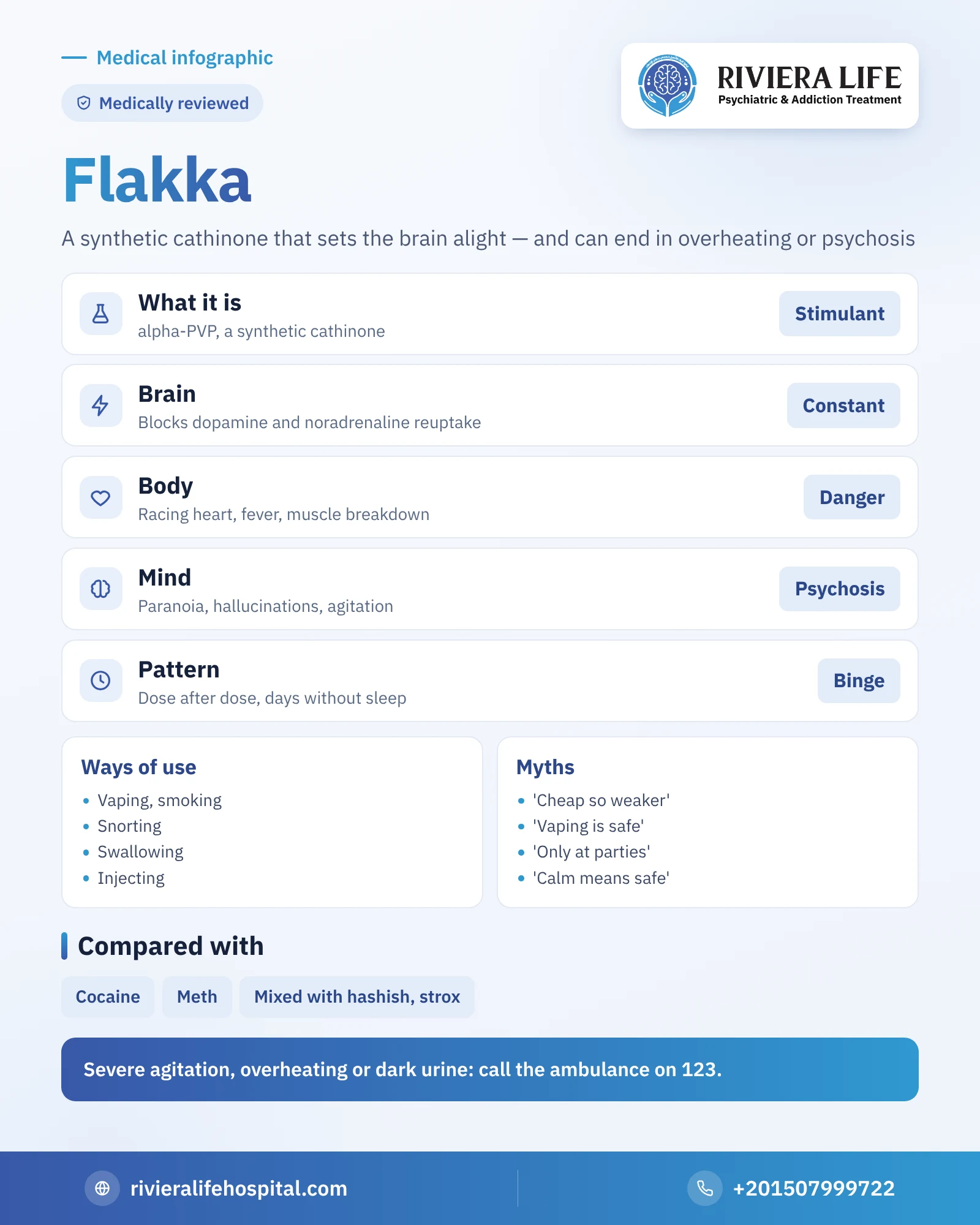
Flakka acts on two main transmitters in the brain: dopamine, responsible for the feeling of reward and motivation, and noradrenaline, responsible for alertness and the emergency response. Normally, nerve cells reabsorb these two transmitters after they have done their job. Flakka strongly blocks the reuptake gates, so the two transmitters accumulate between cells and stimulation continues without stopping. The result:
- A quick burst of activity, confidence and a desire to talk and move.
- A racing heartbeat, raised blood pressure and dilated pupils.
- A rise in body temperature with heavy sweating, and the person may feel a heat that pushes them to take off their clothes.
- Insomnia, loss of appetite and jaw clenching.
- With larger amounts or repetition: pathological suspicion, hallucinations and agitation that may reach violence or self-harm.
The main effect lasts roughly a few hours, then mood drops quickly, so the person hurries to a new dose. This successive repetition in a single session may extend a day or more without sleep or food, and it is the pattern that paves the way for addiction and for the most dangerous complications at the same time.
Does flakka have any medical use?
No. Flakka has never been approved as a medicine for any condition, and isn’t dispensed on prescription in Egypt or elsewhere. This distinguishes it from some other stimulants that have regulated medicinal forms, for example to treat attention deficit hyperactivity disorder. All flakka in circulation comes from illegal laboratories, with no control over concentration or impurities.
Why is flakka considered among the most dangerous drugs?
Several characteristics come together in flakka that make it more dangerous than many known stimulants:
- High strength in a tiny amount, so a safe dose can’t be estimated because it doesn’t exist at all.
- Severe agitation episodes: a state combining confusion, aggression, unusual physical strength and high temperature, an emergency that may end in death.
- A rise in body temperature to dangerous levels that may exceed forty degrees Celsius.
- Muscle breakdown, when muscle fibers break down from the intensity of movement and heat and release their substances into the blood, exhausting the kidneys.
- Psychosis, which may continue for days after the last dose in some users.
- A rush to repeat, because the mood drop after the effect comes quickly and harshly.
Flakka within the stimulant family
Flakka shares the basic mechanism of action with cocaine, as both block dopamine reuptake, but flakka stays in the body longer and is sold at a much lower price. It shares with methamphetamine the ability to cause outright psychosis after days of staying awake. This comparison can be understood more broadly on the cocaine and ice and shabu pages. It is common in Egypt for flakka to be mixed with hashish or strox, or for the user to turn to tramadol or pregabalin to calm down after a long session, and this mixing multiplies the risks and complicates diagnosis and treatment.
Flakka and the law in Egypt
Alpha-PVP is listed internationally among controlled substances, and the Egyptian authorities treat it as a prohibited narcotic substance, whose possession and use are punished by law, with the penalty increasing with trafficking. On the other hand, Egyptian law distinguishes between someone who is caught and someone who comes forward on their own seeking treatment, so no criminal case is brought against the user in the second case. For any legal question about a particular case it is preferable to consult a lawyer, and the Fund for Drug Control and Treatment of Addiction also provides a free, confidential hotline on 16023.
The flakka guide: each aspect in a separate article
We have divided the subject of flakka into separate articles, each going deep into a single question:
- Flakka addiction symptoms: the physical, behavioral and psychological signs the family notices at home.
- Flakka withdrawal symptoms: what happens after stopping, the stages of crash and depression, and how long they last.
- Flakka addiction treatment: the stages of treatment, supporting medicines, behavioral therapy and how to choose a hospital.
- Causes of flakka addiction: why some young people fall into it faster than others, and risk and protective factors.
- The harms of flakka: what it does to the heart, muscles, kidneys, brain and social life.
- How long flakka stays in the body: detection windows in urine, blood, saliva and hair, and why an ordinary test doesn’t detect it.
Common myths about flakka
The myth: flakka is lighter than shabu because it is cheap. The truth is that the low price reflects ease of manufacture, not a weak effect, and the agitation and overheating episodes linked to it are among the most dangerous things that reach emergency departments.
The myth: vaping it with an e-cigarette is safe because there is no smoke. The truth is that vaping delivers the substance to the brain very quickly, and makes repetition easy without anyone noticing.
The myth: someone who uses it only at parties doesn’t become addicted. The truth is that the urge to repeat the dose appears within a single session, and many started with parties and ended with sessions lasting days.
The myth: if the person calms down after the agitation episode, the danger is over. The truth is that muscle breakdown and kidney injury may develop during the following hours without clear signs, which is why everyone who has been through a severe episode needs assessment in hospital.
Discovered your son or relative is using flakka?
Don’t start the confrontation while he is under the influence; in those hours suspicion and irritability are at their highest, and any cornering may turn the conversation into a fight. Wait until he calms down, sleeps and eats, then talk about your fear for him in simple words away from accusation. Write down what you noticed with dates: nights without sleep, weight loss, irritability, and missing money. And if pathological suspicion or talk about people chasing him appears, don’t argue with him about its details, but ask for an urgent psychiatric assessment. You can start by reading the signs of flakka addiction to confirm your observations, then contact a specialized treatment provider, as the family itself needs guidance at this stage.
Signs of flakka poisoning
Call the ambulance on 123 immediately if any of these appear
Flakka poisoning may deteriorate within minutes to hours, and waiting for the person to calm down on their own isn't enough.
- Severe agitation, aggression or unusual strength with confusion and incoherent speech
- A very high body temperature or taking off clothes and heavy sweating or hot, dry skin
- Pain or pressure in the chest or a very fast heartbeat
- Seizures or loss of consciousness
- Severe muscle pain, dark tea-colored urine or very little urine
- Hallucinations or pathological suspicion with threats to harm himself or others
Until the ambulance arrives, keep the person away from heat, crowds and noise, loosen their clothes and cool their body with a wet cloth, and speak to them calmly without shouting or restraining them by force unless there is a direct danger to their life or the life of others. Don’t give them a sleeping pill or sedative from home or any other substance.
When should you ask for help?
Any use of flakka deserves an early medical assessment, even if it seems intermittent, because the substance itself gives no chance for safe experimentation. At Riviera Life in Sheikh Zayed the consultants in psychiatry and addiction treatment take on the assessment of the case in complete confidentiality, deal with psychosis and agitation if present, then set a treatment plan that suits the patient, and the first consultation is free.
Medical sources and referencesThe information in this article is based on reliable scientific sources