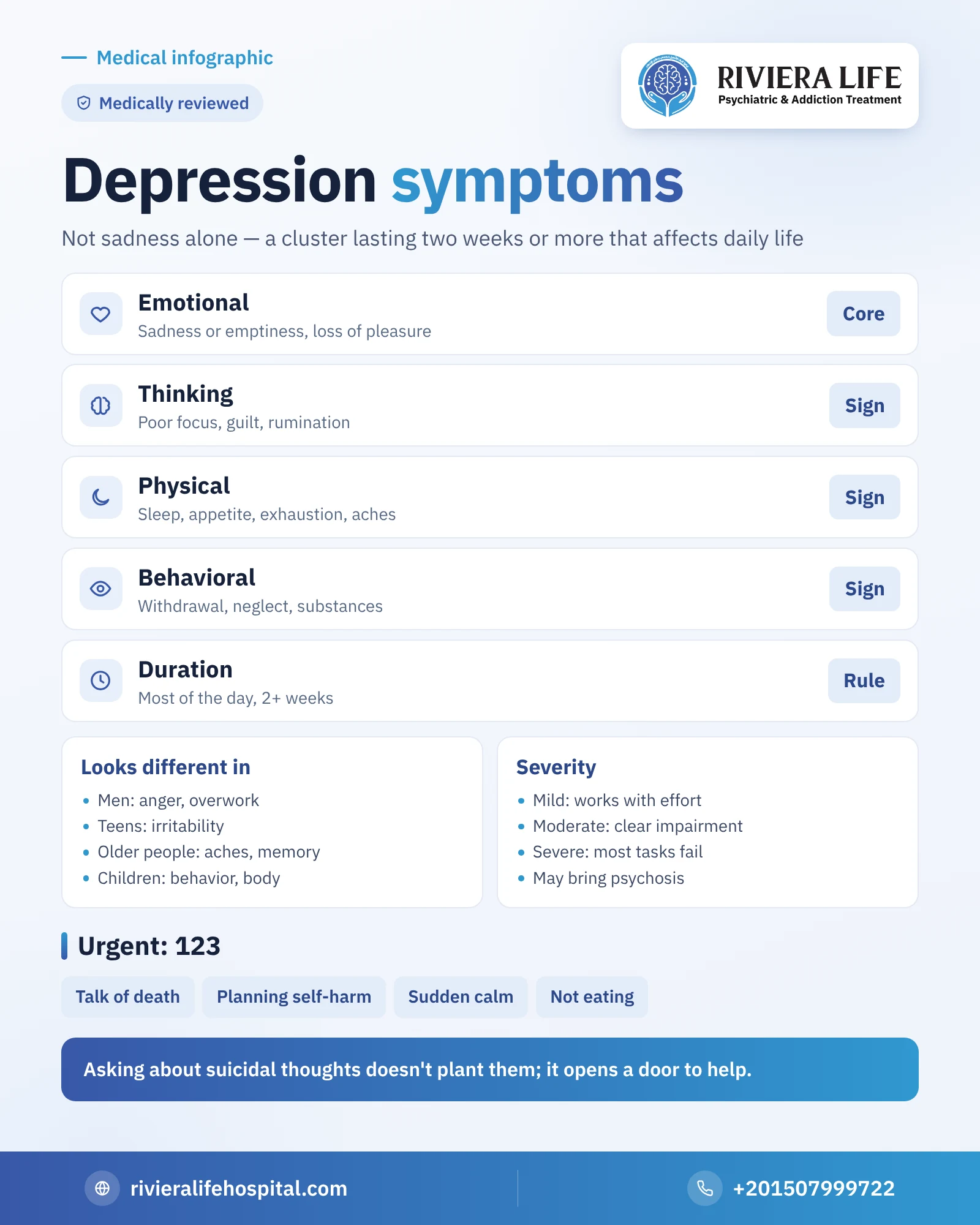
Depression symptoms aren’t limited to sadness. They include loss of pleasure, disturbed sleep and appetite, exhaustion, difficulty concentrating, feelings of guilt or worthlessness, and may reach thoughts of death. What makes them depression and not just passing distress is their coming together, lasting most of the day for at least two weeks, and their clear effect on daily life. In this article we set out the psychological, thinking, physical and behavioral signs, how they differ between ages, and offer questions to help you decide when to see the doctor, remembering that only a specialist makes the diagnosis.
When are symptoms depression and not just distress?
Distress after a bad day or disappointing news usually disappears with sleep or a talk with a friend. In depression, three conditions are present together: one of the two core symptoms is present, namely low mood or loss of interest and pleasure; other symptoms from the list we will set out accompany it; and the picture lasts most of the day on most days for at least two weeks. The condition many overlook is the effect: has performance at work or study declined? Have simple household tasks become a mountain? Has the person withdrawn from people?
Psychological and emotional symptoms
- Sadness or inner emptiness that stays with the person most of the day, which they may describe as “a weight” on their chest.
- Loss of pleasure: favorite food tasteless, the match without excitement, and meeting friends a burden.
- Quick temper and irritability over small things, sometimes more noticeable than the sadness itself.
- A feeling of hopelessness and that the future won’t improve whatever happens.
- Frequent crying without a clear reason, or on the contrary an inability to cry and emotional numbness.
- Accompanying anxiety and tension, which is very common with depression.
Thinking symptoms: when the way of thinking changes
Depression doesn’t only affect feelings, but the way the mind works. The patient finds it hard to concentrate on a page of a book or a long conversation, forgets appointments, and hesitates long before simple decisions such as what to wear. Negative thoughts about themselves dominate: “I’m a failure”, “I’m a burden on my family”, with exaggerated guilt over old or small mistakes. Many sink into rumination, repeating the same painful thoughts for hours without reaching a solution. In severe cases thoughts of death or self-harm may appear, and this is a sign that calls for action immediately, not waiting.
Physical symptoms of depression
Many patients are surprised that depression is “an illness of the body” too, with signs including:
- Disturbed sleep: waking before dawn and being unable to get back to sleep, or long sleep that doesn’t refresh.
- Changes in appetite and weight: loss in some, and gain with sugar cravings in others.
- Constant exhaustion that makes showering or getting dressed a big effort.
- Clear slowness in movement and speech, or restlessness and inability to sit still.
- Headaches, back and muscle pain and digestive problems without a clear organic cause.
- Reduced sexual desire.
These physical complaints push many to move between clinics and tests for years before anyone notices the depression.
Behavioral signs the family notices
The family often notices the change before the person admits it. Watch for a son who was sociable and now spends the day in his room, a mother who stopped caring for the home whose every detail she used to tend, or an employee who has started being absent and late. Other signs include neglecting personal hygiene and appearance, giving up hobbies, putting off responsibilities, and increased smoking or turning to alcohol, sedatives or hash to escape feelings. This last escape needs special attention, because it may open the door to an addiction that complicates the whole picture.
Do depression symptoms differ between men and women?
The core symptoms are the same, but how they show may differ. Men, especially in our societies that tie them to the image of “the man who doesn’t complain”, often express depression as anger and irritability, burying themselves in work, reckless driving or substance use, instead of talking about sadness.
Women usually describe sadness, guilt and anxiety more clearly, and their episodes may be linked to hormonal stages such as after childbirth. These are general tendencies, not rules, and each person is assessed individually. In women specifically, distress may appear as tension and irritability that shift with the cycle and pregnancy, which we detail in excessive nervousness in women and its treatment.
Depression symptoms in teenagers and older people
Teenagers
Depression in a teenager may appear as constant irritability and rebellion more than open sadness, with a sudden drop in studies, withdrawal from friends, long nights on the phone, and excessive sensitivity to criticism. Telling it apart from normal teenage moods requires looking at duration, severity and effect.
Older people
Older people tend to complain of tiredness, aches and weak memory more than talk about sadness, and depression in them may be confused with early dementia. What matters is that depression isn’t considered “a natural part of ageing”; it is treatable at every age.
Smiling depression: when symptoms hide
Some people go to work, laugh with colleagues and post cheerful pictures, then collapse when they close the door at home. This is what is popularly called “smiling depression”; it isn’t an official diagnosis, but a description of someone who hides their symptoms skillfully. Its danger is that those around notice nothing, so no one offers help. If you know someone who seems fine but repeats phrases like “I’m tired” or “it doesn’t matter”, take their words seriously and ask them.
Degrees of severity: mild, moderate and severe
The doctor estimates severity by the number and strength of symptoms and how much they disrupt life. In mild depression the person can carry on working with difficulty; in moderate depression a clear part of their life is impaired; and in severe depression they are unable to do most tasks, and suicidal thoughts or psychotic symptoms may appear. Determining the degree guides the treatment plan, and the details of the classification are in the article on types of depression.
Questions to ask yourself before seeing the doctor
The following questions aren’t a diagnostic test, but a tool to help you organize your observations. Over the past two weeks:
- Have you felt sad or empty most of the day on most days?
- Have you lost enjoyment in things you used to love?
- Has your sleep or appetite changed in a way those around you noticed?
- Do you now tire from the least effort or find it hard to concentrate?
- Has your performance at work, study or home declined?
- Have you had thoughts that life isn’t worth it, or of harming yourself?
If your answer is yes to several questions, the right step is a specialist assessment. Note also that some depression symptoms resemble anxiety symptoms, and that previous periods of excessive activity and little sleep without tiredness may point to bipolar disorder, which the doctor sorts out.
Signs that call for urgent help
Seek urgent help immediately if you see
These signs can't wait: call the ambulance on 123 or take the person to the nearest emergency department.
- Talk of death, of wanting to disappear or of being a burden on everyone
- Planning self-harm or collecting medicines or tools for it
- Suddenly saying goodbye to family and friends or giving away treasured possessions
- A strange, sudden calm after weeks of severe depression
- Stopping eating and drinking or complete inability to care for oneself
- Strange, unrealistic voices or ideas accompanying the depression
Stay with the person and don’t leave them alone, and ask them calmly and directly what they are thinking about; the question doesn’t plant the idea but opens a door to help.
And if these symptoms apply to you, the options for psychotherapy and medication and when hospital is needed are explained in depression treatment.
How can Riviera Life help you?
If you recognized yourself or someone you love in these lines, you can book a free first consultation with a consultant psychiatrist at Riviera Life in complete confidentiality. The assessment starts with a calm interview and tests to rule out physical causes, then a treatment plan suited to the severity is built, explained in detail on the depression treatment page.
Depression and sleep: insomnia or oversleeping?
Depression and sleep are linked in a relationship that runs both ways. A depressed person often sleeps badly, and chronic poor sleep in turn raises the likelihood of depression or its return.
The complaint takes different forms from one person to another:
- Difficulty falling asleep, with thoughts going round the head until late hours.
- Waking early before dawn, unable to get back to sleep.
- Broken sleep that leaves the person tired in the morning.
- Excessive sleep lasting many hours without giving rest, more common in some teenagers and some patterns of depression.
That is why treating insomnia alone isn’t enough if undiagnosed depression lies behind it, and treating mood isn’t enough if sleep is neglected. If sleep disturbance continues for weeks with loss of pleasure, ask for a psychological assessment instead of relying on sleeping pills. You will find more on the types of the problem in the guide to sleep disorders and their types, and on supplements in the article on melatonin and sleep.
Night-time depression: why do symptoms worsen as night falls?
“Night-time depression” is a common description, not an official diagnosis, but it expresses an experience many know: the day passes among distracting tasks, then when the house quiets and the lights go out, the heavy thoughts return in full force.
There are understandable reasons for this. The absence of occupation leaves room for rumination and guilt, tiredness at the end of the day weakens the ability to resist negative thoughts, and loneliness at night magnifies the feeling of helplessness. Insomnia may make it worse, because long hours in bed turn into an arena for worry.
This doesn’t mean symptoms are worse at night for everyone; for some patients the morning is the heaviest. What matters is to notice your pattern and mention it to the doctor, because it helps in choosing treatment.
What usually eases difficult nights: fixed sleep times, reducing screens and caffeine in the evening, and writing thoughts on paper instead of chasing them in your head. But if thoughts of ending life appear, this is an emergency, so call the ambulance on 123 or the nearest trusted person immediately.
Depression in children: signs that differ from adults
A child may have depression, but rarely says “I’m sad”. Children, especially younger ones, express themselves through behavior and the body more than through words.
Signs that deserve attention include:
- Quick anger and crying without a clear reason, or stubbornness that is new for the child.
- Losing the desire to play with peers or in their usual hobbies.
- Repeated complaints of stomach or head pain without an organic cause.
- A change in sleep or appetite, and a sudden drop in schoolwork.
- Excessive clinging to parents or refusing to go to school.
These signs may also accompany anxiety, learning difficulties or pressures at home and school, which is why the matter needs a specialist assessment rather than a guess. Treatment is usually built on psychotherapy and involving the family. To learn more, read about mental illness in children and its signs by age, and about teen depression and how parents can talk.
More from the depression guide
- Depression: the complete guide
- The causes of depression and risk factors
- Depression treatment and the steps of recovery
- Types of depression and its degrees of severity
- Depression symptoms in women: hidden forms and hormonal stages
- Sadness vs depression: duration, effect and when sadness becomes an illness
- Anhedonia: what it is, its link to dopamine and how it differs from depression
- Depression vs anxiety: a comparison table, what is similar and how they are treated
- Sadness for no reason: hidden causes and when it is a sign that needs a doctor
- Feeling guilty: when is it healthy and when does it become a burden?
- The PHQ-9 depression test: instant result
Questions many people ask
Doctors require the symptoms to last most of the day on most days for at least two weeks, with a clear effect on daily life.
Yes, depression may appear as irritability, emotional numbness, exhaustion and physical aches, and some people hide their symptoms skillfully from others.
It often starts with a change in sleep, loss of enjoyment in usual things, and gradual withdrawal from people and activities, before sadness clearly appears.
They can alert you to the need for assessment, but they don't diagnose. Diagnosis needs an interview with a specialist who rules out physical causes and similar disorders.
When there is talk of death or planning self-harm, stopping eating and drinking, or psychotic symptoms. Then you must call the ambulance on 123 or go to the emergency department immediately.