If you have discovered that your husband gambles and you are asking, “My husband gambles — what should I do?”, start by protecting yourself, your children and the money that remains, before any confrontation or big decision. Secure your accounts and documents, separate what you know for certain from what you are guessing, and ask for a consultation for yourself even if he hasn’t accepted treatment yet. This article is written for you: how to act in the first days, how to protect your money from debts you aren’t responsible for, whether to pay them for him, how to protect the children, when your safety matters more than any conversation, and how to think about the future of the marriage without rushing.
My husband gambles — what should I do? Your priorities in the first days
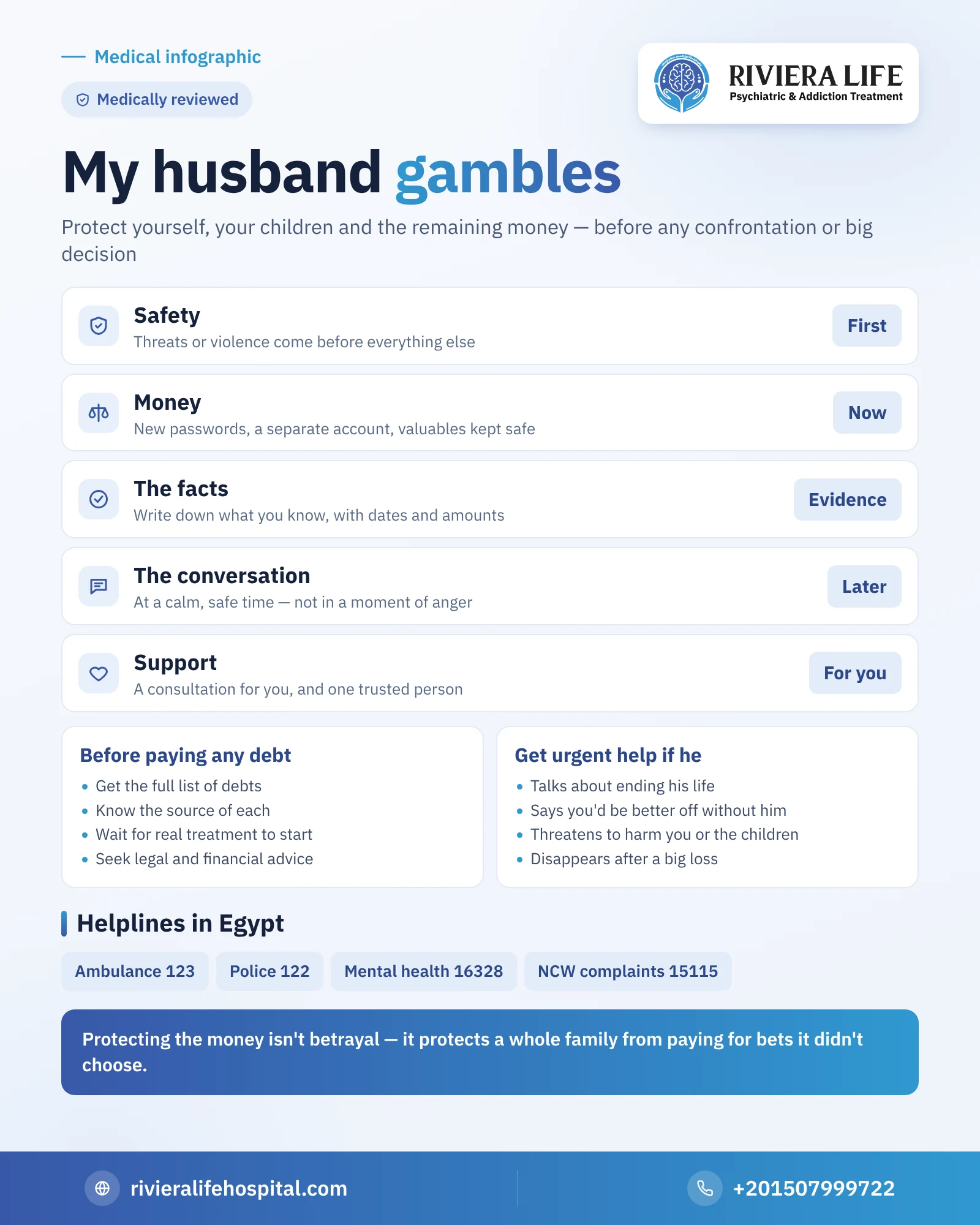
Shock pushes many women to one of two extremes: a violent confrontation that same night, or complete silence for fear of scandal. A third path is usually more useful, beginning with five priorities in order:
- Your safety: if there are threats or violence, this comes before everything else.
- Money: protect what remains before it is lost in a new bet.
- The facts: write down what you have seen, with dates and amounts, away from conclusions.
- The conversation: at a calm, safe time, not in a moment of anger.
- Support: a specialist consultation for you, and one trusted person to talk to.
After the discovery: separate certainty from guesswork
You may find a bank message or a betting app, or hear from a relative that he borrowed from them. Before you build a whole picture on that, write on a sheet of paper what you know with evidence, what you suspect, and what you don’t know yet. This separation protects you from an accusation that may turn out to be wrong, and makes your conversation with him stronger because it rests on facts. And don’t make a life-changing decision, such as leaving home or telling the whole family, in the first days unless your safety is at risk. If you want to compare what you see with the recognized signs, see the symptoms of gambling addiction.
Talking to him without it turning into a battle
Choose a time when he is calm and away from the children, and start with the facts and their effect on you: “I found that the savings account is empty, and I’m frightened for the children’s future.” Then make a specific request: to know the full extent of the debts, or for him to come with you to one consultation. If talking with him always turns into shouting, it can take place in the presence of a specialist or a wise relative both of you trust. You will find conversation techniques, and what to say and avoid, in detail in our article on how to deal with someone addicted to gambling.
If he denies it or plays it down
He may say “It was once and it’s over” or “I know what I’m doing and I’ll make everything back.” Don’t get into an argument about whether he is addicted or not; what matters is the harm that has been done. Ask for actions you can see instead of promises: transparency about the accounts, closing betting apps in front of you, and an appointment with a doctor. Love doesn’t mean accepting words that actions don’t back up.
How do you protect your money and the household’s money?
Protecting money isn’t betraying him; it protects a whole family from paying the price of a bet it didn’t choose. Some practical steps:
- Change the passwords of your bank accounts and e-wallet, and don’t leave your card or its PIN within his reach.
- Open a separate account for your salary or the household budget if money is shared.
- Put gold and important papers, such as the flat and car contracts, somewhere safe with your family or in a bank safe-deposit box.
- Don’t sign a loan, guarantee, cheque or promissory note for him, however great the pressure.
- Check your credit report with the credit bureau to make sure there are no loans or cards in your name that you don’t know about.
- Keep copies of important documents and messages, as you may need them later.
If you have shared property or debts, consult a lawyer who can explain your legal position in Egypt before any step.
Should you pay his debts?
This is the hardest question a wife faces, especially when creditors call or one of them threatens to file a complaint. The general rule: don’t pay anything from your own money before you know the full list of debts and the source of each one, and before he begins real treatment. Paying quickly may give him the feeling that the crisis is over, or free up money for a new bet. After treatment begins, a repayment plan can be arranged for which he takes responsibility, with financial and legal advice. The difference is subtle but decisive: helping with an organized solution is one thing, and rescuing him every time is another.
Limits you can actually enforce
The limit that works is one that describes your own behavior and suits your real capacity. “I won’t give you any money from my salary” is a clear limit. “If you bet again I’ll leave you” is a strong limit, but only say it if you are ready to carry it out, because a threat that isn’t carried out makes your words lose their weight. It is natural to review your limits over time, easing them with real progress or tightening them if the lying repeats.
How do you protect the children?
Children sense tension even when they don’t understand its cause. Explain to them, in words suited to their age, that their father is going through a problem he is being treated for, and that they aren’t the cause, without the details of debts and losses. Don’t make them messengers between you, and don’t ask them to watch his phone or tell you what he is doing. Keep school, sleep and meal times as normal as possible, as routine gives them security. And if a clear change appears in their behavior, schoolwork or sleep, ask for a specialist assessment for them.
If he refuses any help
His refusal doesn’t mean you should wait. Ask him calmly what frightens him about treatment: scandal, the cost, or admitting the size of the debts — that fear may be the real obstacle. At the same time, start yourself: a psychological consultation for you, a financial plan, and support from someone you trust. Many husbands accept treatment after they see that their wives have changed and stopped rescuing them, not after another argument. Our article on gambling addiction treatment explains what awaits him if he agrees, which may reassure him.
When safety matters more than conversation
Stop attempts at conversation immediately if threats, violence, breaking things, or pressure on you to sign papers or sell your belongings appear. In danger, call the police on 122; the women’s complaints office of the National Council for Women, on 15115, offers legal and social advice. Don’t face him alone in these circumstances, and make sure there is a safe place you can go to with the children if needed.
Get urgent help immediately if you see
Call an ambulance on 123 or go to the nearest emergency department; you can also call the hotline of the General Secretariat of Mental Health and Addiction Treatment on 16328.
- He talks about death or ending his life because of the debts
- He says you would all be better off without him
- He threatens to harm himself, you or the children
- He suddenly disappears after a big loss, with messages of despair
- You yourself feel that life has become unbearable
Your first week: a plan you can bear
Don’t try to solve everything in a week. Choose just three priorities, such as securing the money, an appointment for a consultation for you, and one calm conversation with him. Set a limited time each day to think about the problem, then return to your day. Sleep and eat, and ask a relative to help you look after the children some of the time. Write on one sheet what you can control, and on another what needs a joint decision later. Constant pressure without rest can lead you into depression, and your mental health is part of protecting your home.
How will you know that trust is starting to return?
Not by words, but by actions repeated over weeks and months: attending sessions regularly, transparency about the accounts without you having to ask, keeping to the agreed limits, and honesty when he goes through a moment of weakness. You have the right to take your time before you feel safe again. And if he goes back to betting, don’t rely only on feelings: review the facts again and decide your next step based on them.
Should I stay in the marriage or separate?
This is your decision alone, and there is no right answer for everyone. But don’t make it at the height of anger or fear. Ask yourself: what do I need in order to feel safe if I stay? And is he taking real steps towards treatment, or making repeated promises? Get help from a therapist who can help you see the picture, and from a lawyer who can clarify your rights before any step. And watch his actual behavior for long enough: repeated actions say what promises don’t.
At Riviera Life you can begin with a session just for yourself, in complete confidentiality; the first consultation is free on +201507999722, around the clock.
More from our gambling addiction guide
- Gambling addiction: the complete guide
- How to deal with someone addicted to gambling
- Treating gambling and online betting addiction
- The causes of gambling addiction
- How to deal with an addicted husband: a wife’s guide to protection and treatment
- My husband is addicted to his phone: a wife’s guide to phones and games
Questions many people ask
Choose one trusted person whose support you need rather than telling everyone, as scandal increases denial and makes treatment harder. But if your safety is at risk, ask for help immediately from someone you trust.
In principle, a debt is owed by the person who took it on, but any signature of yours as a guarantor, or on a cheque or promissory note, may make you liable. Consult a lawyer to know your legal position precisely.
You can request your credit report from the credit bureau in Egypt to see the loans and cards registered in your name, and review your bank accounts regularly.
Yes. Many gamblers recover when they commit to psychotherapy, close off betting routes and take responsibility for their debts. Recovery is measured by actions repeated over months, not by promises.
Wives of gamblers live under great pressure that can cause anxiety, insomnia and depression. Support sessions help you make clearer decisions and protect yourself and your children, even if he doesn't accept treatment.