In psychiatry, masochism means that a person’s sexual arousal is repeatedly and strongly linked to experiencing pain, humiliation or restraint. The presence of this interest alone does not mean an illness; the doctor diagnoses “sexual masochism disorder” only if the interest causes real distress to the person, disrupts their life, or exposes them to the danger of physical injury. In everyday speech, the word is used with a completely different meaning, to describe a person who seems to punish themselves or choose what hurts them. This page explains both meanings in calm medical language, clarifies when the matter needs assessment and treatment, then leads you to a separate article on each aspect.
The meaning of “masochist” when said about a person depends on the context: in the clinic it means someone who has this sexual interest, and in everyday conversation it is used figuratively for someone who tolerates harm or seeks it out, which is a common usage that is not equivalent to a medical diagnosis.
What is masochism?
The word is taken from the name of the Austrian novelist Leopold von Sacher-Masoch, who described in his novels characters who found their pleasure in submission, then the German psychiatrist Krafft-Ebing used it as a scientific term in the late nineteenth century. Since then, medicine’s understanding of this subject has changed a great deal. Modern classifications place sexual masochism among what are called “atypical sexual interests” or “paraphilias”, and draw a clear distinction between the interest itself and the disorder that needs treatment.
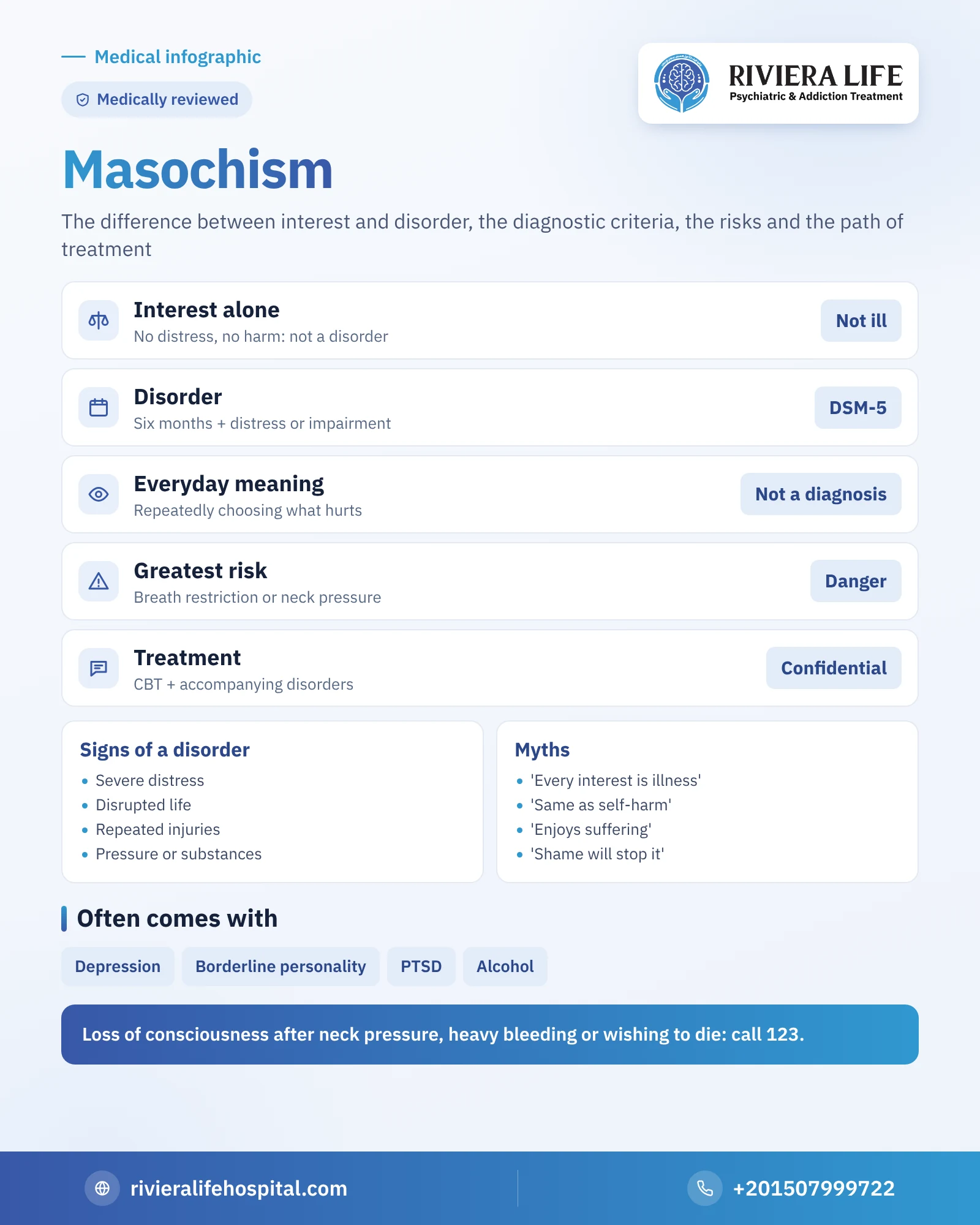
The fifth edition of the American Diagnostic and Statistical Manual describes “sexual masochism disorder” when the fantasies, urges or behaviors linked to suffering last at least six months and cause clear distress or impairment in work, relationships or important areas of life. It asks the doctor to specify whether the matter includes breath-restriction practices, because they are by far the most dangerous medically.
The interest is one thing and the disorder is another
This is the point that settles most questions. Many people have fantasies or interests of this kind without feeling any distress, and without it affecting their lives, and psychiatry does not diagnose them with any disorder. The American Psychiatric Association deliberately changed the name to stress that a mutual interest between consenting adults is not an illness in itself. The disorder, however, appears when one or more of these signs are present:
- Severe psychological distress about the interest itself, such as a constant feeling of guilt, shame or inner conflict, not merely fear of how society sees it.
- Clear disruption of work, study, marriage or relationships because of mental preoccupation or behavior.
- Repeated exposure to physical injuries or dangerous situations, or an escalation that goes beyond the limits of safety.
- Practices that take place under pressure, coercion or without real consent, or under the influence of alcohol and drugs.
The eleventh edition of the International Classification of Diseases deals with the subject with almost the same logic: an individual interest, or a mutual one by consent, is not considered a disorder unless it is linked to severe distress or a real danger of injury or death.
The common meaning: the “masochistic personality” and psychological self-harm
When someone says in passing that their friend is “a masochist”, they usually do not mean anything sexual. They mean a person who repeatedly chooses relationships that hurt them, refuses help when it is offered, ruins their own success, or feels they do not deserve rest unless they have toiled and suffered. This usage has old roots in psychoanalysis, which spoke of “moral masochism”, and an earlier version of the American manual proposed a diagnosis called “self-defeating personality”, but it was not officially adopted because of weak evidence.
What matters is that you know the difference: a pattern of psychological self-harm is not a standalone diagnosis today, but it may be a sign of chronic depression, the effects of old trauma, or personality traits that need psychotherapy. And it is not necessarily related to sexual masochism; one may exist without the other.
Is masochism common?
There are no precise figures, because the subject is surrounded by embarrassment and people do not talk about it easily. Some surveys in Western countries indicate that a not-insignificant proportion of adults reported fantasies or interests of this kind at some stage, while those who meet the criteria for the disorder are estimated to be far fewer. No reliable Arab or Egyptian studies are available on this. The practical conclusion is that the interest is not rare, and that the disorder that needs treatment is clearly less common.
The symptoms in brief
The doctor does not look for the details of the practice, but for its effect: Is the person living through a painful conflict with their urges? Do they consume their time, money and concentration? Do injuries or emergency visits repeat? Are they gradually giving up any safety limit? Are they hiding it from their spouse in a way that threatens the relationship? Signs of anxiety, depression or thoughts of self-harm may also appear alongside. You can find these signs in detail, with questions to help you review your situation, in the article Symptoms of masochism.
Why does it happen? What we know and what we don’t
Scientific honesty requires saying that the causes of masochism are not well understood. There are old psychological theories, explanations based on early learning and the linking of different feelings to one another, and observations of higher rates of trauma or accompanying disorders among those who seek treatment in particular. But most of these ideas have not been tested in large studies, and there is no single cause that explains all cases. What seems clearer are the factors that turn the interest into a problem, such as isolation, extreme secrecy and substance use. The details and the limits of the evidence are in the article Causes of masochism.
How is sexual masochism disorder diagnosed?
The diagnosis is made by a psychiatrist or a clinical psychologist after a calm, confidential interview, in which the person is not asked to describe what they do not want to describe. The specialist asks about the duration of the symptoms, the degree of distress, the effect on life, previous injuries, and whether there are any practices involving breathing, then looks for accompanying disorders such as depression, anxiety, substance use and personality disorders. No lab tests or scans reveal masochism, and no test circulating online can replace this assessment.
Treatment of masochism: an overview
An interest that causes neither distress nor harm does not need treatment. When it turns into a disorder, however, the goal is to reduce distress and danger, regain control over behavior, and repair the relationships that were affected. Treatment relies mainly on psychotherapy, the best known being cognitive behavioral therapy, together with treatment of depression, trauma or substance use if present. In some cases the doctor may turn to medicines that reduce urgency and impulsivity, after a careful assessment and within a comprehensive plan. The details and the criteria for choosing a place of treatment are in the article Treatment of masochism.
The real risks: what worries doctors?
The medical concern here is not about morals, but about safety. The most dangerous thing is that some practices may escalate over time, leading to serious physical injuries. The most severe of these risks by far is anything that involves restricting breathing or pressure on the neck, whether the person does it alone or with someone else; these practices can cause permanent brain damage or sudden death within seconds, even for someone who believes they are in control of the situation. That is why the diagnostic manual asks that their presence be specifically noted in the diagnosis.
There are psychological risks that are no less important: overlap with self-harm in some people, depression fed by a sense of shame, exploitation by a partner who takes advantage of the other person’s vulnerability, and the effect of alcohol and drugs on the ability to judge and refuse.
Masochism, accompanying disorders and addiction
Many of those who seek treatment do not come because of masochism alone, but because another disorder with it adds to the burden. Among the most prominent of these disorders are depression, borderline personality disorder, which is linked to impulsivity and self-harm, and post-traumatic stress disorder when there are old painful experiences. Substance use comes along to add a double risk: alcohol and stimulants weaken judgment, reduce the sensation of pain and push people to cross limits. When the two disorders occur together, the patient needs one plan that treats them both, not treatment of one while ignoring the other.
The role of the family and the partner
A husband, wife or family member may discover the matter suddenly, and shock and anger are the first reaction. This is understandable, but blame, exposure and threats usually push the person toward more secrecy, and secrecy in particular is what raises the danger. It is more useful for both sides to talk calmly, or to ask for a session with a specialist who manages the conversation. And if you notice repeated injuries, signs of depression or talk of self-harm, safety comes first, before any other discussion.
Common myths about masochism
Myth: anyone with a masochistic interest is mentally ill. The truth is that medical classifications clearly distinguish between the interest and the disorder, and that a diagnosis requires clear distress, harm or danger.
Myth: masochism is the same as self-harm. The truth is that self-harm is a different behavior, usually linked to an attempt to relieve psychological pain; the two may occur together in some people, but they are not the same thing, and each has its own assessment.
Myth: the “masochistic” person in everyday life enjoys their suffering. The truth is that someone who repeatedly makes choices that hurt them really is in pain, and often carries a deep sense of guilt or unworthiness that can be treated.
Myth: the solution is to force the person to stop through punishment or exposure. The truth is that this increases shame and secrecy, while confidential psychotherapy is what actually reduces the danger.
The masochism guide: each aspect in its own article
We have devoted a separate article to each important question, answering it in depth and without any offensive details:
- Symptoms of masochism: the psychological and behavioral signs that distinguish the disorder from the interest, self-review questions, and when you need a psychological assessment.
- Causes of masochism: the possible psychological and biological theories, the risk factors, and the limits of what the medical evidence says to date.
- Treatment of masochism: psychotherapy, the role of medicines, how long improvement takes, when hospital is needed, and how to choose a place of treatment.
When does it become an emergency?
Most cases are treated calmly in the clinic, but some situations need immediate intervention that cannot be postponed.
Seek urgent help immediately if you see
Call the ambulance on 123 or go to the nearest emergency department, and do not leave the person alone.
- Loss of consciousness, difficulty breathing or blue face or lips after any pressure on the neck or chest
- Bleeding that won’t stop, a deep wound or a large burn
- Seizures, severe confusion or unresponsiveness
- Expressing a wish to die or end life, or planning to harm oneself
- An injury that happened under the influence of alcohol or drugs with reduced consciousness
In urgent cases, immediate psychological support can be requested from the hotline of the General Secretariat of Mental Health and Addiction Treatment by calling 16328 or 0220816831.
When should you seek help?
Seek an assessment if these urges cause you ongoing distress or a conflict that won’t settle, if injuries repeat, if it begins to affect your marriage or work, if you feel you are losing control and crossing your limits, or if it has become linked to alcohol, drugs or thoughts of self-harm. And if what worries you is a pattern of “punishing yourself” in your everyday life, that too is reason enough to see a specialist. At Riviera Life, consultant psychiatrists carry out a completely confidential assessment, without judgment, and put together a plan that suits the case. The first consultation is free via +201507999722.
Medical sources and referencesThe information in this article is based on reliable scientific sources
1MSD Manual — Sexual masochism disorder (consumer version)merckmanuals.com2MSD Manual — Overview of atypical sexual interests and paraphilic disordersmsdmanuals.com3APA — Paraphilic disorders in DSM-5 (fact sheet)psychiatry.org4NIMH — Suicide preventionnimh.nih.gov5NIMH — Psychotherapies and their typesnimh.nih.gov