Medicine doesn’t yet know a confirmed cause of masochism. Research in this field is limited, and most of it was done on small numbers or on people who had already sought treatment, so everything said about the causes of masochism remains within the bounds of theories and associated factors, not proven causes. What can be said with more confidence is that there is a difference between what may explain the appearance of the inclination, and what turns it into a disorder that causes distress or harm. In this article we present the possible psychological and biological theories, risk factors, and the causes of the everyday pattern people call “masochism”, clarifying the limits of the evidence at each point.
Why is it hard to determine the causes of masochism?
There are practical reasons that make the picture incomplete. The first is embarrassment: most people don’t talk about this subject, even in anonymous surveys. The second is that those with the inclination without distress don’t visit doctors, so most clinical observations come from a specific group suffering from other disorders, which distorts conclusions. The third is that studies comparing large groups and following them for years are almost absent. So you should treat with caution any source that presents “the real cause of masochism” with complete confidence.
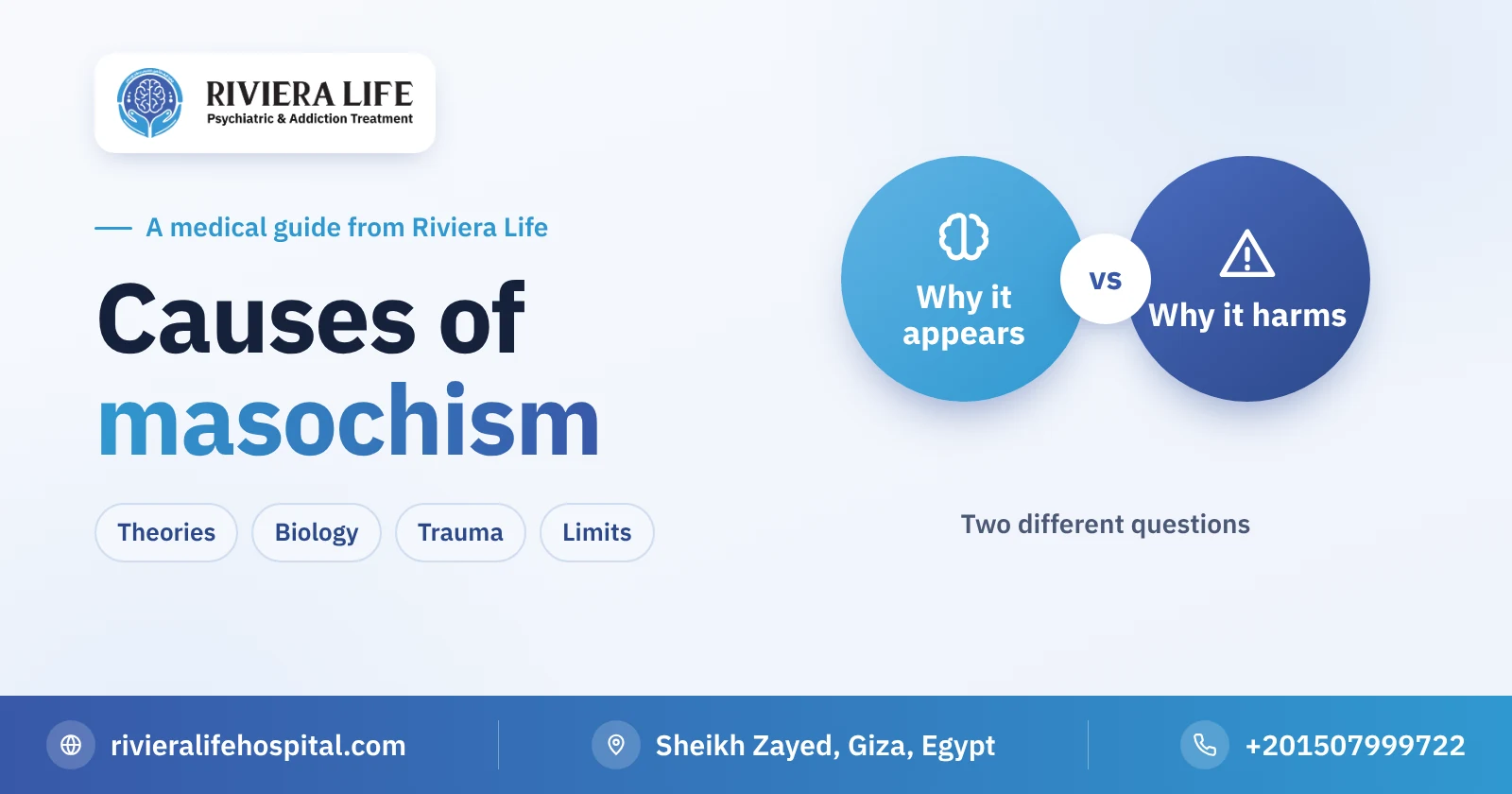
Two different questions: why does the inclination appear? And why does it become a problem?
This distinction helps a lot. The first question, about the origin of the inclination, has no clear answer yet. The second question, about the inclination turning into a disorder, has a relatively clearer answer, because it is linked to observable factors: intense inner conflict, secrecy and isolation, substance use, co-occurring psychological disorders, and escalation without limits. These latter factors are what treatment usually focuses on, as you will find in the following sections. To learn the signs that distinguish the disorder, see our article on masochism symptoms.
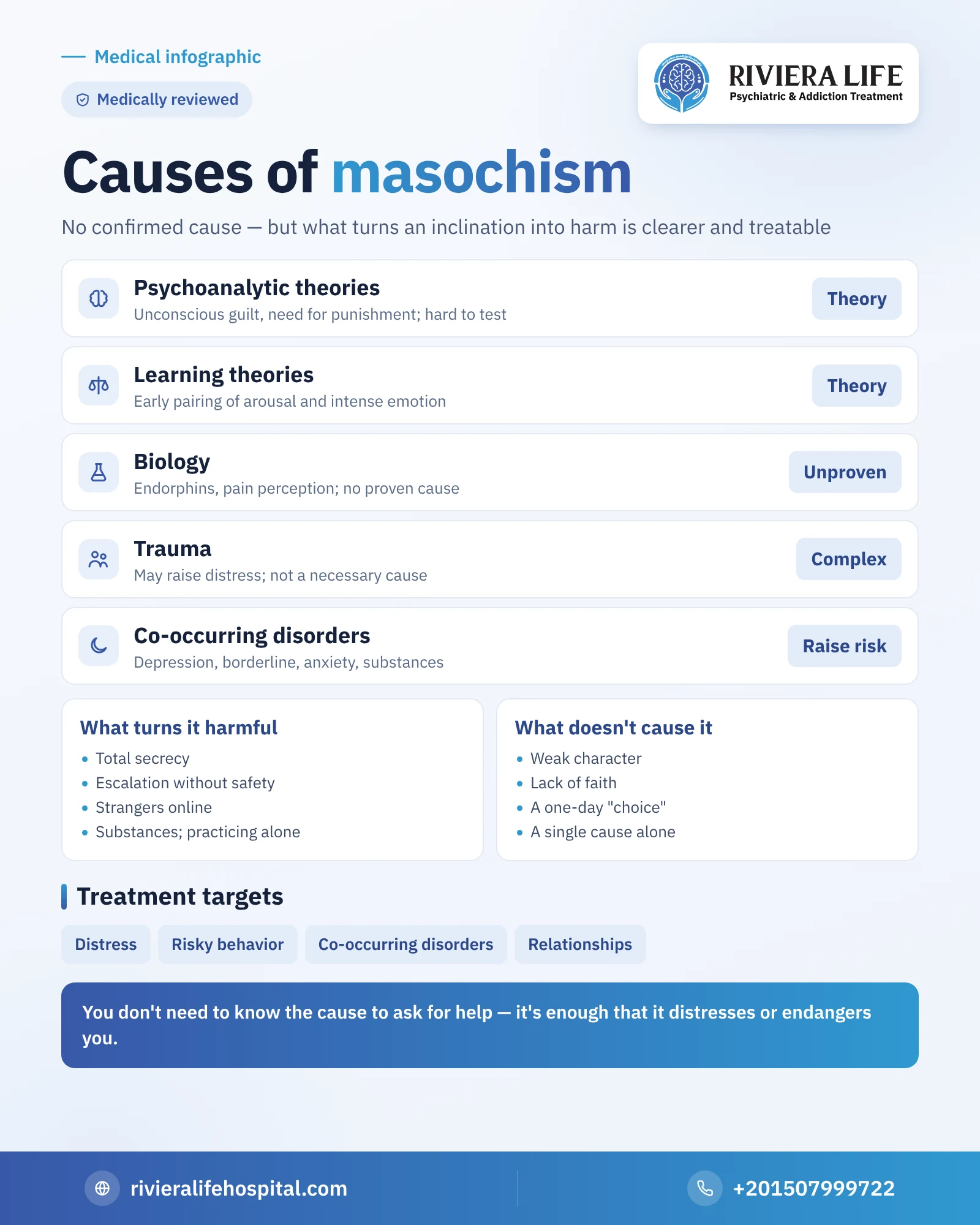
Psychoanalytic theories
Psychoanalysis was the first to try to explain masochism in the early twentieth century. Freud and his students offered explanations linking it to an unconscious sense of guilt, a need for punishment, and the way the child deals with feelings of aggression. From here came the term “moral masochism”, describing someone who seeks suffering in their life in general. These ideas influenced our understanding of patterns of self-punishment, but they are hard to test scientifically, and today they aren’t considered a proven explanation of sexual masochism.
Learning and association theories
Learning theories suggest that the brain may, at an early stage of development, link two sensations that occur together by chance or repeatedly, such as arousal and intense emotion, so an association forms that strengthens with repetition. They add that repeated fantasy itself may reinforce this association. The idea is logical, and explains why cognitive behavioral therapy can help in some cases, but it doesn’t explain why this association happens in one person and not another in the same circumstances.
Biological factors: what do we know?
Scientists know that the body releases natural painkilling substances in response to pain, such as endorphins, and that some painful or exhausting activities may be followed by a sense of relief. Some researchers rely on this to explain part of the phenomenon. There are also known differences between people in how they perceive pain and in seeking excitement and intense experiences. But there are still no strong studies proving that a specific disturbance in the brain, hormones or genes causes masochism. That is why there is no test or examination that detects it.
Childhood experiences and trauma: a complex relationship
Some clinical reports mention that those seeking treatment for atypical sexual disorders sometimes carry a history of neglect or trauma in childhood. But this must be read with great caution: most people who went through trauma don’t develop any inclinations of this kind, and many who have these inclinations didn’t go through trauma. It is more accurate to say that trauma may increase distress and conflict in some people, and may weaken personal boundaries, which is why assessing post-traumatic stress disorder is an important part of the examination when there are indications of it.
Co-occurring disorders: factors that increase distress and risk
Clinical observations indicate that the disorder sometimes occurs together with other psychological conditions that increase its severity:
- Depression: it feeds feelings of guilt and unworthiness, and may push towards more dangerous behavior. Read about its roots in the causes of depression.
- Borderline personality disorder: linked to impulsiveness, unstable relationships and self-harm.
- Anxiety and obsessive disorders: they make thoughts more insistent and inner conflict more intense.
- Alcohol and drug use: weakens judgment, dulls the sense of pain and makes crossing limits easier.
The presence of these conditions doesn’t mean they “cause” the inclination, but it explains many of the cases in which it turns into a problem.
Factors that turn the inclination into harm
Here the picture becomes clearer, because these factors recur in the stories that reach the clinic:
- Total secrecy and isolation, so there is no one to notice or stop the escalation.
- Seeking a higher level each time, with safety controls declining.
- Meetings with strangers via the internet, with the risk of exploitation or blackmail this carries.
- Practicing under the influence of substances that weaken awareness.
- Practicing alone in dangerous positions, the thing doctors warn against most.
- Major life pressures in which the person uses the behavior as a way to escape their feelings.
Causes of the everyday pattern: why do some people punish themselves?
“Masochism” in the common sense, meaning a tendency to choose what hurts in relationships and work, has causes closer to what therapists know well. Among the most prominent are an old feeling of unworthiness formed in a harsh or critical environment, early learning that love comes with pain, a chronic sense of guilt, and long depression that makes suffering seem “normal”. The person may repeat relationships resembling what they lived in childhood because they are familiar, not because they are comfortable. This pattern isn’t necessarily related to the sexual side, and usually responds to psychotherapy.
When does the inclination usually appear?
Many who have this inclination say they noticed it in adolescence or early adulthood, and some remember fantasies older than that. The distress that prompts seeking treatment may appear years later, often at marriage, when the secret is exposed, after an injury that frightened the person, or with an episode of depression. This timing matters because it shows that the appearance of the inclination is one thing, and the moment it turns into a problem is another, and the latter is usually linked to life circumstances and pressures more than to the origin of the inclination itself.
What doesn’t cause masochism?
Masochism isn’t the result of a weak character or lack of faith, and a person doesn’t acquire it because they “chose” it one day. Excessive guilt and self-punishment don’t treat it; they increase the conflict. And attributing it to a single cause, such as upbringing or trauma alone, is a simplification the evidence doesn’t support.
What does this mean for the treatment plan?
Because the causes are uncertain, treatment isn’t based on “removing the cause”, but on what can be changed: reducing distress, controlling risky behavior, treating accompanying depression, trauma or substance use, and repairing relationships. This is what our article on masochism treatment explains in detail. And if you are looking for the general picture, go back to the masochism guide.
How can Riviera Life help you?
You don’t need to know the cause of what you are going through to ask for help. It is enough that it is distressing or dangerous for you. At Riviera Life consultant psychiatrists start with a confidential assessment that looks for the factors increasing distress and risk in your case specifically, and the first consultation is free.
More from our masochism guide
- Masochism: the complete guide
- Masochism symptoms and when you need an assessment
- Masochism treatment and steps to improvement
- Post-traumatic stress disorder symptoms
Questions many people ask
There is no strong evidence of a specific gene or genetic factor causing it. Research in this field is limited, and the role of genetics can't be stated with certainty so far.
Not necessarily. Some who seek treatment have a history of trauma, but many without trauma have the inclination, and most who went through trauma don't develop it. Trauma may increase distress, no more.
Usually because of factors such as secrecy, isolation and escalation without limits, or alcohol and drug use, or accompanying depression and anxiety. These factors can be dealt with in treatment.
It is usually linked to an old feeling of unworthiness, a harsh upbringing, chronic guilt, or long depression. This pattern is different from sexual masochism and responds to psychotherapy.
Yes, treatment doesn't depend on knowing the cause but on reducing distress, controlling risky behavior and treating co-occurring disorders, which are achievable goals.