Borderline personality, medically called borderline personality disorder, is a mental health condition centered on severe difficulty regulating emotions: feelings that ignite quickly and calm down slowly, a persistent fear of abandonment, relationships that swing between attachment and aversion, and a self-image that never settles. It is not a moral flaw, nor “being spoiled”, nor a wish to attract attention; it is a recognized disorder with psychological treatments of proven effectiveness, and many people with it improve clearly over time.
This page gathers what you need to know about the disorder, then directs you to a detailed article on each of its aspects. The diagnosis is made only by a psychiatrist or a clinical psychologist after a direct assessment, so the purpose here is understanding, not diagnosing yourself or others.
What is borderline personality?
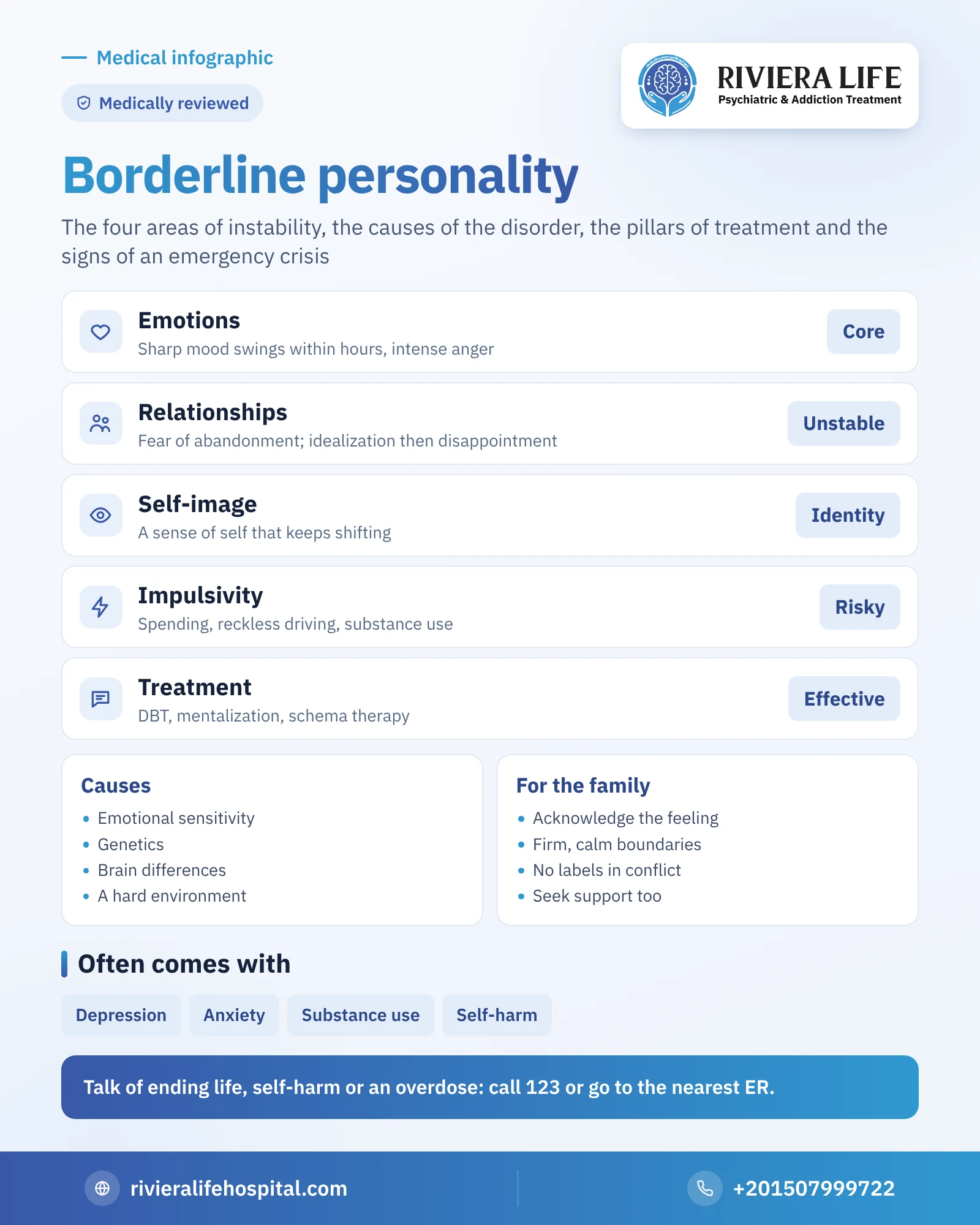
Borderline Personality Disorder is an extended pattern of instability in four intertwined areas: emotions, relationships, self-image and impulse control. It usually begins in adolescence or early adulthood, and appears in many situations, not just one. A woman with this disorder may be at the height of warmth in the morning, then feel by evening that her close friend has abandoned her because she was late replying to a message, so the warmth turns into sweeping anger, then into regret and shame the next day.
The word “borderline” has a story. Doctors once used it to describe patients they believed stood on the “border” between neurosis and psychosis. Science moved past this idea long ago, and only the name remained. So the name does not mean the person is on the edge of madness, nor that their condition is half an illness.
How common is borderline personality disorder?
Medical references estimate its prevalence at roughly one to two percent of the general population, and the proportion rises considerably in psychiatric clinics and emergency departments, because people with it often seek help during crises. Women are diagnosed with it in clinics more than men, but community studies point to a much smaller difference; men reach the clinic less, and may be misdiagnosed with other disorders because their anger and impulsivity are read as “a temper” or substance use.
On the hopeful side, long-term follow-up studies show that a large proportion of people with the disorder see their symptoms recede clearly over the years, especially impulsive symptoms and crisis behaviors, and that relapse after stable improvement is less common than was thought.
Types of borderline personality: what is official and what is popular?
You will read online about “four types” of borderline personality: quiet, impulsive, petulant and self-destructive. These patterns are taken from a description proposed by the American psychologist Theodore Millon, then circulated by websites under simplified names. They are useful for understanding that the disorder does not look the same in everyone, but they are not official diagnoses, and they do not appear in the fifth edition of the American Diagnostic and Statistical Manual or in the eleventh edition of the International Classification of Diseases.
The American manual treats borderline personality as a single diagnosis without subtypes, while the international classification changed the whole way of looking at it: it now determines the severity of the personality disorder, then adds a description of the dominant traits, including what is called the “borderline pattern”. We explain the four patterns, the official classification and the difference between them in the article Types of borderline personality.
The main symptoms in brief
The American manual lists nine signs, and requires at least five of them in a fixed, extended pattern. These signs fall into four groups:
- Emotions: sharp mood swings within hours, intense anger that is hard to control, and a chronic feeling of emptiness.
- Relationships: frantic effort to avoid real or imagined abandonment, and intense, unstable relationships that move from idealization to disappointment.
- The self: a self-image that changes often, so the person does not know steadily what they want or who they are.
- Behavior and thinking: impulsivity in harmful areas such as spending, reckless driving or substance use, repeated thoughts or behaviors of self-harm, and a passing sense of detachment from reality or suspicion under stress.
We have explained the nine signs one by one in simple language, with examples from everyday life and a checklist to help you decide when to seek an assessment, in the article Symptoms of borderline personality.
The causes of borderline personality in brief
There is no single cause. The picture supported by science is that a child is born with high emotional sensitivity, meaning their feelings ignite faster, are stronger and calm down more slowly, then grows up in an environment that did not help them understand and regulate these feelings, but met them with neglect, mockery or punishment. Over time, they learn painful ways of dealing with their emotions. Genetics contributes a considerable share, differences appear in the activity of the brain regions responsible for emotion and impulse control, and trauma and neglect are more common in the childhood of many people with the disorder, without being a condition in everyone.
This does not mean the parents are “the cause of the illness”. Many families did what they knew, and the disorder is the result of a complex interaction for which no single party bears responsibility. The details and the weight of each factor are in the article Causes of borderline personality.
How is borderline personality diagnosed?
No lab test or scan reveals the disorder. Diagnosis relies on a detailed psychiatric interview, sometimes on standardized scales, and on information from the family about the person’s history since adolescence. The doctor takes care to distinguish it from conditions that resemble it on the surface, such as bipolar disorder, in which mood episodes last days or weeks, not hours, complex post-traumatic stress disorder, attention-deficit/hyperactivity disorder, and the effects of substance use.
Many doctors deliberately take their time before giving this diagnosis, especially to adolescents, because some emotional intensity is normal at that age, and because the stigma attached to the name can do harm. But a long delay has a price too, because an accurate diagnosis is what opens the door to the right treatment.
The harms of borderline personality to the person and their relationships
The harm of borderline personality is not tied to one specific behavior, but to the intensity of emotions, how fast they swing and the decisions that result. The longer the assessment is delayed, the higher the cost of these swings to the person and those around them.
- Relationships: an intense fear of abandonment that sometimes ends in excessive attachment and then anger or withdrawal, so conflicts in friendship and marriage repeat.
- The self: a chronic inner emptiness and a fragile sense of worth, which may come with depression and anxiety.
- Behavior: impulsivity in spending, driving or relationships, and sometimes using substances to relieve psychological pain.
- Safety: self-harm or suicidal thoughts during crises, which requires immediate intervention.
- Work: absence from work or suddenly leaving jobs after a conflict or a sense of rejection.
Even so, this picture is not destiny. Specialized psychotherapy, especially dialectical behavior therapy, has shown the ability to reduce crises and improve relationships for many people. You can find how the course of relationships changes in the article Borderline personality and marriage, and the details of recovery in Treatment of borderline personality.
The borderline personality disorder test presents the nine criteria in simple statements, and is useful for understanding the pattern, not for making a diagnosis.
Treatment of borderline personality: an overview
The main treatment is psychological, not medication. The most studied approaches are dialectical behavior therapy, which teaches practical skills for tolerating distress, regulating emotions and managing relationships; mentalization-based therapy, which trains the person to understand what is going on in their own mind and in the minds of others before acting; and schema therapy, which addresses deep patterns formed since childhood. These programs usually last from a year to more, and their results improve with commitment.
There is no approved medicine for treating the disorder itself, but the doctor may prescribe medicines to treat accompanying depression, anxiety or insomnia, or for a short period during an acute crisis. The hospital’s role is mostly a short stay when there is imminent danger, followed by a return to outpatient treatment. The stages of treatment, the limits of medicines and what can be done at home are explained in the article Treatment of borderline personality.
Borderline personality and addiction: a frequent dual diagnosis
Impulsivity and acute emotional pain make drugs and alcohol a quick way to put out feelings, which is why the disorder and substance use often occur together. In Egypt we see this with sedative pills and painkillers such as pregabalin and tramadol, and with hash and alcohol. Substance use brings temporary calm, then increases impulsivity and mood swings and raises the risk of crises. That is why someone who has both conditions needs one plan that treats them together, not treatment of the addiction alone followed by waiting for “the personality to calm down” on its own.
Borderline personality and motherhood: can a mother with the disorder raise her children?
Yes, many mothers with borderline personality are able to raise their children with love and care. The diagnosis alone does not determine a mother’s ability, but motherhood puts daily pressure on the nerves that can make regulating emotions harder, especially with little sleep and marital conflicts.
What a mother in this situation faces most:
- Bouts of anger or crying that the child sees, followed by regret and self-blame.
- A fear of abandonment that may make her intensely attached to her child or inconsistent in her closeness to them.
- A feeling of guilt that she is “not enough”, which doubles the pain.
What truly helps is regular treatment, learning self-soothing skills during emotional moments, and having the husband or a relative share in caring for the child during crises. A child needs a stable, predictable environment more than a mother without mistakes, and apologizing to them after an outburst teaches them that relationships can be repaired.
If the crisis reaches the point of thinking about harming oneself or the child, seek immediate medical help. You can find the steps of support in Treatment of borderline personality and the family’s role in this same guide.
Living with borderline personality and the family’s role
Many people with the disorder are able to build stable relationships, work and study, and their lives improve more the earlier treatment begins. The family has a role that makes a real difference:
- Understanding that intense emotion is not acting or deliberate manipulation, but real pain that comes out in a confusing way.
- Acknowledging the feeling before discussing the behavior; a phrase like “I understand you’re very angry right now” calms more than arguing.
- Setting clear, firm boundaries calmly, because inconsistent boundaries increase the anxiety about abandonment.
- Avoiding labels such as “moody” or “mentally ill” in moments of conflict.
- Seeking support for themselves, because living with intense emotions is exhausting, and family programs teach useful skills.
Common myths about borderline personality
Myth: people with borderline personality are manipulative attention-seekers. Fact: behavior that looks like showing off is often a desperate attempt to relieve pain that finds no other way out, and it deserves serious attention, not mockery.
Myth: borderline personality cannot be treated. Fact: this is one of the most harmful misconceptions; specialized psychotherapies clearly relieve the symptoms, and many no longer meet the diagnostic criteria after years.
Myth: the disorder affects only women. Fact: it affects men too, but they are diagnosed less.
Myth: it is the same as bipolar disorder. Fact: they may look alike in mood swings, but the nature of the swings, their duration and their treatment are different, and the two can sometimes occur together.
Myth: the cause is bad parenting. Fact: the environment is one factor among many, including genetics and the nature of temperament since birth.
The borderline personality guide: each aspect in its own article
We have devoted an article to each major question, answering it in depth without repetition:
- Symptoms of borderline personality: the nine signs in simple language, how they differ from ordinary emotion, and when to seek an assessment.
- Causes of borderline personality: genetics, the brain, childhood and environment, and how they interact.
- Types of borderline personality: the four popular patterns and their limits, and what the official classification says.
- Treatment of borderline personality: dialectical behavior therapy, mentalization and schema therapy, the role of medicine, and what helps at home and what does not replace treatment.
- The difference between bipolar disorder and borderline personality disorder: a clear comparison
A borderline personality crisis: when is it an emergency?
Some crises pass with talking and calming down, and some cannot wait. Take any talk of self-harm or ending life with complete seriousness, even if it has happened before.
Seek urgent help immediately if you see
Call the ambulance on 123 or go to the nearest emergency department, and stay with the person until help arrives.
- Talk of wishing to die or ending life, or unusual goodbyes
- Self-harm that has caused a wound or injury needing medical care
- Taking a large amount of a medicine or substance, with or without alcohol
- Near-total loss of control with threats to harm themselves or others
- Severe detachment from reality or suspicion that puts them in danger
Speak in a calm voice, listen more than you advise, and remove medicines and dangerous tools from the place without confrontation. You can also ask for guidance from the hotline of the General Secretariat of Mental Health and Addiction Treatment on 16328 or 0220816831.
When should you seek help?
If intense emotions, unstable relationships and impulsivity are a pattern that has repeated for years and harms study, work or home, a psychiatric assessment is the right step, even if it turns out the cause is another disorder. At Riviera Life in Sheikh Zayed, consultant psychiatrists carry out the assessment in complete confidentiality, the first consultation is free, and you can reach us around the clock on +201507999722.
Medical sources and referencesThe information in this article is based on reliable scientific sources
1NIMH — Borderline personality disordernimh.nih.gov2NHS — Borderline personality disorder: overviewnhs.uk3StatPearls — Borderline personality disorderncbi.nlm.nih.gov4MedlinePlus — Borderline personality disorder (medical encyclopedia)medlineplus.gov5APA — What are personality disorders? (American Psychiatric Association)psychiatry.org