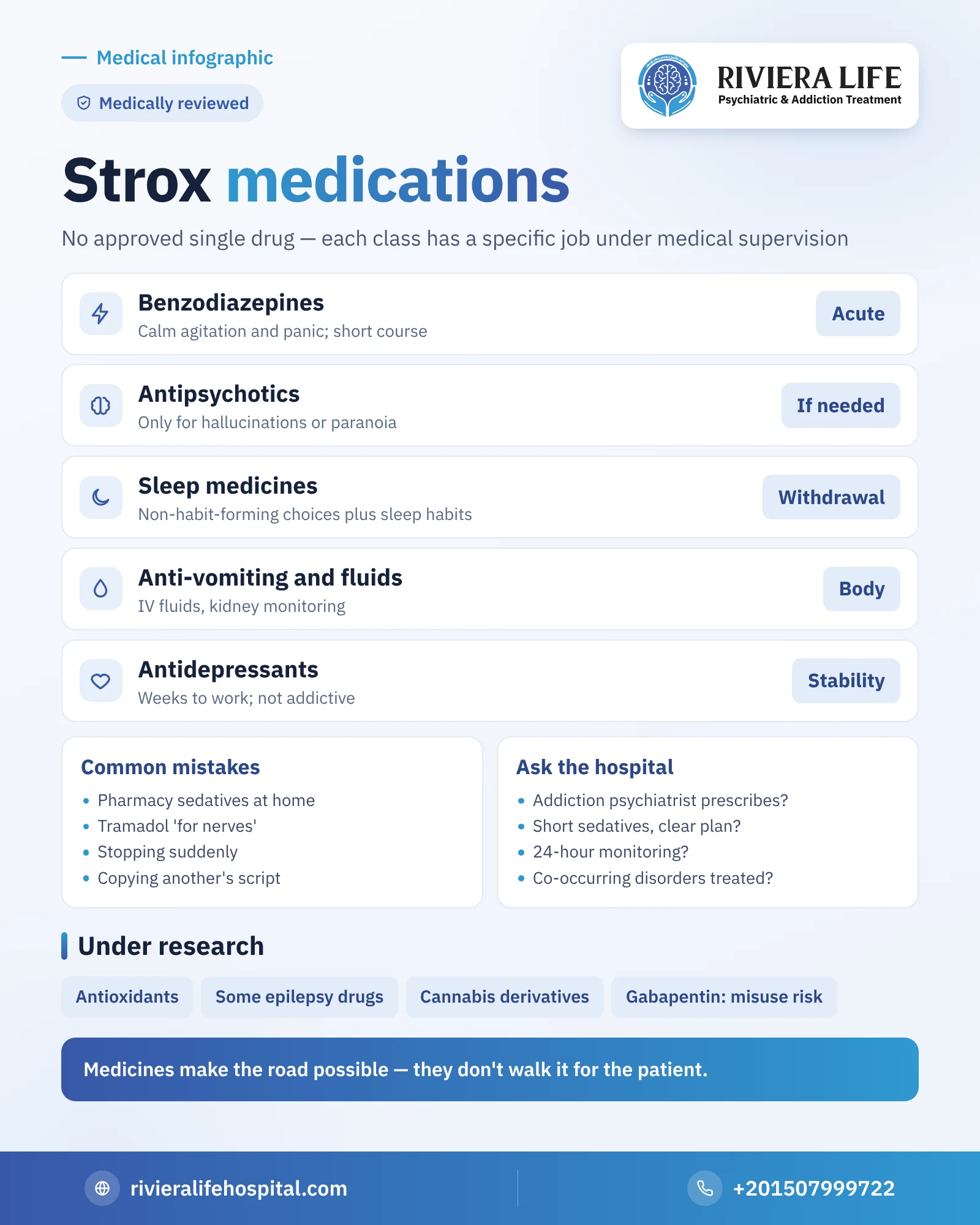
To date there is no single globally approved medicine that treats strox addiction by itself, and no “injection” that erases the craving as some advertisements promise. The strox addiction treatment medications that doctors actually use are a group of medicine classes, each with a specific goal: calming agitation and anxiety in the first days, controlling hallucinations and persecutory thoughts if they appear, regulating sleep, stopping vomiting and replacing fluids, then treating the depression or anxiety that remains after stopping.
This article explains each class, its role and when it is used, without going into doses, because choosing the medicine and its dose is an individual medical decision that shouldn’t be carried from one patient to another.
Why is there no single medicine for strox addiction?
With opioid addiction, for example, there are medicines that work on the same receptors and so prevent withdrawal and craving. With cannabinoids, both natural and synthetic, research hasn’t yet succeeded in reaching a medicine with this precision, despite trying several compounds. Added to this, strox isn’t a single substance, but changing compounds that differ in strength and how long they stay. That is why drug treatment rests on a different principle: treating the symptoms that appear on the patient, and the accompanying disorders they carry, in a way that makes them able to benefit from psychotherapy, which remains the cornerstone.
Medicines are one part of the plan. The full stages, from assessment to relapse prevention, the duration of treatment and how to choose the hospital, belong in the article on strox addiction treatment.
When do medicines enter the treatment journey?
- In acute poisoning: in the emergency department, to calm agitation, stop seizures and protect the heart and kidneys.
- During withdrawal: to ease anxiety, insomnia and nausea in the hardest days.
- In the stabilization stage: to treat any psychotic symptoms, depression or persistent anxiety.
- In the long term: to treat the accompanying psychological disorder if present, which is among the most important things that protect against relapse.
Medicines to calm agitation and acute anxiety
The class most used in poisoning and withdrawal is benzodiazepines, sedatives that work quickly to ease agitation, anxiety and panic attacks, and reduce the likelihood of seizures. Their effectiveness in these states is known, but they have another face: they themselves may cause dependence if used for long. That is why they are given in hospital for a short, calculated period, then withdrawn gradually according to a clear plan. This is precisely what makes using them at home without supervision a double danger.
Antipsychotics
When hallucinations, persecutory thoughts or severe agitation that doesn’t respond to sedatives appear, the psychiatrist turns to antipsychotics. Their initial goal is to control the acute episode and protect the patient and those around them. After stabilization, the doctor decides how long to continue: if the symptoms are linked to the substance alone a short period may be enough, but if the assessment reveals an independent psychotic disorder, the patient may need longer treatment with regular follow-up. These medicines require monitoring of their side effects such as drowsiness, stiffness and weight gain.
Medicines to regulate sleep
Insomnia is among the things that most push a strox patient to go back, because they are used to the joint putting them to sleep. To treat it the doctor chooses medicines that usually don’t cause dependence, such as some antidepressants with a sleep-inducing effect or some antihistamines, and avoids as far as possible sleeping pills that may be misused. The medicine is always accompanied by training in sleep habits, because medicine alone doesn’t restore the natural rhythm.
Medicines for nausea, vomiting and fluids
Vomiting in poisoning or withdrawal needs anti-vomiting medicines and fluid replacement, sometimes with intravenous fluids, with monitoring of kidney function. But the episodes of repeated vomiting linked to chronic cannabinoid use usually don’t respond to the usual anti-vomiting medicines, and their main treatment is stopping the substance, which the article on the harms of strox explains.
Antidepressants and anti-anxiety medicines
After withdrawal ends, many are left with low mood or anxiety that doesn’t disappear. If the doctor diagnoses depression or an anxiety disorder, they prescribe antidepressants that usually need several weeks for their effect to appear, and don’t cause addiction. A common mistake is for the patient to stop them after days because they “didn’t feel a difference”, or after a month because they “improved”, and both may bring the symptoms back, and with them the craving.
Medicines under research to reduce craving
Several compounds have been tried in research in the hope of reducing the craving for cannabis, including antioxidants, some epilepsy medicines and derivatives of cannabis itself, and their results came out conflicting and insufficient to adopt them as routine treatment. Some of them, such as gabapentin, have a potential for misuse in Egypt, so the patient should never try it on their own. The doctor alone decides whether any of them has a place in a particular case.
When another substance is with strox
Many strox patients come with tramadol, pregabalin or sedatives too. Each of these substances has a different withdrawal, and some, such as tramadol, carry a seizure risk of their own. That is why the doctor sets an order for withdrawing each substance, may use medicines specific to it, and carefully manages interactions between medicines. This point alone is enough to explain the danger of home experiments.
How does the doctor monitor the safety of medicines?
Prescribing the medicine is half the task, and the other half is following it up. During the stay the team monitors drowsiness, blood pressure, pulse and breathing after sedatives, stiffness or tremor after antipsychotics, and the development of mood and sleep day by day. Tests of liver and kidney function may be requested, or a heart tracing before and during some medicines, especially if strox has affected the heart or kidneys. On discharge, the patient and family get a written plan: which medicine, why, when to review, and which signs call for contacting the doctor. This follow-up is what makes the medicine a safe part of treatment, not a new danger.
Common mistakes in using medicines
- Buying sedatives or sleeping pills from the pharmacy to get through withdrawal days, so dependence moves to a new substance.
- Using tramadol or pregabalin “to calm the nerves” while stopping.
- Stopping a psychiatric medicine suddenly without going back to the doctor.
- Copying another patient’s prescription because “his case was similar”.
Steps to safe recovery: medicine is part of the plan
Medicines make the road possible, but they don’t walk it instead of the patient. Safe recovery starts with a medical and psychological assessment, then withdrawal of the substance under observation, then psychological and behavioral therapy that rebuilds habits, then extended follow-up. The details of these stages and how they are managed are in the article on strox addiction treatment, while the withdrawal days themselves are explained in the article on strox withdrawal symptoms.
How do you make sure medication treatment for strox addiction is managed safely?
The right hospital for treating strox addiction is the one that uses medicine wisely: it prescribes it when needed, stops it when its role ends, and treats what lies behind the symptoms. Before you choose, ask:
- Are medicines prescribed by a psychiatrist specialized in addiction after a full assessment?
- Are sedatives used for a short period with a clear withdrawal plan?
- Is there round-the-clock medical follow-up to monitor the effects of medicines and any complications?
- Is the patient assessed for accompanying psychological disorders and treated for them?
- Does the team have experience in withdrawing tramadol and pregabalin if they are with strox?
And don’t trust any medicine advertised as curing strox addiction in days or with a guaranteed rate.
How Riviera Life meets these standards in strox addiction treatment
These are the details of what Riviera Life offers in this area:
- Official license: a hospital licensed by the Ministry of Health.
- Specialist consultants: medicines are prescribed and followed up by consultants in psychiatry and addiction treatment.
- Continuous supervision: 24-hour medical follow-up of the effects of medicines and withdrawal symptoms.
- Fourteen years of experience: and thousands of recovered cases, including cases mixing more than one substance.
- Complete confidentiality: in the medical file and at every step.
- After the medicine: a family program and aftercare that protect against relapse.
The first consultation is free, and to contact us around the clock call +201507999722; we are based in Sheikh Zayed, Giza.
More from the strox guide
- Strox: the complete guide
- Strox addiction treatment: stages and duration
- Strox withdrawal symptoms
- The causes of strox addiction
Questions many people ask
There is no approved medicine that treats cannabinoid addiction by itself. The doctor uses medicines that treat the symptoms and accompanying disorders, while psychological and behavioral therapy remains the foundation.
Some, such as benzodiazepines, may cause dependence if used for long, which is why they are given for a short period under supervision and then withdrawn gradually according to a plan.
No, they are only used when hallucinations, persecutory thoughts or severe agitation appear, and the doctor sets how long to use them depending on whether the symptoms are linked to the substance or to an independent disorder.
This isn't advised, as some sleeping pills and sedatives cause new dependence or interact with other substances in his body. The doctor chooses safe sleep medicines after assessment.
Look for medicines prescribed by an addiction psychiatrist after full assessment, short sedative use with a clear withdrawal plan, round-the-clock medical supervision and treatment of accompanying disorders. Riviera Life in Sheikh Zayed meets these criteria, and the first consultation is free.