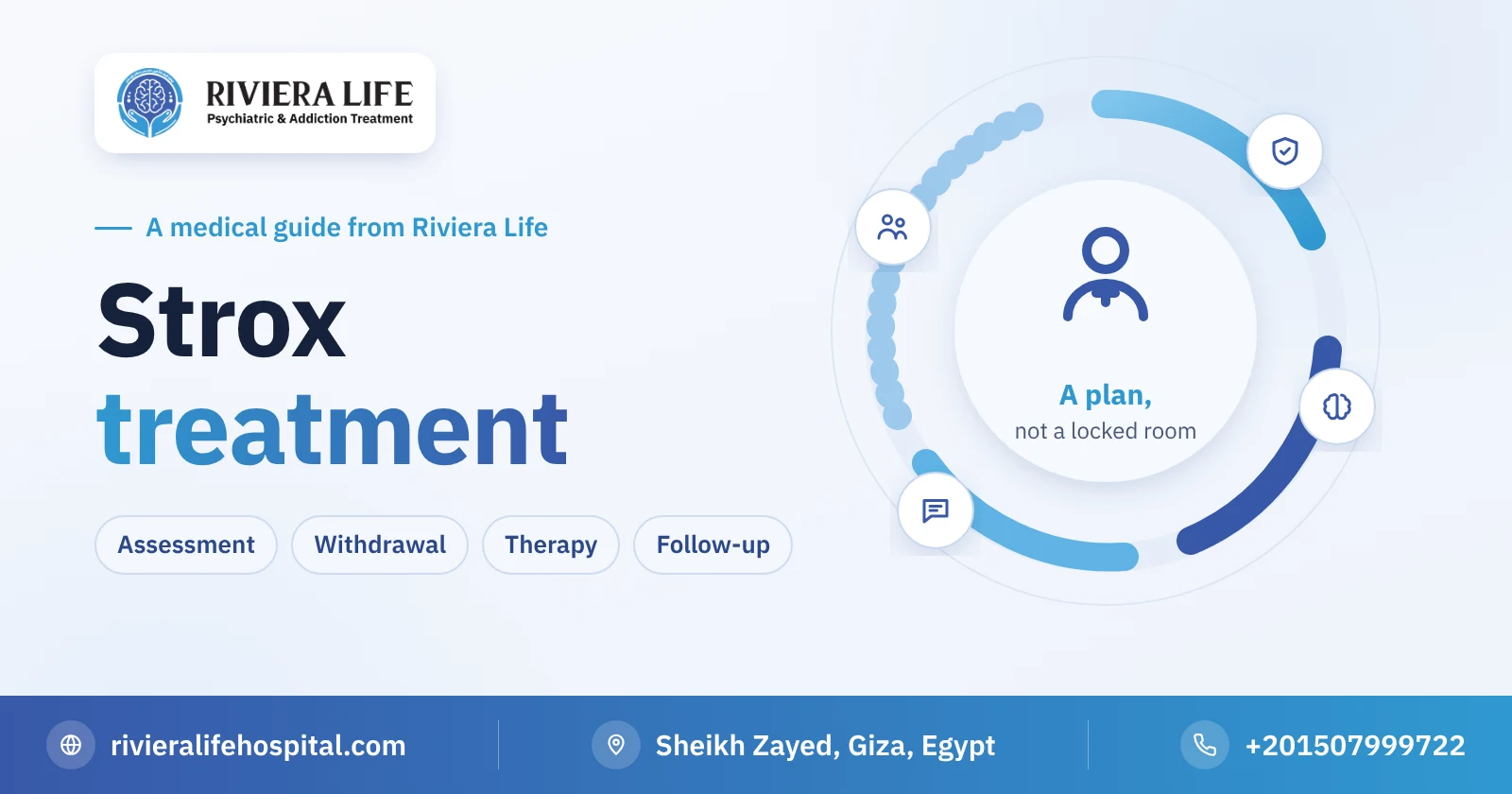
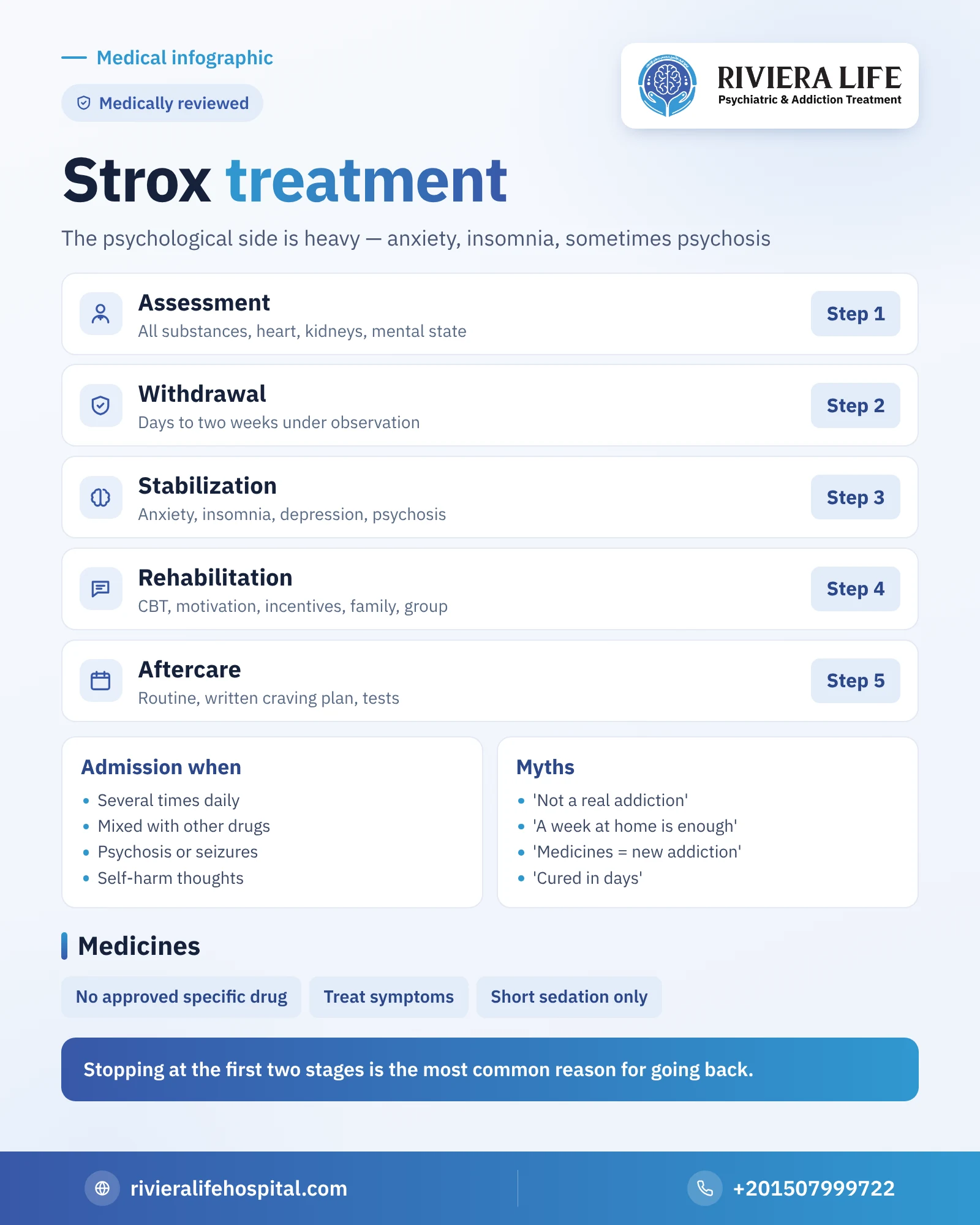
Strox addiction treatment is possible, and its results are good when it is built on an integrated plan, not on locking the person in their room for a week. Treatment usually goes through five stages: a comprehensive medical and psychological assessment, then safe withdrawal of the substance under observation, then treatment of the accompanying psychological symptoms, then behavioral rehabilitation that rebuilds habits, and finally extended follow-up to prevent relapse. What distinguishes a strox patient from others is that the psychological side is heavy: anxiety and insomnia, sometimes psychosis, and often another substance with it. This article explains each stage, the expected length, the difference between admission and outpatient treatment, and how to choose the right hospital.
The stages of strox addiction treatment
- Comprehensive assessment: a medical and psychological examination and tests, and identifying all substances used and the severity of dependence.
- Safe withdrawal of the substance: getting through the first days of withdrawal under medical observation.
- Stabilizing the psychological state: treating anxiety, insomnia, depression or psychotic symptoms if present.
- Psychological and behavioral rehabilitation: understanding the motives for use and learning alternative skills.
- Care after discharge: regular meetings and a written plan the person in recovery goes back to when craving intensifies.
Settling for the first two stages is the best-known reason for going back to use, because craving and triggers remain after the substance leaves the body.
The assessment: why does treatment start with the psychiatrist?
The first session doesn’t aim to prove use, as the family is usually sure of it. Its aim is to draw the full picture: how long he has been smoking, how many times a day, whether he combines it with tramadol, pregabalin or bango, and whether he has had episodes of hallucinations or seizures before. The team examines the heart, kidneys and fluids, because strox may leave an effect on them, and assesses the psychological state carefully to distinguish symptoms of the substance from an independent psychiatric disorder that needs specific treatment. The whole plan is built on this picture.
Strox withdrawal: days under observation
The acute stage of withdrawal usually extends from several days to about two weeks, and its difficulty centers on insomnia, irritability, anxiety and nausea, with the possibility of psychological or physical complications in some patients. During this period the team follows sleep, vital signs and mood, and intervenes early at any deterioration. You will find the timeline of symptoms in the article on strox withdrawal symptoms.
The role of medicines in treatment
There is still no internationally approved medicine that treats cannabinoid addiction specifically, as is the case with some other types of addiction. That is why the doctor relies on medicines that treat symptoms and accompanying problems: calming agitation and anxiety for a short period, regulating sleep, controlling psychotic symptoms if they appear, and treating depression or chronic anxiety. Each medicine is chosen according to the case and reviewed continuously, and these categories and the role of each are detailed in the article on strox addiction treatment medicines.
Psychological and behavioral therapy
This is where real change happens. Among the most effective approaches with cannabinoid addiction:
- Cognitive behavioral therapy: in which the patient learns to spot the situations and thoughts that come before craving, and build practical responses to them.
- Motivational therapy: helps the hesitant patient discover their own reasons for change instead of settling for family pressure.
- An incentive system: tangible rewards for commitment and follow-up results, supported by strong evidence in this type of addiction.
- Family therapy: especially with teenagers, to rearrange boundaries and communication at home.
- Group therapy: in which the patient sees that others have been through the same experience and succeeded.
Treating co-occurring psychiatric disorders
A large proportion of strox patients have anxiety, depression or attention deficit disorder, and some have been through a psychotic episode. Ignoring these problems means the reason that drove them to the cigarette is still there. That is why the same team must treat them in parallel with the addiction, not postpone them until after “getting clean”. What drives use in the first place is explained in the article on the causes of strox addiction.
How long does strox addiction treatment take?
It varies from patient to patient. Withdrawal of the substance takes days to about two weeks, the intensive program may extend from several weeks to a few months depending on the severity of the case and the presence of accompanying disorders or substances, then outpatient follow-up continues for months. The rule research confirms is that staying in treatment long enough, usually estimated at at least three months of structured treatment, is clearly linked to better results.
Admission or outpatient treatment?
Admission to hospital suits someone who smokes several times a day, combines strox with other substances, has had psychotic episodes or seizures, has thoughts of harming themselves, has had failed previous attempts, or lives in an environment where the substance is plentiful. Outpatient treatment suits milder cases and those who have finished a period of admission. In many cases the best path is to start treatment with admission and then move gradually to follow-up.
Relapse prevention and aftercare
The first months after discharge are the most sensitive. The patient needs a clear daily routine with regular sleep, activity and work or study, distance from the group and places linked to smoking, and a written plan for what to do when craving intensifies: who to call, where to go, and how to refuse. Regular specialized tests help detect any relapse early, as the article on how long strox stays in the body explains. And relapse, if it happens, doesn’t mean failure, but means the plan needs adjusting.
The family’s role during treatment
The family is a partner in the plan, not just a visitor. It needs to learn how to support without watching every move, how to set limits on money and going out without cutting off dialogue, and how to act if it notices signs of relapse. With teenagers especially, involving the parents is among the strongest things that improve results. That is why good programs dedicate sessions to the family itself, in which it deals with the feelings of anger and guilt that have built up, and agrees on clear house rules after discharge.
Myths about strox addiction treatment
The myth: strox isn’t a real addiction, so it is enough for the young man to stop. The truth is that dependence on it is real, and its withdrawal may be harsher than bango withdrawal.
The myth: locking him in at home for a week is enough. The truth is that this treats only part of withdrawal, leaves the motives and triggers as they are, and may be dangerous if complications appear.
The myth: psychiatric medicines will make him addicted to something else. The truth is that the doctor chooses medicines that mostly don’t cause dependence, and uses strong sedatives for a short, measured period.
The right hospital for strox addiction treatment: how to choose
The right hospital for strox addiction treatment is the one that provides what a strox patient specifically needs: strong psychiatry that deals with psychosis and anxiety, medical supervision that handles withdrawal complications, and experience with cases that combine more than one substance. Ask before you decide:
- Is the case handled by consultant psychiatrists able to distinguish substance symptoms from a psychotic disorder?
- Is a doctor present day and night if the patient is struck by agitation or a seizure?
- Does the place have a plan to withdraw accompanying substances such as tramadol and pregabalin in a safe order?
- Are specialized tests for synthetic cannabinoids done instead of settling for the bango strip?
- Does it offer a family program, especially if the patient is a teenager?
- Is there clear aftercare after discharge?
And don’t trust any party that promises you a guaranteed result, or claims that getting rid of strox happens in a few days.
How Riviera Life meets these standards in strox addiction treatment
Riviera Life applies these criteria as follows:
- Ministry of Health license: Riviera Life works with an official license in psychiatry and addiction treatment.
- A long record: fourteen years of addiction treatment, during which thousands of patients recovered.
- Psychiatry at the heart of the plan: consultants in psychiatry and addiction treatment assess psychotic symptoms and anxiety from day one.
- Constant medical oversight: a team that follows the patient day and night throughout strox withdrawal, and intervenes immediately if any complication appears.
- Experience with mixing: organized plans for those who combine strox with tramadol, pregabalin or bango.
- Complete confidentiality: the data of the patient and their family is protected at every stage.
- The family and after discharge: a program that involves the parents, and continuing care after leaving that limits relapse.
You pay nothing for the first consultation, and the phone +201507999722 takes your call at any hour; the hospital is based in Sheikh Zayed, Giza Governorate.
More from the strox guide
- Strox: the complete guide
- Strox addiction treatment medicines
- Strox withdrawal symptoms and their duration
- The harms of strox on body and mind
- How to deal with a strox addict: safety during agitation and psychosis
Questions many people ask
Yes, many patients recover and return to their studies and work, especially with a plan that combines safe withdrawal, psychotherapy and follow-up. Relapse is possible but it means adjusting the plan, not its failure.
Withdrawal takes days to about two weeks, the intensive program weeks to months, then outpatient follow-up for a period. Staying at least three months in structured treatment is linked to better results.
Not always, but admission is preferred with heavy daily use, mixing substances, psychotic episodes or seizures, suicidal thoughts, or failed previous attempts.
Look for psychiatrists who can tell substance symptoms from psychosis, a doctor present day and night, a safe plan for tramadol or pregabalin taken with it, specialized synthetic cannabinoid tests, a family program and aftercare. Riviera Life in Sheikh Zayed, Giza meets these criteria.
This often happens, and the family can start the consultation alone to learn how to talk with him and increase his motivation, as motivational therapy helps hesitant people reach their decision.