The causes of strox addiction are many, and none of them alone is enough to explain it. What usually happens is the meeting of three parties: a strong, short-acting substance that creates dependence quickly, a person carrying a psychological or genetic susceptibility or going through pressure they don’t know how to deal with, and an environment that makes the substance cheap, available and acceptable among friends. Understanding these parties doesn’t aim to blame anyone, but to know where intervention is possible. This article explains why strox turns from a “trial cigarette” into a daily need, who is most at risk of that, and what the family and school can do for prevention.
Why does strox create addiction so quickly?
A large part of the answer is in the substance itself. Strox compounds activate cannabis receptors in the brain much more strongly than bango, producing an intense effect that settles in memory quickly. Many of them are short-acting, so their effect drops after a short time and leaves behind distress and irritability that push toward the next cigarette. With repetition the number of available receptors decreases and their response weakens, so the person needs a larger amount or more times. This cycle of high, then crash, then need may be completed within weeks in someone who smokes daily.
From experiment to dependence: how does it develop?
The story repeats with similar details. It starts with a cigarette offered by a friend at a night out or in a café, accompanied by a reassuring sentence such as “it’s just herbs” or “lighter than hash”. Then the cigarette becomes a means of escaping boredom, anxiety or insomnia. After that use turns into a daily ritual linked to times and places, then into a necessity to avoid irritability and distress. At this stage the motive has completely changed: it is no longer the search for pleasure, but for the feeling of being “normal”. Often the person doesn’t notice this shift themselves, so they remain convinced they “can stop at any time” until the first serious attempt to stop.
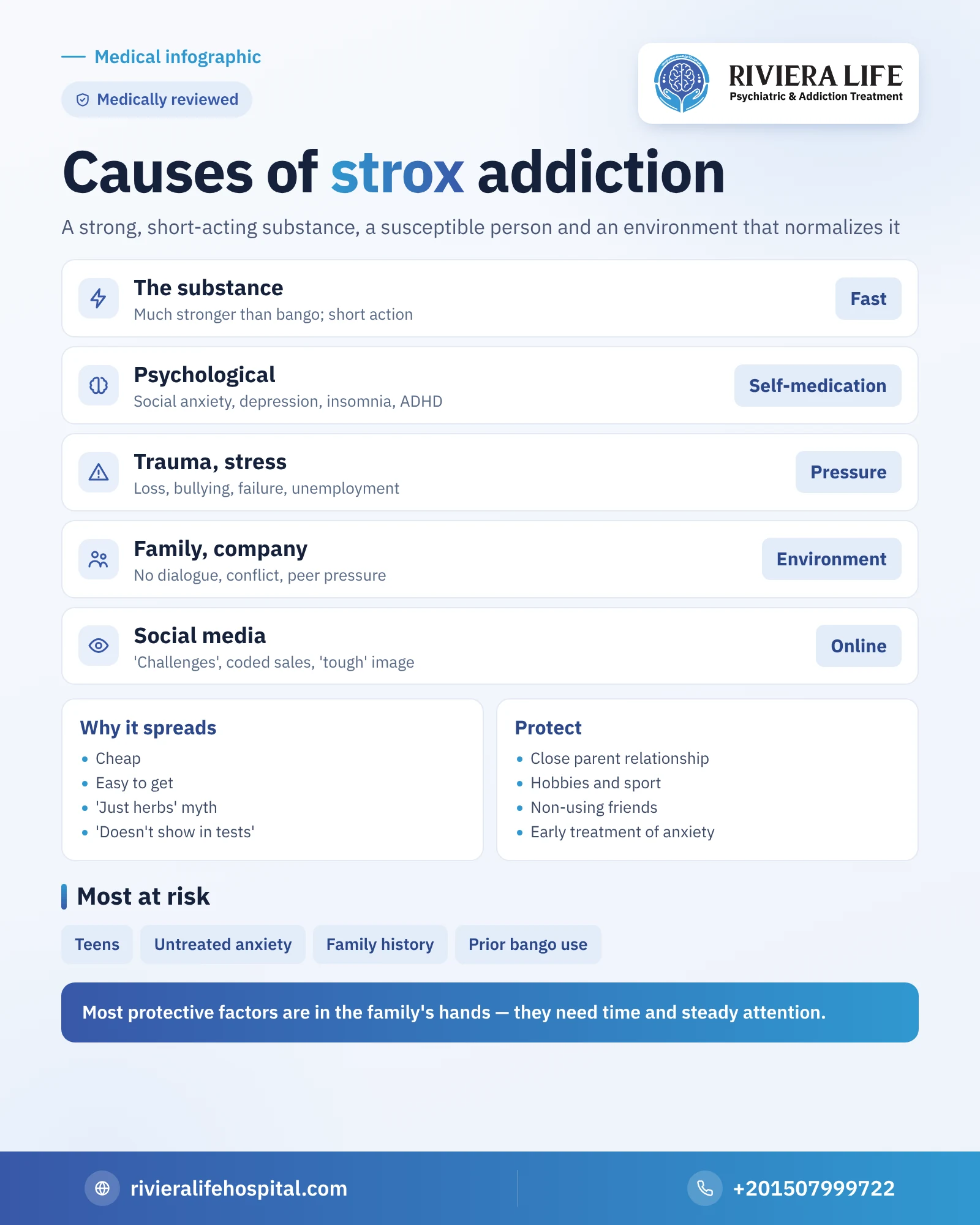
Why is strox spreading among young people in Egypt?
- The low price compared with other substances, which puts it within reach of school and university students.
- The ease of getting it through networks of friends and social media.
- The deceptive image in which it is promoted as herbs or a “lighter” alternative.
- Some young people’s belief that it doesn’t show in tests, so they choose it thinking it is safer from consequences.
- The ease of hiding it and smoking it like an ordinary cigarette.
Psychological causes
Many who become addicted to strox carried psychological suffering before the first cigarette, without diagnosis or treatment. Social anxiety makes the cigarette a means of bearing gatherings, depression makes it a temporary escape from emptiness, and chronic insomnia makes it an easy “sleeping pill”. Attention deficit hyperactivity disorder, impulsivity and the constant search for excitement are all linked to a higher susceptibility to trying and continuing. The paradox is that strox makes these problems worse in the medium term, so the need for it widens.
Trauma and life pressures
Exposure to harsh experiences in childhood, losing a close person, bullying, repeated academic failure or long unemployment are all pressures that may push toward looking for a quick anesthetic for feelings. This doesn’t mean that everyone who has been under pressure will become addicted, but it raises susceptibility, especially if support is absent.
Family and environmental factors
The close environment makes a big difference. Susceptibility rises when dialogue is absent at home, sharp disputes recur, or parents’ follow-up of their children’s friends and times out decreases. Also, having a family member who uses a substance makes use seem normal. On the other hand, the group with which the young person spends their time may be more influential than the family in adolescence, and if smoking is part of this group’s identity, refusing becomes difficult.
The role of social media and company
Friends on the street are no longer the only source of getting to know strox. Short clips showing laughter and trembling as if they were a funny “challenge”, songs and phrases that make use part of the image of the “tough” young man, and closed groups where sales are offered under coded names all reduce the dread of the first experiment. In adolescence specifically, the fear of exclusion from the group is stronger than the fear of the substance itself, so the young man says “yes” to a cigarette he doesn’t want so as not to be accused of being “scared”. That is why modern prevention programs focus on training the teenager in practical refusal rather than settling for warning.
Genetic and biological factors
Studies on addiction in general indicate that genetics explains a considerable part of susceptibility, through genes that affect the reward system and the response to stress. Someone with a first-degree relative who suffered from addiction or a psychotic disorder needs double caution, because strox may reveal a latent disorder in them. Age is also a biological factor: the younger the age at which use starts, the greater the likelihood of dependence.
False beliefs that pave the way
Some ideas widespread among young people make the first step easier: that it is “not drugs” because it is herbs, that it doesn’t cause addiction, that whoever smokes it only on occasions is safe, and that it is milder than bango. Each of these ideas collapses before what the strox page explains about the nature of the substance, and what the article on the harms of strox presents of real complications.
From bango and pills to strox
Many don’t start with strox directly. Some come from bango looking for a stronger or cheaper effect, and some combine it with tramadol or pregabalin to balance the effects. This moving between substances raises the risk of multiple dependence, and makes treatment more complex because each substance has its own withdrawal.
Who is most at risk of strox addiction?
- Teenagers and young people of school age.
- Those suffering from anxiety, depression or insomnia without treatment.
- Those with a family history of addiction or psychotic illnesses.
- Those who have previously used bango or pills.
- Those living with long emptiness, unemployment or dropping out of study.
Factors that protect from addiction
Just as there are risk factors, there are real protective factors: a close relationship with one of the parents to whom the son can talk without fear, hobbies or sport that give him a sense of achievement, friends who don’t use, early treatment of any anxiety or depression, and correct information about the substance away from exaggeration or downplaying. These factors don’t work as an absolute shield, but they delay the age of the first experiment, and make the young person more able to admit early if they get involved, and this alone makes a big difference in the speed and results of treatment. The good news is that most of them are in the family’s hands, and need only time and steady attention.
Ways to prevent strox addiction
- Start talking about strox with your children early and calmly, before they hear about it from their friends.
- Know their friends and where they go without suffocating supervision.
- Treat insomnia, anxiety and depression at their first appearance.
- Teach them practical ways to refuse the offer without feeling embarrassed.
- Pay attention to early changes in mood, sleep, appetite and spending.
And if these changes have already appeared, the list of strox addiction symptoms will help you distinguish the worrying from the normal.
How does Riviera Life help you?
Understanding the cause of addiction is part of treating it. That is why the consultants in psychiatry and addiction treatment at Riviera Life begin with an assessment that looks at what lies behind the cigarette: anxiety, depression, trauma or family pressure, then the plan is built on treating these causes in parallel with stopping the substance, with a family program that rearranges the relationship inside the home. The first consultation is free and confidential.
More from the strox guide
Questions many people ask
Because its compounds activate cannabis receptors much more strongly, and the action of many of them is short, so use repeats during the day and tolerance and dependence form in less time.
Addiction doesn't usually happen from one time, but the first experience may be the start of rapid repetition, and it may cause serious poisoning even without addiction.
Untreated depression, anxiety and insomnia are among the most important risk factors, because the person uses the substance to ease what they feel, then the substance makes these problems worse.
Genetics raises susceptibility but doesn't settle fate. Someone with a family history of addiction or psychotic illnesses needs greater caution with strox in particular.
With an early, calm conversation about what it really is, knowing his friends and where he goes, treating any anxiety or insomnia early, and teaching him practical ways to refuse the offer without embarrassment.