Anxiety treatment is possible, and its results are among the best in psychiatry. It rests on two main pillars: psychotherapy, led by cognitive behavioral therapy, and medicines, the best known being antidepressants from the serotonin reuptake inhibitor class. One of them may be enough in mild and moderate cases, and they are combined in more severe cases. This article explains how treatment starts, what happens in sessions, the medicine classes and the role of each, the expected duration, when the patient needs an inpatient program, and how to choose the right place.
Where does anxiety treatment start?
The start is always a careful assessment, because “anxiety” is a broad word. The doctor needs to know: is it generalized anxiety, panic attacks or a specific phobia? Is there accompanying depression? Does the patient use sedatives or alcohol? Is there a physical cause? The answers determine the plan. Approved treatment guidelines, such as those of the UK’s National Institute for Health and Care Excellence, follow the principle of “stepped care”: starting with education and guided self-help in mild cases, then intensive psychotherapy or medicine, then specialist care if the condition doesn’t improve.
Cognitive behavioral therapy: the cornerstone
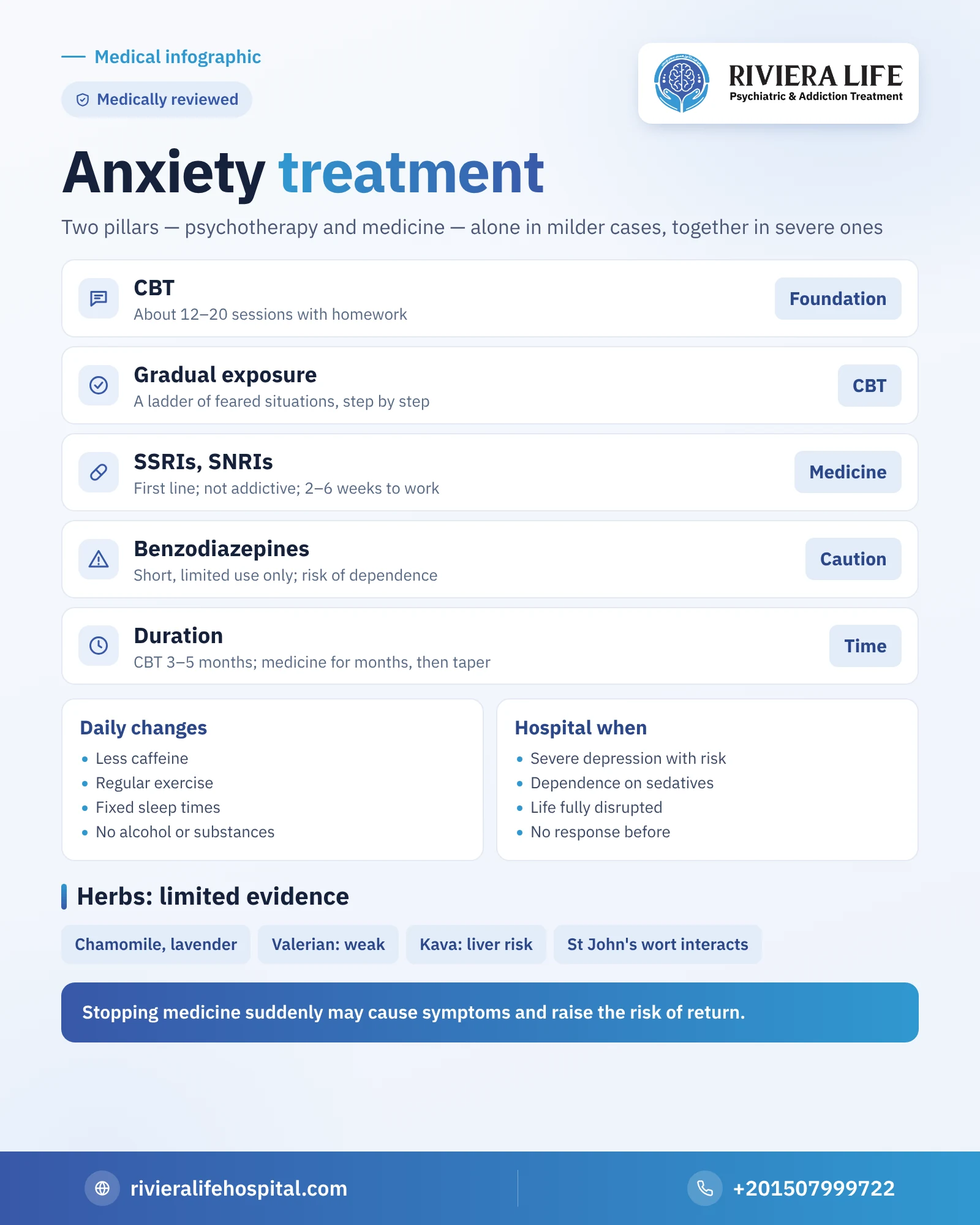
It is the most studied type of psychotherapy in anxiety disorders, and usually extends to about 12 to 20 sessions, depending on the type and severity of the disorder. It is a practical treatment with homework between sessions, not just talking about feelings. It has three main components:
Gradual exposure
The patient and their therapist build a ladder of frightening situations, from the easiest to the hardest, then face them step by step without escaping until the anxiety falls on its own. A patient who fears lifts may start by standing in front of the lift, then going in with the door open, then going up one floor. With repetition, the brain learns that the expected danger doesn’t happen.
Modifying thoughts
The patient learns to catch their automatic thoughts, such as “I’ll lose control in front of everyone”, and test them against the evidence instead of accepting them. The goal isn’t false positive thinking, but realistic thinking.
Skills to calm the body
Slow, regular breathing, progressive muscle relaxation and applied relaxation are tools that help lower physical arousal, and are used to support exposure, not replace it.
Other psychological approaches
- Acceptance and commitment therapy: trains the patient to let anxious thoughts pass without struggling with them, and to move towards what matters to them despite their presence.
- Mindfulness-based therapy: helps attention to the present moment instead of constant preoccupation with the future.
- Guided self-help and group therapy: suitable options for milder cases, or as a stage after individual therapy.
- Family therapy: important especially with children, when patterns of overprotection are part of the problem.
Anxiety medicines: the main classes
Choosing the medicine is a decision the psychiatrist makes after assessment, and it isn’t right to start or stop without their supervision. These are the most important classes used:
Serotonin reuptake inhibitors and serotonin-noradrenaline reuptake inhibitors
They are the first line in most guidelines. They don’t cause addiction, but their effect doesn’t appear immediately; improvement usually begins after about two to six weeks, and tension may rise slightly in the first days before settling. Hence a common mistake: the patient stops after a week because they “didn’t feel a difference”.
Pregabalin
Some guidelines approve it as an option for generalized anxiety disorder when the previous class doesn’t suit the patient. But it carries a risk of misuse, and it is widespread in Egypt outside the medical setting, so it needs careful follow-up. The details are in the article on pregabalin and anxiety.
Buspirone
An anti-anxiety medicine that doesn’t cause dependence, which may be used in generalized anxiety, and also needs weeks for its effect to appear.
Benzodiazepines: a short, limited role
They calm symptoms within minutes, which is why many patients ask for them. But they may cause tolerance and dependence within weeks, and difficult withdrawal when stopped. That is why guidelines limit them to short periods in specific crises. Someone who has developed dependence on them needs gradual withdrawal under medical supervision, as we explain on the benzodiazepines page.
Beta blockers
They may be used to ease physical symptoms such as tremor and palpitations in specific performance situations, but they don’t treat the anxiety itself.
When anxiety comes together with depression, the doctor chooses a medicine that suits both disorders, as the article on medication for depression and anxiety explains.
How long does anxiety treatment take?
Cognitive behavioral therapy usually extends about three to five months. As for medicine, after improvement doctors usually advise continuing it for several months, and the period may extend to about a year or more, then it is reduced gradually under the doctor’s supervision. Stopping suddenly may cause unpleasant symptoms and raises the risk of anxiety returning.
Daily changes that support treatment
- Reducing caffeine and energy drinks gradually.
- Regular physical activity, even a brisk half-hour walk most days.
- Fixed sleep and wake times, and keeping the phone away from the bed.
- Setting a short time each day for worrying instead of letting it chase you all day.
- Staying away from alcohol and substances, as they calm for hours and then increase anxiety.
When does a patient with anxiety need hospital admission?
Most patients with anxiety are treated in the outpatient clinic. But an inpatient program becomes the most suitable option in cases including: severe accompanying depression with thoughts of self-harm, dependence on sedatives, pregabalin or alcohol that needs safe withdrawal, or severe anxiety that has completely disrupted life and hasn’t responded to previous treatment attempts. Here admission provides a safe environment, daily follow-up and intensive treatment in a shorter time.
Situations that need special planning
With children and teenagers, psychotherapy usually comes first, with wide participation from parents, who learn how to encourage their child to face fears instead of protecting them from them, and medicine is only used when needed and with close follow-up. During pregnancy and breastfeeding, the doctor balances the benefits and risks of medicine with the gynecologist, and psychotherapy is preferred wherever it is enough. Older people need a review of their other medicines, and great caution with sedatives because they raise the risk of falls and confusion. Tension and irritability in women have particular hormonal causes, which we explain in the article on the causes of irritability and tension in women.
Treating anxiety with herbs: what does the evidence show?
Many turn to herbs because they seem lighter than medicines. The accurate picture is that the evidence is limited, and that “natural” doesn’t mean “safe”. Here are the best known:
- Chamomile and lavender: used as a calming drink or scent; some standardized lavender extracts have shown benefit in studies of mild anxiety, but the evidence doesn’t compare with the strength of psychotherapy.
- Valerian: used for sleep and tension, and the evidence for it is weak and conflicting.
- Kava: it has been linked to reports of liver harm in some countries, so it shouldn’t be taken without consulting a doctor.
- St John’s wort: it interacts with many medicines, including antidepressants, and may cause serotonin toxicity when combined.
So tell your doctor about any herb you take, and don’t stop a prescribed medicine to replace it with one. Herbs remain a complement, not a substitute, and moderate and severe anxiety disorders and panic attacks aren’t treated with them. To compare medication options, read medication for depression and anxiety and how the doctor chooses it, and to understand what feeds anxiety in the first place, see the causes of anxiety.
The right hospital for anxiety treatment: how to choose
The right hospital for anxiety treatment is the one that offers what a patient with anxiety specifically needs: evidence-based psychotherapy, careful prescribing that avoids reliance on sedatives, and the ability to deal with depression or addiction that may accompany anxiety. Ask before you choose:
- Does the place offer cognitive behavioral therapy and gradual exposure by trained therapists?
- Does it carry out an assessment that rules out physical causes before making a diagnosis?
- Does it deal with benzodiazepines carefully, and can it withdraw them safely for those dependent on them?
- Does it treat accompanying depression or addiction in the same plan?
- Does it involve the family and teach them how to support the patient without feeding their avoidance?
- Is there clear follow-up after the program ends to prevent relapse?
And beware of any party that promises to rid you of anxiety for good within days or with a guaranteed cure rate.
How Riviera Life meets these standards
This is what the patient and their family find at Riviera Life in practice:
- Approved license: the hospital holds a Ministry of Health license to practise psychiatry and addiction treatment.
- Extended experience: fourteen years treating psychiatric disorders, and thousands of recovered cases.
- Accurate diagnosis and measured medicine: consultants in psychiatry and addiction assess the anxiety and choose the medicine and its dose carefully.
- Treating anxiety that accompanies addiction: a program that combines treating anxiety and withdrawing sedatives or substances in one plan.
- Round-the-clock medical supervision: 24-hour follow-up for cases that need admission.
- Complete confidentiality: full privacy for the data of the patient and their family.
- The family is part of treatment: sessions that involve the family, and follow-up after leaving hospital that protects the improvement achieved.
Take the first step with a free consultation; our number +201507999722 answers you at any time, and we welcome you in Sheikh Zayed, Giza.
More from the anxiety guide
- Anxiety: the complete guide
- Anxiety symptoms
- The causes of anxiety
- Types of anxiety
- Are psychiatric medications addictive? What causes dependence and what doesn’t
- Paroxetine (Seroxat): uses, discontinuation symptoms and sexual effects
- Ways to increase GABA safely: what helps, what is exaggerated and what to avoid
- Fear of the future: why it happens and how to stop expecting the worst
- Propranolol (Inderal): physical anxiety, performance nerves and warnings
- GAD-7 anxiety test
Questions many people ask
Yes, many patients improve with cognitive behavioral therapy alone, especially in mild and moderate cases. Medicine is added if symptoms are severe or psychotherapy isn't enough.
The antidepressants used for anxiety usually need about two to six weeks for their clear effect to appear, so they aren't judged after a few days.
It may return in some patients, especially with sudden stopping of medicine or under major stress. Skills learned in psychotherapy and gradual reduction of the medicine lower this likelihood.
It belongs to the benzodiazepines, which calm symptoms quickly but may cause dependence, so they are only used for short periods by the doctor's decision, and aren't a long-term treatment for anxiety.
Choose a place that combines evidence-based psychotherapy, careful prescribing, and treatment of accompanying depression or addiction. Riviera Life in Sheikh Zayed meets these criteria: it is licensed by the Ministry of Health, with specialist consultants and round-the-clock supervision.