Social anxiety disorder is an intense, persistent fear of situations in which a person may be under the eyes of others, accompanied by a constant expectation of being criticized, mocked, or having their awkwardness shown to everyone. Its owner doesn’t hate people; they often wish to get close to them, but fear gets to every meeting before them. Over time they begin to excuse themselves from invitations, avoid calls, and turn down job opportunities that require speaking in front of a group. The good news is that it is a well-known and well-studied disorder, with effective psychological and medicinal treatment. On this page you will find a complete picture of it, with links to detailed articles on its symptoms, causes, types and treatment.
What is social anxiety disorder?
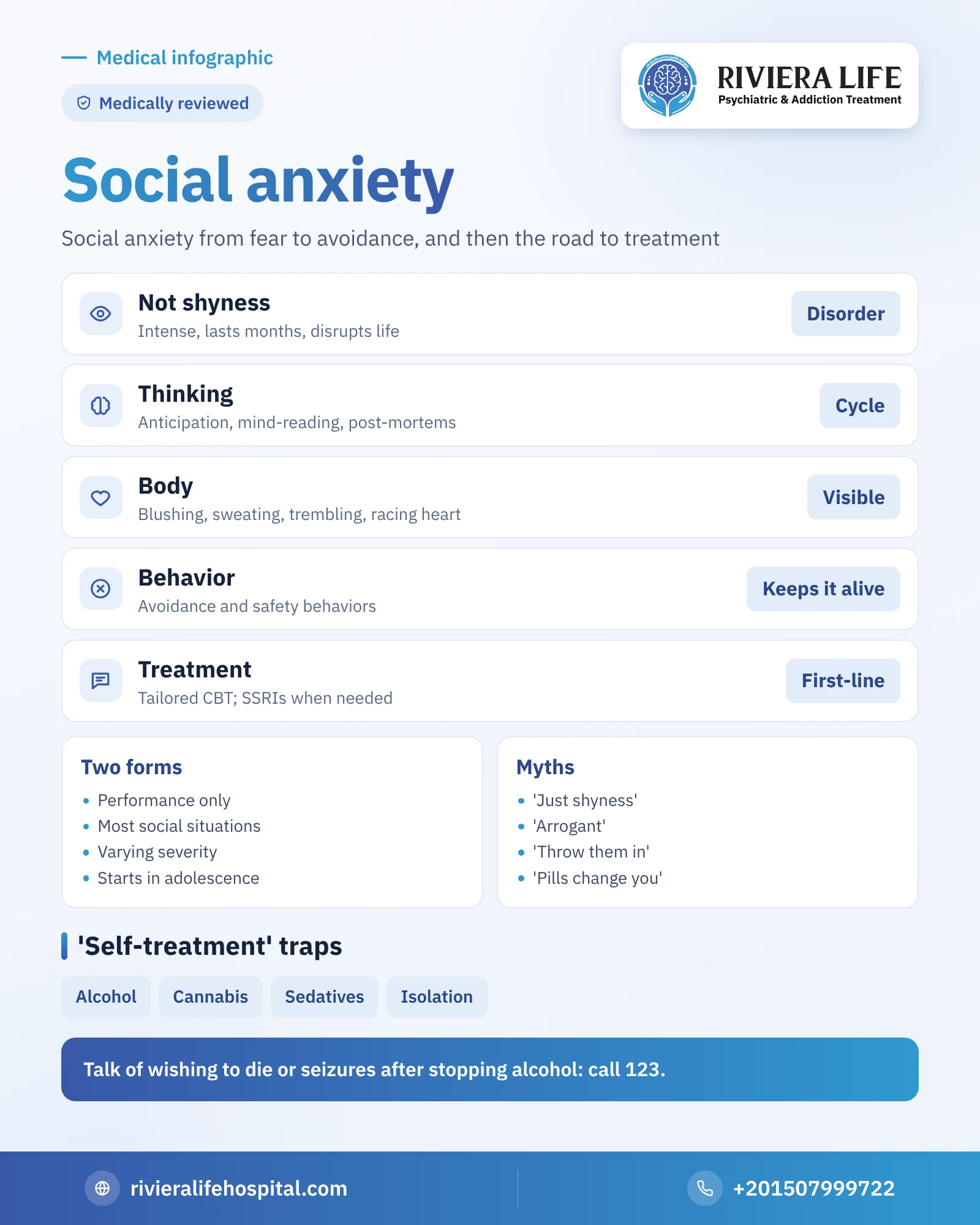
It is one of the anxiety disorders, and its core is the fear of negative evaluation. The person doesn’t fear physical danger, but fears saying something silly, or someone noticing their red face or their hand trembling as they hold a coffee cup, and judging them as weak or strange. Three things distinguish it from ordinary shyness: the intensity of the fear compared with the actual situation, its continuation for long months, and the price its owner pays in their studies, work or relationships.
Imagine an employee at a company in Cairo who knows his work well, but spends a whole sleepless night before a weekly meeting at which he is asked to give a two-minute update. He writes what he will say and memorizes it, sits near the door, avoids looking at the manager, then returns home to replay the meeting in his mind for hours, looking for every “embarrassing” word. This cycle, not the moment of tension itself, is what makes the condition a disorder.
How common is it?
Social anxiety is among the most common anxiety disorders. American estimates indicate that roughly 7% of adults meet its criteria within a single year, and that the lifetime proportion is higher than that, with figures differing from country to country according to methods of measurement. It usually begins in late childhood or adolescence, and years often pass before the person asks for help, because they think what they feel is an unchangeable temperament, or because visiting a doctor is itself a frightening social situation.
Types of social anxiety in brief
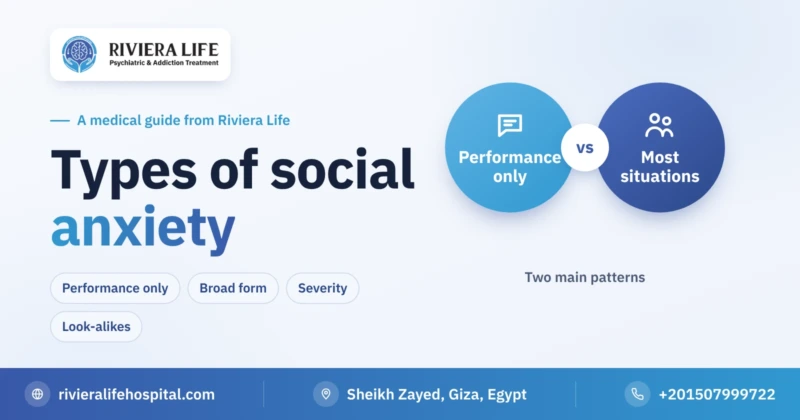
Doctors distinguish between two main forms. In the first, the fear is limited to performing in front of an audience, such as giving a speech, playing music or an oral exam, and the American DSM-5 gives it a special specifier named “performance only”. The second is wider, with the fear extending to most social situations, from talking with a colleague to eating in a restaurant. Between the two forms are varying degrees of severity. The full explanation and the differences between it and related disorders are in the article on the types of social anxiety.
The main symptoms
The signs appear on three levels. In thinking: anxiety that begins days before the situation, preoccupation with what others think, and painful analysis of every meeting after it ends. In the body: blushing, sweating, trembling, dry mouth, a racing heart, and sometimes nausea or an urgent need to use the bathroom. In behavior: outright avoidance, or attending with “safety behaviors” such as holding the phone the whole time or talking quickly to end the conversation. The detailed list and the signs in children and adolescents are in the article on the symptoms of social anxiety.
Why does it happen?
There is no single cause. Usually a genetic predisposition, a temperament that has been reserved since childhood and a brain that picks up signals of rejection with excess sensitivity come together with experiences such as bullying, public embarrassment, or a highly critical or overprotective upbringing. Then come mechanisms that keep the fear alive: avoidance that prevents the person from discovering that the situation is easier than they imagine, focusing on oneself while talking, and negative review afterwards. The details are in the article on the causes of social anxiety.
How is it diagnosed?
The diagnosis is made by a psychiatrist or psychologist, after an interview in which they ask about the frightening situations, how long ago the fear began, what the person avoids, and how this has affected their life. The diagnostic manual usually requires the fear to last about six months or more, and to cause clear distress or disruption. The specialist may use approved scales to estimate severity. They also take care to distinguish it from panic attacks, agoraphobia and depression, and to ask about alcohol and sedatives, because they often hide behind the picture.
Many think what they suffer from is ordinary shyness; the free social anxiety test clarifies when fear goes beyond the limits of shyness and deserves assessment.
Treatment: an overview
Cognitive behavioral therapy designed specifically for social anxiety is the first option in approved treatment guidelines. In it the patient learns to test their expectations in real situations, to gradually give up safety behaviors, and to direct their attention to the conversation instead of monitoring themselves. When the symptoms are severe or psychotherapy isn’t available, the doctor prescribes medicines from the category of serotonin reuptake inhibitors or related categories. Structured self-help has a supporting role at home, but it is no substitute for assessment. The details and home steps are in the article on the treatment of social anxiety.
Is social anxiety curable?
Social anxiety rarely disappears on its own if it is left for years, but it responds well to treatment in many patients. The realistic goal isn’t never to feel any tension, as tension before an important interview is normal for everyone, but for tension to return to its normal size, so that it doesn’t decide for you where you work and who you talk to. Some symptoms may return in periods of stress or with big changes such as a new job, but someone who has learned the skills of treatment knows how to deal with them before they widen.
Social anxiety and addiction
Many people with social anxiety discover, usually at an early age, that a drink or a hashish cigarette before a party makes talking easier. Here the trap of “self-treatment” begins. The relief is real but short, and the fear returns more strongly the next day, so the drink becomes a condition for any meeting. That is why disorders of alcohol and bango and cannabis use are among what most often accompanies social anxiety, and others resort to sedatives without a prescription. Someone who has both disorders needs a single plan that treats them together, because giving up the substance without treating the fear quickly returns the person to where they were.
Living with social anxiety and the family’s role
The family may be the biggest help or an obstacle without meaning to be. Phrases such as “toughen up a bit” or “people aren’t paying attention to you” seem encouraging, but they increase the person’s feeling of helplessness. On the other hand, a father answering every call on his son’s behalf, or a mother ordering food for her daughter at a restaurant, eases the moment and fixes the fear. It is more useful to ask about the step they can take this week, to praise the attempt, not the result, and to be patient with slow progress. And if the sufferer is a student, calm communication with the school or university may allow temporary arrangements that help them without isolating them.
The harms of social anxiety
Social anxiety isn’t shyness that passes with getting used to things. When it pushes its owner to avoid social situations, their world gradually shrinks, and small losses accumulate until they become a way of life.
- Study and work: avoiding participation, discussion, presentations and interviews, so professional progress is delayed despite competence.
- Relationships: few friends, declining invitations, and difficulty starting or keeping a relationship, and withdrawal may be interpreted as coldness or arrogance.
- Mood: social anxiety commonly comes together with depression and generalized anxiety, along with self-criticism after every situation.
- The body: palpitations, sweating, trembling and nausea before and during situations, and the matter may turn into panic attacks.
- Alcohol and substances: some resort to alcohol or sedatives to ease tension before occasions, so dependence adds a second problem.
- Health and learning: some avoid visiting the doctor or asking questions in class, so solutions are delayed.
Treatment gradually reverses this course, because gradual exposure to frightening situations gives the sufferer back their space. Read the symptoms of social anxiety to see whether your case is among them, and learn about the steps of treating social anxiety. And if withdrawal dominates the whole personality, the matter may be closer to avoidant personality.
Common myths about social anxiety
- It’s just shyness and will go away with marriage or work: shyness is a trait its owner lives with peacefully, while social anxiety disrupts life, and rarely disappears on its own without treatment.
- The sufferer is arrogant or doesn’t like people: usually the opposite; they want to connect but fear stops them.
- The solution is to throw them into difficult situations all at once: sudden confrontation without a plan may increase the fear, and successful treatment is based on gradual exposure agreed between the patient and their therapist.
- Social anxiety medicines change the personality: the medicines used ease the intensity of anxiety, and don’t create another person, and the doctor decides their duration and how to stop them.
The social anxiety guide: each aspect in a separate article
- Symptoms of social anxiety: the psychological, physical and behavioral signs before, during and after the situation, and when to ask for an assessment.
- Causes of social anxiety: genetics, temperament and experiences, and the cycle that makes the fear continue for years.
- Types of social anxiety: performance anxiety and the wider form, degrees of severity, and the difference between it and related disorders.
- Treatment of social anxiety: cognitive behavioral therapy and medicines, supporting steps at home, and how to choose a place of treatment.
For the wider picture of anxiety disorders and how each differs from the others, see the anxiety guide and the article on types of anxiety.
When does the matter need urgent help?
Social anxiety alone doesn’t threaten life, but long isolation may open the door to severe depression, and excess alcohol or sedatives may lead to dangerous situations. If any of the following appears, don’t wait for a clinic appointment:
Seek urgent help immediately if any of these appear
Call the ambulance on 123 or go to the nearest emergency department.
- Talk of wishing to die, self-harm, or that life has no value
- Complete isolation for days with refusal of food and not leaving the room
- Loss of consciousness, repeated vomiting or slow breathing after drinking alcohol or taking sedatives
- Severe tremor, confusion or seizures after suddenly stopping alcohol or sedatives
Someone who suffers from social anxiety can seek support and advice from the hotline of the General Secretariat of Mental Health and Addiction Treatment in Egypt: 16328 or 0220816831.
When should you ask for help?
If fear has come to decide for you where you work, who you talk to and which invitations you accept, or if you find yourself needing a drink or a pill to endure an ordinary meeting, don’t postpone the assessment any longer. At Riviera Life, the consultant psychiatrists receive you in a calm atmosphere and complete confidentiality, and put in place with you a plan that usually begins with psychotherapy sessions and outpatient follow-up, and may develop into an intensive program if behind the fear lies deep depression or attachment to a drink or a sedative. You won’t pay anything for the first consultation, and you can start with a message or a call if meeting in person is hard for you right now.
Medical sources and referencesThe information in this article is based on reliable scientific sources
1NIMH — Social anxiety disorder: what you need to knownimh.nih.gov2NHS — Social phobia (social anxiety disorder)nhs.uk3StatPearls — Social anxiety disorderncbi.nlm.nih.gov4NICE — Social anxiety disorder: recognition, assessment and treatment (CG159)nice.org.uk5APA — What are anxiety disorders?psychiatry.org