Serotonin syndrome is a toxic state that happens when serotonin builds up in the nervous system beyond what it can bear, usually because of combining two medicines or substances that raise it, such as tramadol with an antidepressant, or ecstasy with psychiatric medicines. Its symptoms usually appear within hours of starting a new medicine, raising its dose or combining two substances, and include agitation, sweating, raised temperature, tremor and muscle rigidity. Mild cases improve when the cause is stopped, but severe cases are emergencies that may threaten life. This article explains its causes and signs and when to call the ambulance immediately.
What is serotonin syndrome?
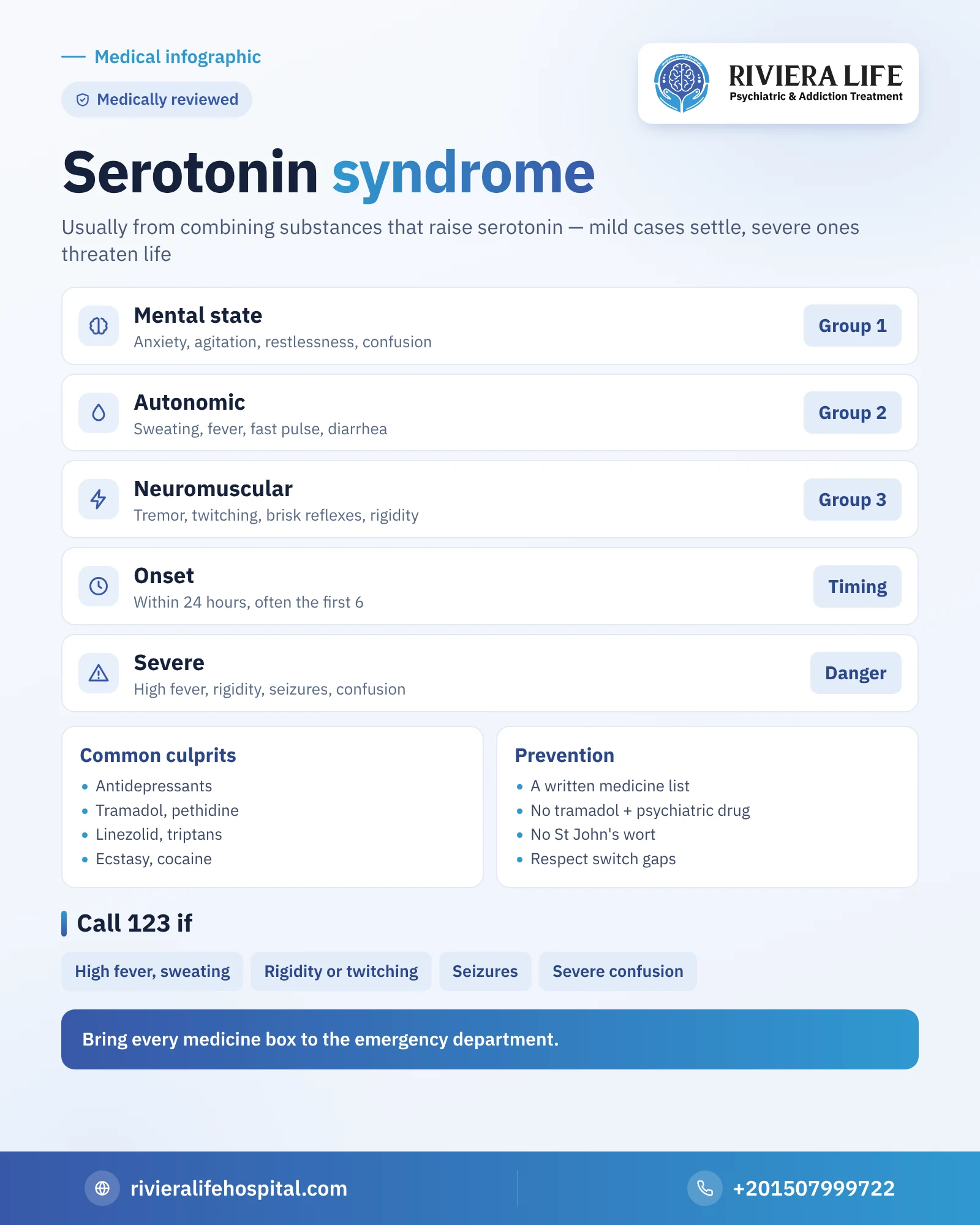
Serotonin is a neurotransmitter that regulates mood, sleep, gut movement, muscles and body temperature, as the serotonin guide explains. Normally the body controls its amount precisely: it releases it, takes it back up, then breaks it down. In serotonin syndrome these controls fail, either because more than one substance blocks its reuptake at the same time, because a substance pushes cells to release their stores, or because another stops its breakdown. The result is overstimulation of receptors in the brain, spinal cord and body, showing in three groups of symptoms: a change in mental state, disturbance of the autonomic nervous system, and overactivity of muscles and nerves.
How does it happen?
There are three common scenarios:
- Combining two or more medicines that raise serotonin, the most common cause.
- Raising the dose of a single medicine, or adding a new medicine before the previous one has left the body.
- Taking an overdose, deliberately or by mistake, of a medicine or drug that raises serotonin.
The problem is that many of these combinations happen without the patient realizing, such as a dentist prescribing a painkiller while they are taking an antidepressant prescribed by another doctor, or taking a cough medicine from the pharmacy without mentioning their medicines.
Medicines and drugs that may cause it
| Class | Examples |
|---|---|
| Antidepressants | Selective serotonin reuptake inhibitors and serotonin-noradrenaline reuptake inhibitors, tricyclics, and monoamine oxidase inhibitors |
| Painkillers | Tramadol, pethidine, fentanyl and methadone |
| Other medicines | Some migraine medicines, some anti-sickness medicines, lithium, the antibiotic linezolid, and the cough medicine dextromethorphan |
| Herbal supplements | St John’s wort, tryptophan and 5-HTP |
| Drugs | Ecstasy, cocaine, amphetamines and some hallucinogens |
A medicine being on this list doesn’t mean it is dangerous alone; most are safe at prescribed doses. The danger is in combining them without supervision, and the most dangerous combinations of all are those involving a monoamine oxidase inhibitor.
Tramadol and antidepressants: a common combination in Egypt
Tramadol doesn’t act only as an opioid painkiller; it also blocks the reuptake of serotonin and noradrenaline. When it is combined with an antidepressant that raises serotonin, the risk of the syndrome increases, along with the risk of seizures that tramadol causes on its own. In Egypt this scenario repeats in more than one form: someone using large doses of tramadol is then prescribed an antidepressant by a doctor without telling them about the use, or a patient taking an antidepressant takes tramadol tablets to ease pain or “for more energy”. So tell the doctor frankly everything you take, even substances you are embarrassed to mention. You will find wider details on the medicine’s risks in the article on the harms of tramadol.
Ecstasy and serotonin syndrome
Ecstasy pushes nerve cells to release large amounts of serotonin all at once, which is why it can cause the syndrome even without other medicines, especially with repeated doses on the same night. The risk increases when other factors come together: dancing for hours in a crowded, hot place, dehydration, or using it with an antidepressant or with other stimulants. Pills in circulation may also contain unknown substances that increase the risk. Severe overheating after ecstasy is one of the most dangerous forms of the syndrome, and may lead to muscle breakdown and kidney failure. To learn about its other effects, see the harms of ecstasy.
Symptoms: three groups
A change in mental state
- Anxiety, tension and sudden insomnia.
- Agitation, restlessness and inability to sit still.
- Confusion and disturbed consciousness in more severe cases.
Disturbance of the autonomic nervous system
- Heavy sweating and raised temperature.
- A fast heartbeat and raised blood pressure.
- Dilated pupils.
- Diarrhea, nausea and vomiting.
Overactivity of muscles and nerves
- Tremor and shaking.
- Repeated involuntary muscle jerks, especially in the legs.
- Increased intensity of reflexes.
- Muscle rigidity in severe cases.
Degrees of severity and when it starts
Most cases start within 24 hours of starting the new medicine, changing the dose or combining two substances, many within roughly the first six hours. Their severity ranges between:
- Mild: tremor, sweating, a slightly fast pulse and diarrhea, which may be wrongly interpreted as anxiety or a stomach bug.
- Moderate: raised temperature, clear muscle jerks and agitation.
- Severe: a very high temperature, muscle rigidity, seizures and disturbed consciousness, a life-threatening condition.
The danger is that the condition may move from one degree to another quickly, so don’t wait to see whether it improves on its own if fever or rigidity appears.
When should you call the ambulance?
Call an ambulance on 123 immediately if you see
After a new medicine, a higher dose, or combining tramadol or ecstasy with a psychiatric medicine, and don't give the patient any other medicine at home.
- A severely raised temperature with heavy sweating
- Muscle rigidity or repeated muscle jerks that won’t stop
- Seizures or an epileptic fit
- Severe confusion, agitation or loss of consciousness
- A very fast or irregular heartbeat
Take with you to the emergency department the boxes of all the medicines and supplements the patient took, and tell the medical team frankly about any drug they used, as this shortens diagnosis time and saves life.
How is it diagnosed?
There is no blood test that proves serotonin syndrome. The doctor relies on the clinical picture: a history of taking a substance that raises serotonin, with distinctive signs on examination such as muscle jerks, increased reflexes and fever. They order tests to assess complications such as muscle breakdown and kidney function, and rule out conditions that resemble it, most notably neuroleptic malignant syndrome, which develops slowly over days and causes rigidity with slow reflexes, and anticholinergic poisoning, which makes the skin dry rather than sweaty.
Treatment
Treatment is in hospital, and depends on severity:
- Stopping all the causative medicines and substances immediately, the most important step.
- Monitoring vital signs and giving fluids.
- Sedative medicines determined by the doctor to control agitation and jerks.
- A medicine that blocks serotonin receptors in moderate and severe cases.
- Cooling the body, and intensive care in severe cases.
Most cases improve within about 24 hours of stopping the cause, but it may last longer if the causative medicine stays in the body for a long time.
Serotonin syndrome or antidepressant discontinuation symptoms?
Many confuse the two conditions. Serotonin syndrome is caused by too much serotonin, and comes after adding a medicine or raising a dose. Antidepressant discontinuation symptoms come after stopping it suddenly, and include dizziness, sensations resembling mild electric shocks, irritability and disturbing dreams; they are unpleasant but usually not dangerous. They are prevented by reducing the medicine gradually with the doctor, not by stopping it suddenly or adding another medicine.
How do you protect yourself?
- Keep a written list of all your medicines and supplements and show it to every doctor and pharmacist.
- Don’t combine tramadol with any psychiatric medicine without the doctor’s permission.
- Don’t start supplements such as St John’s wort or tryptophan while on antidepressants.
- When changing antidepressant, keep to the gap the doctor sets, as some medicines’ effect lasts for weeks.
- Watch yourself in the first days after starting a new medicine or raising its dose.
How can Riviera Life help you?
Many cases of serotonin syndrome in Egypt have a deeper problem behind them: using tramadol or ecstasy with psychiatric medicines without supervision. After the emergency is over, the patient needs an assessment that treats the cause. At Riviera Life, consultants in psychiatry and addiction treatment review medicines safely, and set a plan for withdrawing substances under round-the-clock medical supervision, in complete confidentiality. The first consultation is free on +201507999722. And if tramadol is the problem, start by reading tramadol addiction treatment.
More from the serotonin guide
- Serotonin: the complete guide
- Serotonin deficiency symptoms
- How to increase serotonin
- Tramadol: the complete guide
- Mixing drugs: why combinations become deadly and which are most dangerous
- Neuroleptic malignant syndrome: symptoms, danger and when to call an ambulance
Questions many people ask
It rarely happens at the usual dose of one medicine, and its likelihood rises with raising the dose, an overdose, or combining more than one substance that raises serotonin.
It may raise the risk of serotonin syndrome and seizures, so they are only combined by medical decision and with follow-up, and the doctor must be told about any tramadol use.
Most cases improve within about a day of stopping the cause and treatment, and it may last longer if the causative medicine stays in the body longer.
No. Any suspicion needs medical assessment, and cases with fever, rigidity or disturbed consciousness need emergency care immediately through the ambulance on 123.
Yes, because it releases large amounts of serotonin, and the risk increases with repeated doses, heat and dehydration, or combining it with psychiatric medicines.