Oxytocin is both a hormone and a neurotransmitter, made by the brain in the hypothalamus, and it is famous as “the love hormone” because it rises with hugging, touch, breastfeeding and closeness to people we trust. But its oldest and medically clearest function is childbirth: it is what drives the uterus to contract and releases milk from the breast. This page explains how it is made and when it is released, its role in women and men, its relationship with stress, addiction and mental illness, and what research actually says, away from the widespread exaggerations.
What is oxytocin?
Oxytocin is a small peptide, meaning a short chain of only nine amino acids, partly folded into a ring. Its name is derived from two Greek words meaning “quick birth”, a description that reminds us that scientists first knew it from its effect on the uterus, decades before noticing its role in social behavior.
It works in two ways. When released into the blood, it acts as a hormone reaching the uterus, breast and other organs. And when nerve cells release it inside the brain itself, it works as a neurotransmitter and neuromodulator affecting areas of fear, emotion and reward, such as the amygdala and the reward-circuit centers where dopamine works. It has a chemically very similar “sibling”, vasopressin, the antidiuretic hormone; the two differ in only two amino acids.
Where is it made and how is it released?
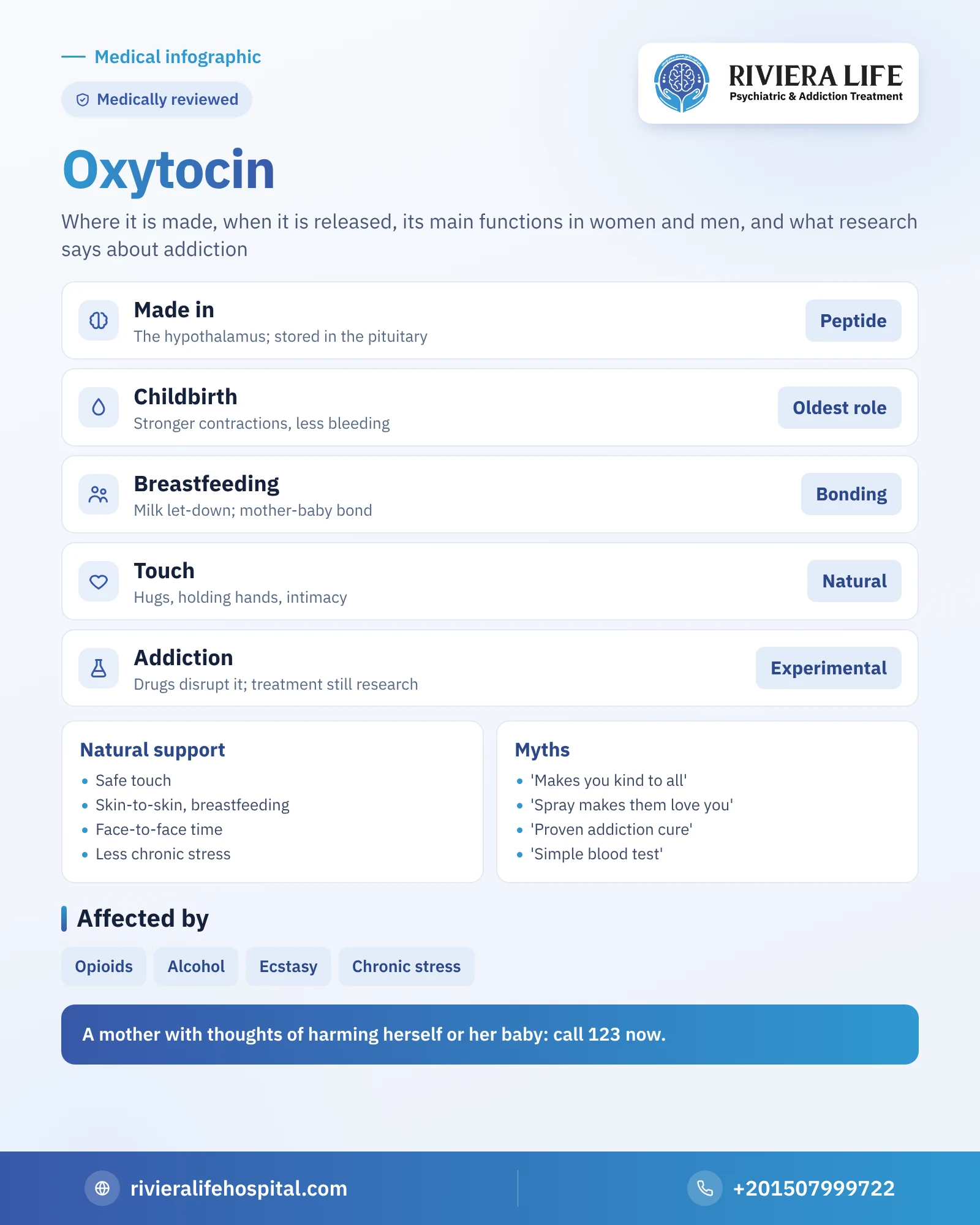
It is made by specialized nerve cells in two nuclei within the hypothalamus at the base of the brain. Then the following happens:
- It travels inside the extensions of these cells to the posterior lobe of the pituitary gland, and is stored there in small vesicles.
- When a suitable stimulus arrives, such as the pressure of the baby’s head on the cervix or the infant suckling at the breast, the gland releases its store into the blood.
- At the same time, other cells release oxytocin directly inside the brain, reaching areas of emotion and social behavior.
- It binds to its own receptors spread across the uterus, breast, heart and brain, then breaks down quickly; its lifetime in the blood is a matter of minutes.
Its release in childbirth has a special character: each contraction increases the pressure on the cervix, so more oxytocin is released, so the next contraction becomes stronger. This “positive loop” is rare among hormones, and stops only when the baby is born.
The main functions of oxytocin
- Childbirth: it strengthens and regulates uterine contractions, and helps the uterus shrink after birth, which reduces bleeding.
- Breastfeeding: it causes what mothers call “let-down”, pushing milk from the glands to the nipple during feeding, while another hormone, prolactin, handles making the milk itself.
- Bonding: it takes part in forming the bond between mother and infant, and in attachment between partners, according to many studies, most of them in animals.
- Trust and reading emotions: human studies indicate it may increase attention to faces and their expressions, with varying results between studies.
- Calming stress: it is believed to ease the activity of the stress axis that releases cortisol, and to calm the amygdala’s response to danger.
- Other functions: it takes part in the feeling of fullness, and in sexual response and orgasm in both sexes.
When is oxytocin released?
Oxytocin rises in situations united by physical or emotional closeness:
- During childbirth, every time the baby feeds, and with skin-to-skin contact between mother and newborn.
- With warm touch: hugging, holding hands and massage.
- During intimacy, peaking with orgasm.
- In positive social interaction, such as a reassuring talk with a trusted person or parents playing with their children.
- And in some cases of acute stress, as if it were the body’s attempt to push a person to seek support.
Chronic stress and long isolation, however, are linked in research to disruption of this system, although it is difficult to measure this precisely.
Oxytocin in women and men
In women, oxytocin is directly linked to the stages of pregnancy, childbirth and breastfeeding, and takes part in building the bond with the baby in the first weeks. Research is studying the link between its disruption and postnatal depression and breastfeeding difficulties, without results so far that allow it to be used in diagnosis.
In men its presence is no less important; it takes part in erection and ejaculation, and rises with closeness to a partner and with caring for children. Studies indicate that fathers who spend more time playing with their children show responses linked to it. As for the lists spreading online under the title “symptoms of oxytocin deficiency in men”, such as difficulty attaching, isolation and stress, these are general symptoms with many causes, and there is no approved clinical test that measures oxytocin to diagnose a deficiency in a healthy person.
Oxytocin, endorphins and dopamine: what is the difference?
| Substance | Its most prominent role | When it rises |
|---|---|---|
| Oxytocin | Bonding, trust, childbirth, breastfeeding and calming stress | Touch, closeness and breastfeeding |
| Endorphins | Pain relief and a feeling of relief | Physical exertion, laughter and pain |
| Dopamine | Motivation, seeking reward and learning from it | Anticipating reward and achievement |
| Serotonin | Mood stability, sleep and impulse control | Daylight and regular habits |
These substances work together, not alone; oxytocin, for example, affects the release of dopamine within the reward circuit, which partly explains why the company of those we love feels “rewarding”.
Oxytocin and addiction
Researchers are interested in oxytocin in the field of addiction for two reasons. The first is that drugs tamper with its system: opioids, including heroin, suppress its release from the pituitary gland, and alcohol weakens its release, while ecstasy raises it strongly, which is believed to be behind the artificial feeling of closeness to strangers that its users describe. The second is that addiction strikes social life at its core; the user gradually loses the relationships that gave them support and calm, and the drug takes their place.
Animal experiments have shown that giving oxytocin may reduce drug-seeking and withdrawal symptoms, but human trials are still small and their results conflicting, and oxytocin has not been approved anywhere as a treatment for addiction. The details and the limits of the evidence are in the article Oxytocin and addiction.
Oxytocin and mental illness
Oxytocin has been tried as a nasal spray in research on autism spectrum disorder, schizophrenia, social phobia and post-traumatic stress disorder, in the hope of improving social communication or easing fear. Early results were encouraging, but larger and more precise later studies did not confirm a clear benefit in many of them, including a large trial in children with autism that found no meaningful difference from placebo.
So its use in psychiatry remains experimental, while the approved treatments for these disorders remain psychotherapy and the medicines the doctor determines. Disrupted relationships and isolation are also linked to the risk of depression, and here the role of oxytocin overlaps with many factors that cannot be separated.
How can you support oxytocin naturally?
It doesn’t need supplements or sprays; the natural stimulants are known, although the strength of the evidence varies:
- Safe touch: hugging family members, holding hands and massage, which are among the clearest stimulants in studies.
- Skin-to-skin contact between mother and newborn and breastfeeding, whose benefits for mother and baby are proven for many reasons.
- Real time with friends and family, and talking face to face, not only through screens.
- Helping others and volunteering, and group activities such as singing or team sports, with weaker but encouraging evidence.
- Reducing chronic stress and regulating sleep, because they improve the environment in which all brain systems work.
- Some studies indicate it rises with stroking pets; the evidence here is preliminary.
Medicines and substances that affect oxytocin
The established medical use of synthetic oxytocin is in maternity units: it is given by injection under medical supervision to induce or strengthen labor, and to prevent and treat postpartum hemorrhage, and the World Health Organization considers it the first choice for this purpose. It is a powerful medicine that may cause excessive contractions if given incorrectly, so it is used only in hospital. As for the sprays sold online as “increasing love and trust”, there is no approved basis for their use, and their quality and content are not guaranteed.
Among the substances that affect it: opioids, which suppress its release; alcohol; and ecstasy, which raises it temporarily and then leaves the user in a mood crash, as well as research on various psychiatric medicines that has not reached conclusive results.
Common myths about oxytocin
Myth: oxytocin is “the love hormone” and makes a person kind to everyone. The truth is that its effect depends on context; some studies indicate it may strengthen bias toward one’s close group and wariness of strangers, not unconditional love.
Myth: oxytocin spray makes the other person trust you or love you. The truth is that the early studies on trust have not been consistently replicated, and no medicine creates real feelings.
Myth: oxytocin is a proven treatment for addiction or autism. The truth is that it is still under research, and its results in humans are conflicting so far.
Myth: a simple blood test reveals an oxytocin deficiency. The truth is that measuring it in the blood is difficult and fluctuating, does not reflect its activity inside the brain, and is not used to diagnose any mental disorder.
The oxytocin guide: each aspect in its own article
We devote separate articles to the questions that need detail, the first of which is:
- Oxytocin and addiction: how drugs tamper with the brain’s bonding system, what research says about its use in treatment, and what is actually available today.
The picture is completed by related articles from the other brain chemistry guides: Dopamine and addiction on the reward circuit, How to lower cortisol on chronic stress, and How to increase serotonin on the habits that support mood.
When should you see a doctor?
No one needs to see a doctor because of an “oxytocin deficiency” in itself, but there are things that deserve assessment: intense sadness or anxiety after childbirth that prevents the mother from caring for herself or her baby, isolation and withdrawal from people lasting weeks, repeated difficulty building relationships that causes suffering, or substance use that has replaced relationships and support.
And if a mother has thoughts after childbirth of harming herself or her baby, this is an urgent situation that calls for contacting emergency services on 123 immediately. At Riviera Life, the hospital licensed by the Ministry of Health in Sheikh Zayed, Giza, consultant psychiatrists and addiction specialists assess these cases in complete confidentiality, and the first consultation is free on +201507999722.
Medical sources and referencesThe information in this article is based on reliable scientific sources