No one starts using ecstasy intending to become addicted to it; the causes of ecstasy addiction form gradually, and the first is usually a pill at a party taken out of curiosity or a desire to belong to a group, then the person discovers a feeling of closeness and release they never knew before. The shift to addiction doesn’t happen to everyone, and happens more slowly than with cocaine or ice, but it happens when the nature of the substance meets the person’s circumstances, psychology and environment. Here we explain why some return to the pill again and again, who is most at risk, and what protects.
What does ecstasy give at first?
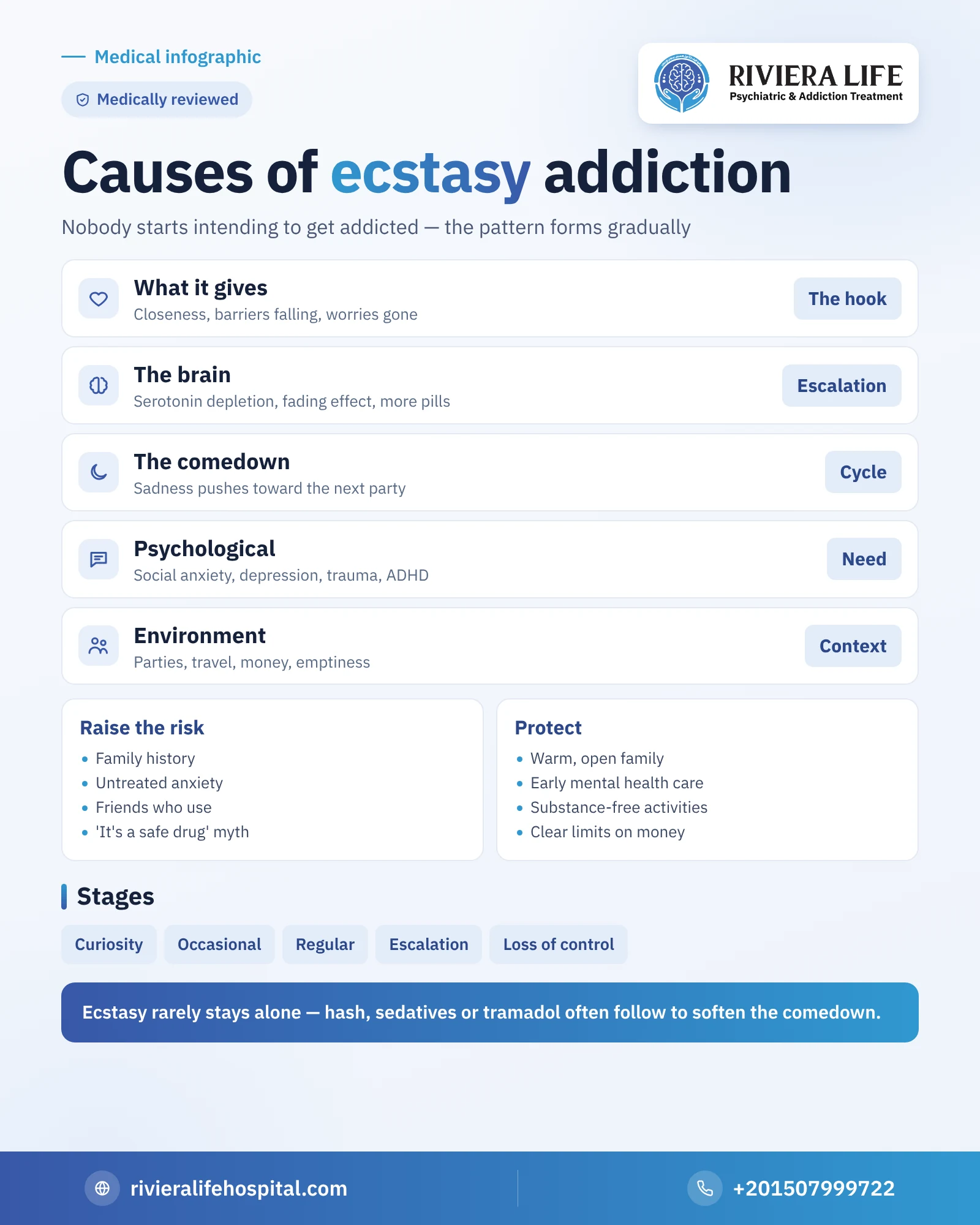
To understand the causes of addiction we must first understand what the person finds in the substance. Ecstasy doesn’t only give euphoria, but gives a feeling that the barriers between the person and others have fallen. The shy young man finds himself talking fluently, someone carrying heavy worries feels for hours that they have disappeared, and someone who feels lonely senses that they are surrounded by friends who love them. This social and emotional effect is what distinguishes it from many drugs, and it is also the key to understanding the reason for returning to it: the person isn’t looking for the substance so much as for the feeling that became linked to it.
From experiment to addiction: how does it develop?
The usual path doesn’t jump from the first experiment to addiction, but passes through stations that can be noticed:
- Curiosity: a pill on a special occasion, usually with friends who tried it before.
- Occasional use: returning to it only at parties and trips, with a conviction that the matter is under control.
- Regularity: parties turn into a fixed appointment, and planning them becomes part of the week.
- Escalation: the decline of the effect pushes toward more than one pill a night, or adding other substances.
- Loss of control: continuing despite depression and decline in study and work, and failed attempts to stop.
What happens in the brain?
Ecstasy pushes nerve cells to release huge amounts of serotonin, and with it a measure of dopamine, the transmitter linked to reward and learning. Dopamine records in memory that this place, this music and these friends were linked to a wonderful feeling. Over time these same elements become triggers, so merely hearing a certain type of music or seeing party photos may awaken the craving.
On the other hand, each use depletes the store of serotonin, and the brain needs days to rebuild it. If the occasions come close together before it recovers, the euphoric effect weakens, so the person raises the amount, which increases the depletion. This loop is what users call “losing the magic”, and it is among the most important causes of escalation.
The comedown itself is a reason to return
The days following use are full of sadness, anxiety and exhaustion. Some young people don’t link these feelings to the pill, but think their ordinary life has become gloomy, and that the solution is the next party. And so ecstasy becomes a temporary treatment for a problem it made itself. The details of this stage are in the article on ecstasy withdrawal symptoms.
Psychological motives
Many who cling to ecstasy have a psychological need that preceded it. Among the most prominent things doctors notice:
- Social anxiety and severe shyness, so the pill becomes a means of communicating with others.
- Depression or a feeling of emptiness and loss of meaning.
- Difficult experiences or old untreated trauma.
- ADHD, and the impulsivity and thrill-seeking that accompany it.
- Low self-esteem, and a strong need for acceptance by the group.
Treating these disorders is an essential part of recovery, not a side matter.
Genetics and biological predisposition
Research indicates that an important part of a person’s susceptibility to addiction in general is inherited, so someone whose father or brother suffered from addiction to any substance is more at risk. People also differ in traits such as thrill-seeking and impulsivity, traits that have a biological basis. But genetics is a predisposition, not an inevitable fate; it raises the risk and doesn’t impose it.
Environment: parties, travel and money
Environment in the case of ecstasy has special weight, because the substance is linked to places and seasons. In Egypt, in many people’s minds it is linked to electronic music parties, nights at summer resorts, and groups of young people who have money and travel. Friends who use, the availability of the substance in the place, and the absence of family supervision on a long trip all make refusal harder. Added to this is what some platforms publish of images linking the pill to fun and freedom without any mention of emergencies.
Emptiness is no less important than friends. Long holidays without organized activity, the years after graduation before settling in a job, and moving to a new city to study are all periods in which the young person looks for excitement or belonging. On the other hand, the pressures of exams or work may push some to see the party as an indispensable weekly reward. When the only available entertainment is linked to the pill, use turns from a passing choice into part of the social identity, and stopping it becomes like losing friends and enjoyment together, which is what makes it hard.
The myth of the safe substance
One of the strongest reasons for continuing is a common belief that ecstasy is a “clean substance” that causes neither addiction nor harm compared with heroin or ice. This belief makes the person ignore the first warning signs, and mix the pill with alcohol or others without caution. The truth is that the pill may contain other substances, and that its harms to temperature, the heart and mood are proven, as explained in the article on the harms of ecstasy.
From ecstasy to other substances
Rarely does the matter stop at ecstasy alone. To ease the comedown some turn to hash, sedatives or tramadol, and to prolong the night they may add other stimulants. Over time the stronger dependence may become on the accompanying substance, not on ecstasy itself. That is why the medical assessment cares about everything the person uses, not the pill alone.
Starting at an early age
The brain continues to mature until about the mid-twenties, and the areas responsible for controlling impulsivity and planning are the last to be completed. That is why the younger the age at which use begins, the greater the chance it turns into a disorder later. And the university stage, with its sudden freedom and sometimes distance from home, is among the most sensitive periods.
Risk factors and protective factors
| Factors that raise the risk | Factors that protect |
|---|---|
| A family history of addiction | A warm relationship and open dialogue with the family |
| Untreated anxiety or depression | Diagnosing and treating mental disorders early |
| Friends who use and frequent parties | Friends and activities not linked to substances |
| Plenty of money without follow-up | Clear limits and reasonable follow-up of pocket money |
| A belief that the substance is safe | Correct information about its real risks |
| Starting use at an early age | Delaying any experiment as much as possible |
How do you protect your children?
Protection doesn’t mean absolute prevention from going out, but means that your son knows you are a safe source of information and help. Talk with him before the season of parties and trips about unknown pills and what they may contain, and about cases of high temperature, without exaggeration or long lectures. Know his friends, and set a clear agreement about return times and staying in touch. And if you notice a change in mood after every night out, review the signs explained in the article on ecstasy addiction symptoms before you confront him.
And if the psychological causes are clear, such as anxiety or depression, treating them early with a psychiatric consultant may prevent the development of use in the first place. At Riviera Life the first step begins with a free and confidential consultation with the psychiatry and addiction treatment team, and the full stages of the plan are in the article on ecstasy addiction treatment.
More from the ecstasy guide
- Ecstasy: the complete guide
- Ecstasy addiction symptoms
- The harms of ecstasy
- Ecstasy addiction treatment
Questions many people ask
No, most who try it don't reach addiction, but a proportion of them lose control. The risk rises with repetition, mixing with other substances, and the presence of anxiety, depression or a family history of addiction.
Because the euphoric effect weakens quickly with repeated use and depletion of serotonin. So they try to make up for it by increasing the amount, which increases the harm and the risk.
It may, because the substance gives for hours a feeling of ease with people, so those suffering from severe shyness become attached to it. Treating the anxiety itself reduces this need.
Both have an effect. Genetics gives a predisposition, and the environment of friends, parties and availability of the substance largely determines whether this predisposition will appear or not.
With an open conversation before party seasons, knowing his friends, clear limits on pocket money and return times, and treating any anxiety or depression early.