The short answer
No one becomes addicted for a single reason. Vulnerability is shaped by several factors meeting in the same person: a genetic and biological predisposition that makes their brain more affected by the substance, psychological pressures such as anxiety, depression or an old trauma that make the drug a quick painkiller, an environment that provides the substance and makes it acceptable, and then the nature of the substance itself and how fast it acts. The more these factors pile up, the higher the risk, while a warm family relationship, delaying the first experience and treating psychological problems early lower it.
- Accumulating factorsA single cause is rarely enough
- About half of vulnerabilityExplained by genes, according to NIDA estimates
- Age at first useThe later the first try, the lower the risk
The causes of addiction are the first thing a mother asks about when she discovers her son is using: "Where did we go wrong?" The honest answer is that the matter is rarely one person's fault. On this page we take the picture apart into its layers: the motives behind the first experience, the share of genetics and the body, psychological wounds, the effect of home, street and friends, and why it differs from one substance to another, then we set out what actually protects and end with a guide to all the articles in the section.
What are the causes of addiction in brief?
Doctors deal with the causes of addiction through what is called the biopsychosocial model. The idea is that there are three overlapping circles: the body, with its genes, brain chemistry and age; the mind, with its feelings, temperament and experiences; and the surroundings, with family, friends and the availability of the substance. A fourth factor relating to the substance is added: its price, how easy it is to get, and how fast it reaches the brain.
Imagine three young men in the same neighborhood who tried hash on the same night. The first didn't repeat it because his father is close to him and they talk a lot. The second repeated it on holidays then stopped when he got busy with his work. The third had suffered from social anxiety since middle school, and in his family there was an uncle addicted to alcohol, so he found in the substance a relief he had never known before. The experience was the same, and the result was completely different because the other circles were different, and this is the core of understanding the causes of addiction.
Why does a person try a drug for the first time?
The motive to try is not one of the causes of addiction in its full sense, but it is the door that opens first. Particular motives recur in psychiatric clinics:
- Curiosity and the wish to belong: a teenager wants to be "one of the gang", and refusing seems harder to him than trying.
- Escaping distress: sadness after a breakup, the pressure of final secondary-school exams, or long unemployment after graduation.
- Improving performance: a stimulant pill to stay up studying, or a stimulant to endure long work shifts.
- A medical prescription: a painkiller after surgery or a sedative after a panic attack, then use continues without review.
- Boredom and idleness: long time with no goal and no activity, especially in the holidays.
After the first try, the brain takes care of the rest: the substance releases a strong burst of dopamine, so the brain records it as an experience worth repeating. We won't expand on this mechanism here, as we have explained it in the general guide to the concept of addiction and in the article Dopamine and the reward system.
Is addiction hereditary?
Genetics is one of the strongest known causes of addiction, but it passes on vulnerability, not the illness. The US National Institute on Drug Abuse (NIDA) estimates that genetic factors explain roughly between forty and sixty percent of a person's predisposition to addiction, including the effect of the environment on how these genes work. This means that the son of an addicted father is more at risk than others, but he is not destined for the same fate.
Addiction is not inherited through "a single gene", but through dozens of small genes that affect how the brain receives the substance, how fast it is broken down in the liver, and traits such as impulsivity and sensation-seeking. A child who grew up with an addicted parent is also affected by the chaos and tension he saw at home, which the article When the father is an addict covers. And for those asking about heredity in mental illness generally, the article Is mental illness hereditary? will help.
The body and age: biological factors
The most important biological factor that can be controlled is age at first use. The maturation of the brain's frontal cortex, the area of judgment and restraining impulses, continues until roughly the mid-twenties, while the reward system is at the peak of its activity during adolescence. This gap makes the young brain highly responsive to the substance and weak in its brakes at the same time, which is why NIDA stresses that starting early raises the risk of addiction later.
There are other factors, including chronic pain, which opens the door to painkillers, sleep disorders, which push toward sleeping pills, and differences between the sexes in how fast dependence develops with some substances. These factors do not create addiction alone, but they bring the substance closer to the person, and they often appear when reviewing the causes of addiction in older people and the chronically ill.
Psychological factors: when the substance becomes a painkiller for inner pain
Psychological wounds occupy a prominent place among the causes of addiction. Many patients describe their first use as "the first time I felt calm". This sentence explains a lot. A person who carries constant anxiety, a sadness they can't name, or traumatic memories from childhood finds in the substance a quick painkiller. The problem is that after a while the painkiller turns into a new source of pain.
Among the traits that increase the risk are impulsivity and difficulty postponing a desire, constantly seeking excitement, low self-confidence, and difficulty expressing feelings in words. This raises a frequently repeated question about whether there is a personality predisposed to addiction, which we have discussed in a separate article in the guide below. Psychological trauma deserves special attention, and the article Psychological trauma and its effects explains it.
The mental disorder first, or the drug use?
The doctor faces this chicken-and-egg question every day. NIDA explains that mental disorders and addiction often occur together in the same person, and that the relationship between them runs in both directions.
When the mental disorder comes first
- Social anxiety calmed with alcohol or sedatives
- ADHD not treated in childhood
- Depression faced with stimulants
- An old trauma numbed with opioids
When drug use comes first
- Stimulants that trigger episodes of psychosis or paranoia
- Hash that brings forward psychosis in those predisposed to it
- Repeated withdrawal that breeds depression and anxiety
- Chronic sleep disturbance that opens the door to mood disorders
In both cases, treating one side doesn't work, and the co-occurring disorder is one of the causes of addiction that is discovered late. That is why you will find articles on the site covering each disorder in its relationship with drug use, such as ADHD and drug use, Anxiety and addiction, PTSD and addiction and Social phobia and drug use. The two sides are treated together within the dual diagnosis program.
Environment, family and friends
The home is the first and strongest environment, which is why the discussion of the social causes of addiction starts there. Lack of dialogue, excessive harshness, permissiveness without rules, or drug use or violence within the family all raise the risk. Added to this outside the home are friends who use, bullying at school, long idleness, easy access to the substance in the neighborhood, and the normalization of drug use in songs, series and social media.
Economic and social pressures are no less important: a young man working exhausting night shifts, an expatriate living alone in a new city, or a woman carrying the burdens of the home alone. Here pills may become a way of "getting through the day". The article Psychological stress and its effect helps with this side.
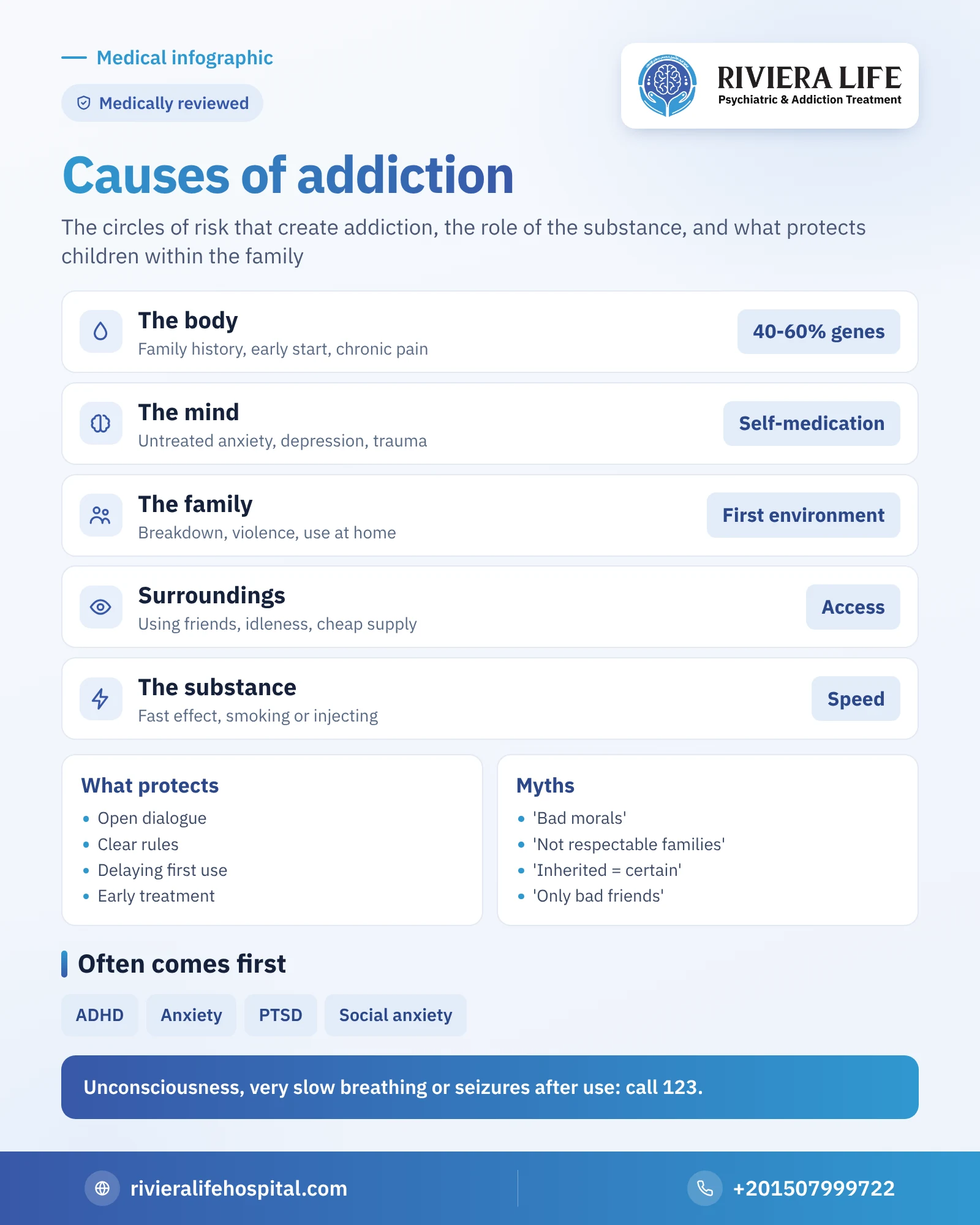
The causes of addiction and protective factors in one table
The following table helps the family assess its position calmly. A risk factor doesn't mean addiction is coming, and protective factors don't guarantee absolute safety, but they tip the balance.
| Area | What raises the risk | What lowers it |
|---|---|---|
| The body | A family history of addiction, an early start, chronic pain | Delaying the first try, treating pain under a doctor's supervision |
| The mind | Untreated anxiety or depression, trauma, severe impulsivity | Early diagnosis, skills for coping with stress, self-confidence |
| The family | Breakdown, violence, drug use at home, absent supervision | A warm relationship, clear rules, calm attention to friends |
| Surroundings | Friends who use, idleness, the substance being available and cheap | Sport and hobbies, supportive friends, an academic or career goal |
| The substance | Fast effect, smoking or injecting, unknown mixtures | Honest knowledge of its risks, difficult access to it |
Why do teenagers fall into drug use faster?
Adolescence is by nature a stage of experimentation, and to this are added a brain that hasn't finished maturing, high sensitivity to friends' opinions, and mood swings explained in Psychological changes in adolescence. A sixteen-year-old weighs risk differently from his father, not because he is less intelligent, but because the reward of the moment drowns out the voice of consequences at this age.
Among the signs that deserve parents' attention are a sudden change of friends, a decline in grades, long isolation in his room, and asking for money without explanation. The practical details of dealing with this age are in the teen addiction article in the guide, and in the treatment program for students and adolescents.
Why do the causes of addiction differ from one substance to another?
The causes of addiction differ by substance because each substance attracts a different kind of motive. Tramadol begins for many as a painkiller for fatigue in hard work, pregabalin may be prescribed for nerve pain and then misused, stimulants are linked to staying up, studying and weight loss, and synthetic cannabinoids spread because of their low price. How much the substance itself adds to the risk also differs, as the following indicator shows.
Opioids and heroinRapid dependence
Ice and cocaineStrong craving
Synthetic cannabinoidsCheap and unpredictable
Sedatives and sleeping pillsOften start with a prescription
HashMost dangerous with an early start
This indicator is approximate, for awareness, and personal vulnerability remains a decisive factor. You will find an article dedicated to the motives for each substance in the article guide below.
And what about the internet, the phone and games?
The causes of behavioral addiction resemble the causes of substance addiction: escaping loneliness or anxiety, intermittent rewards carefully designed by the app, and long idleness. Because this subject has its own section, we refer you to the behavioral addiction guide and the article Compulsive attachment to the phone.
Myths about the causes of addiction
Common beliefs
- An addict is a person of bad morals from the start
- Children of respectable families don't become addicted
- Someone with an addict in the family will inevitably become addicted
- The only cause is bad friends
What research says
- Addiction is an illness that affects people of every temperament
- It happens at all social and educational levels
- Genetics raises the risk but doesn't settle it
- Friends are one factor among many intertwined factors
The most painful myth is for parents to load themselves with the entire blame. Knowing the causes of addiction aims at the right intervention, not at looking for someone to accuse.
What actually protects against addiction?
Just as the causes of addiction accumulate, protection accumulates too; it is not a single wall, but small layers that build up over the years. These are the most effective in our experience with families:
1
Open dialogue
A home where the son can talk about his pressures without being put on trial.
2
Clear rules
Known limits on going out, pocket money and staying up, applied calmly and consistently.
3
Delaying the first try
Every year that passes before first use gives the brain maturity and protection.
4
Early treatment
Diagnosing anxiety, depression and ADHD before they go looking for a painkiller.
5
Healthy alternatives
Sport, hobbies and friends who fill the emptiness with meaning.
For practical steps by your children's age, read the drug prevention guide. And if drug use has already started, recognizing the signs the family notices is the next step.
When does it become an emergency?
Understanding the causes of addiction is calm work that takes its time, but some situations can't wait for analysis.
Don't wait in these situations
Call the ambulance on 123 immediately if you notice:
- Loss of consciousness or difficulty waking after use
- Very slow breathing or blue lips
- Seizures, or agitation with hallucinations
- Talk of self-harm or wanting to die
- For psychological support: the hotline of the General Secretariat of Mental Health and Addiction Treatment, 16328
The causes of addiction article guide: the motives and risk factors for each substance
We have arranged the section's articles by substance family, after a general axis on personality and adolescence. Start with the substance that concerns your family.
Personality and adolescence
2 articlesWho is most at risk, and why
- Is there an addictive personality?: what research says about risk traits and what is exaggeration.
- Why teenagers use drugs: the reasons they fall quickly and how parents can protect them.
Opioids and painkillers
4 articlesFrom pain and the prescription to dependence
- The motives for opioid use: why it starts and why stopping is hard.
- The factors behind falling into heroin: why dependence develops faster in some people.
- Morphine after the medical prescription: how dependence begins and its risk factors.
- Why tramadol spreads among workers and young people: risk factors and ways of prevention.
Stimulants
4 articlesStaying up, performance and a quick high
- Shabu and crystal: why some ice users become addicted faster than others.
- The factors behind attachment to cocaine: how recreational use turns into addiction.
- Amphetamine, studying and work: the psychological and social motives and a prevention guide.
- Captagon pills: why use begins and why it is hard to give up.
Hash, bango and marijuana
3 articlesWhy "the mood" turns into dependence
- The motives for smoking hash: how it turns from an evening out into a daily need.
- Bango and its low price: why use turns into dependence.
- Marijuana risk factors: why some become addicted to it and not others.
Synthetic substances and cheap mixtures
7 articlesUnknown formulas and unpredictable effects
- The spread of strox among young people: the psychological and environmental factors and ways of prevention.
- Spice and its low price: why use begins and how it repeats.
- The causes of shadow drug addiction: why some fall into it faster than others.
- Voodoo and risk factors: how psychological pressures and the environment increase the likelihood of use.
- Chemical and repeated use: the psychological and social causes behind it.
- The causes of bouffa addiction: the psychological, biological and environmental factors that raise the risk.
- Flakka among young people: why some fall into it faster than others.
Parties and hallucinogens
3 articlesFrom a try at a party to repetition
- Ecstasy pills at parties: how a party pill turns into addiction.
- The motives for ketamine use: risk factors and how to understand them.
- The causes of paper drug addiction: the psychological and social motives and risk factors.
Sedatives, medicines and alcohol
4 articlesWhen the road starts at the pharmacy or the glass
- Pregabalin and its risk factors: what raises the likelihood of misuse and how to protect yourself.
- Lyrolin from the prescription to dependence: why the medicine turns into an addiction.
- Sedatives from the benzodiazepine family: the motives for use and the risk factors.
- Why some people become addicted to alcohol: the psychological, genetic and social factors.
When should you seek help?
If you recognized yourself or one of your children in some of what you read, don't wait for the picture to be complete. An early consultation uncovers your causes of addiction and risk factors and treats them before they turn into dependence, and helps the family act with confidence instead of fear. At Riviera Life in Sheikh Zayed, licensed by the Egyptian Ministry of Health, consultant psychiatrists have worked for fourteen years in complete confidentiality, and the first consultation is free. Call us on +201507999722.
Medical sources and referencesThe information in this article is based on reliable scientific sources