Ecstasy addiction treatment is possible and its results are usually good, especially when it starts early. Treatment doesn’t rely on a magic medicine, as there is still no medicine approved specifically for this addiction, but on a plan combining careful assessment, safe management of the weeks of depression and anxiety after stopping, behavioral therapy that changes the person’s relationship with parties and triggers, and treatment of any psychiatric disorder that was pushing them towards the pill. This article explains the stages of treatment, the role of medicines, the expected duration, and how to choose the right hospital.
What we present here covers treating addiction to ecstasy under all its circulating names, including MDMA and “molly”, because the active substance is the same.
Does ecstasy addiction need specialist treatment?
Many think ecstasy is a “party substance” that a person only needs to decide to stop to get rid of. This is true for some who have tried it a few times. But someone who has reached regular use, increasing the number of pills and mixing with other substances, or has started living through successive days of comedown, needs a real treatment plan. Relapse is common when the person is left alone with post-stopping depression and with the same friends and seasons. The signs of this stage are explained in the article on ecstasy addiction symptoms.
The stages of ecstasy addiction treatment
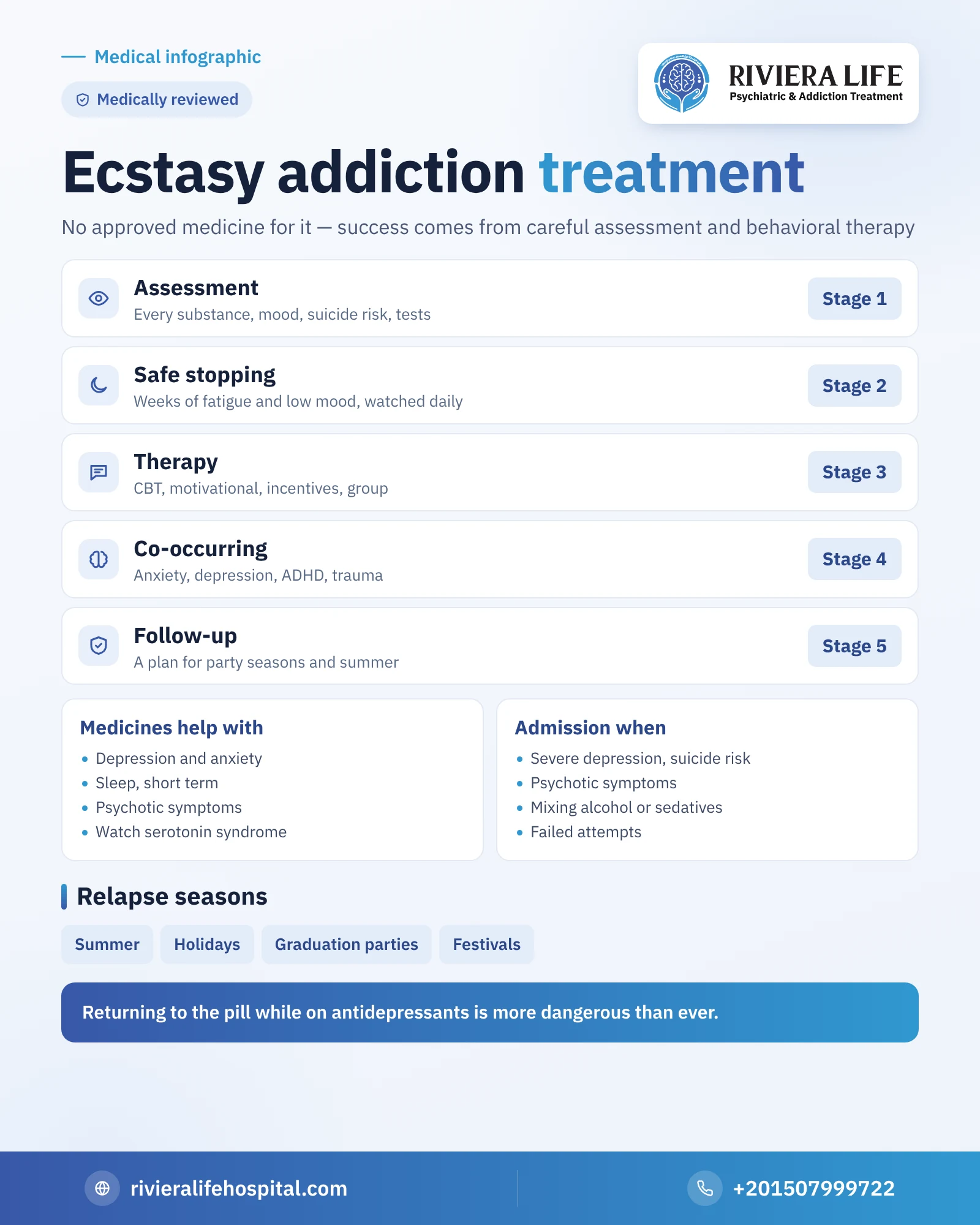
Good treatment usually passes through five successive stages, which sometimes overlap depending on the case:
- Comprehensive assessment: a psychological and medical interview and tests to identify all the substances used and the physical and mood state.
- Safe stopping: getting through the first weeks with monitoring of mood, sleep and the risk of self-harm.
- Psychological and behavioral therapy: understanding motives and building skills that replace the pill.
- Treating accompanying disorders: anxiety, depression, hyperactivity and the effects of trauma.
- Follow-up and relapse prevention: a plan for party seasons and summer, and follow-up for months.
The first assessment: what does the doctor look for?
The first session isn’t a formality, as it determines the whole course of treatment. The doctor asks about the number of pills and the duration of use, and about everything mixed with them, especially alcohol, sedatives, tramadol, hash and stimulants, because some of these have physical withdrawal that needs different supervision. They assess mood carefully, the presence of suicidal thoughts, and any psychotic symptoms. And they ask for liver and kidney function tests and a heart tracing when needed. The assessment often reveals that the stronger dependence is on a substance other than ecstasy; the details of the tests used are in the article on how long ecstasy stays in the body.
Managing the first weeks after stopping
This stage doesn’t usually involve great physical pain, but it is full of fatigue, sadness, anxiety and insomnia. The goal is for the patient to get through it safely: regular sleep, good nutrition, daily monitoring of mood, early psychological support, and protection from triggers. Most important is watching for any sign of severe depression. You will find a timeline of these symptoms in the article on ecstasy withdrawal symptoms.
Medicines in ecstasy addiction treatment
There is no medicine that cancels the craving for ecstasy or blocks its effect as happens in opioid treatment. But medicines play an important supporting role when the doctor chooses them carefully:
Treating depression and anxiety
If depression or anxiety continues after the comedown stage, or was present before use, the doctor may prescribe suitable treatment. And here there is a delicate point: many antidepressants act on serotonin, and combining them with ecstasy raises the risk of serotonin syndrome. So this treatment is started under supervision, after making sure of abstinence, and with a clear explanation to the patient of the danger of returning to the pill while on it.
Regulating sleep
Insomnia is among the things that most push towards relapse, and short-term treatment may be used carefully, with a focus on healthy sleep habits and avoiding medicines that may cause a new dependence.
Treating psychotic symptoms
In cases where hallucinations or suspicious thoughts appear, especially with pills adulterated with stimulants, the patient may need antipsychotic treatment for a period the doctor determines.
Behavioral and psychological therapy
This is the heart of ecstasy treatment. Among the most used approaches:
- Cognitive behavioral therapy: links thoughts, situations and craving, and trains the person to deal with party invitations and peer pressure.
- Motivational interviewing: helps a young person who doesn’t see ecstasy as a problem discover their own reasons for change.
- An incentive system: tangible rewards for negative test results, which has proven useful in treating stimulant addiction.
- Developing social skills: someone who used the pill to connect with people learns how to do so without it.
- Group therapy: meeting people who have been through the same experience breaks the sense of isolation.
Hospital admission or outpatient treatment?
Many ecstasy cases are treated with an intensive outpatient program, in which the patient attends regular sessions and continues their study or work. But admission is the better option when there is severe depression or suicidal thoughts, psychotic symptoms, regular mixing with alcohol, sedatives or tramadol, failed previous attempts, or an environment that makes staying away from triggers almost impossible. Treatment can start with a short admission and then move to outpatient follow-up.
How long does ecstasy addiction treatment take?
There is no single duration for everyone. The first stage may take a few weeks, the structured psychological program usually extends for months, and follow-up may continue for a year or more when there are accompanying disorders. Research in addiction treatment generally indicates that staying in treatment for a sufficient period, estimated at at least three months for structured programs, is linked to better results. More important than the number of weeks is that the patient doesn’t suddenly drop out at the first improvement.
Young people and university students
Most of those seeking ecstasy treatment are young, so the program needs to take study, exams and friends into account, and involve the family more. Family sessions teach parents how to set limits on late nights and pocket money without cutting off dialogue, and how to deal with days of irritability. If there are clear psychological or environmental factors behind the use, the article on the causes of ecstasy addiction helps to understand them.
Preventing relapse: party seasons and summer
Relapse with ecstasy has seasons: summer, holidays, graduation parties and festivals. That is why the relapse-prevention plan includes identifying these seasons in advance, agreeing on alternatives to nights out, reducing contact with friends linked to use, and having a number the patient calls when the urge is strong. The patient must know that returning to the pill while taking antidepressants is more dangerous than ever, and that any pill may contain something they don’t expect.
The right hospital for ecstasy addiction treatment: how to choose
The right hospital for ecstasy addiction treatment is the one that offers what a patient using this substance specifically needs: close monitoring of depression after stopping, attention to mixed substances, and a behavioral program that suits young people. Ask before you decide:
- Does the hospital have a license, and does it include consultants in psychiatry and addiction treatment?
- Does it assess depression and the risk of self-harm carefully, and monitor mood daily in the first weeks?
- Does it detect substances mixed with ecstasy, and deal with withdrawal from alcohol, sedatives or tramadol if present?
- Does it have experience in safely combining psychiatric medicines and preventing serotonin syndrome?
- Does it offer structured behavioral therapy and a program that suits young people and students and involves the family?
- Is a specific post-discharge plan given that takes party times and nights out into account?
And don’t believe any party that commits to a fixed cure rate or promises to end ecstasy addiction in a few days.
How Riviera Life meets these standards
At Riviera Life these criteria take the following form:
- Official license: a hospital licensed by the Ministry of Health.
- Years of practice: fourteen years with addiction patients, in which thousands of cases ended in recovery.
- Experienced consultants: doctors in psychiatry and addiction treatment who assess depression and anxiety and uncover whether the patient mixes ecstasy with other substances.
- Medical presence day and night: constant follow-up in the first days, when mood is most fragile.
- Safe medication treatment: choosing psychiatric medicines and their timing under supervision that takes the risk of serotonin interaction into account.
- Involving the family: sessions that guide parents towards sound support and towards setting limits on late nights and pocket money.
- Aftercare: follow-up after discharge that includes a plan for holiday and party seasons.
- Complete confidentiality: full protection of the privacy of the patient and their family, which matters especially to students and young people.
We offer you the first consultation free, and you can talk to us at any hour of the day on +201507999722, or come to the hospital in Sheikh Zayed City, Giza.
More from the ecstasy guide
- Ecstasy: the complete guide
- Ecstasy withdrawal symptoms
- The harms of ecstasy
- The causes of ecstasy addiction
Questions many people ask
There is no medicine approved specifically for it yet. Medicines are used to treat the accompanying depression, anxiety and insomnia, while treatment relies mainly on the behavioral and psychological program.
The first stage takes weeks, the structured psychological program usually extends for months, and follow-up may continue for a year. Staying at least three months is linked to better results.
Yes, many cases are treated with an intensive outpatient program. Severe depression, psychotic symptoms or mixing substances make admission safer.
They may be necessary, but combining them with ecstasy raises the risk of serotonin syndrome. So they are started under medical supervision, after making sure of abstinence.
Look for close monitoring of depression after stopping, attention to mixed substances, safe prescribing that avoids serotonin syndrome, and a youth-friendly behavioral program. Riviera Life in Sheikh Zayed, Giza, licensed by the Ministry of Health with round-the-clock supervision, meets these criteria, and the first consultation is free and confidential.