No one falls into compulsive pornography viewing for a single reason, or because they “have no willpower”. The causes of porn addiction usually intertwine in three kinds of factors: the nature of the content itself and the way it is delivered online, a psychological vulnerability that makes some people more prone to attachment, and life circumstances that make escaping into it an easy solution to difficult feelings. Understanding these causes isn’t a justification of the behavior, but the first step to changing it, because successful treatment targets what feeds the habit, not the habit alone. In this article we explain the most important psychological, behavioral and environmental factors, and what research cautiously says about them.
Does porn addiction have a single cause?
No. Specialists view problematic pornography use as the result of an interaction of biological, psychological and social factors, the weight of each differing from person to person. For a young man living alone in an unfamiliar city and working long hours, loneliness may be the main entry point; for an impulsive teenager who spends the night on his phone, impulsivity and empty time may be the drivers; and a married man going through a financial crisis may find in viewing an escape from stress. That is why good treatment begins with a question: what drives you specifically?
How does the brain learn the habit?
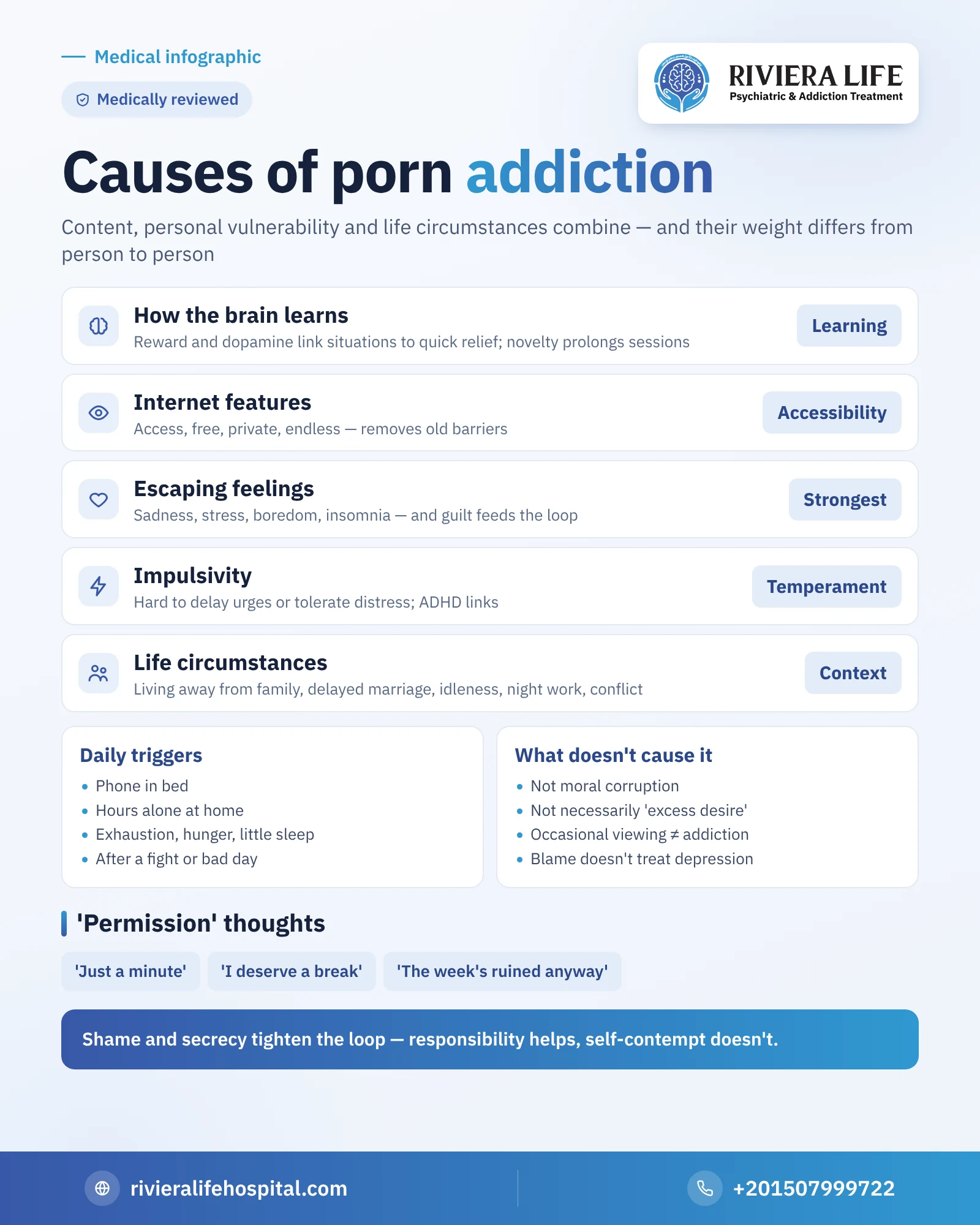
Sexual content is a powerful natural stimulus for the brain’s reward system, the system that relies on dopamine to tell us “repeat this”. When viewing repeats in the same situations, such as loneliness at night or after an exhausting day, the brain links these situations with quick relief, so the situations alone become enough to trigger the urge.
Constant novelty adds another element: moving from one clip to another keeps arousal going and prolongs the session. Some studies suggest similarities between what happens here and what happens in behavioral addiction, but this evidence is still limited and under scientific debate, so it isn’t correct to say that pornography “damages” the brain, as some widely shared videos claim.
Internet features that make attachment easier
Researchers summarize what makes internet pornography different from any time before in several features:
- Ease of access: the phone is in the pocket all day, and access takes seconds.
- Free of charge: no cost to make the person think before starting.
- Privacy: no one sees, and no need to face anyone.
- Endless flow: successive suggestions make stopping a decision that takes effort.
These features don’t create the problem on their own, as most internet users don’t fall into it, but they remove the barriers that used to protect those who are vulnerable.
Escaping difficult feelings
This is one of the strongest and most common causes. Many of those who seek help don’t watch out of sexual desire so much as to escape sadness, stress, boredom or insomnia. Studies reveal a clear relationship between problematic pornography use and depression, anxiety and loneliness, although the relationship runs both ways: sadness drives viewing, and compulsive viewing, with the guilt and isolation that follow it, increases sadness. That is why stopping the behavior isn’t enough without treating the condition the person is escaping.
Impulsivity and difficulty regulating emotions
Some people act quickly before they think, and find it hard to delay an urge or tolerate distress without doing something to remove it immediately. These traits make compulsive behavior more likely, whether it is viewing, video games or shopping. Attention deficit hyperactivity disorder in adults and teenagers is linked to greater impulsivity and sensation-seeking, which is why the doctor looks for it during assessment, because treating it may make the behavior easier to control.
Starting at an early age and a lack of healthy knowledge
Many children are first exposed to pornographic content at a young age, often by chance or through a classmate. In the absence of a calm family conversation or age-appropriate sex education, these materials become the only “school” from which the child learns about the body and relationships. Some studies find that early onset is linked to a greater likelihood of problematic use later, although it is hard to separate its effect from other accompanying factors. That is why our article on the harms of pornography focuses on the role of parents in protection and conversation.
Loneliness, empty time and life circumstances
Some circumstances increase the likelihood of turning to viewing: living abroad and traveling for work far from family, delayed marriage, unemployment and long periods of empty time, night work, chronic marital disputes, and weak social relationships. What they have in common is the absence of alternative sources of pleasure, support and connection, so the screen fills this gap in the easiest way. That is why treatment usually includes rebuilding these sources, not just prohibition.
How do shame and secrecy feed the cycle?
It may seem strange for shame to be a cause, but it is. A person who feels intense shame after each time lives with great inner tension, and tension is the main trigger for going back. Secrecy also prevents them from asking for help or talking to anyone, so they remain alone with the problem. In conservative societies this factor is stronger, because the subject is surrounded by silence. A sense of responsibility is useful, but self-contempt tightens the cycle further.
Small thoughts that pave the way back
Before many of the times, quick phrases pass through the mind that the person doesn’t notice: “I’ll just look for a minute”, “Today was hard and I deserve a break”, “I’ve ruined the week anyway”. Therapists call them permission thoughts, because they grant permission for the behavior and weaken resistance. They aren’t an original cause so much as a link between the trigger and the act, but recognizing and writing them down is one of the most useful things a person learns in treatment, because noticing them in the moment gives back the chance to choose.
Common daily triggers
Alongside the deeper causes, there are direct triggers that can be tracked, and knowing them is an essential part of the treatment plan:
- The phone in bed before sleep or after waking.
- Being alone at home for hours.
- Extreme tiredness, hunger or lack of sleep.
- After a disagreement, a frustrating situation or a bad day at work.
- Random scrolling on social media that leads to suggestive content.
Known risk factors
Research points to factors linked to a greater likelihood of problematic use, without meaning that the person will inevitably fall into it:
- Depression, anxiety or attention deficit hyperactivity disorder.
- Alcohol or drug use, since the two behaviors sometimes occur together and each strengthens the other.
- A history of traumatic experiences in childhood.
- Impulsivity and weak skills for dealing with stress.
- Loneliness and weak social support.
- Early onset and intensive daily use.
These factors closely resemble what is explained in our article on the causes of sex addiction, because the two conditions belong medically to the same family.
What doesn’t cause the problem?
The problem isn’t evidence of moral corruption or weak faith, and isn’t necessarily the result of “excessive” sexual desire, as many of those affected watch to escape their feelings rather than to seek pleasure. Occasional viewing doesn’t inevitably lead to addiction either; most people who watch don’t lose control. This correction matters, because wrong causes lead to wrong solutions: blame and threats don’t treat depression or loneliness.
Can it be prevented?
The risk can be greatly reduced, especially in children, through early conversation and protective tools on devices, and in adults by treating anxiety and depression early, keeping regular sleep, keeping the phone out of the bedroom, and building real relationships and sources of pleasure. For someone who notices the beginning of a loss of control, early intervention is much easier; the practical steps are explained in our article on porn addiction treatment, while the list of porn addiction symptoms helps you assess where you stand.
More from our pornography guide
- Pornography: the complete guide
- The symptoms of porn addiction and signs of losing control
- Porn addiction treatment step by step
- The harms of pornography on the mind, relationships and teenagers
Questions many people ask
No. Compulsive behavior forms from an interaction of psychological and environmental factors and repeated learning, which is why many people need a treatment plan, not determination alone.
Because the brain has learned that watching gives quick relief from difficult feelings. Breaking this link needs real alternatives for dealing with distress, and treating any depression or anxiety behind it.
Loneliness and empty time are known risk factors, but they don't create the problem alone. Many married people also struggle with it when watching is used to escape stress.
The impulsivity and sensation-seeking that accompany this disorder are linked to a greater likelihood of compulsive behaviors, so the doctor looks for it during assessment, because treating it may help.
Some studies suggest early onset is linked to a greater likelihood of problematic use, though its effect is hard to separate from other factors. Early family conversation reduces this risk.