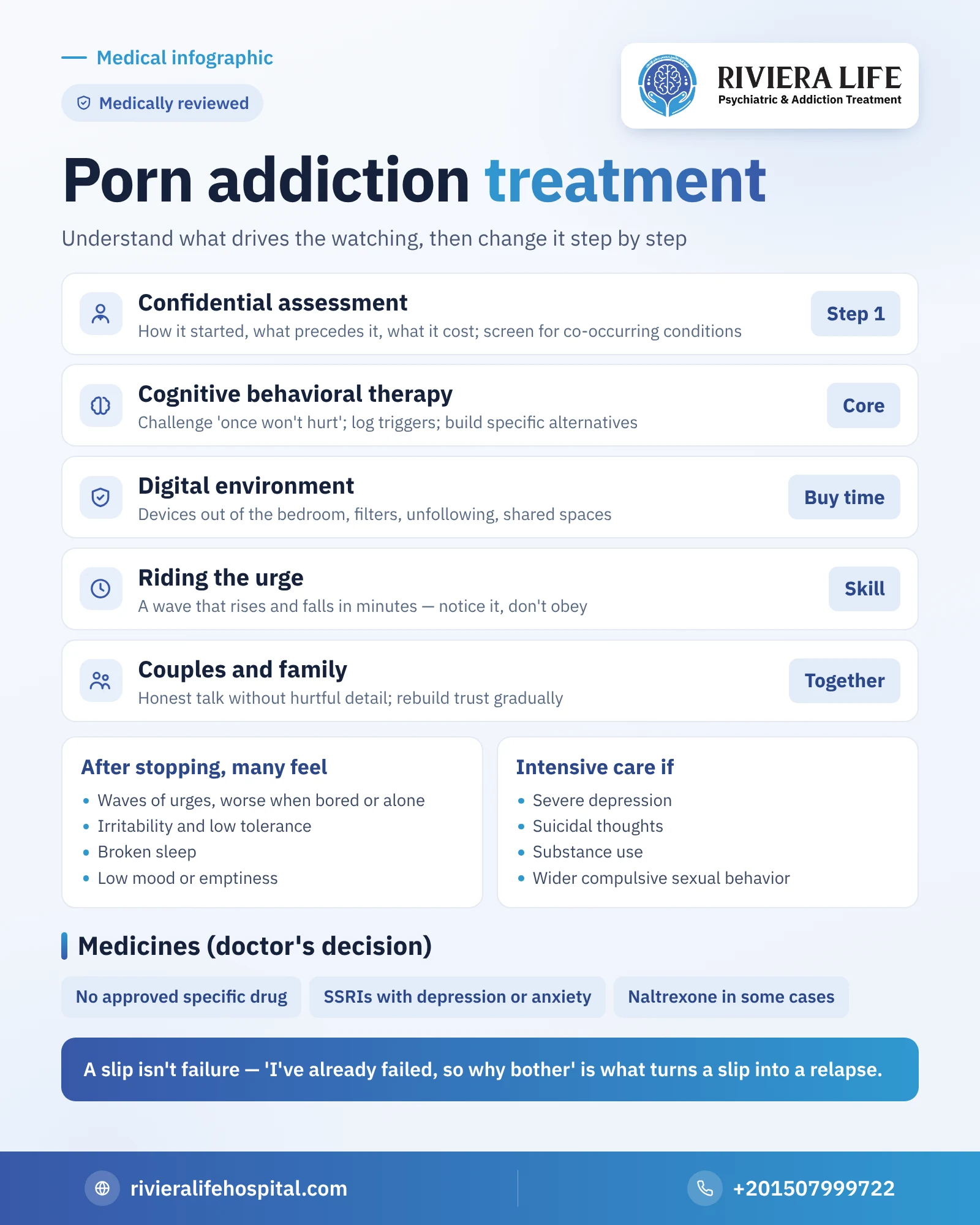
Porn addiction can be treated, and treatment doesn’t rely on willpower alone or on stopping suddenly, but on a plan that understands what drives the person to watch and then changes it step by step. Treatment usually rests on cognitive behavioral therapy, managing the digital environment and daily triggers, and treating any accompanying depression or anxiety, with the partner involved when the relationship has been affected. In specific cases the psychiatrist may decide to add a medicine. This article explains each stage, what to expect from the sessions, how to deal with a slip, and how to choose a suitable place for treatment.
Can porn addiction really be treated?
Yes. Many people improve clearly when they get organized help, and recent scientific reviews suggest that psychotherapy, especially cognitive behavioral approaches, reduces compulsive viewing and eases the distress linked to it, although the studies are still fewer than we would like. The treatment goal is set by the person with their therapist according to their values: some want to stop completely, others want to regain control. What matters is that the goal is clear and realistic, and that progress is measured by improvement in life as a whole, not just by the number of days.
The first step: a comprehensive, confidential assessment
Treatment begins with a session in which the doctor or psychologist listens to the person’s story without judgment: when did the viewing start? How did it develop? What usually comes before it? And what has it cost them? The specialist looks for accompanying conditions such as depression, anxiety, ADHD, OCD and substance use, and distinguishes between a real loss of control and distress arising from the viewing conflicting with one’s values, because each has a different treatment. Reviewing the symptoms of porn addiction helps prepare what you want to say in this session.
Cognitive behavioral therapy: the heart of the plan
Cognitive behavioral therapy works on two fronts. The first is thoughts: such as “once won’t hurt” or “I’m a failure and there’s no hope for me”, thoughts that pave the way back or deepen despair, so the person learns to notice and review them. The second is behavior: tracking the situations that come before viewing, recording them in a simple notebook, then building specific alternatives for each situation. Someone who watches after an exhausting workday needs another way to unwind, someone who watches because of insomnia needs a sleep plan, and someone who watches because of loneliness needs real connection. Sessions usually continue for weeks to months depending on the case.
Managing triggers and the digital environment
A large part of success comes from changing the environment so that access becomes harder in moments of weakness. Practical steps the person agrees with their therapist include:
- Taking the phone and computer out of the bedroom at night, and using an ordinary alarm clock.
- Enabling content filters on devices and the router, and giving the password to a trusted person if they wish.
- Unfollowing accounts that lead to suggestive content on social media.
- Identifying the usual risky times and filling them with a pre-planned activity.
- Using devices in shared areas of the home as much as possible.
Blocking tools alone don’t treat anything; someone who wants to get around them will find a way. But they buy the person precious minutes in which they can choose.
Dealing with intense urges
A strong urge comes as a wave that rises and then falls within minutes if the person doesn’t respond to it. In treatment the patient learns ways to deal with it, including what is called “urge surfing”: noticing the urge and describing it to themselves without fighting it or obeying it until it subsides. Others include mindfulness techniques that help them stay in the moment, and acceptance and commitment therapy, which links daily decisions to what the person wants for their life. It also helps to change place immediately, go out for a walk, or call a supportive person.
Treating co-occurring disorders
If viewing is a way of escaping depression or anxiety, stopping it without treating them leaves the person with no way of dealing with their pain, so they go back quickly. That is why the doctor treats depression, anxiety, ADHD and OCD if present, with psychotherapy or medication, within the same plan. If drug or alcohol use is combined with the behavior, both are treated together because each triggers the other.
Are there medicines to treat porn addiction?
There is no medicine approved specifically for this purpose, and psychotherapy is the foundation. But in some cases the psychiatrist may decide to use a medicine, such as antidepressants from the SSRI class when there is depression, anxiety or persistent intrusive thoughts, or naltrexone, which limited studies suggest may ease the urge in some compulsive behaviors. This decision is the doctor’s alone after assessment, and none of these medicines should be taken without a prescription and follow-up.
Couples therapy and the family’s role
When the problem comes to light in a marriage, the other partner often experiences shock and a sense of betrayal or inadequacy, and needs support too. Couples sessions help manage this stage: talking honestly without hurtful details, gradually rebuilding trust, and improving communication and intimacy. With teenagers, parents learn how to support their son without suffocating surveillance or humiliation. You’ll find the problem’s effect on relationships in detail in our article on the harms of pornography.
Slips and relapse: how do you deal with them?
Many people slip along the way, and it doesn’t mean the treatment has failed. There is a big difference between a passing slip from which the person learns what happened and how to avoid it, and a complete collapse that usually comes after thinking such as “since I’ve already slipped, there’s no point”. A relapse prevention plan includes identifying early warning signs, such as late nights, isolation and skipping sessions, a written plan for what to do when they appear, and regular follow-up after improvement. The more openly a slip is discussed with the therapist, the faster it is contained.
When does a person need an intensive program?
Most cases are treated in the outpatient clinic. But an intensive program or a short inpatient stay may be suitable when the behavior comes with severe depression or suicidal thoughts, drug use, or when it is combined with wider compulsive sexual behaviors that need closer supervision, as explained in our article on sex addiction treatment. If viewing is accompanied by compulsive masturbation, the same plan covers both, and you can learn what is scientifically established about its harms in the harms of masturbation.
Porn withdrawal symptoms: what does someone who stops suddenly feel?
Pornography doesn’t cause physical withdrawal like alcohol or opioids, so there are no seizures and no danger to life from stopping alone. But many who cut off viewing after years describe psychologically exhausting first weeks. These symptoms are real in their effect on the person, even though medicine hasn’t adopted a separate diagnosis by this name.
What is most often reported at this stage:
- Intense urges that come in waves, stronger when bored, alone or before sleep.
- Tension, irritability and low tolerance for small stresses.
- Insomnia or broken sleep and repeated thoughts about viewing.
- Low mood or a feeling of emptiness, because the behavior was the person’s way of calming themselves.
These symptoms usually ease over the weeks if there is a healthy way to regulate emotions, and they last longer and become more complicated when untreated depression or anxiety lies behind them. The appearance of thoughts of self-harm isn’t something to wait on; it needs an urgent psychological assessment. And be wary of what some forums say about “reset” stages fixed at a number of days; they have no strong scientific evidence.
To distinguish these symptoms from the signs of loss of control themselves, read the symptoms of porn addiction, and to understand what feeds the cycle of returning, see the causes of porn addiction.
The right place to treat porn addiction: how to choose
The right hospital for treating porn addiction is the one that offers what this patient specifically needs: complete confidentiality and a judgment-free environment, real behavioral therapy rather than sermons, and the ability to uncover what lies behind the behavior, such as depression, anxiety or substance use. Before you decide, ask:
- Does the team apply cognitive behavioral therapy with a written plan and homework between sessions?
- Does the doctor assess depression, anxiety, ADHD and substance use and treat them within the same plan?
- Does the therapist respect the patient’s values and beliefs without mockery or imposition?
- Does it offer sessions for couples or parents when the family is affected?
- Does it clearly guarantee the confidentiality of data and sessions?
- Is there follow-up after improvement and a written relapse prevention plan?
And stay away from any provider that guarantees a specific recovery rate or claims it will end the problem in a few days.
Why Riviera Life for porn addiction treatment?
This is what the patient and family find at Riviera Life in practice:
- Complete confidentiality: sessions and data fully protected, in an environment that respects the privacy and sensitivity of the subject.
- Consultants in psychiatry and addiction: who assess the case and set an individual plan suited to each person’s motives.
- Structured behavioral therapy: tracking triggers, building alternatives and a plan for managing the digital environment.
- Treating co-occurring conditions: depression, anxiety and substance use within a single plan.
- A family program and aftercare: support for the husband, wife or parents, and follow-up after improvement to prevent relapse.
- Round-the-clock medical supervision: for cases that need an intensive program or come with severe depression.
- Official accreditation and long experience: licensed by the Ministry of Health, fourteen years of work and thousands in recovery.
You can request your free first consultation at any hour of the day on +201507999722, and we are in Sheikh Zayed, Giza governorate.
More from our pornography guide
- Pornography: the complete guide
- The causes of porn addiction and risk factors
- The symptoms of porn addiction and signs of losing control
- The harms of pornography on the mind, relationships and teenagers
- The benefits of quitting porn: realistic gains and what stopping doesn’t guarantee
Questions many people ask
It varies with severity and accompanying conditions; many notice improvement within weeks to months of regular sessions, with follow-up afterwards to consolidate progress.
Usually not; most cases are treated in the outpatient clinic. An intensive program is considered when there is severe depression, suicidal thoughts or accompanying substance use.
They are a useful aid because they delay access in moments of weakness, but they don't treat the causes. Success needs a behavioral plan and treatment of what drives the person to watch.
Treat it as information, not failure: what happened before it, and what can be changed? Then discuss it with your therapist. Harsh self-blame increases the likelihood of it happening again.
Complete confidentiality, real behavioral therapy rather than lectures, and treatment of underlying depression, anxiety or substance use. Riviera Life in Sheikh Zayed is licensed by the Ministry of Health and meets these standards.