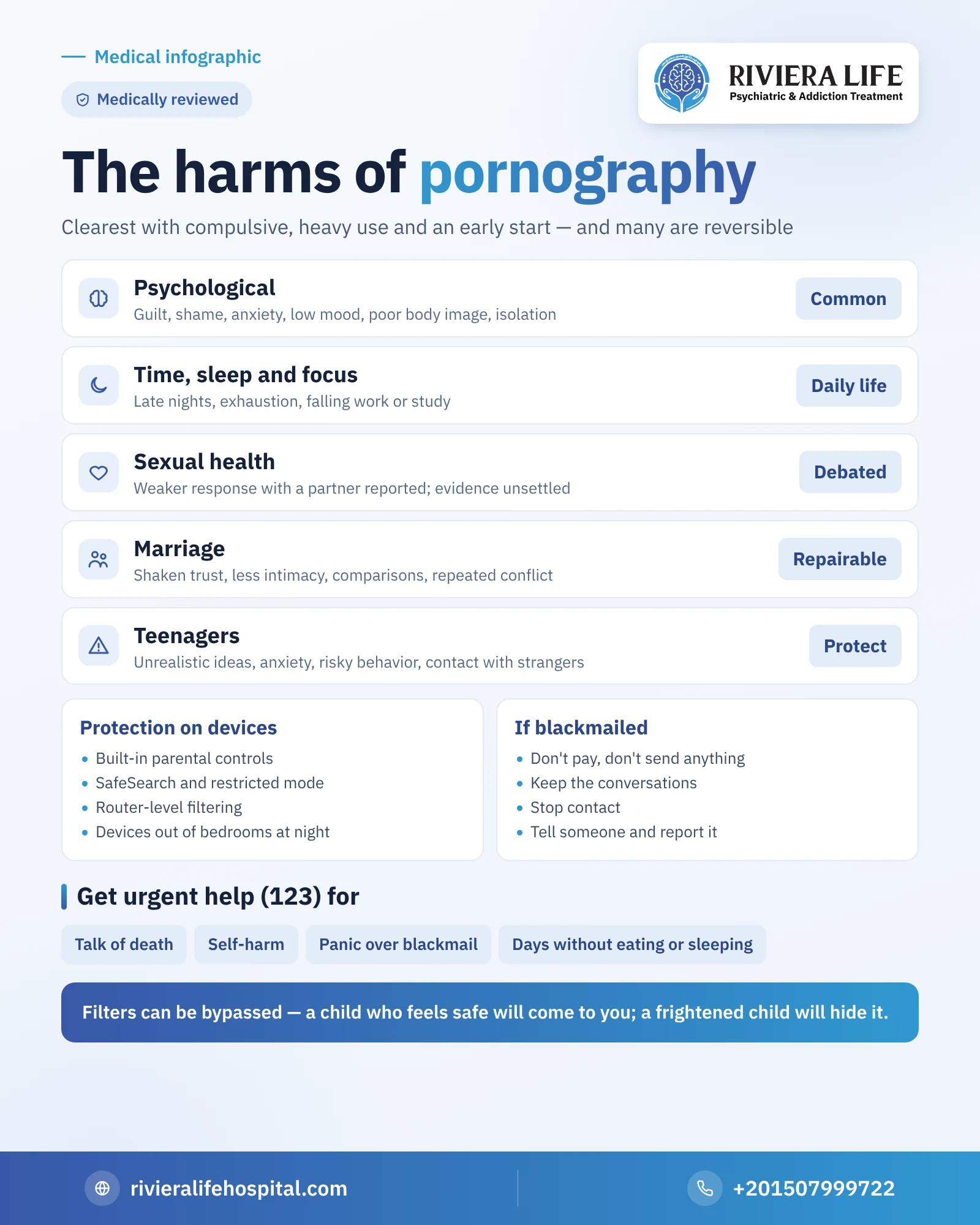
The harms of pornography don’t appear to the same degree in everyone who watches, but they become clear when viewing turns into a compulsive pattern: repeated guilt and anxiety, disturbed sleep, wasted time, a widening gap in the marriage, and unrealistic ideas about the body and intimacy. Teenagers need special protection, because they are exposed to this content before they have the means to understand it. In this article we set out the psychological, sexual and social harms as research describes them, distinguishing what is established from what is debated, and then give parents a practical guide to protection and conversation.
Is pornography always harmful?
The honest answer is that the effect varies from person to person. Research links the clearest harms to compulsive and heavy use, to starting at a young age, and to viewing used to escape feelings. Some of the frightening figures circulating online about “destroying the brain” or permanent impotence aren’t supported by strong evidence. On the other hand, other voices ignore the real suffering many people live with. What we present here is what specialists agree on to a reasonable degree, with a note of what is still under debate. To learn when use becomes compulsive, see porn addiction symptoms.
The psychological harms
What exhausts people with compulsive viewing most is the accumulated psychological burden:
- Guilt and shame: especially when viewing conflicts with their values; shame can turn into self-contempt.
- Anxiety: a constant fear of being found out, and tension that rises with each failed attempt to stop.
- Low mood: problematic use is linked to symptoms of depression, and the relationship works both ways, as our depression guide explains.
- A shaken body image: comparison with what is shown can plant a sense of inadequacy in men and women.
- Isolation: a gradual withdrawal from friends and activities in favor of the screen.
Lost time, sleep and focus
An hour here and two hours there become whole days over the weeks. Viewing often happens at night, so sleep is delayed and the person wakes up exhausted, their performance at work or study declines, and postponed tasks pile up. This invisible harm is one of the main things that drives people to seek help, because it touches their daily life directly.
The effect on sexual health
Some men, including young men, complain of a weaker sexual response or difficulty getting an erection with a partner, while the same problem doesn’t occur when watching. Some give this a name of its own, but the scientific evidence on it isn’t settled: some studies find a link and others don’t. What is established is that erectile dysfunction has many physical and psychological causes — anxiety, diabetes, certain medications and smoking — so it needs a medical examination, not guesswork.
Many report an improvement in their response when they cut down viewing and treat anxiety. Heavy viewing can also cause cooling desire for a partner, or unrealistic expectations of intimacy. And if it comes with excessive masturbation, you will find the medical facts about that, away from the myths, in the harmful effects of masturbation.
The effect of pornography on a marriage
Many wives, and some husbands, feel deeply hurt when they discover their partner’s compulsive viewing, and may describe it as betrayal or a feeling that they aren’t enough. This varies with the couple’s values and agreement, but in our society it is usually painful. Common effects include:
- Shaken trust, especially when it has gone hand in hand with lies and hiding.
- Less emotional closeness and intimacy between the couple.
- Comparisons that make the other partner feel pressured or inadequate.
- Repeated arguments that may lead to separation if left unaddressed.
These effects can be repaired in many cases, and couples sessions are part of the plan explained in porn addiction treatment. And when the behavior widens to include relationships or sexual behaviors outside the marriage, the condition is closer to what our sex addiction guide covers.
Distorted ideas about relationships
Pornographic content is a commercial industry designed to attract viewers, not to teach them. Much of it shows encounters without feelings or understanding, and sometimes portrays harshness or ignoring the other person’s wishes as if it were normal. Someone who learns from this content alone may carry unrealistic expectations about the body and performance, or confuse what they see with what suits a real relationship built on respect and consent. This risk is greater in young people, who have no experience to compare it with.
The harms of pornography for teenagers
A teenager’s brain is still maturing, especially the areas responsible for controlling impulses and weighing consequences, and they are at a stage when their understanding of the body and relationships is taking shape. That is why scientific reviews raise concern that early and repeated exposure may be linked to unrealistic ideas about relationships, anxiety, poor self-image and sometimes risky behaviors — although long-term studies haven’t settled all these links yet. Add to this what late nights steal from sleep and study, and the risk of exposure to shocking content or contact with strangers who exploit young people.
A parents’ guide: protection tools on devices
Technical protection is a first line of defense, and is best set up before giving a child their own device:
- Turn on the parental controls built into the phone and operating system, set according to the child’s age.
- Turn on safe search in search engines and video platforms, and restricted mode in the apps that offer it.
- Use a filtering service at the router level so it covers every device in the house.
- Review apps and online games that have chats with strangers.
- Agree that devices stay outside the bedroom at night.
But remember that any filter can be bypassed, and that a friend’s phone or a device somewhere else is enough to break it. That is why tools are no substitute for conversation.
A parents’ guide: how to open the conversation
A child who feels safe will come to you when they see something that upsets them; a frightened child will hide it. Start early, in language suited to their age, with a simple sentence such as: “Unsuitable or upsetting pictures may come up on the internet, and if that happens, come to me — you won’t be punished.” With a teenager, choose a calm moment, such as a car journey, and ask what their classmates are passing around instead of starting with an accusation. Explain that this material is a commercial performance that doesn’t resemble real relationships, and express your family’s values calmly without frightening them. Most importantly, control your reaction: anger and humiliation teach a child to hide, not to stop.
What to do if you discover your child is watching
Take time to calm down before you talk. Then separate the act from the person: “I’m worried about what I saw” instead of “You’re corrupt.” Ask how it started, where they reach this content, and whether something is bothering them — sometimes viewing is an escape from loneliness, bullying or anxiety. Set clear rules for devices together, and follow up calmly. And if you notice a clear loss of control, sadness and withdrawal, or a big drop in school performance, consult a mental health professional for adolescents. Our article on the causes of porn addiction will help you understand what may lie behind the behavior.
Online blackmail: a danger to watch for
Teenagers and adults may be blackmailed by people who obtain private pictures or conversations and then threaten to publish them in exchange for money or more pictures. The victim is not to blame, and the biggest mistake is giving in or staying silent. Don’t pay and don’t send anything; keep the conversations, stop contact, report it to the authorities that handle cybercrime, and tell someone you trust. Parents should tell their children plainly: “If this happens to you, come to us — we won’t blame you.”
Get urgent help immediately if you see
Call an ambulance on 123 or go to the nearest emergency department, and don't leave the person alone.
- Talk of death, or of not deserving to live after being found out
- Self-harm, or hints of it
- Severe panic and despair because of blackmail or a threat of exposure
- Completely stopping eating, sleeping or leaving the room for days
Do the harms go away after stopping?
In most cases, yes, to a large degree. Sleep and concentration improve within weeks, guilt and anxiety ease as control returns, and many relationships regain their balance when the couple work together to repair them. Some people need treatment for accompanying depression or anxiety for the improvement to be complete. At Riviera Life the person and their family find a confidential assessment and support without judgment, and the first consultation is free on +201507999722.
More from our pornography guide
- Pornography: the complete guide
- Porn addiction symptoms and signs of losing control
- The causes of porn addiction and risk factors
- Porn addiction treatment, step by step
- The benefits of quitting porn: the realistic gains and what stopping doesn’t guarantee
Questions many people ask
Some men link heavy viewing with a weaker response with their partner, but the evidence isn't settled. Erectile dysfunction has many physical and psychological causes, and a medical examination is the way to find the cause.
In many cases, yes — if the partner concerned commits to treatment and there is honesty in the conversation. Couples sessions help rebuild trust gradually.
It is advisable to start early, in simple language, before or when the child gets their own device: tell them the internet may show unsuitable pictures and that they should tell you without fear of punishment.
They are an important line of protection but not enough on their own, because they can be bypassed on other devices. Ongoing conversation and trust between the child and parents are the strongest protection.
Don't pay and don't send anything; keep the conversations, stop contact, and tell parents or someone you trust straight away so it can be reported to the authorities. The victim is not to blame.