Parkinol is a widespread trade name in Egypt for the substance trihexyphenidyl, a medicine the psychiatrist usually prescribes to ease the tremor and stiffness that some antipsychotics may cause, and that the neurologist sometimes uses in cases of parkinsonism. This small blister strip that protects a schizophrenia patient from muscle rigidity has found its way to the street, because taking it in amounts beyond treatment may give a temporary euphoria and hallucinations that some young people chase. The price may be a poisoning that confuses the mind, raises body temperature and speeds the heart. In this guide we explain what Parkinol is, why it is misused, how the family knows the matter has gone beyond the prescription, and when the case becomes an emergency.
What is Parkinol?
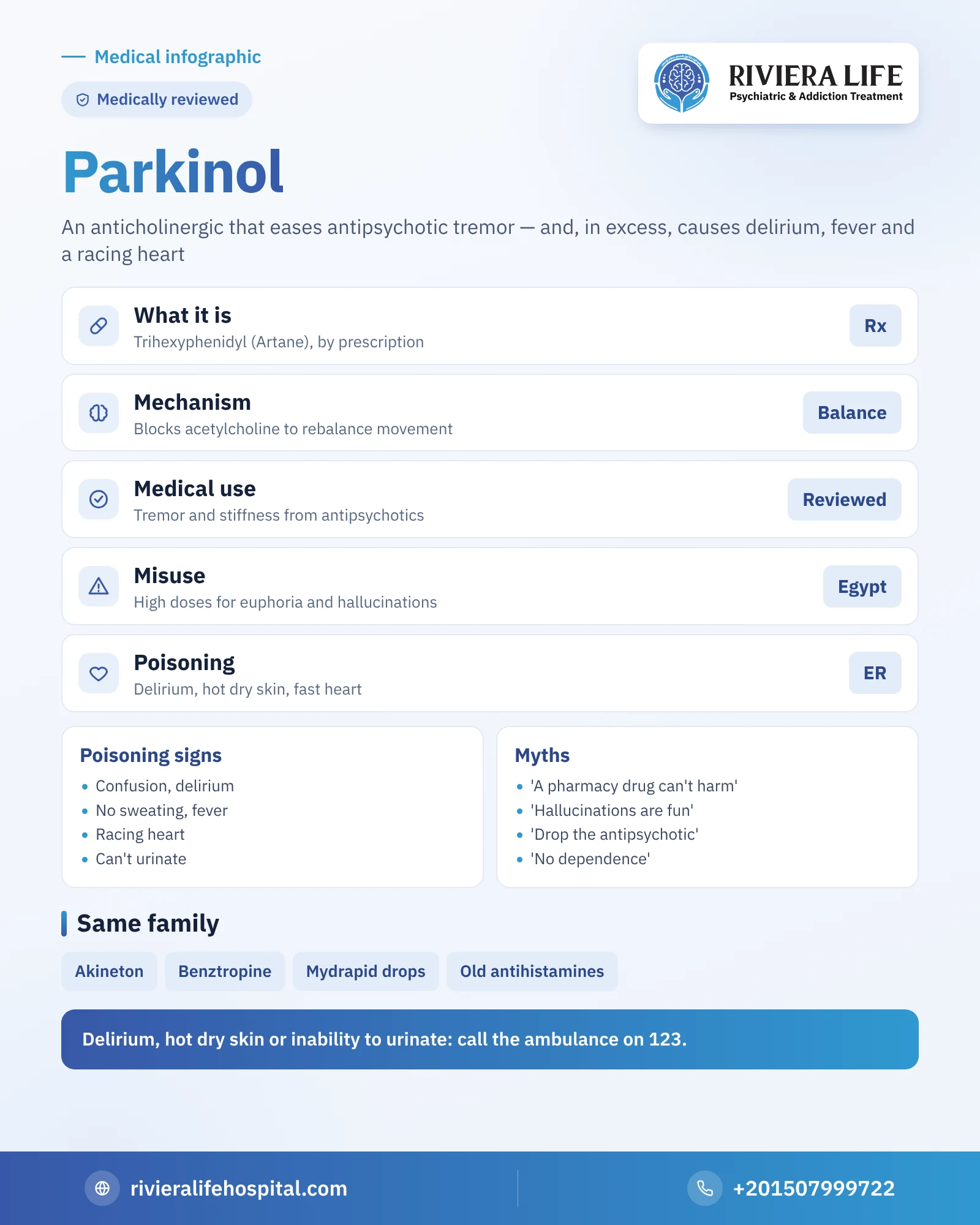
Trihexyphenidyl belongs to the “anticholinergic” medicines (Anticholinergics), that is, those that block the effect of the neurotransmitter “acetylcholine” on its receptors called muscarinic receptors. The medicine appeared in the late 1940s, and became known worldwide under the name “Artane”, while Egyptians know it better as “Parkinol”. It is dispensed as tablets.
The idea, simply, is that normal movement needs a delicate balance in the brain between dopamine and acetylcholine. When the effect of dopamine decreases, as happens in Parkinson’s disease or with medicines that block its receptors, the scale tips in favor of acetylcholine, so tremor, stiffness and slow movement appear. Here Parkinol comes in to lighten the other side of the scale, restoring some of the balance.
The medical uses of Parkinol
Most of those who take Parkinol by prescription in Egypt are psychiatric patients receiving antipsychotics, especially older medicines such as haloperidol. These medicines may cause what doctors call “extrapyramidal symptoms”, including:
- Drug-induced parkinsonism: tremor in the hands, muscle stiffness, a face with little expression, and a slow walk with short steps.
- Acute dystonia: a sudden, painful spasm in the muscles of the neck, jaw or eyes, which may need an urgent injection.
- Parkinson’s disease: it is sometimes used in its early stages or to ease tremor, though newer alternatives now exist in many cases.
Parkinol doesn’t help with every movement disorder; for example, it doesn’t treat tardive dyskinesia, which appears after years of antipsychotics, and may make it worse. Many patients don’t need it for life, as the doctor reviews their need for it after the condition stabilizes, and adjusting the type or amount of the antipsychotic may be enough. That is why it isn’t started, changed or stopped except by the decision of the doctor who prescribed it.
How does Parkinol affect the brain and body?
The role of acetylcholine isn’t limited to movement; it is a key partner in memory and attention, and controls the secretion of saliva and sweat, heart rate, bowel movement, bladder contraction and the adjustment of the pupil. That is why blocking this transmitter in large amounts doesn’t only stop tremor, but strikes all the body’s systems at the same time: the mouth and skin dry out, sweating stops so the temperature rises, the pulse speeds up, the pupils dilate so vision blurs, digestion slows, and urinating becomes difficult.
In the brain, attention and short-term memory are disturbed first, then with larger amounts what doctors call “anticholinergic delirium” appears: confusion and disorientation in place and time, incoherent speech, and visual hallucinations in which the person may see insects or people who aren’t there and talk to them.
Why is Parkinol misused in Egypt?
Parkinol brings together what makes it tempting for someone looking for a cheap “high”: a relatively low price, a strip that looks like an ordinary medicine and doesn’t attract attention, and an effect different from sedatives and opioids. At amounts beyond the therapeutic limit, some users describe a feeling of refreshment, euphoria and talkativeness, and with excess comes a dream-like state with hallucinations, which in reality is the beginning of poisoning, not a pleasant trip.
Those who misuse it are mostly three groups. The first is young people who try it in mixes including tramadol, hashish or alcohol, or count it among the “hallucination pills” passed around among friends. The second is psychiatric patients for whom the medicine is actually prescribed, some of whom discover that doubling the amount improves mood or relieves boredom and distress, so the increase begins secretly. The third is users of other substances who use it to change sensation or to make up for the absence of their main substance. This phenomenon resembles what happens with another medicine from the same family that we explained in the article on Mydrapid eye drops.
Anticholinergic poisoning: the real danger
The problem is that the distance between the amount that “gives a mood” and the amount that causes poisoning is short, and differs from person to person according to age, weight and other medicines. The signs of anticholinergic poisoning are distinctive and emergency doctors know them by heart:
- Confusion and delirium: incomprehensible speech, not recognizing places or people, and random movements as if picking things out of the air.
- Hallucinations: mostly visual, and they may be frightening and push the person to agitation or flight.
- A fast heart: palpitations, and the rhythm may be disturbed in severe cases.
- Raised temperature: hot, dry, red skin without sweat, a particular danger in the Egyptian summer.
- Urinary retention: an urge not followed by urination and swelling of the lower abdomen, with severe constipation.
- Dilated pupils and dry mouth: with blurred vision and thirst.
The condition may develop into seizures or coma, and the danger increases clearly when Parkinol is combined with other medicines that have an anticholinergic effect, such as some old antihistamines and some tricyclic antidepressants, or with alcohol and narcotic substances. Older adults are also more prone to confusion even with therapeutic amounts.
Parkinol within its medicine family
Sharing the same category with Parkinol is the medicine “biperiden”, known commercially as “Akineton”, which many write as “Aktineton”; it is used for the same purposes and misused in almost the same way, and it comes in injections that doctors use inside hospitals and emergency departments. Outside Egypt there is “benztropine”, which plays the same role. The wider family of anticholinergic medicines includes eye drops for dilating the pupil, some antihistamines and bladder medicines.
What they have in common is that excess of any of them, or combining more than one, leads to the same picture of poisoning. The antipsychotics with which Parkinol is prescribed belong to a completely different category, and combining them on prescription is a routine medical practice as long as the patient sticks to what their doctor set and reviews it regularly.
Does Parkinol cause addiction?
Parkinol isn’t among the substances whose name is linked with addiction like heroin or tramadol, but dependence on it is documented in those who use it for its effect on mood. It starts with a small increase, then the person needs a larger amount to feel the same effect, getting hold of the strip becomes a preoccupation, and they continue despite episodes of confusion or problems at work and at home. In psychiatric patients in particular the matter may become blurred; the patient insists they need it for tremor, while their amounts exceed what any movement symptom justifies.
Parkinol withdrawal in brief
Stopping suddenly after regular use of large amounts may cause something resembling “cholinergic rebound”: nausea and vomiting, sweating, headache, insomnia, anxiety and tension, and a general feeling of being unwell. Tremor and stiffness may return in those taking antipsychotics, so the patient thinks their illness has relapsed. These symptoms aren’t usually life-threatening, but they are troublesome enough to push the person to go back to the medicine, which is why it is reduced gradually with a plan the doctor sets.
Parkinol and the law
Parkinol is a licensed medicine dispensed only by medical prescription, and selling or circulating it outside this framework is a violation that may expose a person to accountability. With the widening misuse of some anticholinergic medicines, the health authorities in Egypt have tightened control on the dispensing of a number of them, and these controls change from time to time, so the precise reference is the pharmacist and the treating doctor. A patient who actually needs it gets it with their prescription without a problem. As for someone who has fallen into the trap of excess, voluntarily seeking treatment is the safe path, and inquiries can be made through the hotline of the Fund for Drug Control and Treatment of Addiction, 16023.
The Parkinol guide: each aspect in a separate article
These are detailed articles that complete the picture:
Parkinol addiction treatment
How the doctor distinguishes between a real need for the medicine and its misuse, how gradual reduction is done in coordination with the psychiatrist, and the role of psychotherapy.
Mydrapid eye drops
Another medicine from the anticholinergic category that is misused in Egypt, and its poisoning closely resembles Parkinol poisoning.
Schizophrenia treatment
For those taking Parkinol with antipsychotics: how a schizophrenia treatment plan is built and its medicines reviewed.
Drug names circulating among young people in Egypt
The names the family hears on the street and what they refer to, including medicines used outside their purpose.
Common myths about Parkinol
The myth: it’s a medicine dispensed from the pharmacy, so it can’t do harm. The truth is that the medicine is safe only at the amount and for the purpose the doctor set, and that exceeding them may lead to delirium, high temperature and a disturbed heart.
The myth: the hallucinations it causes are a passing, pleasant experience. The truth is that they are a sign that the brain is in a state of poisoning, and may push the person to agitation or self-harm without realizing it.
The myth: a schizophrenia patient can stop the antipsychotic if the tremor bothers them and make do with Parkinol. The truth is that stopping the antipsychotic exposes them to relapse, and the solution is to tell their doctor about the symptoms so the plan can be adjusted.
The myth: Parkinol doesn’t cause dependence. The truth is that someone who uses it for mood may need increasing amounts and be unable to stop, and this is the essence of dependence.
Where does the family start?
Start with a simple question: is Parkinol prescribed for the person taking it? If it is prescribed with a psychiatric medicine, watch the amount: do the strips run out before their time? Do they ask to renew the prescription early or buy from more than one pharmacy? Contact the treating doctor and tell them what you have noticed, without a noisy confrontation. And if it isn’t prescribed, watch for the accompanying signs: a dry mouth and thirst, dilated eyes, confused speech or talking with people who aren’t there, and redness of the face. Don’t treat the matter as a scandal, and don’t search, confiscate and then fall silent; talk with them when they are clear-headed, and ask for a specialized assessment that covers everything they take.
When does the case become an emergency?
Call the ambulance on 123 immediately if any of these appear
After taking a large amount of Parkinol or mixing it with other medicines or substances, don’t wait for the effect to wear off on its own.
- Severe confusion, delirium or hallucinations with agitation
- A high temperature with hot, dry skin without sweat
- Severe palpitations, a very fast pulse or chest pain
- Inability to urinate with swelling of the lower abdomen
- Seizures, difficulty waking, or loss of consciousness
Until the ambulance arrives, move the person away from heat, high places and sharp tools, and talk with them calmly without violent restraint. Don’t try to give them medicines or lower their temperature by harsh means, and take all the empty strips with you, because knowing what they took guides the emergency treatment.
When should you ask for help?
Ask for a specialized assessment if Parkinol has come to be taken without a prescription, in more than the doctor set, or for mood and hallucinations, or if episodes of confusion recur, or attempts to reduce it fail. At Riviera Life, the consultants in psychiatry and addiction treatment assess the case in complete confidentiality, determine whether the patient actually needs the medicine for the side effects of antipsychotics or whether the need has ended, and put in place a gradual reduction plan under round-the-clock medical supervision when needed, involving the family from the start.
Medical sources and referencesThe information in this article is based on reliable scientific sources