Schizophrenia treatment is possible and effective, but it is an extended plan, not a short prescription. It rests on three pillars: antipsychotics to calm hallucinations and delusions and prevent their return, psychological and family therapy to learn to deal with the illness, and rehabilitation to regain study or work and relationships. The patient may need hospital admission in acute episodes or when there is a risk. This article sets out the stages of treatment, the classes of medicines and their side effects without doses, the types of psychotherapy, when admission is necessary, and how a relapse prevention plan is built, then the criteria for choosing the right hospital.
What do we want from schizophrenia treatment?
The aim isn’t only to silence the voices. The treating team seeks to end the acute episode safely, then consolidate improvement, then return the patient as close as possible to the life he wants: study, work or a stable home. Modern treatment makes the patient himself a partner in decisions as far as possible, because someone who understands his plan and is convinced by it sticks to it more. Another aim is protecting physical health, as schizophrenia patients are more prone to heart disease, diabetes, obesity and smoking than the general population. Many patients need special support to quit cigarettes, which we cover in our article on nicotine dependence and its treatment.
Stages of schizophrenia treatment
The acute phase
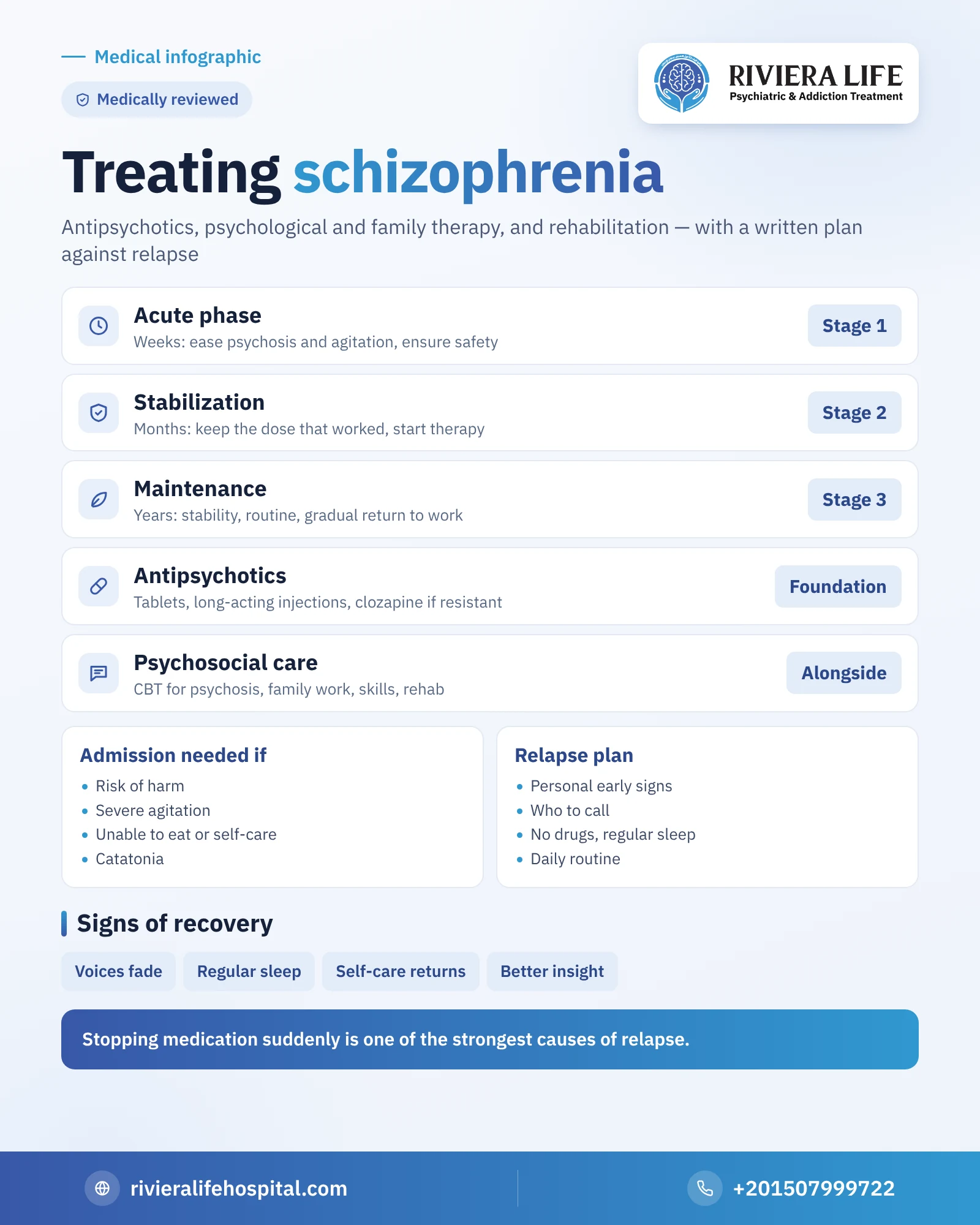
It usually lasts weeks, and focuses on easing psychotic symptoms, agitation and disturbed sleep, and ensuring the safety of the patient and those around him. It includes a comprehensive assessment that rules out physical causes and drugs before the diagnosis is confirmed.
The stabilization phase
It lasts months, during which the medicine continues at the dose that worked, psychological and family work begins in earnest, and the body and side effects are monitored closely. Relapse in this period is common if the medicine is stopped early.
The maintenance and recovery phase
It lasts years, and the aim is to maintain stability, build a regular daily life and return gradually to study or work, with periodic follow-up and a clear plan for dealing with any warning of relapse.
Antipsychotics: the cornerstone
Antipsychotics work mainly by regulating dopamine signals in the brain, so they ease hallucinations, delusions and disordered thinking, and reduce the chance of their return. Their effect on agitation and sleep begins within days, while improvement in psychotic symptoms usually takes weeks.
First and second generation
These medicines are divided into an older first generation and a newer second generation. The two generations differ mainly in the type of side effects more likely to occur, not in one being necessarily stronger. The doctor chooses the medicine according to the symptoms, health history, the patient’s preference and previous experiences, and may change it if it doesn’t suit him.
Long-acting injections
Some antipsychotics are available as injections given every two weeks to several months depending on the type. They help those who forget their tablets or hesitate to take them, or who relapsed before after stopping, and they relieve the family of following daily doses.
Clozapine in treatment-resistant schizophrenia
If symptoms don’t improve after trying two different medicines at an adequate dose and duration, clozapine is considered the most effective option according to international guidelines. It needs regular blood tests to monitor white blood cells, so it is started under close medical supervision.
Side effects and how they are managed
Fear of side effects is one of the most common reasons for leaving treatment, and the solution lies in knowing them in advance and discussing them with the doctor, not in stopping the medicine secretly. Among the most important:
- Weight gain and raised blood sugar and lipids with some medicines, which is why the doctor measures weight, waist circumference, sugar and lipids before starting and periodically.
- Movement symptoms such as restlessness, stiffness or tremor, and sometimes involuntary movements after long use.
- Drowsiness and slowness in the first weeks, which usually improve or are treated by adjusting the timing.
- Raised prolactin with some medicines, which may affect the menstrual cycle or sexual function.
There is also a rare but urgent symptom: high fever with severe muscle stiffness and confusion, in which case you must go to the emergency department immediately.
How long does drug treatment last?
There is no single duration for everyone. After the first episode many guidelines recommend continuing for at least one to two years, and the duration is usually longer after repeated episodes, and some patients may need the medicine for many years, as a blood pressure patient needs his medicine. The fixed rule: the medicine isn’t stopped suddenly or without a doctor, because sudden stopping is one of the strongest causes of relapse. If the patient wants to reduce it, this is planned gradually with close follow-up.
Psychological and social treatment
Cognitive behavioral therapy for psychosis
It helps the patient understand his experiences, weigh the evidence for his distressing beliefs, reduce the distress linked to the voices and build practical ways of dealing with them. It doesn’t replace medication, but it adds a tangible effect to it.
Family intervention
Structured sessions that explain the illness to the family, train it in calm communication and problem solving, and reduce tension in the home. These sessions are linked to a clear reduction in relapse and are recommended by international guidelines. If a family member shows signs of exhaustion or persistent sadness, caring for them is also part of the plan, and they will benefit from our depression guide.
Social skills and cognitive remediation
Practical training in conversation and reading social situations, and exercises to improve attention, memory and planning, which are especially important for those dominated by the negative and cognitive symptoms we described in schizophrenia symptoms.
Rehabilitation for study and work
Returning to a meaningful activity is part of the treatment itself. Successful programs help the patient return gradually with continuous support, instead of waiting for “complete recovery” first.
When does a schizophrenia patient need hospital admission?
- Thoughts or attempts to harm oneself or others.
- Severe agitation or command voices he responds to.
- Inability to eat, drink and care for oneself.
- Catatonia or complete refusal of food.
- The first episode if the assessment needs close observation, or the need to change medication under monitoring.
- Schizophrenia together with an addiction that needs detox.
The patient may refuse admission because of poor insight. Here Egypt’s mental health care law regulates involuntary admission under specific conditions and safeguards, the most important being the presence of serious risk and a psychiatric assessment. The aim is always the shortest safe stay, then moving on to outpatient follow-up.
Electroconvulsive sessions: when are they used?
Brain rhythm regulation sessions are carried out under full anesthesia and medical supervision, and don’t resemble the frightening picture in old films. In schizophrenia their use is usually limited to specific cases, most notably severe catatonia, some treatment-resistant cases, or when rapid improvement is needed because of imminent danger.
Treating schizophrenia with addiction
Schizophrenia together with hashish, stimulant or alcohol use is common, and each complicates the other: use inflames the symptoms and weakens the effect of medication, and the symptoms push toward use. That is why the two disorders are treated together in one plan by a team combining psychiatry and addiction treatment. You will find details of the relationship between substances and psychosis on our pages on hashish and methamphetamine.
The relapse prevention plan
The plan is written with the patient and family before discharge, and usually includes:
- The early signs specific to this patient, such as less sleep or the return of a particular idea.
- What the patient and family do when they appear, and whom they call.
- Follow-up appointments and periodic tests.
- Complete avoidance of drugs, limiting alcohol and caffeine, and regular sleep.
- A daily routine with activity, exercise and social contact.
Signs of recovery from schizophrenia: what does improvement really mean?
Doctors avoid the word “cure” in its absolute sense with schizophrenia, because it is a chronic illness that can relapse. But real recovery is possible: for the symptoms to calm and stabilize, and for the patient to return to a life close to his life before the illness, or better. This is usually what is meant when the family asks about signs of recovery.
Signs that the plan is bearing fruit:
- The voices and suspicions disappear or fade until they no longer control his behavior.
- Regular sleep and calm mood, without long late nights or sudden tension.
- Self-care, hygiene and interest in what is around him return.
- Better insight: he acknowledges that he needs treatment and attends his appointments.
- A gradual ability to study, work or help the family, even half-time at first.
- Social relationships return little by little after the period of withdrawal.
Improvement in positive symptoms such as hallucinations is usually faster than improvement in motivation and concentration, so don’t consider the slowness of the latter a failure. The most dangerous thing some fall into is taking calm as proof that the illness has ended and stopping the medicine on their own; sudden stopping is one of the most common causes of relapse. See antipsychotics to learn why the medicine is continued even after stability.
Schizophrenia relapse: why does it happen and what do you do when it appears?
A schizophrenia relapse is the return of active symptoms after a period of stability, and it isn’t a failure on the part of the patient or the family. It happens to many however good adherence is, but its chance falls a lot when it is detected early.
The most common causes behind it:
- Stopping the medicine or skipping doses, whether because of side effects or because the patient sees himself as well.
- Using hashish or stimulants, or drinking excessively.
- Lack of sleep, severe stress, the loss of a loved one, or a big problem in the family.
- Follow-up being cut off after leaving hospital.
When the first signs appear, such as disturbed sleep, the return of suspicion or sudden withdrawal, call the treating doctor the same day and don’t wait for the review appointment. You will find the list of signs that precede relapse in schizophrenia symptoms. And if a danger to the patient or others appears, going to the emergency department or calling an ambulance on 123 can’t be postponed.
If substances are behind the relapse, it is best to treat both conditions together within our dual diagnosis program, because treating one alone leaves the door open to return.
The right hospital for schizophrenia treatment: how to choose
The right hospital for schizophrenia treatment is one that provides what a schizophrenia patient specifically needs: an accurate assessment that rules out other causes, safety in the acute episode, and a long plan that doesn’t end at discharge. Ask before choosing:
- Is the hospital licensed, with patients supervised by psychiatry consultants?
- Is there an alert medical staff throughout the day, able to calm agitation and deal safely with thoughts of harm?
- Does it carry out an assessment that rules out drugs and physical causes before confirming the diagnosis?
- Does it offer psychological and family therapy and rehabilitation, not just medication?
- Can it treat accompanying addiction within the same plan?
- Is there a clear follow-up and relapse prevention plan after discharge?
Beware of any party that promises you a guaranteed cure or treating schizophrenia in days without medication.
How Riviera Life meets these standards
Here is how these criteria are met at Riviera Life:
- Official license: a hospital licensed by the Ministry of Health.
- Years of practice: fourteen years in treating psychiatric illness and addiction.
- Consultant follow-up: psychiatry and addiction consultants accompany the schizophrenia patient from the first examination until his condition stabilizes.
- Safety in the acute episode: round-the-clock medical supervision.
- Dual diagnosis: treating schizophrenia and accompanying addiction in one plan.
- The family as a partner: a family program and follow-up after discharge to prevent relapse.
- Complete confidentiality: full privacy for the patient and family.
- Tangible results: thousands of recovered cases.
There is no fee for the first consultation, and you can call us night or day on +201507999722, or come to our center in Sheikh Zayed, Giza governorate.
More from our schizophrenia guide
- Schizophrenia: the complete guide
- Schizophrenia symptoms and early signs
- Causes of schizophrenia and risk factors
- Types of schizophrenia and the spectrum of psychotic disorders
- Antipsychotics: first and second generation, side effects and follow-up
- Risperidone (Risperdal): uses, side effects and follow-up
- Olanzapine (Zyprexa): uses, weight, blood sugar and follow-up
- How to deal with a schizophrenia patient: a practical family guide
- Haloperidol (Haldol): uses, movement effects and warnings
- Amisulpride (Solian): uses, prolactin and effects
Questions many people ask
Some patients recover completely, and many others stabilize and live productive lives with treatment and follow-up. Schizophrenia is usually a long-term condition that needs ongoing management, like many chronic illnesses.
Not necessarily. After the first episode, one to two years at least is usually advised, and the duration lengthens with repeated episodes. Any reduction is gradual and decided by the doctor.
Psychotherapy and rehabilitation are very important, but in most cases they don't replace antipsychotics, especially in the acute episode. Combining them achieves the best results.
When there is a risk of harm to self or others, severe agitation, inability to eat and care for oneself, catatonia, or a need for assessment or a medication change under observation.
Look for a licensed hospital with psychiatry consultants, round-the-clock supervision, family therapy and follow-up. Riviera Life in Sheikh Zayed meets these criteria, with a free first consultation and complete confidentiality.