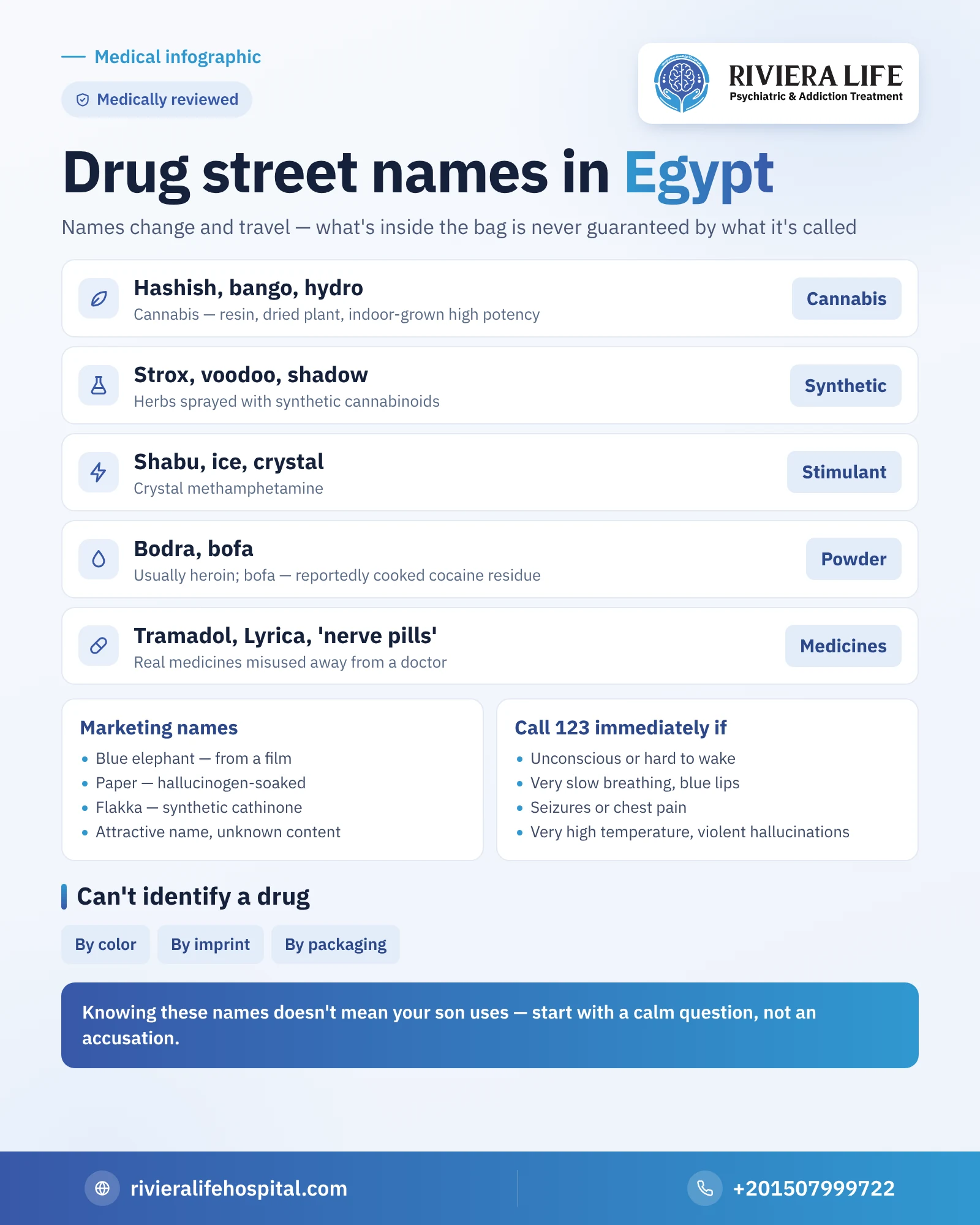
The drug street names circulating among young people in Egypt are many and changing: bango, hashish, shabu, strox, voodoo and bodra (“powder”), alongside names of medicines that are now used like street names, such as tramadol and Lyrica. This article gathers the best-known of these names in one table, explains which substance each name usually refers to, and links to the full medical guide for each one. The purpose is recognition and awareness: for the family to understand what it hears, to know where to find correct medical information, and to remember that the name never guarantees what is in the bag.
Why do drugs in Egypt have so many names?
A single substance may have a scientific name, a brand name if it is a medicine, then one or more popular nicknames that differ from one governorate to another. New names appear for purely marketing reasons, giving an unknown product an attractive name that suggests safety or strength. Over time the same name may move to a completely different substance. So treat this table as a guide for understanding, not a reference that determines the makeup of anything.
Note that this article is about the names of substances only. The words users use in everyday conversation, such as “fixing my head”, have a separate article: addicts’ slang and its meanings.
A table of drug street names in Egypt and what they refer to
| Street name | What it usually refers to | Medical guide |
|---|---|---|
| Hashish | Cannabis plant resin, in dark pieces | Hashish guide |
| Bango | Dried cannabis leaves and flowers | Bango guide |
| Marijuana / hydro | Herbal cannabis; hydro is a type grown indoors with higher potency | Marijuana guide |
| Strox | Dry herbs sprayed with synthetic cannabinoids | Strox guide |
| Voodoo | A herbal mix sprayed with synthetic substances of unknown strength | Voodoo guide |
| Shadow | A product of the same family, whose content varies from batch to batch | Shadow guide |
| Chemical / spice | An umbrella name for lab-made substances | Chemical guide |
| Shabu / shabo | Methamphetamine in crystal form | Shabu guide |
| Ice / crystal | Roughly the same thing under a different word | Ice guide |
| Captagon | Stimulant tablets; seized ones usually contain amphetamine with additives | Captagon guide |
| Bodra (powder) | In Egypt usually refers to heroin | Heroin guide |
| Bofa | A smoked product that reports describe as cooked cocaine residue | Bofa guide |
| Cocaine / crack | A stimulant extracted from coca leaves; crack is its smokable form | Cocaine guide |
| Tramadol / “tamol” | An opioid painkiller with many brand names | Tramadol guide |
| Lyrica / Lyrolin | Pregabalin, a nerve medicine that is misused | Pregabalin guide |
| “Nerve pills” / Xanax | Sedatives from the benzodiazepine family | Benzodiazepines guide |
| Paper | A paper soaked with a hallucinogenic substance | Paper guide |
| Ecstasy / molly | Tablets or powder attributed to MDMA | Ecstasy guide |
| Flakka | A synthetic stimulant from the cathinone family | Flakka guide |
| Ketamine | A medical anesthetic misused for its dissociative effect | Ketamine guide |
| Morphine / opium | Natural or medical opioid substances | Opioids guide |
Hashish, bango and hydro: are they the same thing?
All come from the cannabis plant, but the form and concentration differ. Hashish is the compressed resin, bango is the dried plant with its leaves and flowers, and hydro is a name for cannabis grown with techniques that give a higher concentration of the active substance, which is why its psychological effects are usually stronger, as explained in our article on hydro addiction. The common mistake is to treat bango as “light” just because it is a plant.
Strox, voodoo and shadow: different names, one danger
These three names refer to dry herbs with no value in themselves, sprayed with synthetic chemicals that imitate the effect of cannabis much more strongly. The problem is that the name tells you nothing: the bag called strox today may contain a different compound from the bag before it. That is why this family is linked to acute poisonings that reach the emergency department, even in people trying it for the first time.
Shabu, ice and crystal: why all these names?
These names mostly refer to one substance, crystal methamphetamine. The word “shabu” came from a foreign language, while “ice” and “crystal” come from the look of the clear crystals. The name varies by region and age group, but the effect is the same: a strong stimulant that causes continuous sleeplessness and irritability and can lead to psychosis. It shouldn’t be confused with Captagon, which is tablets of a different form and composition.
Bodra, bofa and cocaine
“Bodra” (powder) in Egyptian speech usually means heroin, but the word itself describes a form, not a substance name, so it may refer to another powder. Bofa is a newer name for a smoked product, with no official published analyses determining its components precisely. Cocaine’s name is well known, and it may be referred to by foreign abbreviations among certain groups.
Medicine names that became street names
A large part of the problem in Egypt comes from real medicines that have a medical use but are now requested by name away from the doctor:
- Tramadol: an opioid painkiller, sometimes requested by the color of the tablet or a brand name; we explained the color myth in our article on the difference between red and white tramadol.
- Lyrica and Lyrolin: two brand names for pregabalin.
- “Nerve pills”: a general expression that may mean sedatives or other psychiatric medicines, and doesn’t identify a particular substance.
- “Barsham”: a colloquial word for any tablets, which doesn’t indicate a specific type.
A substance being a medicine doesn’t mean it is safe outside a prescription; combining it with other substances is one of the most dangerous things doctors see.
Marketing names: blue elephant, paper and flakka
Some names were born from a film or the media and then became a brand in the illicit market. “Blue elephant” is a clear example: a name borrowed from a film, credited with hallucinogenic effects, with no guarantee of what the tablets contain; we cover it in our article on blue elephant pills addiction treatment. The same applies to paper and flakka: the name is attractive, the content unknown.
Does the color or imprint determine what the substance contains?
No. Color, imprint, shape and packaging can all be copied easily. Two tablets identical in appearance may contain two different substances, and a white powder could be anything. The only way to know what a person was exposed to is medical assessment and laboratory testing, the details of which are in our guide to drug testing.
What does Egyptian law say?
Egyptian law criminalizes possession of and trafficking in narcotic substances, and substances are listed in schedules that are updated to include new synthetic substances, while medicines such as tramadol and pregabalin are subject to controls on dispensing. On the other hand, the law provides a treatment path for those who request it, and a voluntary request for treatment is treated differently from possession. For precise legal details, consult a specialized lawyer.
What should you do if you hear one of these names at home?
Your son knowing these names doesn’t mean he uses, as they circulate online and among students. Start with a calm question about what he knows, and explain that attractive names hide unknown substances. And if the name comes together with changes in sleep, money or friends, ask for a specialist assessment.
Call an ambulance on 123 immediately if you see
After using an unknown substance, especially synthetic mixes or unidentified tablets:
- Loss of consciousness or difficulty waking
- Very slow breathing or blue lips
- Seizures
- Chest pain or severe palpitations
- A very high temperature with sweating or agitation
- Violent hallucinations or behavior that puts the person or others in danger
How can Riviera Life help you?
If you hear a name you don’t know, or find something you can’t identify, don’t experiment and don’t guess. Riviera Life’s team of consultants in psychiatry and addiction treatment, with fourteen years of experience in Sheikh Zayed, assesses the case in complete confidentiality and determines the most likely substance and the right next step. The first consultation is free on +201507999722, around the clock.
Read also
- Drug street names among young people in Saudi Arabia
- What is addicts’ slang?
- How do I know if my son is addicted to drugs?
- Drug addiction
- Drug street names in the Maghreb
Questions many people ask
Both come from the cannabis plant, but hashish is the compressed resin and bango is the dried plant with its leaves and flowers, and their concentration differs.
These names mostly refer to crystal methamphetamine; the name varies by region and age group, though what is sold under them may be adulterated.
In Egyptian speech it usually refers to heroin, but it describes the form of the substance and may be used for another powder.
They are brand names for one family of herbs sprayed with synthetic substances, and the actual compound varies from batch to batch regardless of the name.
No. Color, imprint and packaging can easily be copied; laboratory testing with a medical assessment is the only way to know the substance.