Parkinol addiction treatment doesn’t start with withdrawing the drug, but with a question that may change the whole plan: does this person need it medically or not? Many who misuse it are psychiatric patients who take it with antipsychotics, and withdrawing it without reviewing their treatment may bring back tremor and stiffness or push them to abandon their psychiatric treatment. That is why treatment combines a careful assessment in coordination with the treating psychiatrist, gradual tapering under supervision that eases rebound symptoms, and psychotherapy that addresses what drove the overuse. In this article we explain each stage, when residence is necessary, and how to choose the right place.
Why does Parkinol treatment differ from others?
In most cases of addiction the goal is clear: complete stopping of the substance. Parkinol, however, is a medicine with a legitimate place in treating the effects of antipsychotics, so the patient goes down one of two roads. The goal may be stopping it completely, when it turns out they no longer need it or never needed it. Or the goal may be returning it to a small therapeutic amount under strict control, or replacing it with another solution for the movement problem. Added to this is that Parkinol rarely comes alone; tramadol, hash and alcohol are frequent companions, and each has its account in the plan. For those who want to understand the drug itself and the reasons for its spread, the Parkinol guide explains that in detail.
Stages of Parkinol addiction treatment
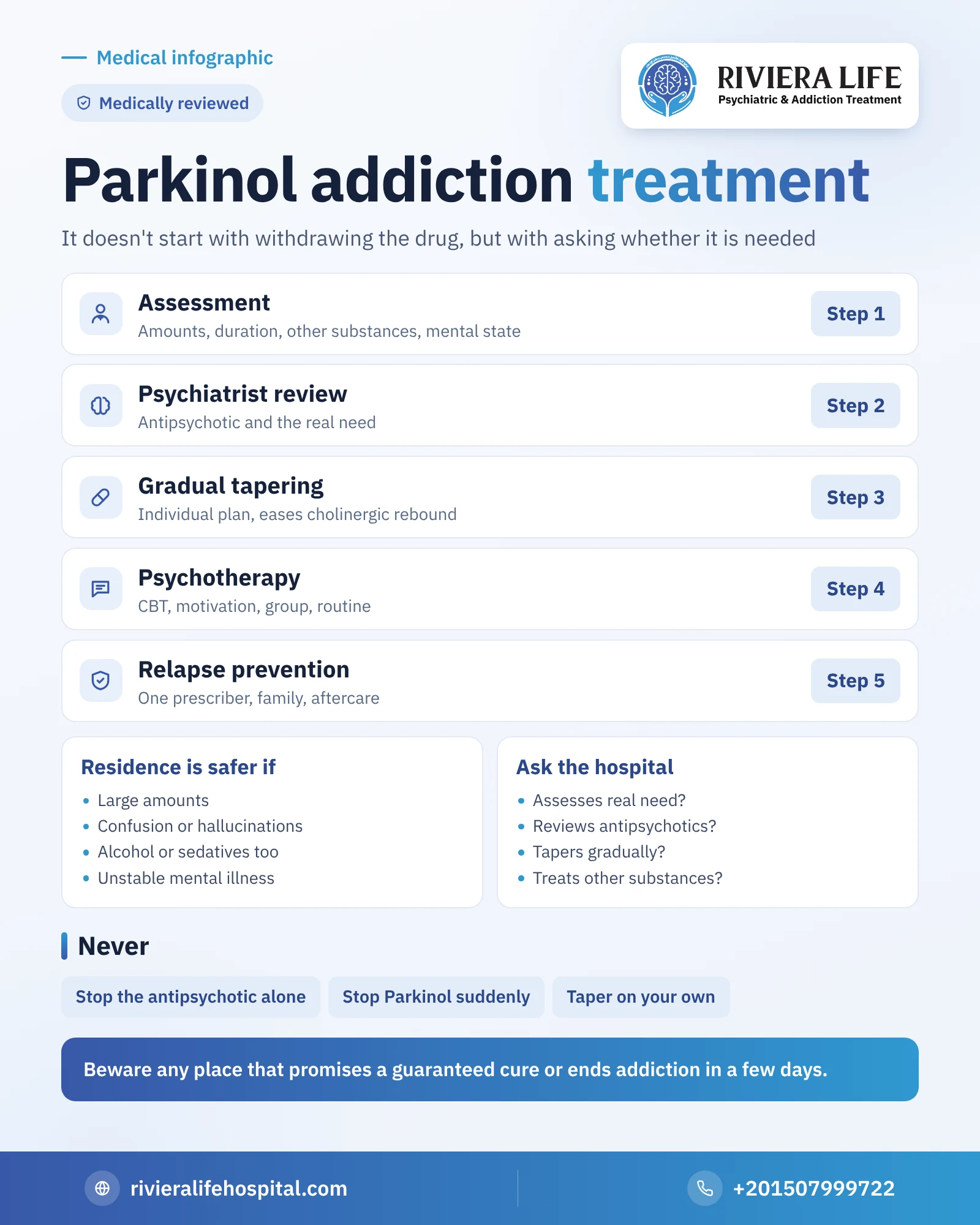
- Comprehensive assessment: amounts, duration, accompanying substances, and the mental and physical condition.
- Coordination with the psychiatrist: reviewing the antipsychotic and the real need for Parkinol.
- Gradual tapering: an individual plan under supervision that eases the cholinergic rebound.
- Treating accompanying substances: a safe order for withdrawing tramadol or others.
- Psychotherapy: individual and group, addressing motives and building skills.
- Relapse prevention and aftercare: a written plan, follow-up and family involvement.
Assessment: does the patient really need Parkinol?
The doctor sits with the patient and their family to learn the whole story: when did the medicine start and why? Who prescribed it? How much do they take now compared with the prescription? Do they take it for the tremor or for the feeling it gives? Then they examine the movement signs themselves: is there real tremor, stiffness, spasms or restlessness? The presence or absence of these signs says a lot.
The assessment includes a physical examination focusing on the heart, blood pressure, temperature, bladder and bowels, because excess anticholinergics leave their mark on them, with tests for other substances they may be taking. The mental state is asked about carefully: is there schizophrenia, bipolar disorder or depression? Is it stable now? Have thoughts of self-harm appeared? The answer determines whether treatment needs residence or whether outpatient follow-up is enough.
Coordinating with the psychiatrist and reviewing the antipsychotic
This is the step that distinguishes Parkinol treatment. If the patient takes it because the antipsychotic causes them movement effects, the ideal solution is often in reviewing the antipsychotic itself, not in Parkinol. The psychiatrist may see fit to adjust the amount, or move to a newer medicine less likely to cause movement symptoms, and then the need for Parkinol declines or disappears. And if the main symptom is restlessness that doesn’t calm down, what doctors call “akathisia”, it may have other treatment options the doctor determines.
The danger the team takes care to prevent is the patient stopping the antipsychotic itself to escape its effects, so their mental illness relapses. That is why the treating doctor is informed of every step, and no psychiatric medicine is changed except by their decision or in agreement with them.
Gradual tapering under supervision
Parkinol isn’t stopped suddenly after regular use in large amounts, because the body that got used to blocking acetylcholine responds with an opposite wave: nausea and vomiting, sweating, headache, insomnia, anxiety, muscle tension, and the tremor may return. The doctor sets a staged tapering plan that suits the amount, duration and mental state, and the team monitors sleep, pulse, blood pressure, mood and movement throughout. Every troublesome symptom is treated with what suits it, so the patient isn’t left facing insomnia or anxiety alone. The length of this stage differs from patient to patient, and may extend for weeks in someone used to large amounts.
Treating accompanying substances
When it becomes clear that Parkinol is part of a mix that includes tramadol, hash, alcohol or sedatives, the doctor determines the order and speed of withdrawal. Withdrawal from alcohol and sedatives may be dangerous and needs careful follow-up, and withdrawing tramadol has its own symptoms explained in the article on tramadol addiction treatment. Leaving these substances untreated while focusing on Parkinol alone makes relapse almost certain, because the person will look for a substitute to fill the gap.
Is there a medicine that treats Parkinol addiction?
There is no dedicated medicine that removes the craving for Parkinol as there is with some other types of addiction. What the doctor offers is treatment for the symptoms during tapering, such as sleep disturbance, anxiety and nausea, treatment for the underlying mental disorder with the best medicine suited to it, and an alternative solution for the movement problem if present. All of this the doctor determines according to each patient’s condition, and there is no place in it for home remedies or tapering the patient decides on their own.
Psychotherapy: what was Parkinol filling?
Some patients used Parkinol to escape a long emptiness, a heavy sadness or the effects of a mental illness that made their lives narrow. Some young people started it looking for excitement within a group of friends. In both cases recovery needs more than medicine:
- Cognitive behavioral therapy: uncovers the situations that ignite craving and builds practical alternatives to them, as the article on cognitive behavioral therapy explains.
- Motivational interviewing: helps the hesitant patient see what they have lost and what they want to regain.
- Medication education: the patient understands why the medicine was prescribed in the first place, and how to tell their doctor about symptoms instead of doubling the amount.
- Group therapy: meeting those who went through the same experience breaks isolation and denial.
- Organizing the day: regular sleep, physical activity, and work or training that fills the time that used to go to use.
Hospital residence or outpatient follow-up?
Residence is safer when the amounts are large, confusion and hallucinations have recurred, the patient combines Parkinol with other substances especially alcohol and sedatives, their mental illness is unstable, or thoughts of self-harm appear. Outpatient follow-up suits someone who exceeded the prescription to a limited degree and has a psychiatrist following them and a family able to support. The dual diagnosis program is suitable for someone who combines a mental illness with misuse of the medicine, because it treats both together with one team.
Relapse prevention and the family’s role
After tapering ends the patient leaves with a clear plan: who is the only doctor who dispenses their medicines, when is the next review appointment, and what to do if the tremor returns or the craving intensifies. The family can help by keeping the medicines in a safe place and handing them over in the prescribed amount if the doctor asks for that, by watching for signs of return such as repeated dry mouth, slurred speech and missing strips, and by attending the family program sessions. Most importantly, it should treat any stumble as a signal to review the plan with the team, not a reason for despair or punishment.
The right hospital for Parkinol addiction treatment: how to choose
The right hospital for Parkinol addiction treatment is one that offers what a patient on this particular drug needs: a psychiatrist who decides the real need for it, safe gradual tapering, and the ability to treat the accompanying mental illness without it relapsing. Before you decide, ask:
- Does the team assess the real medical need for Parkinol in coordination with the treating psychiatrist?
- Is there experience in reviewing antipsychotics and their movement effects?
- Is the medicine tapered gradually with an individual plan instead of being stopped all at once?
- Is there round-the-clock medical supervision able to deal with delirium or high temperature?
- Does the program treat accompanying substances such as tramadol and alcohol?
- Does the program include the family and aftercare after discharge?
And beware any place that promises you a guaranteed cure or ending the addiction in a few days.
How Riviera Life meets these standards in Parkinol addiction treatment
At Riviera Life these criteria take the following form:
- Official license: a hospital licensed by the Ministry of Health for psychiatry and addiction treatment.
- Psychiatry and addiction treatment under one roof: consultants who review the antipsychotic and the need for Parkinol in one plan.
- Carefully planned gradual tapering: an individual plan that eases rebound and protects against the return of movement symptoms.
- Round-the-clock supervision: 24-hour medical care to detect confusion, fever or pulse disturbance early.
- Fourteen years of experience: and thousands of cases recovered from addiction to various medicines and substances.
- Complete confidentiality: the data of the patient and their family is protected at every stage.
- A family program and aftercare: follow-up after discharge that reduces the risk of relapse.
The first consultation is free, and you can get in touch around the clock via +201507999722; we are based in Sheikh Zayed, Giza.
More from the Parkinol guide
- Parkinol: the complete guide
- Mydrapid eye drops and the risks of anticholinergics
- The dual diagnosis program for addiction treatment
- Schizophrenia treatment
- Parkinol withdrawal symptoms: the timeline, cholinergic rebound and when to worry
Questions many people ask
Yes, many patients recover when treatment combines safe gradual tapering, a review of their psychiatric medicines and psychotherapy that addresses the motives for overuse.
The psychiatrist reviews the antipsychotic itself, and may adjust its amount or replace it with a medicine less likely to cause tremor, and then the need for Parkinol decreases or disappears.
That differs according to the amount, duration and accompanying substances; tapering may take weeks, then psychotherapy and follow-up continue for months.
No, stopping the antipsychotic exposes them to relapse. Their psychiatric treatment continues and is adjusted only by the treating doctor's decision and in coordination with the addiction team.
Choose one licensed by the Ministry of Health that combines psychiatry and addiction treatment, reviews the real need for the drug and tapers it under round-the-clock supervision. Riviera Life in Sheikh Zayed, Giza, meets these criteria with fourteen years of experience.