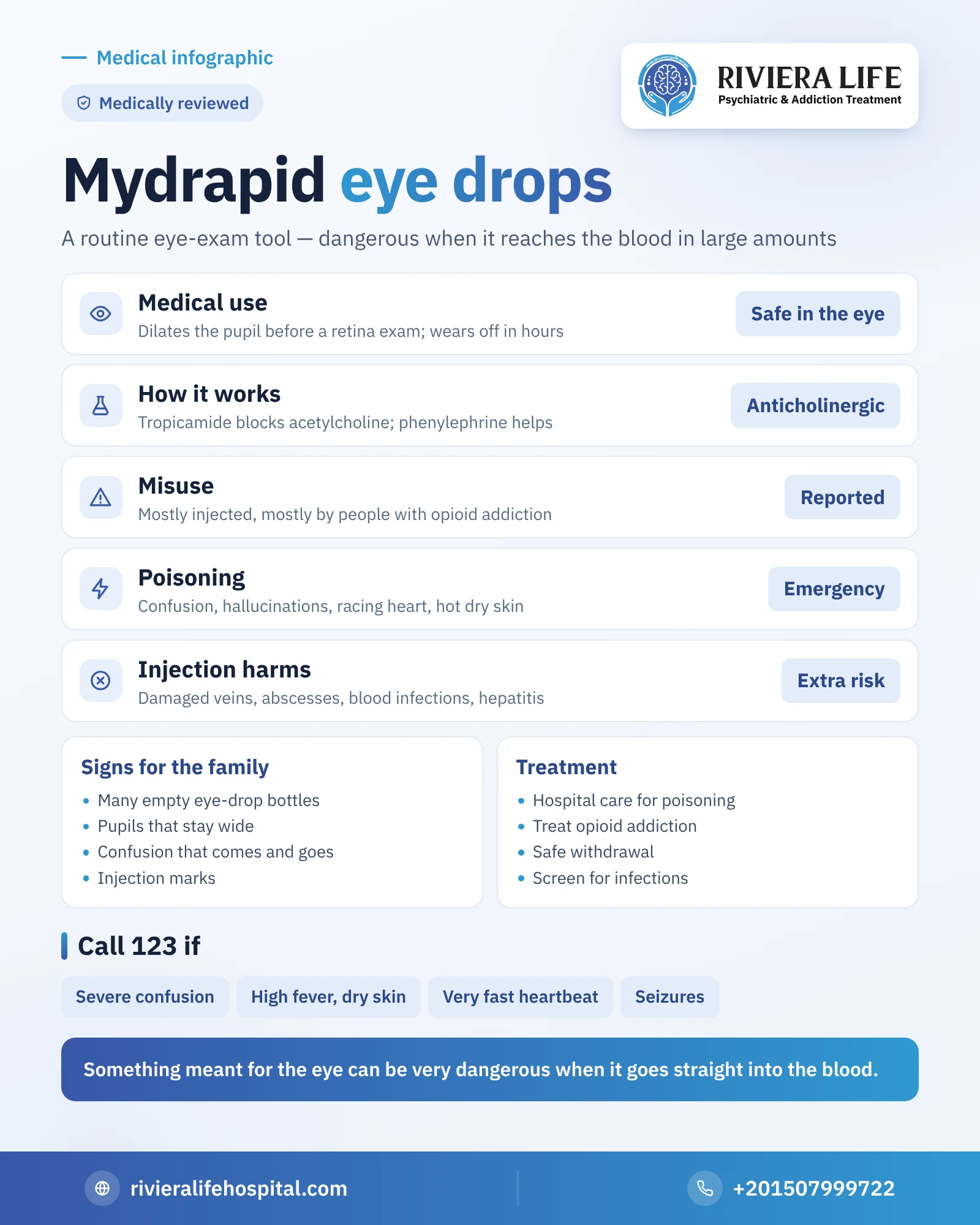
Mydrapid drops are eye drops ophthalmologists use to dilate the pupil before examining the back of the eye, and their main substance is tropicamide, with some formulations combining it with phenylephrine. In the eye clinic they are an ordinary examination tool whose effect wears off within hours.
But medical references from several countries have recorded a worrying phenomenon: the misuse of tropicamide drops outside their medical purpose, usually by injection, and mostly by people with opioid addiction. This misuse can cause serious poisoning that confuses the brain, raises temperature and speeds the heart, and may end in seizures or psychosis. In this article we explain the drops and their correct use, the reality of this phenomenon, its signs, and when it becomes an emergency.
What are Mydrapid eye drops?
Mydrapid is a trade name for eye drops in the class of pupil dilators. The ophthalmologist or his assistant puts them in the eye before the examination, the pupil widens within minutes, and the doctor can see the retina and optic nerve clearly. They are also used before some operations and sometimes in measuring children’s vision. Similar in idea are other pupil-dilating drops containing cyclopentolate, including one sold as “Cyclophrine”, and some people call imported dilating drops “Belgium drops”.
After the examination the patient notices blurred near vision and sensitivity to light for several hours, and in some people this may extend to almost a whole day. That is why not driving after the examination and wearing sunglasses are advised. These are expected effects, not complications.
Tropicamide and phenylephrine: how do the drops work?
Tropicamide is one of the anticholinergic medicines, meaning it blocks the action of acetylcholine, a neurotransmitter responsible for contracting the pupil muscle and the focusing muscle inside the eye. When this messenger is blocked in the eye, the muscle relaxes and the pupil widens. Phenylephrine works differently, activating the pupil-dilating muscle and narrowing blood vessels, completing the effect of tropicamide.
The problem is that acetylcholine doesn’t work only in the eye, but in the brain, heart, bowel, bladder and sweat glands. When tropicamide reaches the blood in amounts exceeding what is absorbed from a drop in the eye, its anticholinergic effects appear throughout the body. That is why medical references warn that children specifically may develop mental confusion or difficulty breathing even with medical use, because of their small bodies.
The phenomenon of tropicamide drop misuse
In recent years medical journals have published reports and reviews about people using tropicamide drops outside the clinic in search of a psychological effect. The phenomenon was first observed in Russia and Italy, then in Turkey, Kazakhstan and other countries, and similar reports have come from the Arab region. These references agree on several features:
- Most of those who misuse them already have an addiction to opioids, such as heroin.
- The most common route in the reports is injection, which is the most dangerous route of all.
- They are often used with other substances, such as opioids, alcohol and hashish, so the risks become intertwined.
- Users describe a short effect dominated by confusion and hallucinations, not real pleasure.
We deliberately don’t mention any details about the method of use here, as the purpose of this article is to help families and patients understand the danger and act correctly.
Why do some people turn to Mydrapid drops?
Medical reviews point to recurring reasons behind the spread of this phenomenon:
- Price: the drops are much cheaper than narcotic substances, so they become a substitute for someone who has run out of money.
- Easy access: being an eye medicine makes them seem far from suspicion.
- A false belief that they are safe: some think that what is put in the eye can’t be dangerous, which is completely untrue when the medicine enters the blood directly.
- Trying to cope with another addiction: some patients say they use them when they can’t find opioids or to ease opioid withdrawal, adding a new danger to an existing one.
- What circulates online: researchers noted that experiences told by users on forums contributed to spreading the phenomenon.
This phenomenon has pushed regulatory bodies in a number of countries to tighten controls on dispensing tropicamide drops in pharmacies, and there are controls regulating the dispensing of this class of medicines.
Anticholinergic poisoning: the first danger
When tropicamide reaches the blood in large amounts, what doctors call anticholinergic poisoning occurs, and it has a distinctive picture:
- Mental confusion, disorientation and not recognizing the place or time.
- Visual hallucinations, incoherent speech, and random movements as if the person is picking up things that aren’t there.
- A very fast heartbeat.
- A raised body temperature with hot, dry, flushed skin, because sweating stops.
- Severe dry mouth, pupils dilated for a long time, and blurred vision.
- Urinary retention and stopped bowel movement.
- In severe cases: seizures and coma.
A raised temperature with stopped sweating can quickly turn into a dangerous condition, especially in hot weather. And if the drops contain phenylephrine, this may add the risk of high blood pressure.
The harms of injection itself
Eye drops are a preparation designed for the eye, not for the vein, and injection in itself carries harms independent of the substance:
- Damage, inflammation and clotting of the veins, and painful abscesses at injection sites.
- Bacterial infection that may spread to the blood or the heart valves.
- Transmission of viruses such as hepatitis and HIV when equipment is shared.
References have also reported, with repeated use, kidney and liver problems, severe weight loss and heart disturbances.
Psychosis and the psychological effect
The hallucinations users describe aren’t a pleasant effect, but a sign that the brain is in a state of poisoning. With repetition, psychotic episodes may appear that continue after the acute effect has worn off: suspicion, paranoia, strange thoughts and disturbed behavior. Reports have also recorded mood swings and suicidal thoughts in some users. These risks increase when the person already has an opioid addiction and an accompanying psychiatric disorder.
Signs that alert the family to misuse of the drops
If a member of your family has an opioid addiction or has recently recovered from one, pay attention to the following:
- Empty eye-drop bottles in numbers no vision problem explains.
- Dilated pupils that don’t narrow in light, and repeated complaints of blurred vision.
- Episodes of confusion, unintelligible speech or hallucinations that come and go.
- Injection marks, bruises or inflammation on the arms or elsewhere.
- Heat and redness in the face, dry mouth, and difficulty urinating.
These signs prove nothing on their own, but they are reason enough for a calm conversation with the patient and asking for a medical assessment. You will find the general signs of addiction to this class in our article on opioid addiction symptoms.
When should you call an ambulance?
Call an ambulance on 123 immediately if you see
Anticholinergic poisoning can develop within a short time, especially with injection or with other substances in the body.
- Severe confusion, hallucinations or agitation that can’t be calmed
- A very high temperature with hot, dry skin
- A very fast heartbeat or chest pain
- Seizures, loss of consciousness or difficulty waking him
- Slow breathing or blue lips if he has also used opioids
Tell the ambulance team everything you know about the substances he used, and keep any empty bottles to hand to the doctor. Don’t try to cool him with ice water or give him any medicine from home.
Treating misuse of Mydrapid drops
Treatment passes through two stages. The first is emergency: the poisoning is treated in hospital with monitoring, lowering the temperature, calming the agitation and protecting the heart and breathing, and the doctor may decide on specific medicines according to the case. The second is treating the cause, which in most cases is the opioid addiction itself, as the drops are a symptom of a bigger problem. This includes a comprehensive psychiatric assessment, safe management of withdrawal, psychological and behavioral therapy, and may include opioid treatment medicines chosen by the doctor, along with screening for hepatitis and infectious diseases linked to injection. Details of this stage are in our article on opioid addiction treatment.
If you use the drops on an ophthalmologist’s prescription, there is no need to worry; medical use in the eye is mostly safe, and what matters is that they are used only as the doctor directs and kept out of children’s reach.
How can Riviera Life help you?
At Riviera Life we deal with opioid patients who turn to unexpected medicines such as these drops, and we know that the family usually discovers the matter by chance and feels confused. The psychiatry and addiction treatment consultants assess the case in complete confidentiality, and the first consultation is free on +201507999722.
More from our opioids guide
- Opioids: the complete guide
- Opioid addiction treatment
- The harms of opioids
- Opioid withdrawal symptoms
- Parkinol: the complete guide
- Treating nasal spray addiction: how to get out of rebound congestion
Questions many people ask
Eye drops that dilate the pupil, used by the ophthalmologist before examining the retina and the back of the eye. Their main substance is tropicamide, and some formulations also contain phenylephrine.
They aren't a narcotic when used in the eye as the doctor directs. But their entering the blood in large amounts, as in cases of misuse, causes poisoning that affects the brain with confusion and hallucinations and can be dangerous.
Usually several hours, and in some people it may extend to about a day, with blurred near vision and sensitivity to light. Not driving until the effect wears off is advised.
Confusion and hallucinations, a racing heart, high temperature with dry skin, dry mouth and dilated pupils, urinary retention, and in severe cases seizures. This is an emergency calling for an ambulance on 123.
Yes. The poisoning is treated first in hospital, then the underlying cause, which is usually opioid addiction, is treated with a program including safe withdrawal, psychotherapy and follow-up.