The short answer
Eating disorders treatment needs a team, not a single doctor: a psychiatrist, a psychotherapist, a dietitian and a doctor who follows up the body. It starts with an assessment that determines whether the case is safe for outpatient treatment or needs admission to stabilize the body first. Its mainstay is psychotherapy, such as cognitive behavioral therapy designed for eating disorders, and family-based therapy for teenagers with anorexia. Medicines have a supporting role in some types, such as bulimia nervosa and binge eating disorder, but they don’t replace psychotherapy. And the earlier treatment starts, the better the chances of recovery.
- The foundationPsychotherapy with medical and nutritional follow-up
- For teenagersFamily-based therapy has the strongest evidence in anorexia
- When hospitalWhen the heart or electrolytes are unstable, or there is a risk of suicide
Eating disorders aren’t a matter of willpower or excessive interest in appearance. They are psychiatric disorders with physical effects that can be serious, and their treatment is often delayed because the person hides them or doesn’t see them as a problem, and because the family may think it is a phase that will pass. This guide explains what modern treatment looks like, its levels, and what the patient and their family can expect at each stage.
The first assessment: two questions before anything else
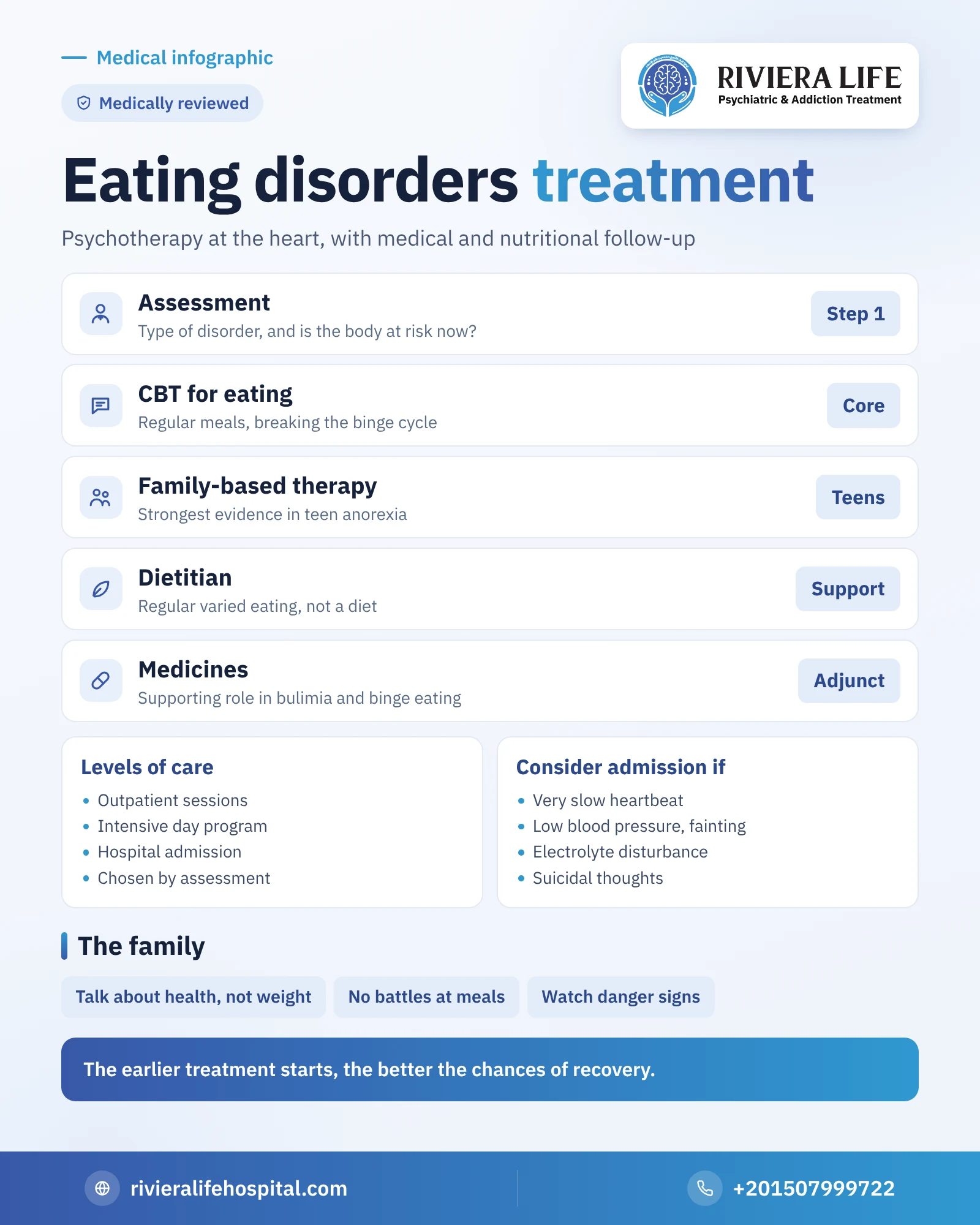
The first assessment answers two questions: what type of disorder is it, and is the body at risk now? That is why it includes a psychological assessment, weight and its history, a medical examination, an ECG and blood tests, especially electrolytes such as potassium and phosphorus. Repeated vomiting or laxative use can seriously disturb electrolytes even if weight looks normal, and severe thinness can slow the heart to a degree that needs monitoring.
The assessment also looks for depression, anxiety, obsessive-compulsive disorder, substance use and thoughts of self-harm, because they often occur together with eating disorders and change the shape of the plan.
Levels of treatment: from the clinic to admission
- Outpatient treatment: regular sessions with the therapist and dietitian and periodic medical follow-up; suits physically stable cases.
- The intensive or day program: hours of treatment and supervised meals several days a week while returning home, for those who need more support than the clinic.
- Hospital admission: for cases where the body is unstable, that haven’t improved with outpatient treatment, or where there is a risk of suicide.
Among the signs that call for considering admission: a very slow heartbeat, low blood pressure with dizziness and fainting, a clear electrolyte disturbance, rapid and continuing weight loss, repeated vomiting that doesn’t stop, complete refusal of food or fluids, or suicidal thoughts.
Psychotherapy: the heart of the plan
Cognitive behavioral therapy designed for eating disorders
A version of cognitive behavioral therapy designed for eating disorders, it works on regular meals, breaking the cycle of deprivation then binge then compensation, and dealing with excessive preoccupation with weight and shape and the way the patient judges themselves through them. It has strong evidence in bulimia nervosa and binge eating disorder, and is also used in adults with anorexia.
Family-based therapy for teenagers
In anorexia in teenagers, family-based therapy has the strongest evidence. In its first phase the parents take responsibility for meals and restoring weight under the therapist’s guidance, then control gradually returns to the teenager as they improve. The idea isn’t to blame the family, but to make it the most powerful tool in treatment.
Other approaches
The therapist may use other approaches depending on the case, such as interpersonal therapy, or dialectical behavior therapy when the disorder occurs together with impulsivity or self-harm.
The dietitian’s role
The dietitian here doesn’t set a “diet”, but helps the patient return to regular, sufficient and varied eating, and to face the foods they fear. In cases of severe thinness, food is increased gradually and under medical supervision, because a fast start may cause what is known as refeeding syndrome, a dangerous electrolyte disturbance that happens when a body that has been starved for a long time suddenly receives large amounts.
Are there medicines to treat eating disorders?
- In bulimia nervosa: fluoxetine is used, an antidepressant approved for this use in a number of countries; it helps reduce binge and vomiting episodes, and works better with psychotherapy.
- In binge eating disorder: cognitive behavioral therapy alone may help, and there are medicines studied for this disorder that the doctor decides on depending on the case.
- In anorexia nervosa: there is no medicine that treats the disorder itself; restoring weight and psychotherapy are the foundation, and medicines may be used to treat accompanying anxiety or intense thoughts.
How long does recovery take?
Recovery from eating disorders usually takes months, and may last longer in long-standing cases. It doesn’t follow a straight line; temporary setbacks are an expected part of the journey and don’t mean treatment has failed. Doctors measure improvement by the return of a healthy weight, regular meals and fewer binge and compensation episodes, and also by weight and shape losing their control over the patient’s thinking and decisions.
The family’s role
- Talk about worry for health and behavior, not about weight and appearance.
- Avoid commenting on other people’s bodies or diets in front of the patient.
- Don’t turn every meal into a battle, and leave the details of the plan to the treatment team.
- Watch for physical danger signs, such as fainting or palpitations, and don’t wait for the next appointment.
- Take care of yourselves too; the journey is long and exhausting for families.
Eating disorders and substance use
Some people with eating disorders use stimulants or slimming pills to suppress appetite, or alcohol to ease tension after eating episodes, creating two intertwined problems. Treatment then needs a plan that deals with both together, because treating one alone often pushes the patient towards the other.
How does Riviera Life help you?
At Riviera Life it starts with a psychological and medical assessment that determines the type of disorder and the appropriate level of care, with follow-up of the physical condition and any accompanying depression, anxiety or substance use, and the plan is built with the family’s participation. Before the visit you can take the eating disorders test as a first step towards understanding, not diagnosis.
More from the eating disorders guide
Questions many people ask
Psychotherapy is the foundation, such as cognitive behavioral therapy designed for eating disorders and family-based therapy for teenagers, together with medical and nutritional follow-up.
When the heart, blood pressure or electrolytes are unstable, with rapid weight loss, complete refusal of food, or suicidal thoughts.
Medicines have a supporting role in bulimia nervosa and binge eating disorder, and there is no medicine that treats anorexia nervosa itself.