Bulimia nervosa is an eating disorder that the person lives with in silence and shame, and it stays hidden for years because the person usually looks completely normal in appearance and life. In it, eating episodes recur in which the person feels they have lost control, followed by guilt, shame and harmful attempts to erase the effect of what happened. This isn’t weakness of will or greed, but a painful cycle fed by shame itself, and it is treated successfully when the patient comes out of secrecy. This article is about understanding the cycle, its signs for the family, its medical risks, and what treatment and talking with someone you love look like. Only a psychiatrist or specialized team diagnoses the condition.
What is bulimia nervosa?
The diagnosis combines two elements that recur over a period: eating episodes with a painful sense of loss of control, then harmful compensatory behaviors the person resorts to out of fear of the effects of what they ate. The person’s view of themselves is greatly affected by the shape of their body and what they think others think of it. Contrary to the common image, the person isn’t necessarily thin; many have a normal or higher weight, which is why discovery is delayed.
To learn where this disorder sits among the other types, you can go back to the comprehensive guide to eating disorders, and for the difference between it and the opposite picture, read about anorexia nervosa.
The cycle that traps the person
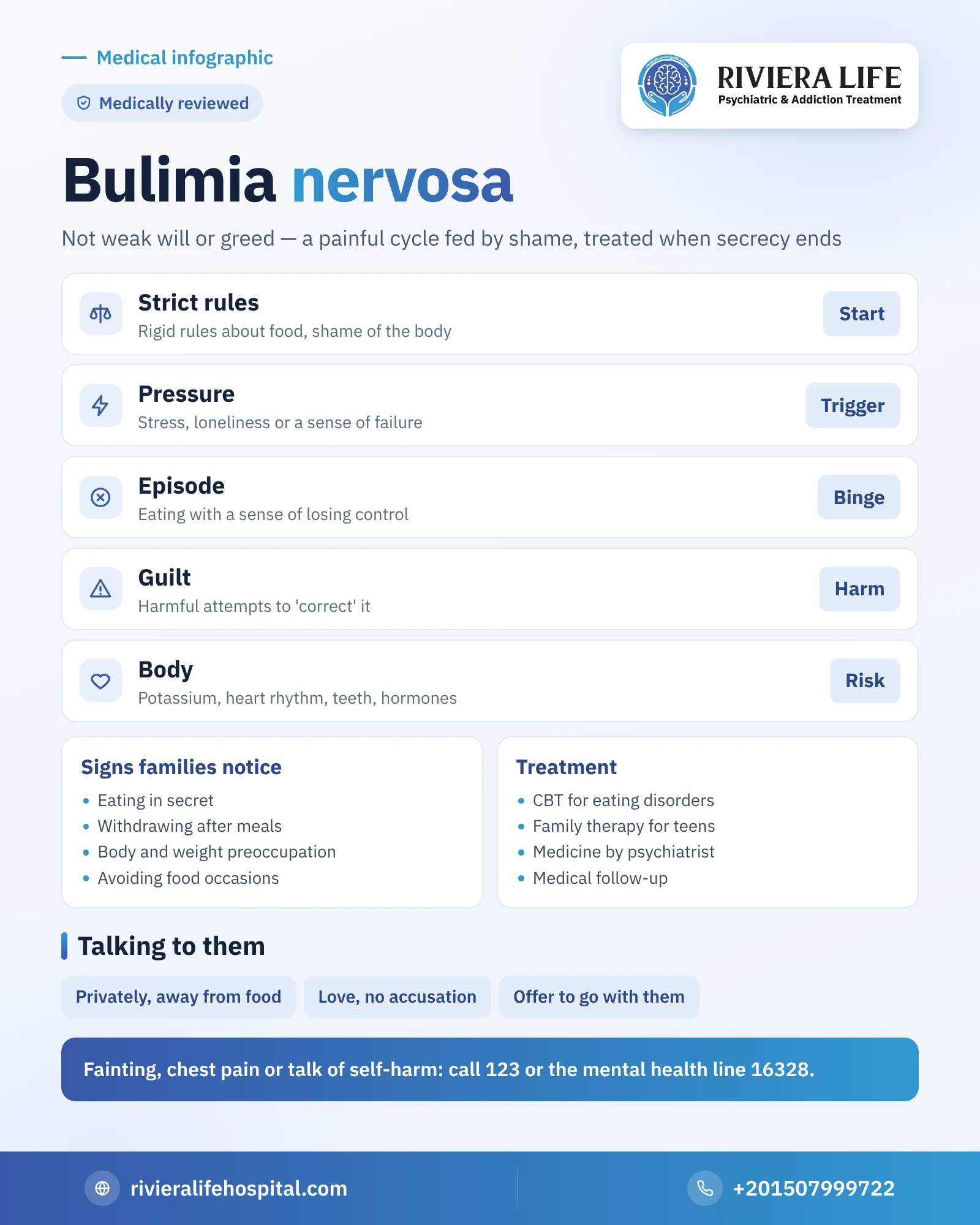
Understanding the cycle is the most important thing, because treatment works to break it. It often begins with strict rules the person imposes on themselves about eating and with shame of their body. Then some pressure comes, stress, loneliness or a feeling of failure, and an episode happens in which they feel things have slipped out of their hands. After the episode guilt and self-disgust arrive, so they try to “correct” what happened in a harmful way, the strict rules increase and the cycle begins again. Nothing changes by willpower alone, because the cycle feeds on shame, and shame pushes to silence.
Often the episode works as a temporary soother of painful feelings, then the relief turns into a bigger burden. This doesn’t make the disorder “food addiction” in the common sense, and we explain the difference in the article on food addiction and binge eating disorder.
How does it differ from other eating disorders?
In anorexia nervosa restriction and clear undernutrition dominate, while in bulimia nervosa the axis is the cycle between the episode, guilt and compensation, and the body may look healthy. In binge eating disorder there are episodes and distress without compensatory behaviors. A person may move between these patterns over the years, which is why treatment depends less on the name than on a comprehensive assessment by a specialist.
Why do people discover bulimia nervosa late?
- Appearance doesn’t reveal it: there is no clear change in the body in many cases.
- The shame is intense: the patient hides it even from the closest people, and may live with it for years.
- The social appearance is fine: study, work and relationships that look stable.
- Lack of knowledge: many don’t know that what they are going through has a name and a treatment.
Signs that catch the family’s attention
No single sign is enough. What matters is what accumulates and persists:
- In behavior: a noticeable change around meals, eating in secret, food disappearing or unexplained leftovers, and repeated withdrawal right after sitting with others.
- In thinking and mood: intense preoccupation with appearance and weight, clear shame of the body, mood swings, and anxiety or deep sadness.
- In the body: noticeable fluctuation of weight up and down, fatigue and dizziness, and erosion of the teeth that the dentist may notice first.
- In life: avoiding social occasions that involve food, and unexplained spending of money on food.
Each of these signs may have another explanation, but a number of them together is what calls for a calm assessment.
What does the illness do to the body?
The cycle and the harmful behaviors it includes affect the body directly. The most dangerous is a disturbance of blood salts, especially potassium, because it may cause a disturbance of heart rhythm even in a young person who looks healthy. The digestive system is affected, tooth enamel erodes, and the menstrual cycle and hormones are disturbed. Mood is strongly affected, as depression and anxiety recur with this disorder. That is why we stress that tests and medical examination are an essential part of treatment.
Call the ambulance on 123 immediately if any of these appear
Go to the nearest emergency department or call the ambulance if someone with an eating disorder shows:
- Fainting or severe dizziness that prevents them from standing
- Chest pain, severe palpitations or an irregular pulse
- Severe muscle weakness, tremor or seizures
- Vomiting blood, severe abdominal pain or difficulty swallowing
- Confusion or talk of ending their life or self-harm, and you can also call the mental health hotline 16328
Bulimia nervosa, depression and substance use
Bulimia nervosa often goes hand in hand with depression and anxiety, and in some people it may be linked with substance use or self-harm. If these are present together, the best treatment is one that addresses them in a single plan, as in the dual diagnosis program. And if the person has thoughts of self-harm, read self-harm: how to help someone you love without blame and seek urgent help.
Treatment: what really works?
- Cognitive behavioral therapy designed for eating disorders: one of the most evidence-supported treatments, it works to break the cycle and the thoughts linked to the body and to build a stable, calmer relationship with food, under the specialist’s supervision.
- Family therapy for teenagers: the family takes part, guided by the therapist, in supporting the teenager.
- Medicine: the psychiatrist may prescribe a medicine from the antidepressant class in some cases, after careful assessment. It is only started or stopped under the doctor’s supervision, and doesn’t replace psychotherapy.
- Medical follow-up: checking salts, the heart and teeth, and treating complications.
- Level of care: the clinic is enough for many, and residence is needed when the physical condition is unstable or there is a risk to the self.
The good news is that bulimia nervosa is among the eating disorders in which many improve greatly with treatment, especially when starting early.
How do you talk with someone you suspect has it?
- Talk privately, at a calm time, and away from food.
- Start with your love and worry, and say that you aren’t judging them, and that what they are going through isn’t a flaw in them.
- Avoid interrogating questions about the details of what they do, and avoid commenting on their appearance or what they eat.
- Tell them that shame is part of the illness, and that there is treatment that helps.
- Offer to accompany them to an appointment with a psychiatrist, and be patient if they refuse the first time.
- Avoid monitoring, searching and punishment, as they push them to more secrecy.
And if you are the one suffering, know that asking for help isn’t an admission of failure, and that the first assessment session may be the hardest part, after which much of the weight lightens.
When should you seek help? And how does Riviera Life help you?
Seek an assessment if episodes of loss of control and guilt have started to recur, or if you feel that you or someone you love is trapped in a cycle they can’t get out of. Don’t wait for complications to appear. At Riviera Life in Sheikh Zayed, Giza, the consultants in psychiatry and addiction assess the case in complete confidentiality, the team follows the medical side when needed around the clock, and families take part in the family program and follow-up. The hospital is licensed by the Ministry of Health. The first consultation is free on +201507999722.
More from the eating disorders guide
- Eating disorders treatment
- Eating disorders: the comprehensive guide to types, signs and treatment.
- Anorexia nervosa: what happens inside the person and what recovery looks like.
- Food addiction: the difference between it and binge eating disorder.
- Depression and addiction: the relationship between them and how they are treated together.
- Fasting, mental health and recovery: who needs caution and how to protect your recovery?
- The SCOFF eating disorders test
Questions many people ask
No. Many have a normal or higher weight, which is why discovery is delayed. Medical risks may be present despite a normal appearance.
No, it is a psychological disorder fed by a cycle of shame and guilt, and it isn't solved by willpower alone but by specialized treatment.
In both there are eating episodes with loss of control, but bulimia is followed by harmful compensatory behaviors, while these behaviors aren't present in binge eating disorder.
The psychiatrist may prescribe a medicine from the antidepressant class in some cases, and it is only started or stopped under the doctor's supervision, and doesn't replace psychotherapy.
Talk with them privately, with love and without accusation, describe your worry about their mood and health, not their appearance, and offer to accompany them to a psychiatrist.