Anorexia nervosa is a serious mental illness, unrelated to low appetite, being spoiled or wanting to be slim. Its essence is an overwhelming fear of the body changing, and a distorted self-image that makes the person see themselves with an eye their family doesn’t see them with. The person usually finds it hard to believe they are ill, which is why the family bears the responsibility of first noticing. This article explains what goes on inside the person, why they deny it, what recovery looks like step by step, and how to talk with them without closing the door. Only a psychiatrist or specialist team makes the diagnosis.
What does the name anorexia nervosa hide?
The phrase “loss of appetite” is misleading. The patient usually feels hunger, but lives in a constant struggle with it, and feels that winning this struggle is evidence of their strength and discipline. Food turns from a natural need into a daily testing ground for the self. From the outside they may seem perfect: high-achieving, tidy and obedient, while inside they carry an anxiety that never settles and low self-esteem.
As for the general framework of eating disorders and all their types, you will find it in the complete guide to eating disorders. Here we focus on anorexia nervosa alone.
Fear first: how does the person think?
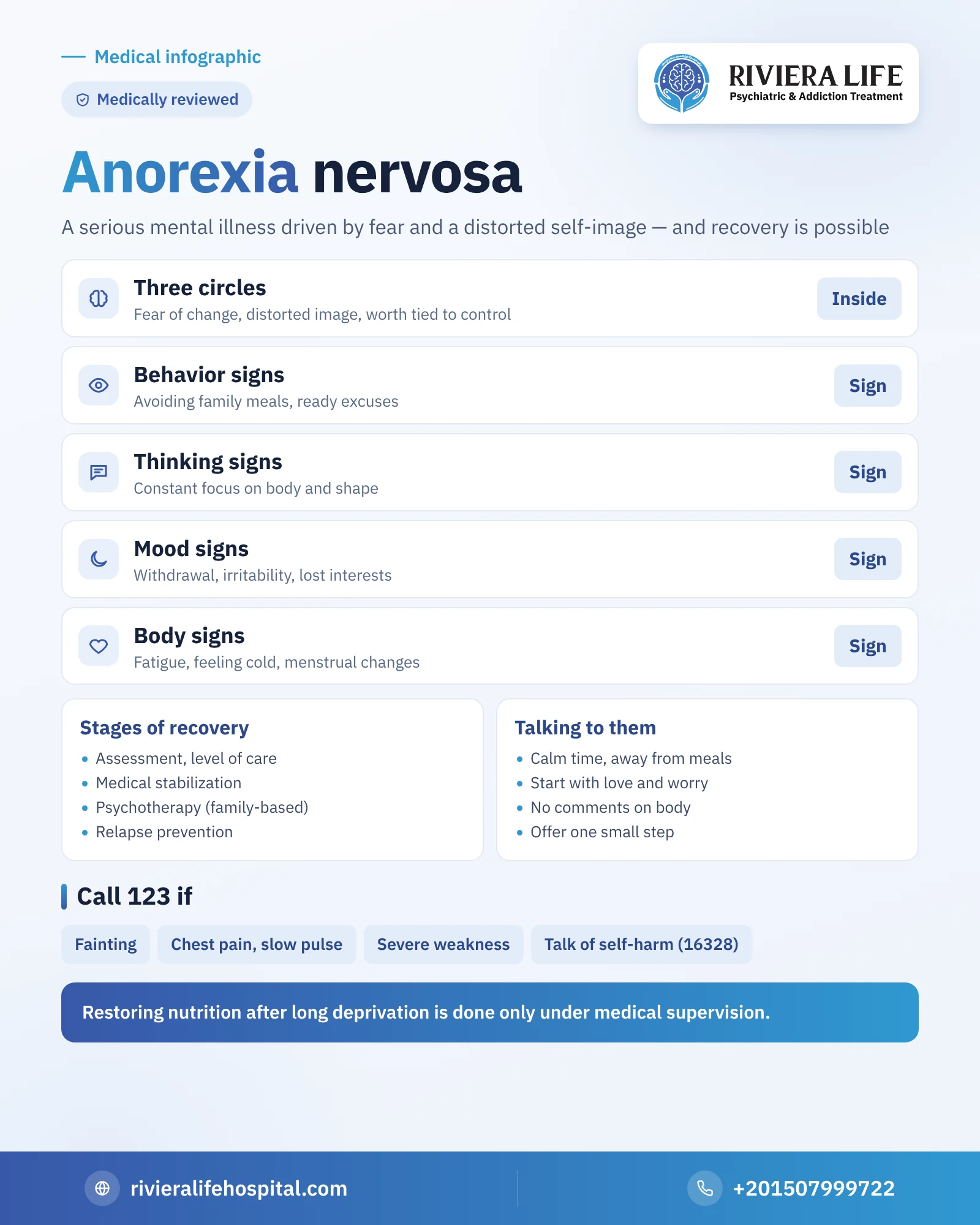
If we look past appearances, we find three intertwined circles. The first is an intense fear of their body changing or of “losing control”. The second is a mental image of the body that doesn’t match reality, so neither the mirror nor the words of those close to them help correct it. The third is a deep link between a person’s worth and their ability to control and refrain. These circles feed each other, so the more the preoccupation increases, the more the person’s life narrows around a single idea.
It is important for parents to know that a body suffering chronic undernutrition changes the brain itself: concentration weakens, obsession around food increases, anxiety and rigidity of thinking intensify, and interest in everything other than food narrows. So part of what you see as stubbornness or irritability is the effect of the illness, not the person’s character.
Why does the patient deny their illness?
Denial here isn’t deliberate lying in most cases. The illness seems to its sufferer like an ally that gives them safety, so they defend it as a person defends something they think protects them. And if you suggest treatment, they hear in your words a threat that this “ally” will be taken from them, so they get angry or withdraw. So their first refusal doesn’t mean the matter is hopeless; it means the conversation needs patience and a different approach, which we detail in the section on talking with the patient shortly.
Several forms of the same illness
Doctors distinguish between two main forms. In the first, refraining and restricting food dominates. In the second, the illness overlaps with episodes of loss of control and harmful compensatory behaviors. A person may move between the two forms over time. We deliberately don’t list the details of these behaviors here; what matters for the family is knowing that the illness has many faces, and that the absence of a particular form doesn’t mean the absence of the illness. To learn about the form that includes episodes, see our article on bulimia nervosa.
Signs that catch the family’s attention
The signs don’t appear all at once, and the person may hide them skillfully. Watch for accumulating changes, not a single situation:
- In behavior: moving away from eating with the family, ready excuses, and clear anxiety around food and occasions where it is present.
- In thinking: constant preoccupation with the body and appearance, constant self-criticism, and difficulty accepting compliments or reassurance.
- In mood: withdrawal, irritability, and loss of interest in hobbies that were once loved.
- In the body: exhaustion and dizziness, a constant feeling of cold, changes in the menstrual cycle, dry skin and hair loss, and a teenager’s expected growth stopping.
Several signs together, persisting, deserve an assessment, even if the person seems fine on the surface. To distinguish the disorder from worry about appearance that doesn’t amount to an illness, see body dysmorphic disorder.
What happens to the body?
Chronic undernutrition deprives the body of its needs, so the heart slows, blood pressure falls and salts become imbalanced, which may lead to a disturbance in heart rhythm. Bones weaken, hormones and fertility are affected, growth stops in the young and puberty is delayed. The digestive system, immunity and concentration are affected. These harms may not show on the person, because the body adapts outwardly until it suddenly collapses. That is why appearance isn’t enough evidence of safety; the case needs a medical examination and tests.
Call an ambulance on 123 immediately if you see
Go to the nearest emergency department or call an ambulance if a person with an eating disorder shows:
- Fainting or loss of consciousness, even for seconds
- Chest pain, severe palpitations, or a very slow or irregular pulse
- Severe weakness that stops them standing or walking, or clouded consciousness
- Seizures, severe abdominal pain or vomiting blood
- Talk of ending their life or harming themselves — you can also call the mental health hotline on 16328
What does recovery look like?
Recovery is possible, and many live stable lives afterwards. But it is a journey in stages, not a decision taken in a day:
- Assessment and setting the level of care: the team decides whether clinic follow-up is enough or whether an intensive program or hospital stay is needed, according to the physical and psychological condition.
- Medical stabilization: monitoring the heart, salts and vital signs. Restoring nutrition after long deprivation is done only under medical supervision, because it has risks if attempted outside hospital.
- Psychotherapy: for teenagers, family-based treatment is one of the strongest evidence-supported options. For adults, types of cognitive behavioral therapy designed for eating disorders and other therapies chosen by the specialist are used.
- Treating what accompanies the illness: it is often accompanied by depression, anxiety or obsessions, and the doctor may prescribe medicine for these conditions when needed. There is no medicine that treats anorexia itself on its own.
- Relapse prevention: a plan to spot early signals and a way of dealing with stress, with extended follow-up.
How does the family talk with the patient?
- Choose a calm time away from the dining table, and talk privately.
- Start with your love and worry, and describe what you have noticed in their mood and life: “I’ve missed your laugh, and I’m worried about you.”
- Avoid talking about appearance and the body, even positively. A compliment may be heard as confirmation of what they fear.
- Don’t argue with their thoughts about their body, as logic won’t convince them. Acknowledge their pain, and say that this pain deserves help.
- Suggest a small, specific step: an appointment with a doctor, and your offer to go with them.
- Avoid threats, pleading, monitoring and punishment, as these approaches deepen secrecy and increase stubbornness.
- Don’t blame yourself or anyone in the family. Reproach doesn’t help; what is needed is for the family to become a team.
If the patient is a minor, the decision to treat is the parents’ responsibility even if they refuse. And if any of the emergency signs above appear, medical intervention comes before any conversation. For a family swinging between worry and anger, our article on when you need a psychiatrist may help decide when to ask.
Relapse doesn’t mean failure
There may be periods in which preoccupation with the body returns or anxiety intensifies, especially around exams, loss or big changes. This isn’t the end of the road, but a signal to seek support early before it builds up. Specialists see that recovery rarely moves in a straight line, and that the outcome is measured by a general direction towards a wider life, not by the absence of every stumble.
When should you ask for help? And how can Riviera Life help you?
Seek an assessment when food and the body dominate the thinking of someone you love, or when the warning signs above come together, and don’t wait for the physical symptoms to become clear. At Riviera Life in Sheikh Zayed, Giza, consultants in psychiatry and addiction assess the case in complete confidentiality, the team follows the medical side around the clock when an inpatient stay is needed, and the family is involved in the family program and follow-up after discharge. The hospital is licensed by the Ministry of Health, and has fourteen years of experience. The first consultation is free on +201507999722.
More from our eating disorders guide
- Eating disorders treatment
- Eating disorders: the complete guide to types, signs and treatment.
- Bulimia nervosa: the cycle of secrecy and guilt, and the road to treatment.
- Body dysmorphic disorder: when a small flaw becomes a daily obsession.
- Teen depression: the signs and how parents can talk.
- Fasting, mental health and recovery: who needs caution and how to protect your recovery
- Exercise addiction: when training becomes a harmful attachment, and how recovery begins
- SCOFF eating disorder test
Questions many people ask
Usually not. The person feels hunger but resists it out of fear, and the medical name is misleading on this point.
Because the illness seems to them a means of safety and control, and undernutrition itself may affect their way of thinking. The first refusal is common and doesn't mean treatment is impossible.
Yes, it affects males too, but is discovered late in them because no one expects it, so it shouldn't be ruled out because of sex.
The medical team decides the level of care according to the physical and psychological condition. Clinic follow-up is enough for some patients, while others need an intensive program or a stay under medical supervision.
Yes, many recover and live stable lives, and early intervention and family support improve the chances. The journey may include stumbles that don't mean failure.