Eating disorders are real and serious psychiatric illnesses, in which a person’s relationship with food, their body and their self-image changes deeply in a way that affects their physical health, mood and whole life. The best known are anorexia nervosa, bulimia nervosa, binge eating disorder, and avoidant/restrictive food intake disorder. They aren’t a choice, vanity or a “fashion” among girls, and they can affect anyone at any age, of any sex and with any body shape, often hiding behind a completely normal appearance. Most importantly, recovery is possible, and seeking help early makes a big difference. Only a psychiatrist or a specialized team can make the diagnosis.
What are eating disorders?
In eating disorders, food and the body become the center of thinking, worry and control, not just part of the day. From the outside it may look like a matter of eating, but from the inside it is often a way of dealing with painful feelings: anxiety, a sense of losing control, self-hatred, or pressure that finds no other way out. That is why it isn’t enough to tell the patient “eat” or “stop eating”; the problem isn’t a lack of willpower or information, but a disorder that needs specialized treatment.
Medical references classify eating disorders among the most dangerous psychiatric disorders in terms of their effect on the body, and anorexia nervosa in particular is linked to high death rates compared with others if left untreated. This fact isn’t meant to frighten, but to emphasize that the matter deserves serious intervention.
Who develops eating disorders?
Many cases begin in adolescence and early youth, but they may appear in childhood or in middle age. They are diagnosed more in females, but males are affected too, and are discovered late because no one expects it in them. The stereotypical image of a very thin girl misleads families; most of those affected appear to be of normal weight or higher, and the presence of an eating disorder can’t be judged from body shape alone.
Types of eating disorders
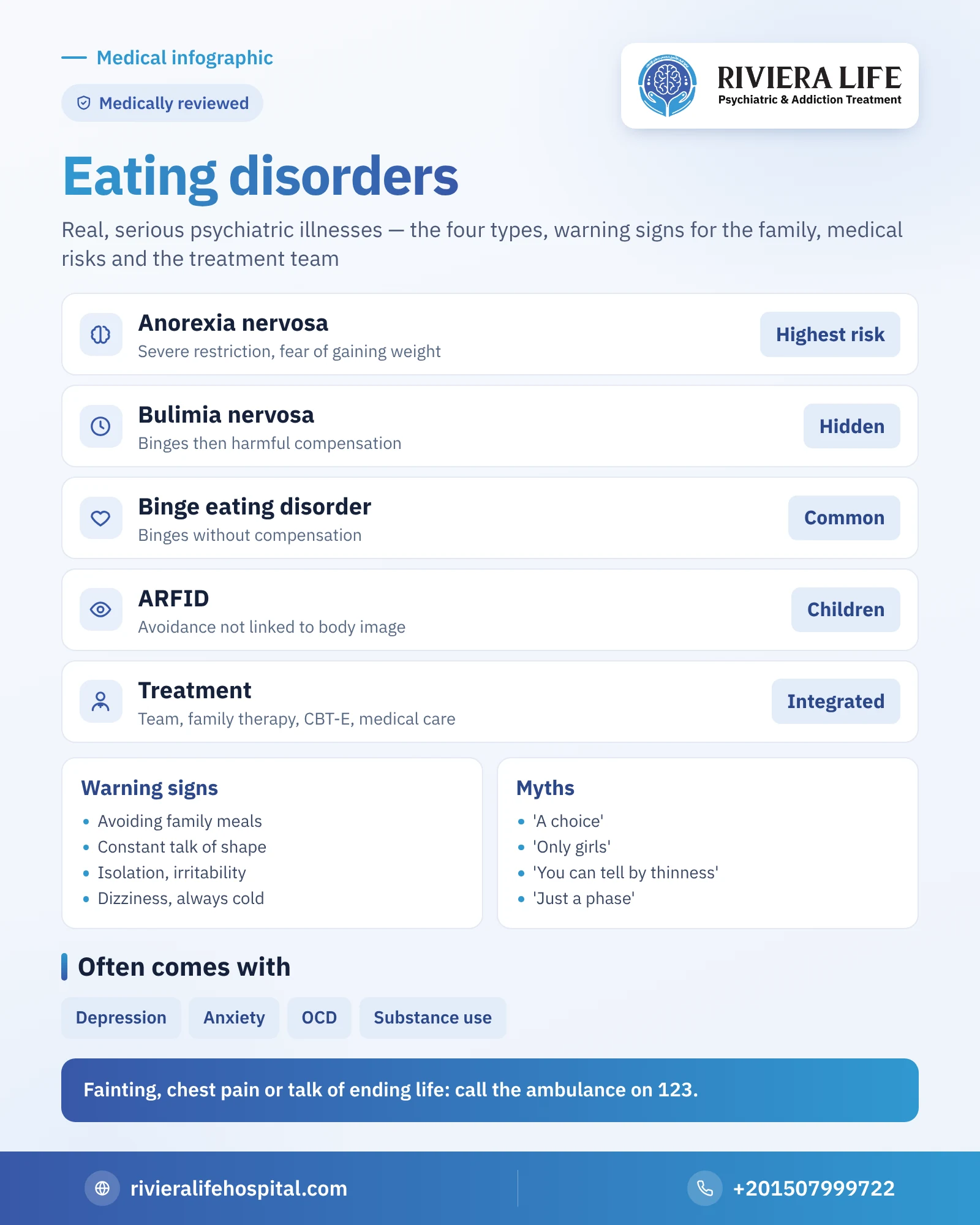
Anorexia nervosa
Severe restriction of food leading to a clear weight deficit compared with what suits the person’s age and height, with a strong fear of gaining weight, and a distorted view of the body that makes the person see themselves as bigger than they are. Despite the name, the patient usually doesn’t lose the sensation of hunger, but resists it.
Bulimia nervosa
Repeated episodes of eating large amounts with a sense of losing control, followed by a feeling of guilt and harmful attempts to get rid of the effect of eating. The patient goes round an exhausting cycle of restriction, then an episode, then guilt, and usually hides this from those closest to them for years.
Binge eating disorder
Repeated episodes of eating large amounts with loss of control and severe distress, but without the compensatory behaviors present in bulimia nervosa. It is among the most widespread eating disorders. It differs from the concept of food addiction, which isn’t considered an official diagnosis, and we explain the difference between them in the article on food addiction.
Avoidant/restrictive food intake disorder
Known by the abbreviation ARFID, it appears as avoidance of many types of food or reduced eating, not because of fear of weight or body image, but because of extreme sensitivity to texture, smell or color, fear of choking or vomiting, or a lack of interest in food in the first place. It is common in children, and differs from the ordinary “picky child” in that it affects growth, nutrition or social life. It recurs in children on the autism spectrum.
Other specified eating disorders
Equally serious conditions that don’t fully meet the criteria for the previous types, and they are in fact common. Being outside the “templates” doesn’t mean they are milder.
Warning signs the family notices
Many of those affected are skilled at hiding what they are going through, which is why the signs usually come as accumulated changes rather than a single sign:
- Around food: avoiding family meals, repeated excuses to eat alone, unusual rituals around food, amounts of food disappearing, or repeatedly withdrawing after eating.
- Around the body: constant preoccupation with shape and weight, harsh comments about the body, repeatedly checking in the mirror or avoiding it completely, and loose clothes to hide the body.
- In mood and behavior: irritability and mood swings, withdrawal from friends, severe anxiety when the routine changes, and excessive physical activity that seems compulsive.
- In the body: a noticeable change in weight in either direction, dizziness, exhaustion, feeling cold all the time, disturbed periods, hair loss, and problems with the teeth or digestive system.
These signs don’t necessarily mean a disorder is present, but a number of them coming together and persisting deserves a calm conversation and a medical assessment.
The medical risks of eating disorders
Eating disorders affect almost every system of the body, and test results may be disturbed even in someone who seems fine:
- The heart: a slow pulse, low blood pressure, and heart rhythm disturbance that may be life-threatening.
- Salts: a deficiency of potassium, sodium and others, among the most dangerous complications because it may cause a sudden heart disturbance.
- Bones and hormones: early osteoporosis, periods stopping, effects on fertility and delayed growth in adolescents.
- The digestive system: constipation, bloating, inflammation of the esophagus and stomach, and erosion of tooth enamel.
- The brain and mood: poor concentration, depression, anxiety, and obsessions about food that increase with malnutrition itself.
Because restoring nutrition after severe restriction may carry risks to the heart and salts, it is done under medical supervision, not by personal or family initiative.
Seek urgent help immediately if any of these appear
Call the ambulance on 123 or go to the nearest emergency department if any of these appear in someone with an eating disorder:
- Fainting or loss of consciousness, even for seconds
- Chest pain, severe palpitations, or a very slow or irregular pulse
- Severe weakness that prevents them from standing or walking, or clouded consciousness
- Vomiting blood or severe abdominal pain
- Talk of ending their life or self-harm; you can also contact the mental health hotline on 16328
Causes of eating disorders
There is no single cause, but an interaction between multiple factors:
- Genetic and biological factors: eating disorders recur in families, and genetics seems to play a considerable role in the predisposition to them.
- Psychological traits: perfectionism, anxiety, low self-esteem, and difficulty dealing with negative emotions.
- Painful experiences: bullying because of appearance, trauma, and family and school pressures.
- Cultural pressures: the ideal body promoted by social media and advertising, and repeated family comments about weight and shape.
- Risky beginnings: many cases begin with a harsh diet or sporting pressure in sports concerned with shape or weight.
The family doesn’t bear the blame for the appearance of the disorder, but it is an essential part of the solution.
How are eating disorders diagnosed?
Diagnosis relies on a detailed psychological interview about the person’s relationship with food, their body and their emotions, alongside a comprehensive medical assessment that includes a clinical examination, measuring vital signs, tests of salts and kidney and liver function, and an ECG when needed. The team also looks for what may accompany the disorder, such as depression, anxiety, obsessive-compulsive disorder or substance use, because treating them is part of the plan.
Treatment of eating disorders
An integrated team
Successful treatment is teamwork: a psychiatrist, a psychotherapist, a clinical dietitian, and an internist or pediatrician who follows the physical condition. The team determines the appropriate level of care, from clinic follow-up to day programs, up to hospital admission when the physical or psychological condition is unstable.
Family therapy
For children and adolescents, family-based treatment is among the approaches most supported by evidence, especially in anorexia nervosa. In it, the parents temporarily take on, under the therapist’s guidance, a larger role in supporting nutrition, then responsibility is gradually returned to the adolescent as they improve. The family here isn’t the accused, but the most powerful tool of treatment.
Enhanced cognitive behavioral therapy
A specialized version of cognitive behavioral therapy designed for eating disorders, known by the abbreviation CBT-E. It works on thoughts connected with shape and weight, on the cycle that feeds the disorder, and on preventing relapse. It is used with adults and older adolescents across the different types.
The role of medicines
Medicines aren’t the main treatment for most eating disorders, but the doctor may prescribe some antidepressants in bulimia nervosa and binge eating disorder, or to treat accompanying depression and anxiety. No medicine is started, changed or stopped except with the treating doctor.
You will find the steps in detail, and what happens at each stage, in the article on the treatment of eating disorders.
Eating disorders and addiction
An eating disorder co-occurs with alcohol or drug use in a considerable proportion of patients, especially in bulimia nervosa and binge eating disorder. Some may misuse stimulants or medicines without a prescription, thinking they help control weight, a use that is extremely dangerous to the heart. Treating one of the two disorders and leaving the other opens the door to relapse, which is why the patient needs a plan that brings them together, as in the dual diagnosis program.
How do you talk to someone you love?
The first conversation is difficult, and may be met with denial or anger. This is expected and doesn’t mean failure. What usually helps:
- Choose a calm time and a private place, away from the dinner table.
- Start with your worry and love, and talk about the changes you have noticed in their mood and life, not about their shape, weight or what they eat.
- Use statements that begin with “I”: “I am worried about you”, instead of “you don’t eat”.
- Listen more than you speak, and don’t argue about the details of food.
- Suggest a specific step: visiting a doctor or a psychological assessment, and offer to go with them.
- Avoid threats, blame and constant monitoring, and avoid commenting on anyone’s appearance in front of them, negatively or positively.
If the patient is a minor, the decision to seek treatment is the parents’ responsibility even if they refuse. And if any emergency sign appears, urgent medical intervention comes before any conversation.
Common myths about eating disorders
The myth: eating disorders are a choice or a bid for attention. The truth: they are psychiatric illnesses with a biological and psychological basis, and no one chooses them.
The myth: they only affect girls. The truth: they affect males too, and are discovered later in them.
The myth: the patient can be recognized by their thinness. The truth: most of those affected appear to be of normal weight or higher, and the medical risk may be significant despite that.
The myth: it’s a phase and will pass. The truth: some cases become chronic if they aren’t treated, and early intervention greatly improves the chances of recovery.
Related articles
- Food addiction: how it differs from binge eating disorder, and ways of treatment.
- Depression: the disorder that most often accompanies eating disorders, and its treatment.
- Anxiety: its symptoms and types, and its role in the persistence of eating disorders.
- Obsessive-compulsive disorder: repetitive thoughts and rituals, and how they overlap with eating disorders.
- The dual diagnosis program: treating an eating disorder and substance use in a single plan.
The SCOFF test for eating disorders is used worldwide as a quick initial screening tool, and its result opens the conversation with the doctor, nothing more.
When should you ask for help?
Ask for an assessment if thinking about food, shape or weight has come to dominate your day, or if you notice in your son, daughter or partner changes from the warning signs above. Don’t wait for things to “get worse” or for weight to change clearly; early intervention is easier and more successful, and full recovery is possible for many. At Riviera Life in Sheikh Zayed, the consultant psychiatrists assess the case in complete confidentiality, follow what accompanies it, such as depression, anxiety or substance use, with round-the-clock medical supervision when admission is needed, and involve the family in the plan. The first consultation is free on +201507999722.
Medical sources and referencesThe information in this article is based on reliable scientific sources