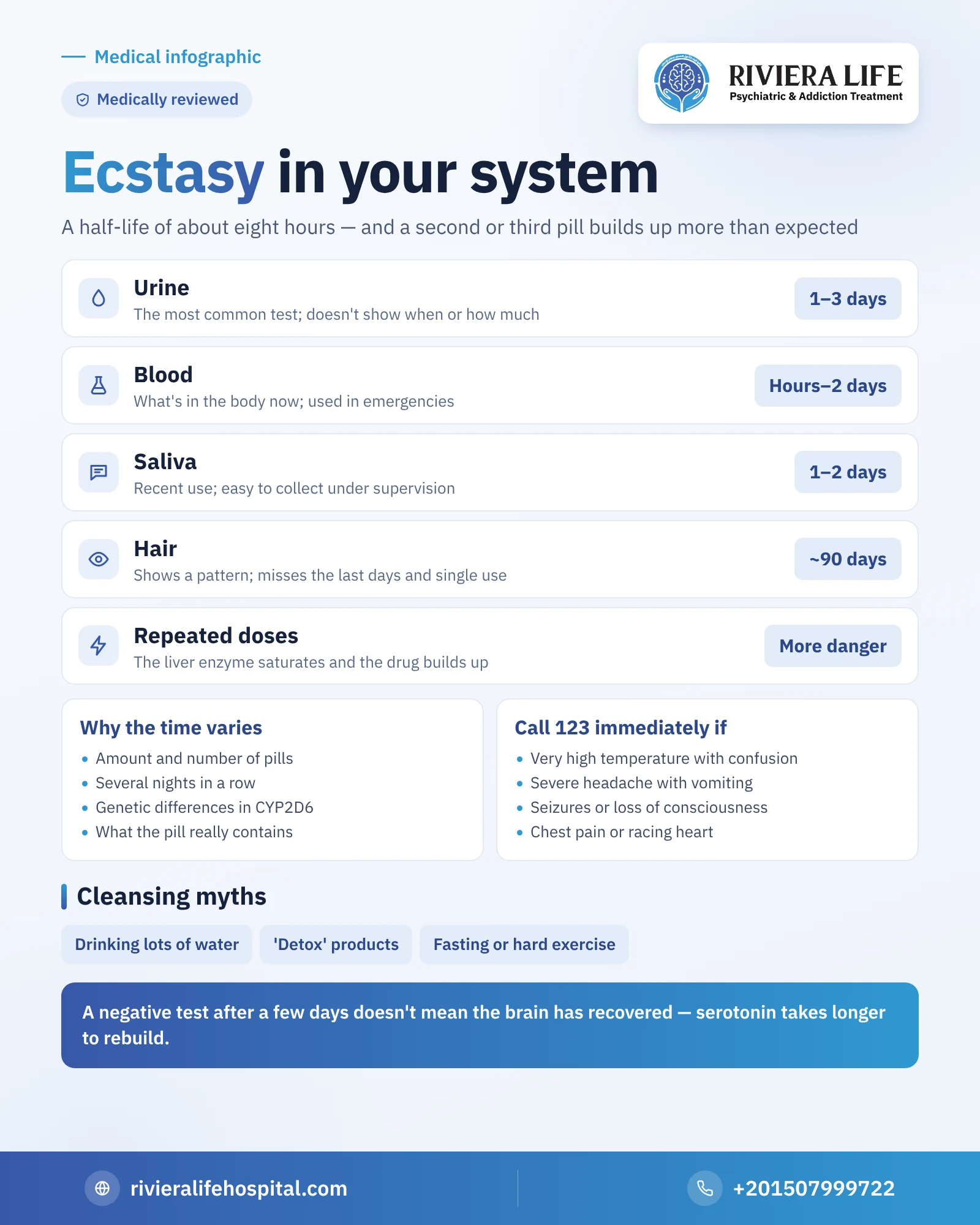
How long ecstasy stays in the body depends on the sample: in urine it remains detectable for about one to three days after the last pill, and the time may stretch a little with large amounts or repeated use. In blood and saliva its window is shorter, usually one to two days, while hair holds its trace for about three months. These are approximate figures that vary from person to person, and the type of test itself changes the result. Here we explain how the body deals with the substance, what each test reveals, and when the result can be misleading.
What happens to ecstasy inside the body?
After swallowing, the body absorbs ecstasy from the gut within about an hour, and then the liver breaks it down, mainly through an enzyme called CYP2D6. This produces several metabolites, the most important being a substance called methylenedioxyamphetamine (MDA), which is itself an active substance with similar effects. Part of the ecstasy and its metabolites leaves unchanged in the urine.
On average, the body needs about eight hours to get rid of half the amount — what is called the half-life. Ecstasy has an important property: with higher doses, or repeated doses on the same night, the enzyme that breaks it down becomes saturated, so the substance builds up in the blood more than the person expects. This property doesn’t only lengthen the detection time; it partly explains why the second and third pills are far more dangerous than the first.
How long ecstasy stays in each type of test
| Type of sample | Approximate detection window | When it is usually used |
|---|---|---|
| Urine | One to three days, and a little longer with heavy use | The most common test at work and in treatment |
| Blood | Hours to about two days | Emergencies and accidents |
| Saliva | About one to two days | Detecting recent use |
| Hair | Up to about ninety days | Showing a pattern of use over months |
The urine test
This is the most widely used test because it is easy, inexpensive and has a longer window than blood. The substance starts appearing in urine a few hours after use, and stays positive in most cases for one to three days. With repeated use over several consecutive days, or large amounts, the window may stretch by a day or more. But urine doesn’t tell you exactly when the person used, how much, or whether they were under the influence when the sample was taken.
Blood and saliva tests
A blood test shows what is going on in the body right now, so it is mostly used in emergency departments to assess poisoning and explain the condition of an unconscious or severely agitated patient. Its window is short: after about one to two days the substance is hard to detect in it. Saliva is similar in duration, and is sometimes used for roadside testing or in some workplaces, because it is easy to collect and hard to tamper with under supervision.
The hair test
When the substance enters the blood, part of it is deposited in the hair follicle and then comes out with the hair as it grows. Because hair grows about one centimeter a month, three centimeters close to the scalp reflect about three months. The advantage of this test is that it reveals the pattern: whether use is frequent or rare. Its drawback is that it doesn’t detect the last few days, because hair needs about a week to grow above the surface of the skin, and a single use may not show in it.
Why does the time vary from person to person?
The figures above are averages, and what really happens is affected by several factors:
- The amount and number of pills: the more there are, the longer the time, especially as the liver enzymes become saturated.
- Frequency: someone who uses several nights in a row is different from someone who used once.
- Genetic differences: the activity of the liver enzyme responsible for breaking down the substance varies genetically between people.
- Liver and kidney function: weakness in either slows the removal of the substance.
- What the pill contains: what is sold as ecstasy may contain other substances with different detection times.
- The sensitivity of the test: every device and strip has a different minimum detection limit.
Does ecstasy show up in a standard amphetamine test?
This is an important question and a source of much misunderstanding. Screening strips for amphetamines vary in their ability to detect ecstasy: some pick it up clearly and some struggle with it. That is why there are strips and panels dedicated to ecstasy specifically. In any case, a preliminary result needs confirmation by a precise laboratory test using chromatographic separation techniques, which can distinguish ecstasy from methamphetamine and from similar medicines. For anyone dealing with a suspected case of ice, our page on how long ice stays in your system explains its tests.
When might a positive result be inaccurate?
A screening test may give a positive result for the amphetamine group without any actual use, because of medicines such as some decongestants and cold remedies, certain psychiatric medicines and others. Stimulant medicines prescribed for ADHD also give a genuinely positive result for amphetamine. That is why the person should mention every medicine they take before the test, and no life-changing decision should be based on a home strip alone.
The effect ending doesn’t mean the substance has left
The feeling of the pill fades within hours, while the substance stays in the urine for days. The reverse is also true: a negative test after a few days doesn’t mean the brain has regained its balance. The serotonin store needs longer to rebuild, which explains the sadness and anxiety of the following days. This stage is explained in our article on ecstasy withdrawal symptoms.
What does a positive result mean for the family?
A confirmed positive result tells you one fact: that the person used in the last few days. But it doesn’t answer the more important questions: is it a one-off or a repeated pattern? Are they mixing it with other substances? Do they have depression or anxiety pushing them towards it? The answers to these questions come from conversation and medical assessment, not from the strip.
So treat the result as the start of a calm conversation, not as evidence of guilt that ends in punishment. Families who use the result as a way into asking for help usually get more cooperation than families who use it for confrontation. To understand what may lie behind the use, see our article on the causes of ecstasy addiction.
Advice for families before a home test
A test is a tool, not a substitute for conversation. A surprise test after an argument may close the door on trust, and a negative result may give false reassurance if it comes after the time window has ended. It is better for testing to be part of a plan everyone agrees on, preferably under medical supervision. And if you have suspicions based on behavior, the signs explained in our article on ecstasy addiction symptoms may be clearer than any strip.
How are tests used during treatment?
In treatment programs, tests aren’t used to punish but to follow progress. Regular tests help the team spot any relapse early and adjust the plan, and in some behavioral programs negative results are rewarded with incentives that encourage people to keep going. The doctor decides the type and frequency of testing according to the stage, as our article on ecstasy addiction treatment explains.
The first hours after use
Call an ambulance immediately (123 in Egypt) if you see
Some complications start hours after the night ends, so don't rely on the effect being over.
- A very high temperature with confusion or delirium
- A severe headache with vomiting and confusion
- Seizures or loss of consciousness
- Chest pain or severe palpitations
Can the body be cleared of ecstasy quickly?
Many people ask about a quick way to “clean ecstasy out of the body”, and the honest answer is that there is no safe shortcut. The liver and kidneys get rid of the substance and its products at their own pace, and no drink, supplement or remedy circulating online changes that pace.
What is common on this subject is more illusion than fact:
- Drinking lots of water: it doesn’t speed up elimination, and it can do harm if it goes beyond what is needed, because ecstasy itself disturbs the body’s fluid and salt balance.
- “Cleansing” products: there is no reliable medical evidence that they remove the substance or its effects from the brain.
- Fasting or physical exertion: they may strain a heart and body already tired after the night of use.
What really helps the body recover is time with rest, sleep and regular food, and then complete abstinence from the substance. And for anyone who has noticed they can’t stop, or that their depression and anxiety get worse on comedown days, the problem isn’t “residue” inside the body but a dependence that needs medical follow-up.
This is where supervised withdrawal comes in: a medical team monitors mental state and vital signs and treats symptoms safely. You will find the details of the weeks after stopping in ecstasy withdrawal symptoms, the full treatment plan in ecstasy addiction treatment, and to compare withdrawal programs you can read about the 7-day detox program.
More from our ecstasy guide
- Ecstasy: the complete guide
- Ecstasy addiction symptoms
- The harmful effects of ecstasy
- Ecstasy withdrawal symptoms
Questions many people ask
Usually one to three days after the last use, and a little longer with large amounts or repeated use. The figure is approximate and varies between people.
Yes, it can detect repeated use over about ninety days. But it doesn't detect the last few days, and it may not show a single use.
It may, but amphetamine strips vary in how sensitive they are to it, which is why dedicated ecstasy strips exist. Confirmation is always done with a precise laboratory test.
A screening test can be affected by certain medicines and give a positive result for the amphetamine group. That is why the result is confirmed in the laboratory, and the medicines being taken should be stated before the test.
Not necessarily: the test may have been done after the detection window ended. A test answers for a specific period of time, and it is no substitute for medical assessment and conversation.