Kleptomania is a rare psychiatric disorder that pushes the person to steal things they don’t need and don’t want the value of, under the pressure of an urge they can’t resist. They feel rising tension before the theft, relief at the moment of carrying it out, and then heavy shame and guilt afterwards, and often hide the stolen items, throw them away or secretly return them. This is completely different from ordinary theft motivated by need or greed. In this article we explain the signs that distinguish it, its link with OCD, depression and addiction, the available treatments, and what it means legally in general terms.
What is kleptomania?
Kleptomania, known medically as Kleptomania, is classified among impulse-control disorders, a group sharing difficulty in resisting a strong inner urge despite the person knowing the act is wrong and harmful. Studies estimate its prevalence at less than 1% of people, it is more common in women, and it usually starts in adolescence or early adulthood.
Imagine a successful employee leaving a shop with a pen and a box of tissues in her bag that she didn’t pay for, even though her purse holds enough to buy almost the whole shop. In the car she feels panic and shame, at home she throws the things in the bin, and swears she won’t do it again. Then it happens again weeks later.
The key word here is “urge”, not “purpose”. The person doesn’t steal to benefit, but to get rid of tension that builds up inside them until it becomes unbearable.
The difference between kleptomania and ordinary theft
| Kleptomania | Ordinary theft |
|---|---|
| Usually cheap or useless items, which they may be able to afford | Items with value or need |
| A sudden urge, usually without planning | Often planned in advance |
| Steals alone, without partners | May involve others |
| Tension before the act, relief during it, then guilt and shame | Usually not followed by this inner conflict |
| Throws away, hides or returns the stolen items | Uses or sells them |
| Not motivated by anger, revenge or hallucinations | Multiple motives including need and greed |
This distinction isn’t decided by the person or their family, but by the psychiatrist after a full assessment, ruling out other causes such as manic episodes in bipolar disorder or conduct disorder.
Is it the same as shopping addiction?
No. Both are compulsive behaviors that give temporary relief followed by regret, but someone addicted to shopping buys and pays, and their biggest problem is financial. Someone with kleptomania takes without paying, and usually has the money. Those who suffer from compulsive buying will find what concerns them in the article on shopping addiction symptoms.
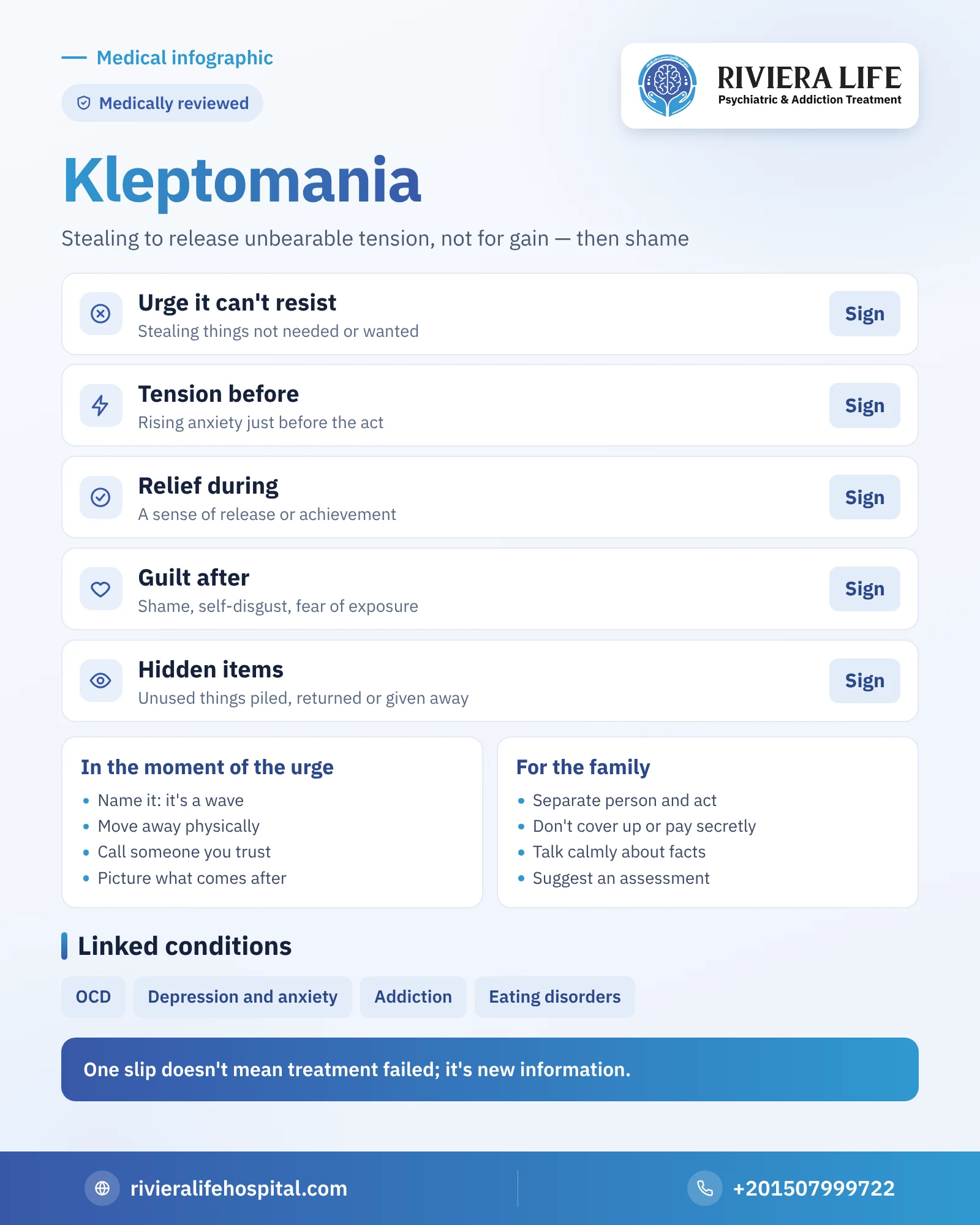
Symptoms and signs of kleptomania
- Repeated failure to resist an urge to steal things they don’t need.
- Increasing tension and anxiety immediately before the theft.
- Relief, pleasure or a sense of achievement during the theft.
- Guilt, shame and self-disgust afterwards, and fear of being exposed.
- Unused things piling up in a drawer or car without explanation.
- Secret attempts to return the items or give them away.
- Avoiding particular places such as large shops for fear of the urge.
Many of those affected live for years without telling anyone, because the shame is greater than their ability to ask for help.
Why does kleptomania happen?
There is no single known cause, but research points to several overlapping factors:
- Brain chemistry: a disturbance in serotonin, linked to impulse control, is believed to play a role, along with the reward system that gives the “relief” after the act.
- Family history: mood disorders, OCD or addiction in the family.
- Trauma and stress: painful experiences in childhood or periods of severe stress may precede its appearance or increase it.
- Accompanying disorders: anxiety and depression make the urge stronger.
Its link with OCD, depression and addiction
Kleptomania sits in a middle zone between OCD and addiction. It resembles OCD in the feeling of tension that only calms with a specific act, and resembles addiction in the feeling of pleasure, craving and repetition despite harm. That is why tools from both fields are used in its treatment.
Depression, anxiety and eating disorders often accompany it, and rates of alcohol and drug use are higher among those affected, as an attempt to ease guilt. Intense shame may push some to despair, so if thoughts of harming yourself come to you, ask for help immediately through the mental health hotline on 16328, or the ambulance on 123 in urgent cases.
Legal consequences: the illness doesn’t cancel responsibility
Legally, theft is a crime regardless of its motive, and having a psychiatric disorder doesn’t automatically mean exemption from accountability. In some cases a psychiatric report may be an element the judicial authorities take into account, but this differs from case to case. This is general information and not legal advice; for any legal situation, consult a lawyer. Most importantly, early treatment reduces the likelihood of reaching that moment at all.
How is kleptomania diagnosed?
Diagnosis relies on a detailed interview with the psychiatrist, who asks about the pattern of theft and the feelings before and after it, and rules out other causes such as manic episodes, psychosis, antisocial personality disorder, or the effect of drugs. The doctor may use standard scales, and assesses accompanying depression and anxiety.
Treating kleptomania
Cognitive behavioral therapy
Cognitive behavioral therapy is the cornerstone. In it the patient learns to recognize the situations and feelings that precede the urge, to challenge the thoughts that accompany it, and to tolerate the tension without carrying out the act. Its techniques include imagining the negative consequences at the moment of the urge, gradual exposure to risky places with response prevention, and setting a practical plan such as shopping with a trusted person in the early stages.
Medicines
There is no medicine approved specifically for kleptomania, but the doctor may use medicines to ease craving or treat accompanying depression and anxiety, including some antidepressants, medicines that act on the reward system such as naltrexone, and sometimes mood stabilizers. Choosing the medicine, its dose and duration is a medical decision that differs from person to person.
Treating what accompanies it
Treating accompanying depression or addiction is part of the kleptomania plan, not separate from it.
The moment of the urge: what do you do when you feel it?
A large part of treatment happens outside the clinic, in the seconds when the urge appears inside a shop or a friend’s home. These are some of the tools the patient practises with their therapist:
- Name what is happening: “This is an urge, it will peak and then calm down”, as the urge is a wave that doesn’t last forever.
- Move away physically: leave the aisle or place immediately, even for a few minutes.
- Call someone you trust: agree in advance with a family member or friend on an emergency call.
- Picture what comes after the act: the guilt, the fear and the possibility of exposure, not just the moment of relief.
- Record the experience: when the urge appeared and what preceded it, to discuss it in the next session.
Relapse is possible, and a single slip doesn’t mean treatment has failed, but is new information about risky situations.
How does the family deal with a member who has kleptomania?
- Separate the person from the act: they are suffering, and don’t enjoy hurting you.
- Don’t cover up for them or secretly pay for the stolen items every time, as this delays treatment.
- Talk with them calmly about the facts, and suggest a psychological assessment without threats or exposure.
- Take part in treatment sessions if the doctor asks.
How can Riviera Life help you?
Shame is the biggest obstacle to treating kleptomania, which is why we start with confidentiality. At Riviera Life, consultant psychiatrists assess the condition and any accompanying depression, anxiety or addiction, and set a suitable psychological and medication treatment plan, involving the family when needed. The first consultation is free: +201507999722, Sheikh Zayed, Giza.
Read also
- Shopping addiction treatment
- OCD treatment
- Gambling addiction treatment
- Cognitive behavioral therapy
Questions many people ask
Yes, it is classified among impulse-control disorders, marked by a repeated urge to steal things the person doesn't need, with tension before and relief during the act.
It can be controlled to a large degree with cognitive behavioral therapy and medicine when needed, with possible slips that are treated as part of the plan.
Not automatically, as theft is a crime regardless of its motive; a psychiatric report may be taken into account in some cases, and a lawyer is the one to judge that.
Someone addicted to shopping buys and pays, and their problem is usually financial, while someone with kleptomania takes without paying even though they can usually afford to buy.
It usually starts in adolescence or early adulthood, and may continue for years without the person asking for help because of shame.