Dealing with someone addicted to ice is different from dealing with any other drug user, because you aren’t dealing with one person but with three states that change within days: someone hyped up and sleepless under the influence of crystal meth, then someone suspicious and quick-tempered at the end of a binge, then someone collapsed, asleep and unable to bear talking.
For anyone who first wants to understand the substance itself — its names, effects and harms — the full introduction is in our guide to ice (crystal meth).
What works in one state may ignite the next. So the first rule in dealing with someone addicted to ice is choosing the right moment, then the right words, then the boundaries that protect the home. This guide is written for families, wives and brothers: what to do step by step, what to say, how to act if paranoia or violence appears, and what to do if they refuse treatment.
Choose your timing: when to talk to someone on ice, and when to wait
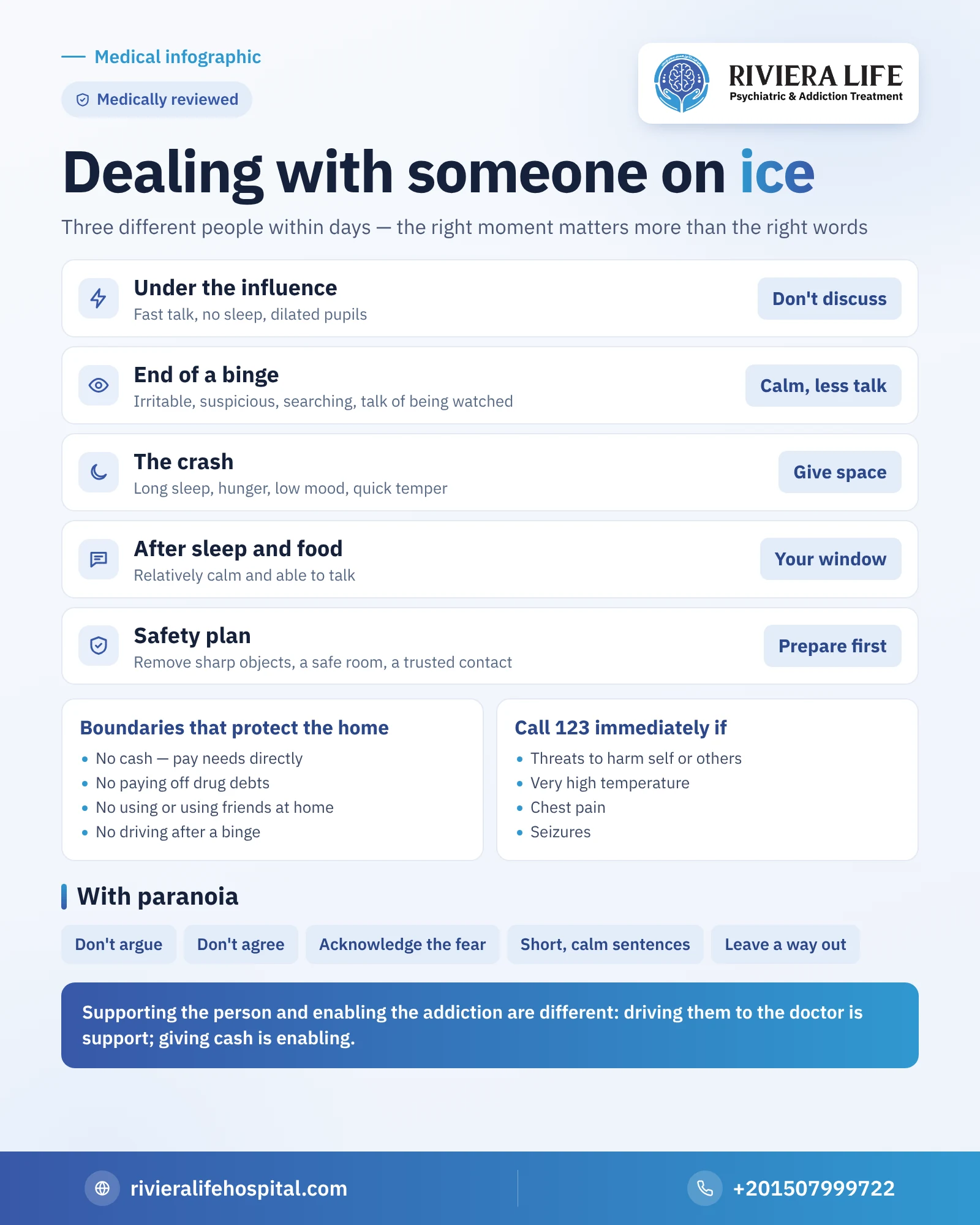
Most failed confrontations with crystal users fail because of the timing, not the words. This table summarizes what suits each state:
| Their state | How to recognize it | What to do |
|---|---|---|
| Under the influence | Fast speech, excess energy, dilated pupils, no sleep | Don’t start any discussion. Just keep things calm and safe |
| End of a binge | Irritability, suspicion, searching, talk of being watched | Reduce talk and confrontation, and remove sources of provocation |
| The crash | Long sleep, hunger, low mood, quick temper | Give them space to sleep and eat, and don’t hold them to account now |
| After sleep and food | Relative calm, able to have a conversation | This is your window for a serious talk |
The best window is usually a day or two after the crash, when they have slept and eaten and haven’t gone back to using yet; they are often regretful then and more ready to listen than at any other time. And if you aren’t yet sure they are really using ice, our article on ice addiction symptoms helps you read the signs before any conversation.
How do you start the conversation with someone addicted to ice?
Before talking, meet as a family and agree on three things: one goal, which is getting to a medical assessment; only one or two people doing the talking; and a treatment contact number ready. A meeting that everyone attends and where everyone speaks quickly turns into a trial, and someone prone to paranoia because of crystal meth may see it as a conspiracy against them.
Start with what you have seen, not with judgments. “I’ve noticed you didn’t sleep for three nights this week, then slept for a whole day, and that you’ve started locking yourself in your room” is far stronger than “You’re an ice addict and you’ve ruined yourself.” Facts are hard to deny; labels invite defensiveness. Then talk about your feelings: “I’m frightened for you, and frightened something will happen to your heart on one of these nights.”
After that, ask and listen. Many people addicted to ice carry specific fears: that people will find out, that they will go to prison, that they will be locked in a hospital, or that they won’t be able to work without the substance. Hearing these fears lets you respond with information: treatment is confidential, Egyptian law doesn’t punish someone who comes forward for treatment on their own, and the plan is made with them, not against them.
Phrases that help and phrases that destroy
| Instead of saying | Try saying |
|---|---|
| You’re mad, nobody is watching you | I don’t see what you see, but I can see you’re frightened and exhausted |
| You’ve wasted your future and ours | There’s still time, and treatment starts with one step |
| If you had any willpower you’d stop | Crystal meth changes the brain’s chemistry, and stopping needs medical help |
| Either hospital today or you leave the house | We’ll stand by you in treatment, but not while you keep using |
| Everyone will know what you’re doing | What happens stays between us, and treatment is confidential |
And avoid talking when you are angry, threatening what you won’t carry out, comparing them with others, and mocking their ideas, however strange they seem.
Dealing with paranoia and hallucinations: don’t argue, don’t agree
One of the hardest things for the family of someone on ice is when their son says the neighbors are listening in, that there are cameras in the room, or that his wife is cheating on him. These ideas are usually caused by the effect of methamphetamine and lack of sleep, and they are completely real in his eyes. So:
- Don’t argue to prove him wrong; arguing increases his suspicion of you.
- Don’t agree with his ideas, and don’t join him in looking for the cameras.
- Acknowledge his feelings, not the content of his thoughts: “I understand you’re frightened.”
- Speak in a calm voice and short sentences, and leave him space and a way out of the room.
- Reduce noise, visitors and stimulation, and encourage him to sleep and eat.
- Ask for an urgent medical assessment — psychosis needs treatment, and you shouldn’t wait for it to pass.
If they become aggressive or violent: a home safety plan
Not every ice user is violent, but crystal meth raises the likelihood of outbursts and aggression, especially with paranoia and sleeplessness. Make a plan in advance rather than waiting for the situation:
- Remove knives, sharp tools and weapons from reach.
- Choose a safe room that can be locked, and a place the children or mother can go if the situation escalates.
- Don’t corner him, don’t stand between him and the door, and don’t try to restrain him by force except to prevent immediate danger.
- Agree with a trusted relative or neighbor who can be called quickly.
- If he threatens to harm himself or others, or develops a very high temperature, chest pain or seizures, call an ambulance on 123 immediately.
Your safety and the children’s safety is a non-negotiable priority, and stepping away from an explosive situation isn’t abandoning him.
If they deny it or refuse treatment
Refusal in the first conversation is expected and doesn’t mean failure. Don’t try to extract an admission of the word “addict”; make your request smaller: one consultation, a call with a doctor to ask questions, or a heart check after he has complained of palpitations. A small step is easier to accept and opens the door to what follows.
There is a well-studied approach to helping families at this stage, built on three ideas: reward the days they spend without using with attention, warmth and time together; stop shielding them from the consequences of using, so those consequences fall on them; and wait for the moments when they are more ready — such as the day after a bad crash — to offer help again. Studies suggest this approach is more successful at getting users into treatment than harsh group confrontation or passive waiting.
Money and the home: non-negotiable boundaries
Boundaries aren’t punishment; they are rules that protect everyone. State them calmly, once, and stick to them:
- Money: no cash. Their basic needs are paid for directly.
- Debts: no paying off drug debts, but the family is ready to pay for treatment.
- The home: no using, no equipment and no using friends inside the house.
- The car: no driving after sleepless nights or under the influence.
- The children: children aren’t left in their sole care while they are using.
The difference between support and enabling is simple: support stands by the person, enabling stands by the addiction. Driving them to the doctor is support; giving them money “so they don’t steal” is enabling.
Can someone addicted to ice be admitted to hospital against their will?
Treatment works better when the patient takes part willingly. But Egypt’s Mental Health Law regulates compulsory admission in specific cases decided by a psychiatrist, such as a severe mental disorder posing serious danger to the person’s life or to others, which may apply to some cases of ice psychosis. Judging this is a medical and legal decision the family doesn’t make alone, and it is preceded by an assessment by a psychiatrist. In other cases persuasion remains the way, and the specialist team can explain the options available for your particular situation.
During the crash and withdrawal days
After stopping, someone addicted to ice sleeps for long hours, then goes through days of low mood, irritability and intense cravings. Don’t wake them by force; provide easy food and water, and postpone any reckoning over what has happened. Most importantly, pay attention to any talk of hopelessness or death: depression after crystal meth can be deep, so don’t dismiss any hint of self-harm. The stages and length of this period are detailed in our article on ice withdrawal symptoms.
After treatment: how to deal with someone recovering from ice
Leaving hospital is the start of a new stage, not the end of the road. Help them build an organized day with regular sleep, regular meals and physical activity, and encourage them to stick with follow-up and testing without turning into an interrogator. Know that waves of craving can come after weeks of stability, and that their mood may stay flat for a while — this is part of the brain’s recovery. If a relapse happens, avoid saying “I knew you’d never change”; say instead, “What happened has happened — what matters is that we call the doctor today.” Relapse is a signal to adjust the plan, as our article on ice addiction treatment explains.
You need support too
Living with someone addicted to ice is exhausting: sleepless nights, constant worry and fear of the next explosion. Wives and mothers in particular carry most of this burden. Ask for support for yourself from a professional or from family support groups, keep part of your normal life, and don’t blame yourself for what is happening — the causes of addiction are many and most of them are beyond your control, as our article on the causes of ice addiction explains. And if you are a husband or wife, protect your physical health too, and don’t accept unsafe sex.
How can Riviera Life help you?
The family doesn’t need to wait for the patient’s agreement to begin. You can contact us for a free first consultation on how to talk to them, how to act during episodes of paranoia or irritability, and the steps for getting them to an assessment. The Riviera Life team in Sheikh Zayed offers a confidential assessment, round-the-clock medical supervision, a dedicated family program and follow-up after discharge. Contact us at any time: +201507999722.
More from our ice and crystal meth guide
- Ice, crystal meth and methamphetamine: the complete guide
- Ice addiction symptoms
- Ice and crystal meth addiction treatment
- Ice and sex
Questions many people ask
Choose a time when they have slept and eaten, talk about facts and feelings rather than judgments, set clear boundaries for money and the home, and prepare a safety plan and a treatment contact number before any conversation.
Don't argue with them and don't agree with them: acknowledge their fear, speak calmly and reduce stimulation, and ask for an urgent medical assessment, because suspicion and hallucinations may be a sign of psychosis that needs treatment.
Not every crystal user is violent, but paranoia and sleepless nights raise the likelihood of outbursts. Remove sharp objects, choose a safe place for the children, and call an ambulance on 123 if they threaten to harm themselves or others.
Egypt's Mental Health Law regulates compulsory admission in specific cases decided by a psychiatrist, such as serious danger to oneself or others. The decision is medical and legal — the family doesn't make it alone.
No. Cash makes it easier to keep using. Pay for their basic needs directly, don't pay off drug debts, and be ready to pay for treatment instead.
Avoid blame and discouraging words, and contact the treating team the same day to adjust the plan. Relapse is common in addiction and doesn't mean treatment has failed.