Ice withdrawal symptoms usually begin within hours to a day of the last dose, are most severe in the first three days, and then most acute symptoms settle within about one to two weeks. But pressing craving, mood swings and reduced enjoyment may continue for weeks, and sometimes months, in those who used shabu or crystal meth for a long time. Unlike withdrawal from heroin or alcohol, methamphetamine withdrawal usually isn’t physically painful: its real danger is psychological — deep depression, dark thoughts and a strong urge to go back. This article explains the stages day by day, what prolongs them, and when the situation becomes an emergency.
Why does withdrawal happen after stopping ice?
Every dose of ice forces the brain to release huge amounts of dopamine. With repetition, the brain adapts by reducing its sensitivity to this substance and depleting its stores, so the person needs crystal meth to feel normal. When they stop suddenly, the brain finds itself in a state of shortage: low energy, an extinguished mood, and difficulty feeling any pleasure. Added to that is the debt the body has built up from days of sleeplessness and hunger, so the crash comes heavily.
How many days do ice withdrawal symptoms last? The timeline
The duration differs from person to person, but the course usually passes through three stages:
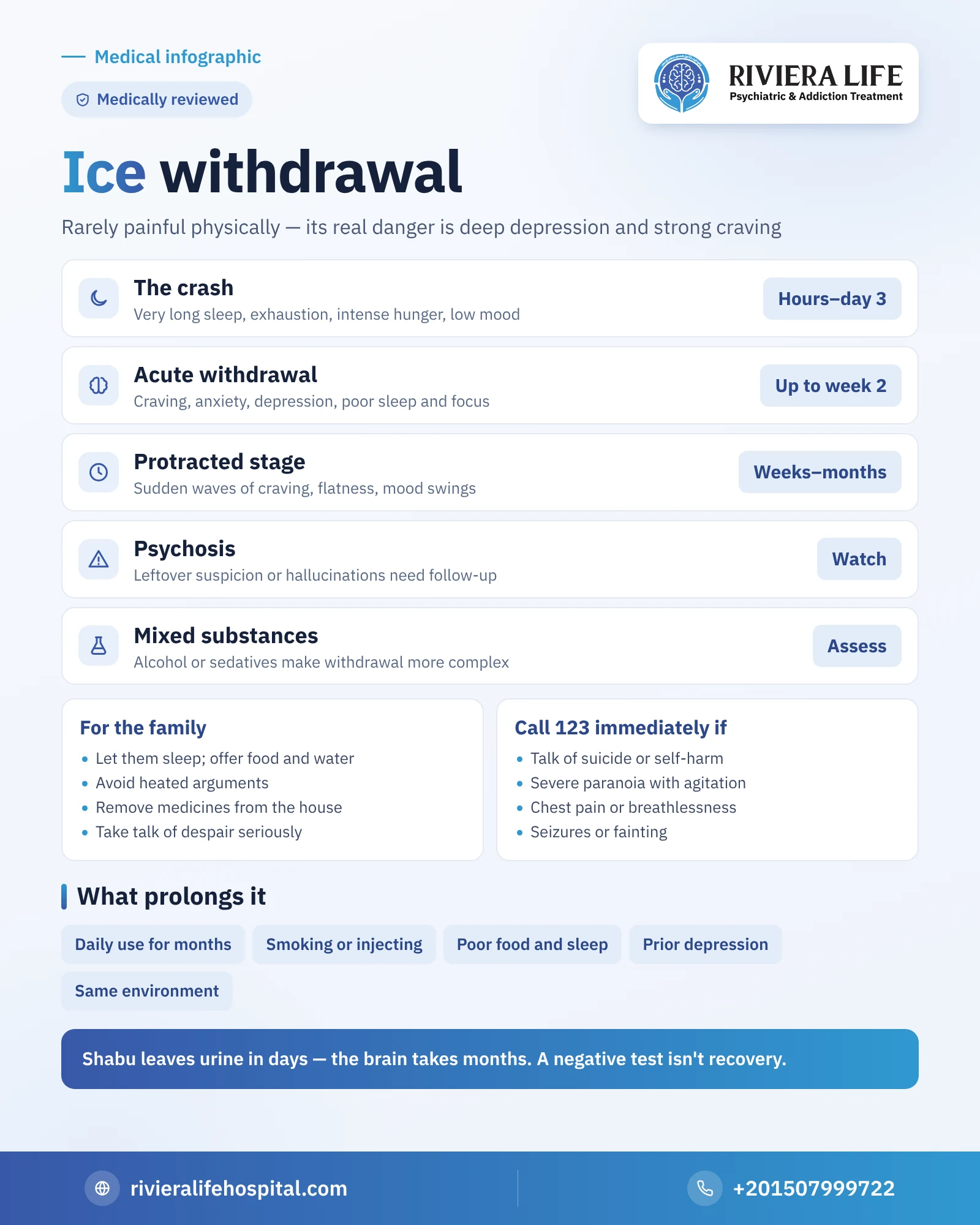
| Stage | Approximate timing | What happens most |
|---|---|---|
| The crash | From hours after the last dose to roughly the third day | Very long sleep, exhaustion, intense hunger, gloom and irritability |
| Acute withdrawal | From the first days to roughly the end of the second week | Pressing craving, anxiety, depression, insomnia or broken sleep, poor concentration |
| The protracted stage | From weeks to several months | Sudden waves of craving, flatness, reduced enjoyment, mood swings |
These figures are approximate, and the stages sometimes overlap, especially in those who have used shabu daily for a long time.
The crash: the first days
It begins after the last binge ends, often after two or three days without sleep. The person sleeps for very long hours, sometimes more than a day, then wakes strikingly hungry, heavy-bodied, with no wish to move or talk. Mood here is very low, patience is short, and any simple request may be met with an outburst. Some families interpret this sluggishness as laziness or stubbornness, but the truth is that it is a brain and body trying to regain a balance they have lost.
Acute withdrawal: the first and second weeks
Once the person has regained some sleep, the psychological symptoms begin to appear more clearly:
- Pressing craving to use, which grows stronger on seeing people or places linked to ice.
- Depression and a feeling of guilt and emptiness, and dark thoughts may appear.
- Anxiety, tension and difficulty relaxing.
- Disturbed sleep: night-time insomnia or broken sleep, and vivid, disturbing dreams.
- Poor concentration and memory, and slowed thinking.
- General aches in the body and headache in some people.
Leftover suspicion or mild hallucinations may continue in the first days in those who had psychosis while using, and these need medical follow-up.
The protracted stage: how long is recovery from ice?
This is the question that worries families more than any other. After the acute symptoms pass, the person feels clearly better, but the brain hasn’t finished recovering yet. That is why sudden waves of craving come with no clear cause, and a feeling of flatness and difficulty enjoying ordinary things remains for a while. Imaging studies indicate that the dopamine system begins to improve gradually over months of abstinence, and that some thinking functions may need a year or more to improve noticeably. In other words: withdrawal is measured in days, while recovery is measured in months, and this is the period in which the patient needs treatment and follow-up, not patience alone.
What lengthens or shortens shabu withdrawal?
- The length and pattern of use: someone who used shabu daily for months differs from someone who used it in widely spaced binges.
- The amount and route of use: smoking and injecting large amounts are linked to heavier withdrawal.
- Age and general health: poor nutrition and accumulated lack of sleep slow recovery.
- Accompanying mental disorders: depression or anxiety that predated the use makes mood worse and longer-lasting.
- Mixing substances: someone who uses alcohol, sedatives or hashish with ice may go through a more complex withdrawal that needs a special assessment.
- The environment: staying among the same triggers prolongs craving and raises the risk of going back.
Is crystal meth withdrawal dangerous?
Physically, crystal meth withdrawal alone is rarely life-threatening, as alcohol or sedative withdrawal can be. But that doesn’t mean it is safe. The main risks are:
- Severe depression, which may come with thoughts of self-harm, especially in the first two weeks.
- Persisting psychotic symptoms in some patients.
- Rapid relapse: craving in the first days is strong, and any return to a large amount after a break can strain the heart.
- Complications of withdrawal from other substances used with it, which are sometimes more dangerous than ice withdrawal itself.
Signs that call for the emergency department
Call an ambulance immediately on 123 if you see
Withdrawal itself is rarely fatal, but these signs mean the situation needs urgent medical intervention.
- Talk of suicide or an attempt at self-harm
- Hallucinations or severe suspicion with agitation or threats to others
- Chest pain, shortness of breath or severe palpitations
- Seizures or loss of consciousness, especially if ice is being mixed with alcohol or sedatives
Can shabu withdrawal be managed at home?
Some mild cases — someone who used for a short period, has no mental disorder and doesn’t mix other substances — may go through withdrawal at home under outpatient medical follow-up. But home often fails at this stage for two reasons: craving in the first days is strong and the substance is close at hand, and the family can’t accurately assess the risk of depression or psychosis.
That is why direct medical supervision is preferred if use was daily or by injection, if suspicion and hallucinations appeared before, if a previous attempt to stop failed, or if the person uses alcohol or sedatives with it. And trying to “calm them down” with the sleeping pills or painkillers available at home can be dangerous and adds a new problem.
How long ice withdrawal lasts isn’t how long it shows in a test
Many people confuse two questions: when the symptoms end, and when the substance disappears from urine. The substance itself usually leaves the body within a few days, while the psychological symptoms continue long after that, because they result from changes in the brain rather than leftover substance. The detection windows in urine, blood and hair are explained in detail in our article on how long ice stays in your system.
How is methamphetamine withdrawal managed medically?
There is still no approved medicine that stops or shortens methamphetamine withdrawal, so doctors rely on careful supportive care:
- A calm, safe environment that allows long sleep in the first days.
- Enough food and fluids to make up for days of hunger and sleeplessness.
- A daily assessment of mood and the risk of self-harm, and treatment of depression, anxiety or insomnia when needed.
- Treatment of psychotic symptoms, if present, with medicines the doctor chooses.
- Starting behavioral therapy early, because craving is the main enemy at this stage.
Withdrawal is only the gateway; the behavioral therapy and follow-up after it are what make the difference, as our article on ice addiction treatment explains.
You will find which medicines actually exist, which have been studied and which have no evidence behind them, in the section on medicines for treating shabu addiction.
Advice for the family during withdrawal
Don’t wake them by force during the days of the crash, and provide easy food and water. Avoid heated arguments and settling past accounts in these particular days, as their ability to cope is at its lowest. Remove the medicines and sedatives in the house, watch for any talk of despair or death, and don’t make light of it. Most importantly, have the number of a medical service with you before you need it. You will find practical ways to talk to them and set boundaries in our guide to how to deal with someone addicted to ice.
When does the body return to normal after quitting ice?
Not every system in the body returns to its state at the same time. Some improvement is felt within days, some needs months, and some doesn’t fully return. The following durations are approximate and vary with the length of use and the person’s condition before it.
- Sleep and appetite: improve gradually over weeks, and lost weight may return slowly with regular food.
- Heart and blood pressure: palpitations and raised blood pressure usually settle within weeks, but damage to the heart muscle or blood vessels needs examination and follow-up.
- Skin: wounds from scratching heal with time once tactile hallucinations stop.
- Teeth: decay and erosion don’t go away on their own and need dental treatment.
- Mood and concentration: improve over months, and memory may lag behind longer.
If psychotic symptoms remain weeks after stopping, that is a sign for a psychiatric assessment, not a long wait. And what best protects this recovery and prevents a return to use is regular follow-up, as in ice addiction treatment and its stages. To learn what may improve and what harm may remain, see the harmful effects of ice on the body and mind.
More from our ice and shabu guide
- Ice, shabu and crystal meth: the complete guide
- Ice addiction symptoms
- Ice and shabu addiction treatment
- How long ice stays in your system
Questions many people ask
The most severe symptoms are in the first three days, and most acute symptoms settle within about one to two weeks. Craving and mood swings may continue for weeks or months, depending on how long the person used.
Shabu itself usually leaves the body within a few days, but the psychological symptoms of withdrawal continue after that, because they result from changes in the brain rather than leftover substance.
Real recovery is measured in months: brain function and the dopamine system improve gradually with abstinence, and some mental abilities may need a year or more to improve clearly.
Methamphetamine withdrawal alone is rarely physically life-threatening, but severe depression, thoughts of self-harm, psychosis and rapid relapse are real risks that call for medical supervision.
No medicine is approved to stop the withdrawal itself, but the doctor treats symptoms such as depression, insomnia, anxiety and psychosis, and provides a safe setting that reduces the risk of going back.