Ice addiction treatment is possible, and many people recover from it and return to their jobs and homes. But treating shabu or crystal meth differs from treating heroin on one essential point: there is still no approved medicine that replaces methamphetamine or blocks its effect. So treatment rests on medical supervision during the crash phase, firm treatment of psychosis and depression if present, then an intensive behavioral program, the most proven approach with stimulants, and follow-up lasting months. This article explains the stages of treatment step by step, the real role of medicines, the expected duration, and how to choose the right hospital for this condition in particular.
Is there real treatment for ice addiction?
Yes. What makes families doubt it is the absence of an “injection” or “tablet” that stops the craving, as they hear about with opioid medicines. But years of research have shown that structured behavioral approaches, especially reward systems linked to negative tests and cognitive behavioral therapy, clearly reduce use and lengthen periods of abstinence. Added to these is treatment of accompanying psychiatric disorders, an inseparable part of the plan. The bottom line is that treatment exists, but it depends on the program and the team more than on any particular medicine.
The stages of ice and shabu addiction treatment
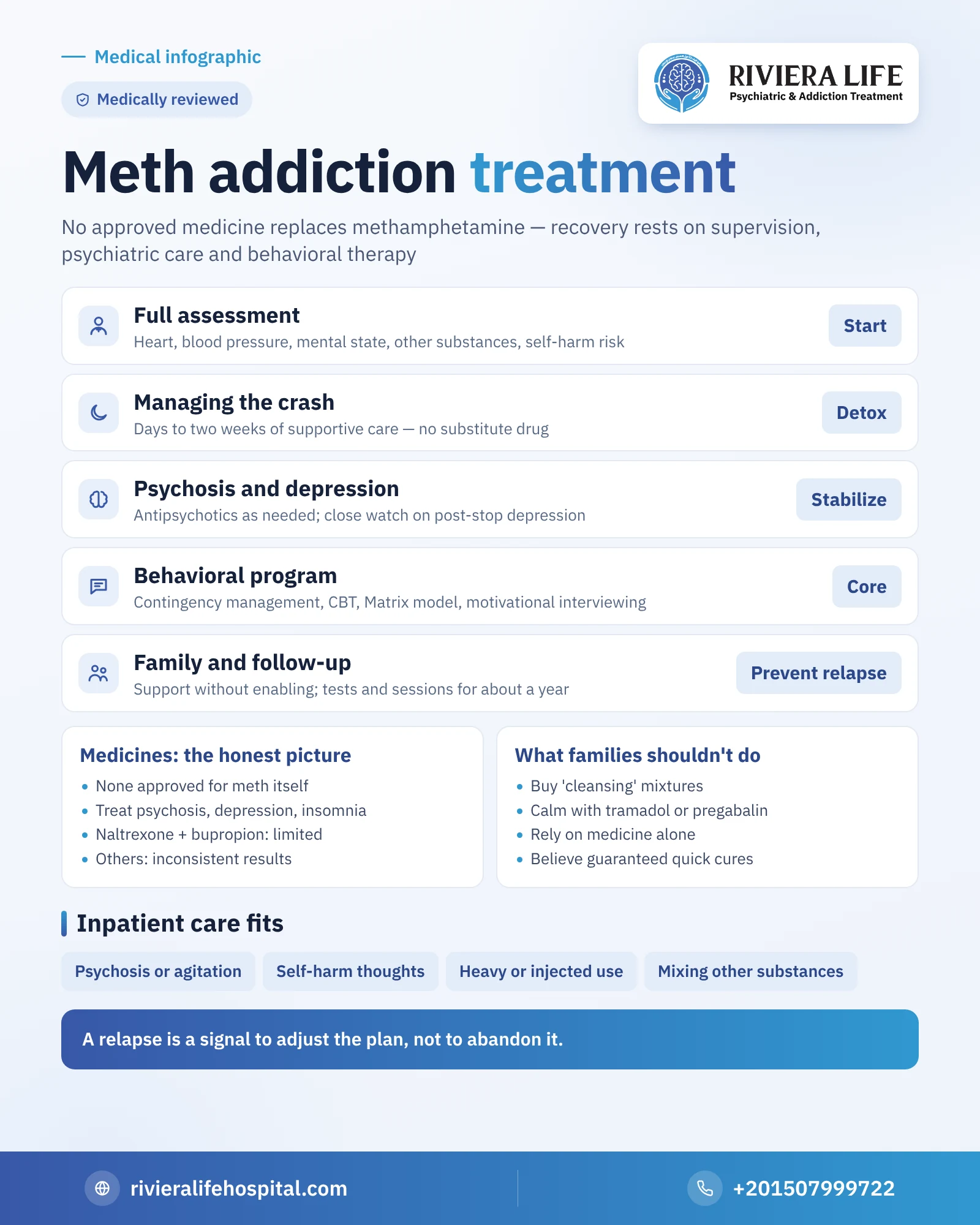
- Comprehensive assessment: checking the heart, blood pressure and mental state, identifying other substances used, and assessing the risk of psychosis and self-harm.
- Managing the crash and detox: days to two weeks of supportive care under medical supervision.
- Stabilizing the mental state: treating psychosis, depression, insomnia and anxiety as suits each patient.
- The intensive behavioral program: individual and group sessions that build skills to resist craving and reorganize daily life.
- Involving the family: training relatives to support without enabling, and repairing what the period of use damaged.
- Follow-up and relapse prevention: regular sessions and tests and a clear plan for months after discharge.
The first assessment: why isn’t detox enough?
A crystal patient may arrive looking calm, while hiding a heart rhythm disorder, high blood pressure, paranoid thoughts they don’t reveal, or depression carrying a risk of self-harm. They may be mixing ice with alcohol, tramadol or pregabalin, each of which needs different handling in withdrawal.
That is why good treatment begins with a full medical and psychiatric assessment including an ECG and basic tests, before any plan is set, because the harms of ice on the heart and brain may be present without clear symptoms. Settling for a week of “cleansing the body” and then going home leaves the craving and triggers as they are, so many go back to using within weeks.
Managing the crash phase
In the first days the patient sleeps a lot, eats with a strong appetite and has a very low mood. This phase doesn’t need substitute medicines, but a calm and safe environment, enough nutrition and fluids, daily monitoring of mood and self-harm risk, and treatment of insomnia or anxiety when needed. The details of what the patient goes through in these days and how long it lasts are in our article on ice withdrawal symptoms.
Treating accompanying psychosis and depression
A considerable proportion of shabu patients reach the hospital with suspicion and hallucinations, or go through them in the first days. The psychiatrist treats these symptoms with antipsychotic medicines for a period set according to the response, and they settle in most patients within days to weeks. Depression following stopping, on the other hand, needs careful follow-up, and may require medication and psychotherapy. The family helps a great deal when it describes to the doctor the symptoms of ice addiction it noticed at home before admission. A common mistake is ignoring these symptoms on the grounds that they “will go away on their own”, because they are among the strongest causes of relapse and dropping out of treatment.
Medicines for shabu (ice) treatment: what actually exists?
This is one of the questions families ask us most, and the honest answer starts with one fact: so far there is no medicine approved by international bodies that treats shabu addiction itself, the way methadone or buprenorphine treat heroin addiction, for example. But this doesn’t mean medicines have no role; they enter the plan through three different doors.
Medicines for accompanying symptoms
Here medicine has a clear and fast effect. Psychosis, suspicion and hallucinations are treated with antipsychotics, depression that continues after the first weeks of withdrawal may need an antidepressant, and severe insomnia is treated with a short-term medicine under supervision. In cases of severe agitation, the doctor may use a sedative for a very short period inside the hospital. These medicines don’t remove the craving for shabu, but they make the patient able to stay in treatment.
Medicines studied to reduce use
Research has tested many medicines in the hope of reducing craving or use. The most notable is the combination of long-acting naltrexone and bupropion: a large trial published in 2021 showed that the proportion who responded to it was higher than with placebo, but it remained a limited proportion. Mirtazapine showed in smaller studies a decrease in positive tests in some groups. Other medicines, such as modafinil, topiramate and acetylcysteine, have inconsistent results so far. That is why these medicines are only used by a doctor’s decision for a specific patient, after assessing their condition.
What the family shouldn’t do
- Don’t buy “mixtures” or “cleansing injections” sold as a quick cure for shabu; there is no evidence for them, and some contain sedatives that cause a new addiction.
- Don’t try to calm the patient at home with tramadol, pregabalin or sleeping pills; this swaps one substance for another, and may be dangerous with withdrawal.
- Don’t rely on medicine alone; what has actually been proven effective in stimulant addiction is the behavioral therapy we explain in the next section.
Before prescribing any medicine, the doctor reviews what the patient uses alongside shabu, the state of the heart and blood pressure, and the presence of depression or thoughts of self-harm, because these details change the choice, which is why two patients with the same addiction may get different medicines.
The bottom line is that medicine in shabu treatment is a helper, not the hero: it treats what accompanies the addiction and makes treatment possible, while recovery itself rests on behavioral therapy and long follow-up.
Behavioral therapy: the heart of stimulant treatment
The following approaches are the best supported by research in treating methamphetamine addiction:
- Contingency management: tangible rewards that increase with each consecutive negative test, one of the most effective approaches with stimulants.
- Cognitive behavioral therapy: teaches the patient to recognize the triggers and thoughts that precede craving, and to build practical alternatives to them.
- The Matrix model: a structured outpatient program over several months combining individual and group sessions, family education and regular tests.
- Motivational interviewing: strengthens the internal motivation to change instead of relying on pressure.
- Structured physical activity: studies suggest it helps improve mood and sleep and reduce craving.
Inpatient or outpatient treatment?
Treatment inside the hospital is more suitable in cases of psychosis or agitation, thoughts of self-harm, heavy daily or injected use, mixing other substances, previous failed attempts, and an unsafe home environment. Intensive outpatient treatment suits milder cases or the stage after a stay. The ideal path often starts with a short stay and then moves to a regular outpatient program.
How long does methamphetamine addiction treatment take?
Managing the crash takes days to two weeks, the intensive program usually several weeks to three months or more, and follow-up usually extends for about a year. The reason is that the brain needs months to regain its balance after ice, and sudden waves of craving continue during this period. And the rule research confirms: staying in treatment long enough is clearly linked to better results.
Preventing relapse after treatment
Among the most important things that protect the patient after discharge: keeping to follow-up sessions and tests, staying away from the people and places linked to use and deleting their numbers, regulating sleep and eating, regular physical activity, dealing early with any depression or insomnia, and having a written plan for what to do when craving is strong. The family has a central role here, explained step by step in our guide on how to deal with an ice addict. And if a relapse happens, it is a signal to adjust the plan, not to abandon it.
The right hospital for ice and shabu addiction treatment: how to choose
The right hospital for treating ice and shabu addiction isn’t the biggest or the most advertised, but the place that provides what a methamphetamine patient specifically needs: psychiatry able to handle psychosis and depression, and a real behavioral program, not just days of isolation. Ask before you decide:
- Is the hospital licensed, and is treatment led by consultants in psychiatry and addiction, or is it limited to supervisors?
- Can it safely handle cases of psychosis and agitation caused by shabu, with round-the-clock medical supervision?
- Does it assess the heart and physical condition at the start, and handle ice mixed with other substances?
- Does it offer a structured behavioral program such as cognitive behavioral therapy and incentive systems, or does it settle for detox?
- Does the program include the family, and provide clear follow-up for months after discharge?
- Does it guarantee the confidentiality of the patient’s and family’s data?
And don’t believe anyone who promises a guaranteed cure for ice, or an end to shabu addiction within days.
How Riviera Life meets these standards in ice and shabu treatment
Here are the details of what Riviera Life offers in this area:
- Official license: a hospital licensed by the Egyptian Ministry of Health.
- Long experience: for fourteen years the hospital has treated addiction, and thousands of people in recovery have left it.
- A consultant team: consultant doctors in psychiatry and addiction who handle ice-induced psychosis and the depression that follows the crash phase.
- Watchful medical care: continuous care 24 hours a day in the first days, when the patient is at their most delicate.
- An individual plan: a comprehensive assessment, then treatment combining medical and psychiatric care and the behavioral program according to each case.
- Support for relatives: meetings that teach the family sound support and setting boundaries.
- Aftercare: structured follow-up after discharge to prevent relapse.
- Complete confidentiality: full protection of the privacy of the patient and their family.
Your first consultation about crystal addiction is free; contact us at any time of day on +201507999722, or visit us in Sheikh Zayed City, Giza.
More from our ice and shabu guide
- Ice, shabu and crystal meth: the complete guide
- The causes of ice addiction
- The harms of ice
- How long ice stays in the body
Questions many people ask
There is still no approved medicine that treats shabu addiction itself. The doctor uses medicines to treat accompanying psychosis, depression and insomnia, and may prescribe some patients medicines studied to reduce use, such as naltrexone combined with bupropion, but their benefit is limited, and behavioral therapy remains the foundation.
Managing the crash takes days to two weeks, the intensive program weeks to three months or more, and follow-up about a year, because the brain needs months to regain its balance.
Some milder cases are treated with a structured outpatient program, but psychosis, thoughts of self-harm or mixing other substances call for a stay under medical supervision.
The approaches best supported by research are contingency management based on rewarding negative tests, cognitive behavioral therapy, and the Matrix model, which combines them with involving the family.
A license, consultant psychiatrists who can handle meth psychosis, round-the-clock supervision, a real behavioral program, family involvement and follow-up after discharge. Riviera Life in Sheikh Zayed meets these standards, with complete confidentiality.