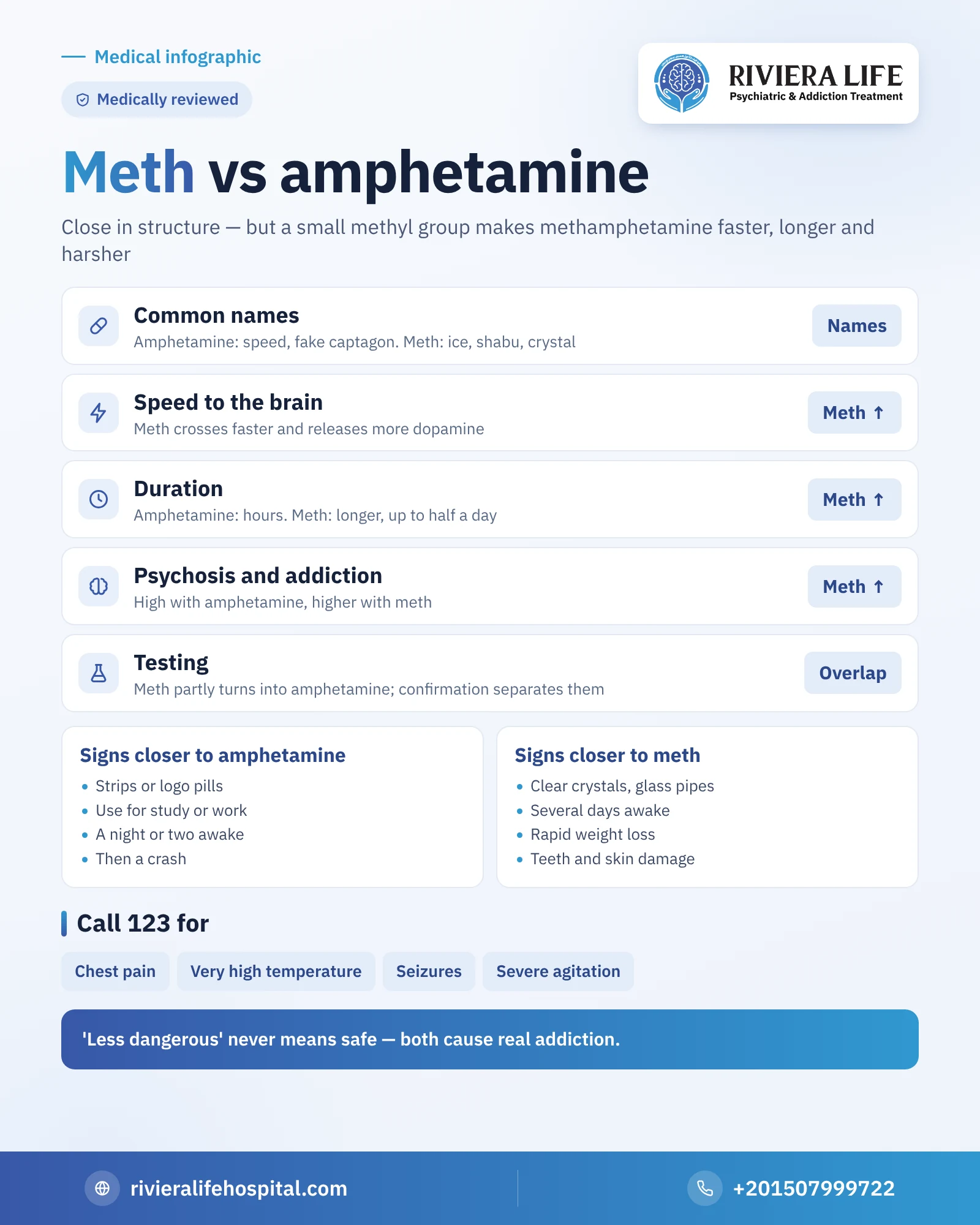
Methamphetamine and amphetamine are very close in structure, but they aren’t the same thing. The chemical difference between methamphetamine and amphetamine comes down to a small group called “methyl”, but it makes methamphetamine cross into the brain faster, its effect last longer, and release larger amounts of dopamine. That is why methamphetamine, known on the street as ice, shabu and crystal, is considered more addictive and more linked to psychosis, tooth damage and nerve damage. Amphetamine, on the other hand, has wider medical uses, and usually comes as pills, including fake captagon. Here we compare them in strength, duration, harms, testing and treatment, and answer the frequent question: which is more dangerous?
The difference between methamphetamine and amphetamine in brief
| Point of comparison | Amphetamine | Methamphetamine |
|---|---|---|
| Common names | Stay-awake pills, speed, fake captagon | Ice, shabu, crystal |
| Usual form | Tablets or powder | Clear crystals or powder |
| Most common way of use | Swallowing, then snorting | Smoking, then injecting and snorting |
| Speed of reaching the brain | Relatively slower | Clearly faster |
| Duration of effect | Hours | Longer, may extend to half a day |
| Medical use | ADHD and narcolepsy | Very rare and limited in a few countries |
| Risk of addiction and psychosis | High | Higher |
How does each work in the brain?
Both enter nerve cells and push them to release their stores of dopamine and noradrenaline, and block their reuptake. But methamphetamine is more fat-soluble, so it crosses the blood-brain barrier faster, releases more dopamine at a similar dose, and stays in the body longer. The result is a more violent high and a harsher crash, and a brain exposed to longer stress each time. That is why research indicates that damage to dopamine cells is clearer with methamphetamine.
The way of use and the risks it adds
Amphetamine is usually swallowed as pills, the slowest-acting route. Crystal methamphetamine, however, is smoked in glass pipes or injected, both of which deliver the substance to the brain within seconds, so the risk of addiction and poisoning rises. And injecting adds the risk of infection with HIV and hepatitis C. But this doesn’t mean the pills are safe; someone who crushes amphetamine pills to snort or inject them comes very close to the risks of methamphetamine.
Which is more dangerous?
In general, methamphetamine is considered more dangerous, for the following reasons:
- It causes addiction faster because of the strength and speed of the high.
- It is linked to higher rates of psychosis, paranoia and violence.
- Its damage to the teeth, skin and weight is clearer and faster.
- Its effect on brain cells is deeper and recovery is slower.
- Its most common ways of use, smoking or injecting, are more dangerous by nature.
But “less dangerous” doesn’t mean “safe”. Amphetamine in large doses causes heart attacks, strokes, psychosis and real addiction, and fake captagon pills have unknown content. The harms of the stronger substance are detailed in our article on the harms of ice.
The difference in physical and psychological harms
The heart is the shared victim: high blood pressure, a racing pulse and rhythm disturbance, and the risk of heart attack and stroke with large doses of either. But methamphetamine leaves clearer effects on appearance because its periods of use are longer and the sleeplessness with it more severe: rapid weight loss, severe decay and erosion of the teeth due to dry mouth, teeth grinding and neglected hygiene, and skin sores from repeated picking. These harms also appear with amphetamine, but usually more slowly and less severely, which makes many of its users continue for years before the family notices a clear effect.
On the psychological level
Both cause anxiety, insomnia and depression during the crash periods. But stimulant psychosis, with its paranoia and hallucinations, is more common and more severe with methamphetamine, and in some users it may persist longer after stopping or return with stress or lack of sleep. With amphetamine, psychosis usually appears with large doses and staying awake for several days in a row.
And where does captagon fall between them?
Captagon is often asked about as if it were a separate third substance. In reality, the name belonged to an old medicine that turns into amphetamine in the body, then that medicine disappeared, and the name remained attached to fake pills, most of which contain amphetamine with caffeine and other substances. So captagon usually falls in the amphetamine category, not methamphetamine, with an important difference: its content isn’t guaranteed, and one pill may differ from another in concentration and ingredients. You will find its details on our page on captagon.
Do they differ in testing?
Yes, and this is an important point. Part of methamphetamine turns into amphetamine in the body, so both usually show in the test of someone who uses it. Amphetamine, however, doesn’t turn into methamphetamine. A screening test may not distinguish between them accurately, while a confirmatory laboratory test identifies each substance separately. Detection periods in urine are similar, usually from a day to a few days, and you will find the details for the stronger substance in our article on how long methamphetamine stays in the body.
How can the family tell the signs of the two substances apart?
Signs closer to amphetamine
Strips of pills or pills bearing a logo, use linked to studying, work or travel, and staying awake for a night or two followed by a crash.
Signs closer to methamphetamine
Clear crystals or burnt glass tools, staying awake for several days in a row, rapid weight loss, clear deterioration of the teeth and skin, and more severe paranoia.
In the end the signs overlap, and testing and medical assessment are what settle the matter.
The difference in withdrawal
Withdrawal in both cases is mostly psychological: exhaustion, long sleep, hunger, depression and intense craving. But it is usually longer and more severe with methamphetamine, and its protracted symptoms may last months. You will find the details in our article on ice withdrawal symptoms.
Overdose: a shared danger
Call an ambulance on 123 immediately if you see
Poisoning with either is an emergency, and don't wait for the person to calm down on their own.
- Chest pain or severe, irregular palpitations
- A very high temperature and hot skin
- Seizures or loss of consciousness
- Violent agitation, or hallucinations and severe paranoia
- A sudden headache and weakness on one side of the body
Does treatment differ?
The basis is the same: there is no approved medicine that directly treats addiction to either, and treatment relies on safe stabilization, then proven behavioral programs such as contingency management and cognitive behavioral therapy, with treatment of depression and psychosis if present. But a methamphetamine patient usually needs a longer period of stay and follow-up, and more attention to psychosis, teeth and nutrition. You will find what is specific to methamphetamine treatment in our article on methamphetamine addiction treatment.
Common myths in the comparison
Some users say ice is “purer” than pills and therefore less harmful; the truth is that higher purity means a stronger dose and greater, not lesser, danger. Others say pills don’t cause addiction because they are “medicine”; the truth is that amphetamine outside medical supervision causes real addiction that may last years. And a third group thinks moving from ice to pills is a form of recovery, while it is a continuation of the same addiction with a slower substance.
The legal position in Egypt
Egyptian law lists amphetamine and methamphetamine together among the narcotic substances subject to the schedules, and criminalizes possessing, using and trading them outside the medical framework. Legitimate medicines from the amphetamine family are only dispensed under special controls. And the door to treatment remains open for those who come forward voluntarily. For the full picture of the stronger substance, see our page on methamphetamine.
More from our amphetamines guide
- Amphetamines: the complete guide
- Amphetamine addiction treatment
- Amphetamine withdrawal symptoms
- The harms of amphetamine on the heart, brain and body
- The difference between heroin and shabu: effects, signs, overdose and treatment
- The difference between captagon and shabu: strength, psychosis, addiction and which is more dangerous
- The difference between cocaine and amphetamine: mechanism, duration, the heart and the crash
Questions many people ask
No, ice is crystal methamphetamine, which is chemically close to amphetamine but stronger and reaches the brain faster.
Methamphetamine is generally more dangerous because it causes addiction faster and is more linked to psychosis and nerve damage, but amphetamine in large doses is dangerous too.
Usually yes, because part of methamphetamine turns into amphetamine in the body, and a confirmatory test distinguishes between the two substances.
Most captagon pills in circulation contain amphetamine, but their content isn't consistent, and the name can't be relied on to know what is inside.
The basis is the same, behavioral therapy with treatment of accompanying disorders, but a methamphetamine patient usually needs longer and more attention to psychosis, nutrition and teeth.