How long ketamine stays in the body is shorter or longer depending on the sample; in a urine test it usually shows for about two to four days after the last use, and the period may be longer in someone who uses large amounts daily because its breakdown products stay longer than the substance itself. In the blood its window is short, measured in hours, and in hair it may be detected for about three months.
But the most important information many don’t know is that common drug tests usually don’t detect ketamine, because it needs a special test requested by name. In this article we explain what happens to ketamine inside the body, how long it shows in each type of test, what affects the result, and how it is read correctly.
What happens to ketamine inside the body?
After entering the body ketamine reaches the brain quickly, then the liver breaks it down into a main substance called norketamine, which in turn turns into other products before most of it leaves with the urine. Ketamine’s half-life is relatively short, around two to three hours, meaning the body gets rid of about half the amount within this period. But norketamine stays longer, which is why laboratories look for it alongside ketamine to widen the detection window.
And here is an important paradox: the effect the person feels wears off within an hour or two, while the substance’s trace stays in the urine for days. So the person’s feeling that he has “come round” doesn’t mean his body has got rid of it.
How long ketamine shows in each type of test
These are approximate, commonly accepted periods, and they differ from person to person:
Urine test
The most widely used. Ketamine and its products usually show in it for two to four days after occasional use. With heavy daily use the window may extend to a week or a little more depending on the sensitivity of the test.
Blood test
Its window is short, from hours to about a day. It is used in emergencies to assess a confused or unconscious person, more than to detect previous use.
Saliva test
It detects recent use, within about one to two days, and is less widespread, and tests specific to ketamine aren’t always available for it.
Hair test
It has the longest detection period, as the part close to the scalp keeps a trace of ketamine for about three months. However, it doesn’t show use in the last few days, because the hair needs time to grow, and it doesn’t determine the day of use precisely.
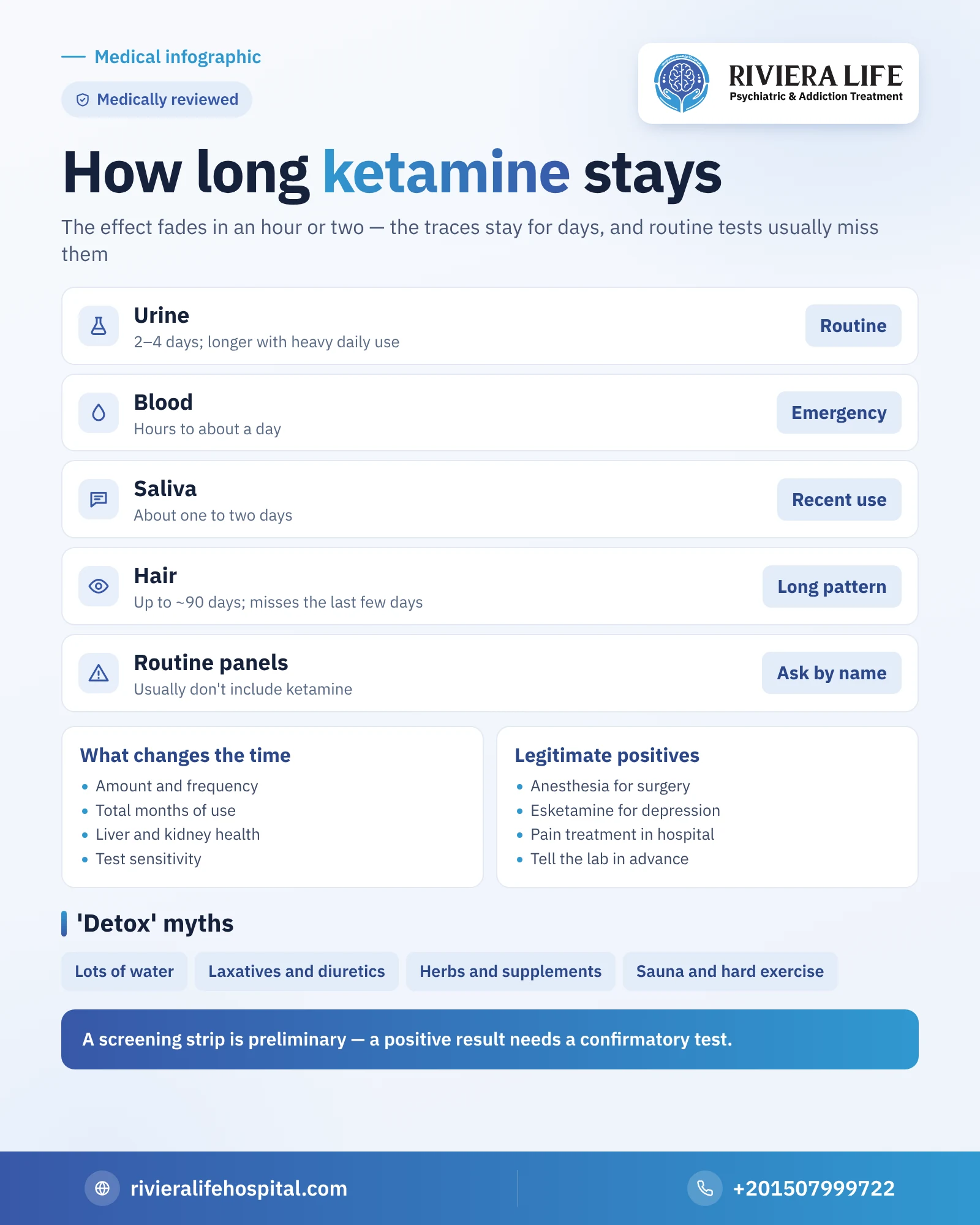
A brief table of detection windows
| Type of sample | Approximate period | When it is usually used |
|---|---|---|
| Urine | 2–4 days, and longer with heavy use | Routine testing and follow-up |
| Blood | Hours up to about a day | Emergencies and poisoning |
| Saliva | About one to two days | Detecting recent use |
| Hair | Up to about 90 days | Detecting an extended pattern of use |
Why doesn’t ketamine show in an ordinary test?
Many families buy a multi-panel home strip or ask for a general “drug test”, and the result comes back negative despite suspicions. The reason is that most common tests are designed to detect specific groups such as hashish, opioids, stimulants and benzodiazepines, and ketamine isn’t usually included. To detect it you need a strip with its own panel, or to request the test by name at the laboratory. So if the suspicion relates to ketamine specifically, say so explicitly when requesting the test.
What lengthens or shortens the period?
- Amount and frequency of use: daily use accumulates the substance and its products.
- Total duration of use: someone who has used for months differs from someone who tried it once.
- Liver and kidney efficiency: their weakness slows getting rid of the substance.
- Age, weight and general health.
- The concentration of the urine at the moment the sample is taken.
- The sensitivity of the test itself and the cut-off the laboratory uses.
It is also important to know that ketamine mixed with other substances, or powder sold as ketamine that isn’t, may change the test result completely. The test may come back negative for ketamine and positive for a substance the person didn’t intend, which happens repeatedly with substances of unknown origin.
Screening tests and confirmatory tests
Rapid strips and the first test at the laboratory rely on an immune reaction, and their result is preliminary and may sometimes be wrong in both directions. If it comes back positive, the correct step is a confirmatory test with precise equipment such as chromatography linked to mass spectrometry, which identifies ketamine and norketamine by name and measures their concentration. An important decision, at work or in the family, shouldn’t be built on a preliminary strip alone.
When is a positive result medically justified?
Ketamine is a medicine, so it may show in a test without any illicit use. This happens after anesthesia in an operation or a procedure in the emergency department, in someone receiving esketamine for treatment-resistant depression inside a medical facility, or after pain-relief sessions with ketamine in hospital. That is why it is important to tell the laboratory and the party requesting the test about any recent medical procedure, while keeping the reports that prove it.
“Body cleansing” recipes for ketamine
Drinks and herbs that promise to remove ketamine from the body in a day are widespread online. There is no evidence that any of them speeds up getting rid of the substance, and some cause salt imbalance or strain the kidneys, which are already strained in ketamine users. The body gets rid of the substance at the speed the liver and kidneys allow, and the only route to a negative test is stopping.
Can the body be cleansed of ketamine quickly?
The honest answer: there is no safe way to speed up ketamine leaving the body. The liver breaks the substance into products the body expels through the kidneys at its own pace, and no drinks or herbs change this pace. Among the common claims:
- “Drinking lots of water flushes it out”: moderate drinking is generally useful, but overdoing it may upset blood salts and doesn’t shorten the period.
- “Laxatives and diuretics cleanse the body”: they cause dehydration and salt imbalance and strain the already strained kidneys of ketamine users.
- “Herbs and supplements solve the matter”: there is no scientific evidence for them, and some harm the liver.
- “Sauna and hard exercise burn it off”: heat and dehydration increase the strain on the body and don’t change how it is eliminated.
The reason these claims spread is that people look for a quick solution out of fear, so they believe whoever sells them an illusion. The factors that really prolong the products’ presence are heavy use and weak kidneys, and neither is treated by a home recipe.
What someone who has stopped really needs is medical supervision: checking the bladder, kidneys and liver, following sleep and mood in the first days of stopping, and a plan that prevents a return. Read ketamine withdrawal symptoms and their timeline to know what to expect after stopping.
Ketamine testing at work and in official situations
Some employers, universities and official bodies require a drug test before hiring or periodically, and some families ask for it before marriage. What the test covers differs from one party to another; some are content with the common groups, and some add ketamine and other substances.
And if the person is receiving medical treatment containing ketamine or had a recent operation, he has the right to present proof of that before the test, not after, and to request a confirmatory test if the preliminary result comes back positive. As for someone who really uses and fears the test, anxiety about the result may be an opportunity to face the real problem instead of looking for a trick to get past one day, and specialist consultation is confidential and isn’t reported to any party.
What can’t the test tell you?
The test says whether the substance is present or absent above a certain threshold, but it doesn’t determine the amount precisely, nor when use happened to the hour, nor whether the person is addicted or used once. Diagnosis needs a full medical and psychological assessment. And ketamine’s absence from the urine after days doesn’t mean the problem is over; craving, anxiety and mood swings may continue for weeks, the subject of our article on ketamine withdrawal symptoms. For the signs that deserve attention alongside testing, see our article on ketamine addiction symptoms.
How are tests used during treatment?
In treatment programs urine tests are done periodically, and their aim isn’t punitive monitoring but follow-up: confirming stability, detecting relapse early, and giving the patient and his family tangible evidence of progress. With ketamine a general urine test and kidney function are usually added to follow the recovery of the urinary tract. You will find the full stages of treatment in our article on ketamine addiction treatment.
Before you use the strip at home
Think first about what you will do with the result. A positive strip needs confirmation, then a calm conversation and specialist consultation, and a negative strip doesn’t reassure you if it didn’t have a ketamine panel in the first place. Make the goal reaching treatment, not catching the person red-handed. For the full picture of the substance, return to our ketamine page.
More from our ketamine guide
- Ketamine: the complete guide
- Ketamine addiction symptoms
- Ketamine withdrawal symptoms
- Ketamine addiction treatment
Questions many people ask
Usually about two to four days after occasional use, and the period may extend to a week or a little more with heavy daily use.
Most common strips don't have a ketamine panel, and you must make sure it is there or ask the laboratory for the test by name.
Its window in the blood is short, from hours to about a day, which is why blood testing is mostly used in emergencies.
It may show if it was used in anesthesia, which is why the laboratory should be told about any recent medical procedure and proof of it kept.
Yes, it may be detected in hair for about three months, but it doesn't reveal the last few days.