The short answer
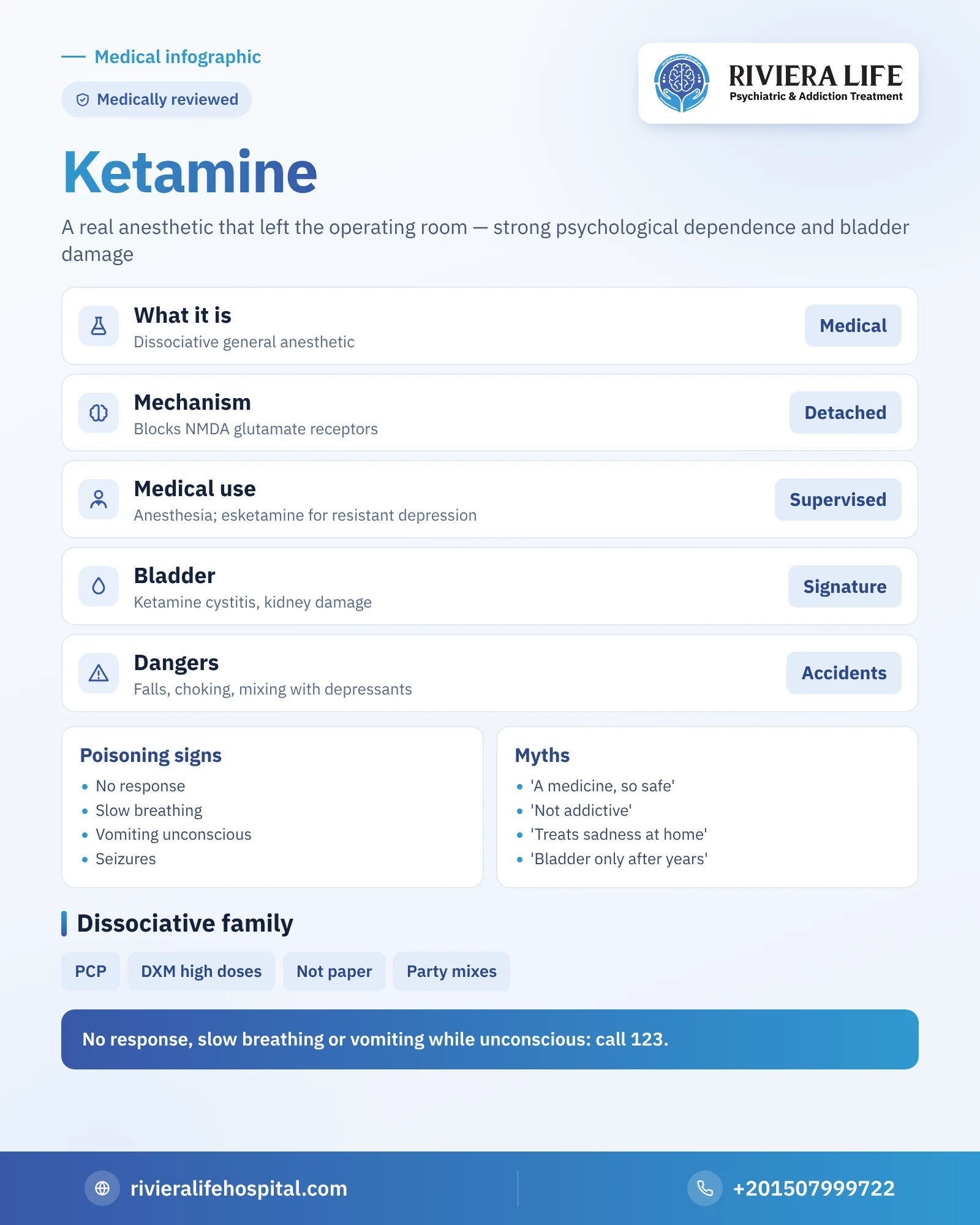
Ketamine is a general anesthetic used in short operations, emergencies and veterinary medicine since the 1970s, and it belongs to the category of “dissociative anesthetics”, which make a person feel detached from their body and reality. One of the two forms of its molecule, esketamine, has an approved use in treating treatment-resistant depression inside a medical facility only. Outside the hospital it is usually used as a white powder by snorting, causing strong psychological addiction and bladder damage that may be hard to repair, and its possession outside the medical framework is criminalized in Egypt.
- CategoryDissociative anesthetics
- Medical useAnesthesia, and treatment-resistant depression
- Distinctive harmBladder damage
Ketamine is a real anesthetic used in operating rooms for more than half a century, but it has left the hospitals for parties and nights out as a drug that detaches its user from their body and their surroundings. This duality confuses many families: how can it be a medicine and a drug at the same time? The answer is that the dose, the purity and the medical supervision are what separate the two cases, and that using it outside the hospital may end in strong psychological addiction and bladder damage that is hard to repair. On this page you will find a complete picture of ketamine, followed by links to detailed articles on its symptoms, harms and treatment.
What is ketamine?
Ketamine is an anesthetic substance from a category called “dissociative” anesthetics, substances that produce a feeling of detachment from the body and reality. It was developed in the 1960s as a safer alternative to the substance phencyclidine (PCP), which caused severe agitation and hallucinations after waking, and it entered medical use in the early 1970s as a general anesthetic for humans and animals. Among its medical advantages is that it relatively preserves breathing and blood pressure during anesthesia, which is why it has remained useful in emergencies, wars and places with limited resources.
But the same properties that make it useful to the surgeon, namely separating the sensation of pain and consciousness from the body, are what attracted to it those looking for an “out-of-body” experience. From around the 1980s it began to spread outside the medical framework in Europe and Asia, then reached the Arab region through medicines leaked from human and veterinary use, and from illegal sources of unknown composition.
Names of ketamine circulating in Egypt
Ketamine doesn’t have an established popular name in Egypt like hashish or tramadol, and it usually circulates under its own name or abbreviations taken from English such as “K” and “Special K”. Some media describe it as “horse tranquilizer” because it is used in veterinary anesthesia, a description that gives the misleading impression that it is a strange, rare substance, while in reality it is a human medicine in circulation in hospitals. More important than the name is that the powder sold as ketamine may be mixed with other substances, or may not be ketamine at all, and only laboratory testing settles that.
Forms of ketamine and ways of using it
Medical ketamine comes as a clear liquid in glass vials intended for injection. On the illegal market it mostly appears in two forms:
- A white crystalline powder, often prepared by evaporating the medical liquid, the most widespread form among users.
- Tablets or capsules, which may sometimes be sold as other substances such as ecstasy.
The best-known methods of use are snorting through the nose, then swallowing, and sometimes injecting into a muscle or vein, or mixing it with cigarettes and hashish. Ketamine is sometimes slipped into drinks without the person’s knowledge, because it has almost no color or smell, and it causes the victim to lose the ability to move, resist and remember. That is why it is important that no one leaves their drink unattended at parties and in crowded places.
What does ketamine do in the brain and body?
Ketamine works mainly by blocking a type of receptor in the brain called “NMDA” receptors, receptors that respond to glutamate, the neurotransmitter responsible for a large part of signal transmission between cells. When these signals are disrupted, what the person perceives becomes detached from what is actually happening around them, so effects appear that escalate with the amount:
- At small amounts: numbness, relaxation, dizziness and a feeling that the body is heavy or far away.
- As the amount increases: a confused sense of time and distances, a change in sounds and colors, and difficulty with speech and coordinated movement.
- At high amounts: a state users call the “hole” or “K-hole”, in which the person is almost detached from their body and surroundings, and may be unable to move or speak.
At the level of the body, ketamine raises heart rate and blood pressure, and weakens the sensation of pain, so the person may suffer wounds or fractures without feeling them. Its effects appear within minutes after snorting, and usually last from half an hour to about an hour, then effects such as confusion and dizziness remain for hours afterwards. This short effect pushes many to repeat the dose in a single night, which is one of the first roads to tolerance and dependence.
The medical uses of ketamine
Ketamine has a legitimate medical standing that shouldn’t be denied. It is an approved general anesthetic used in short operations, in anesthetizing children and some emergency and injury cases, and in veterinary medicine. Anesthetists also use it at low doses within pain-relief plans after some operations.
In recent years a psychiatric use for it has emerged: esketamine, one of the two forms of the ketamine molecule, has been approved as a nasal spray for treating treatment-resistant depression in adults, together with an antidepressant taken by mouth. But this treatment has strict conditions: it is given inside an approved medical facility only, the patient doesn’t take it home, and they remain under monitoring for about two hours after each dose to follow blood pressure and consciousness. The existence of this use doesn’t mean that the ketamine circulating outside the hospital is a “treatment for depression”; the substance is of unknown amount and purity, and repeated use without supervision may increase depression and anxiety instead of easing them.
Why is ketamine dangerous?
Many think ketamine is “safe” because it is a medicine, and in reality its danger comes from more than one direction:
- Accidents: losing the sense of pain and balance makes falls, drowning and road accidents more likely.
- Choking: the person may vomit while barely conscious and inhale the vomit.
- Mixing: the risk of breathing stopping multiplies when it is mixed with alcohol, sedatives or opioids.
- The bladder and kidneys: repeated use may cause chronic inflammation of the bladder known as ketamine cystitis, and the damage may extend to the ureters and kidneys.
- The brain and mind: weakened memory and concentration, depression, and episodes of suspicion or hallucinations in some heavy users.
- Addiction: tolerance develops quickly, and strong psychological dependence and an urgent craving to repeat appear.
Ketamine within the dissociative family
Ketamine belongs to a small group of substances that share causing detachment from reality, the best known being phencyclidine, and it also includes very high doses of the cough medicine dextromethorphan. This family differs from classic hallucinogens such as paper (blotter) drugs, as hallucinogens change perception and emotions while the person usually remains present in their body, while dissociatives detach them from their body itself. Ketamine is often combined with party substances such as ecstasy and alcohol, a mix that raises the risks to the heart, breathing and behavior.
Ketamine and the law in Egypt
Ketamine in Egypt is a controlled substance, permitted inside hospitals and veterinary clinics under strict controls, and possessing, selling or using it outside this framework is a violation punishable by the anti-narcotics law. On the other hand, the law opens a door to treatment, as a criminal case isn’t usually brought against a user who comes forward on their own seeking treatment. For any legal question concerning a specific case it is preferable to consult a lawyer, and the Fund for Drug Control and Treatment of Addiction also provides a free hotline on 16023.
The ketamine guide: each aspect in a separate article
We have dedicated a separate article to each question about ketamine that deals with it in detail, so start with the one closest to your situation:
- Ketamine addiction: how use turns from an experiment into dependence, and why tolerance develops quickly.
- Signs of ketamine addiction: the changes the family notices in the body, mood and behavior.
- Causes of ketamine addiction: the motives for use, the risk factors and who is most at risk.
- The harms of ketamine: what it does to the bladder, kidneys, liver and brain.
- Ketamine withdrawal symptoms: what happens after stopping, the timeline, and when you need a doctor.
- How long ketamine stays in the body: when it can be detected in urine, blood, saliva and hair samples.
- Ketamine addiction treatment: the stages of treatment, bladder care, and choosing a suitable hospital.
Common myths about ketamine
The myth: ketamine is a medicine, so it is safe. The truth is that the medicine is relatively safe when an anesthetist gives it at a calculated dose with monitoring equipment, while the powder in circulation has an unknown concentration and unknown additives, and there is no one monitoring breathing.
The myth: ketamine doesn’t cause addiction. The truth is that it usually doesn’t cause violent physical withdrawal like opioids, but psychological dependence on it is strong, and some addicts use it daily despite bladder pain.
The myth: as long as it is used to treat depression, using it at home treats sadness. The truth is that the approved treatment is done with a known substance and a fixed dose under monitoring, and that random use is linked to depression and anxiety, not to recovery from them.
The myth: bladder problems only affect those who use it for years. The truth is that urinary symptoms may begin after months of repeated use, and become more severe the more the amount increases.
Discovered someone close to you is using ketamine?
Noticing may start with small details: frequent trips to the bathroom, complaints of pain in the lower abdomen, or a vacant look and slow speech after coming back from a night out. Don’t start with accusations; start by writing down what you see and its timing. Choose a time when the person is clear-headed, and express your worry for their health, especially the health of their bladder and kidneys, as this is a less sensitive entry point than talking about shame and punishment. And if they refuse to admit it, don’t enter a long argument; instead ask for a specialized consultation yourself to know your next step. You will find the detailed signs in the article on ketamine addiction symptoms.
Signs of ketamine poisoning
Call the ambulance on 123 immediately if any of these appear
The greatest danger comes from mixing ketamine with alcohol or sedatives, or from vomiting while unconscious.
- No response to being called or touched
- Slow or irregular breathing, or choking sounds
- Vomiting while the person isn’t fully conscious
- Chest pain or a very fast heartbeat
- Seizures
- Severe agitation or hallucinations that make them a danger to themselves
Until the ambulance arrives, put the person on their side if they are unconscious but breathing, move sharp objects away from them, and talk to them in a calm voice if they are agitated. Don’t give them food, drink or any other substance, don’t leave them alone, and tell the paramedics everything you know about the substances they took.
When should you ask for help?
Ask for help if use has been repeated more than once, or the person has started using alone, or urinary symptoms have appeared, or they have failed to stop despite their promises. Early intervention protects the bladder before its damage becomes permanent, and stops dependence before it deepens. At Riviera Life, a team of consultants in psychiatry and addiction treatment assesses the case in complete confidentiality, and puts in place a plan that combines psychotherapy and medical follow-up of complications, and the first consultation is free.
Medical sources and referencesThe information in this article is based on reliable scientific sources