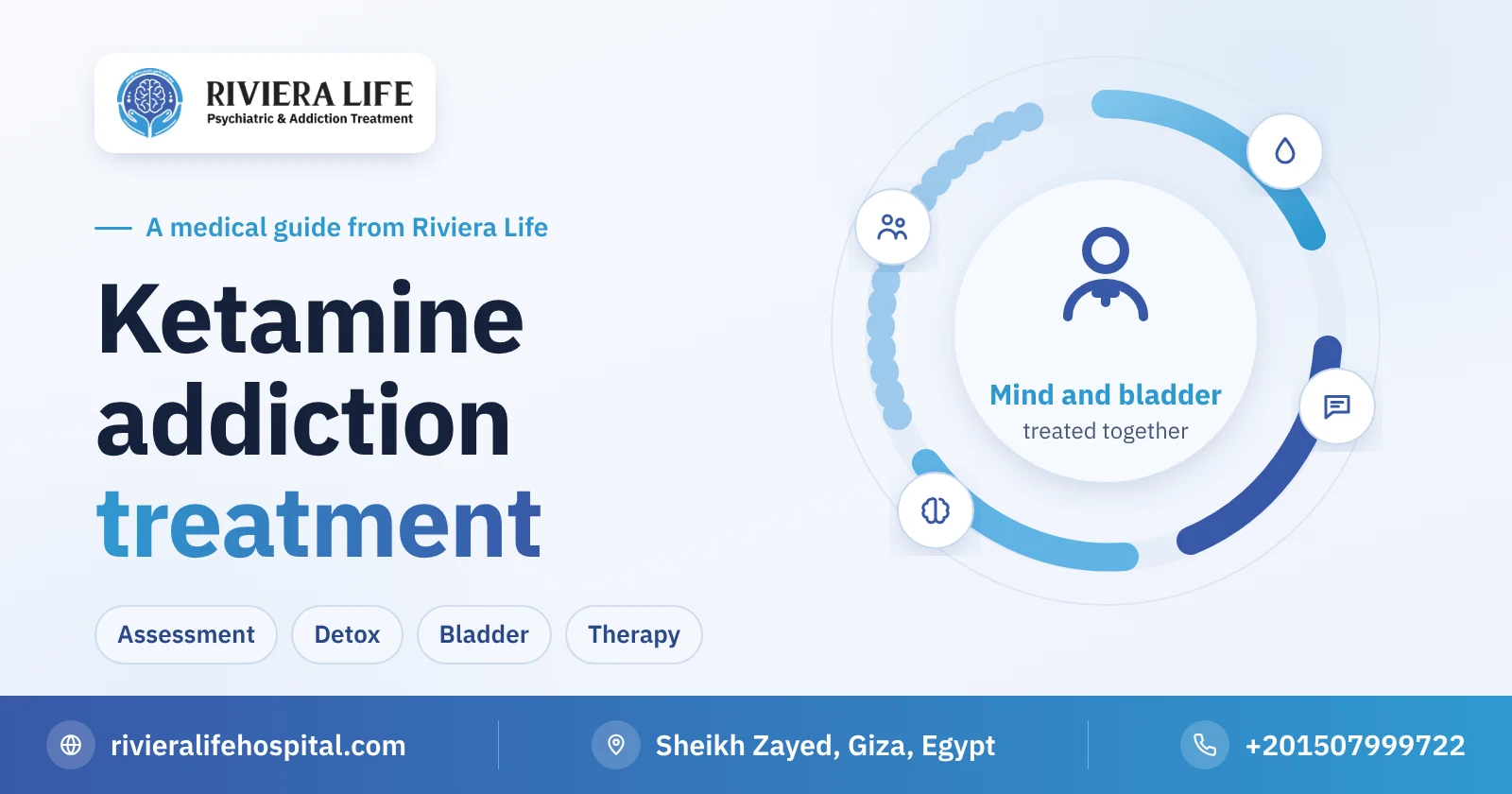
Ketamine addiction treatment is possible, and its results are better the earlier it starts. But it differs from the treatment of many other drugs in two points: there is no approved medicine that replaces the substance or prevents craving for it, which is why psychological and behavioral therapy carries the greatest burden, and at the same time the patient usually needs care for the bladder and kidneys in parallel with addiction treatment. Good treatment passes through clear stages: a comprehensive assessment, then managing the first days of stopping, then psychological rehabilitation that addresses what the patient was escaping from, then follow-up that prevents relapse. This article explains each stage, the expected duration of treatment, and how to choose the right hospital.
Stages of ketamine addiction treatment
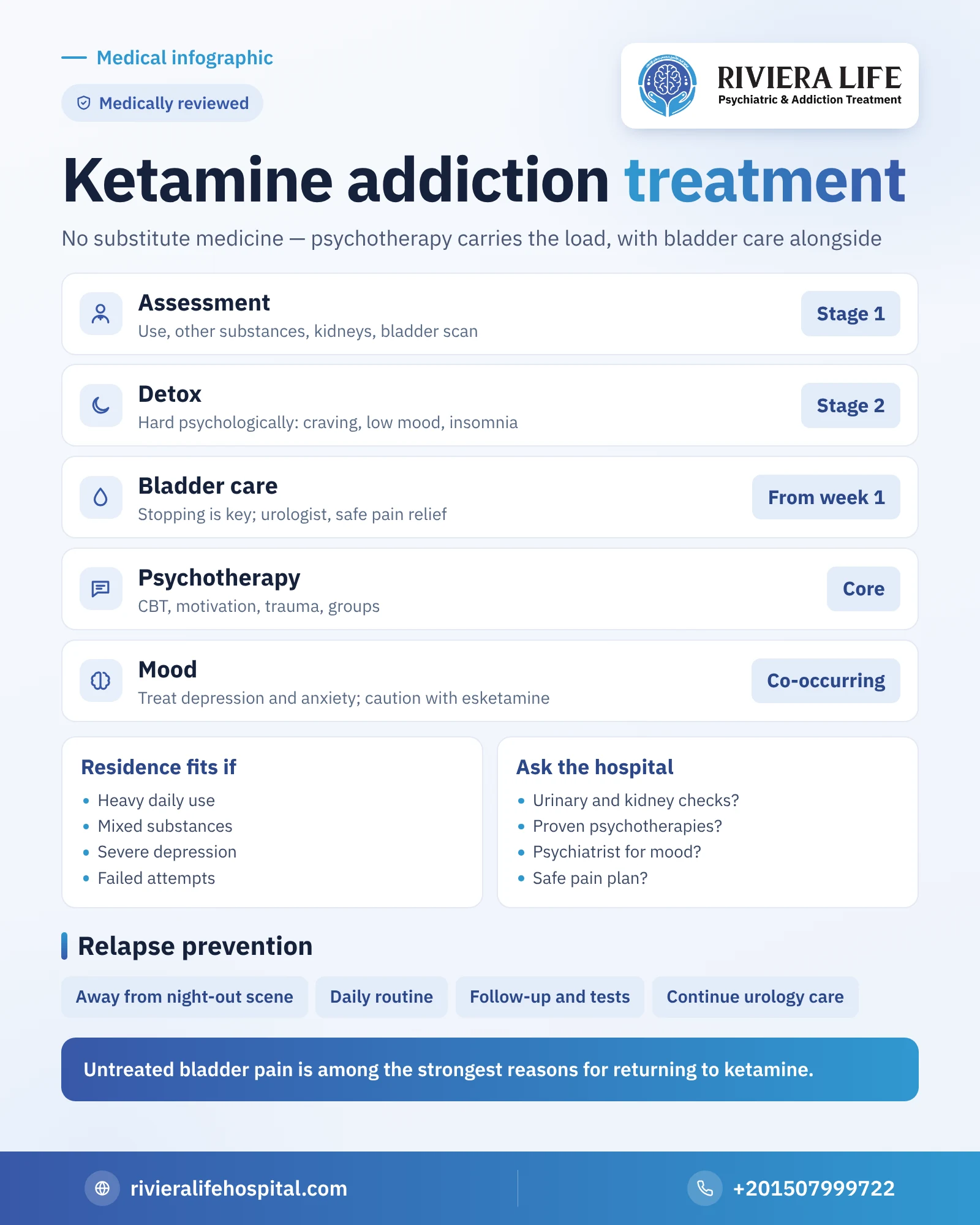
- Assessment: a comprehensive psychological and physical examination that determines the severity of addiction, the accompanying substances and the state of the urinary tract.
- Detox: stopping the substance with follow-up of mood, sleep and pain in a safe environment.
- Psychotherapy and rehabilitation: understanding the motives of use and building alternative skills for dealing with pressures and feelings.
- Treating complications: care for the bladder, kidneys and liver, and treating depression and anxiety.
- Follow-up and aftercare: regular sessions, tests, family support and a relapse prevention plan.
These stages overlap more than they follow each other; bladder care, for example, starts from the first week and doesn’t wait for rehabilitation to end.
The comprehensive assessment: the starting point
Treatment begins with a detailed interview with the patient, then with the family if they agree, about the duration, amount and method of use, the other substances used, and the psychological and family history. It is followed by a physical examination and tests including urine for ketamine and other substances, kidney and liver function, and a general urine test. When there are urinary symptoms, an ultrasound of the kidneys and bladder is usually requested, and the patient may need a urologist’s consultation. The result of this assessment is what determines the place, duration and priorities of treatment.
Detox and the first days
Stopping ketamine doesn’t usually need gradual reduction of the dose, but the first days are psychologically hard because of craving, anxiety, low mood and insomnia. During this period the team follows the patient closely, treats symptoms as needed, and watches for any thoughts of self-harm. Detox becomes more delicate if the patient also uses alcohol or sedatives, because withdrawal from them may need close medical supervision. You will find the timeline of symptoms in the article on ketamine withdrawal symptoms.
Are there medicines to treat ketamine addiction?
So far there is no medicine approved specifically to treat ketamine addiction, unlike opioids or alcohol. Some medicines are being studied in research, but they haven’t reached the level of a general recommendation. That is why medicines are used in treatment for specific purposes: regulating sleep in the first days, easing severe anxiety for a short period, treating chronic depression or anxiety if their presence is confirmed, and relieving bladder pain with safe medicines. The doctor must determine all this, as a patient who treats themselves with sedatives may move from one addiction to another.
Bladder care is part of addiction treatment
Many ketamine patients come to treatment because of the bladder, not because of the addiction itself. The most important treatment for the bladder is completely stopping the substance, as early symptoms improve in many within weeks to months. The urologist adds what is needed to ease pain and urgency, and some patients may need local treatments inside the bladder. Advanced cases in which the bladder has become fibrosed or the kidneys have been affected may need surgical intervention. Most important here is treating pain in a safe way, because untreated pain is among the strongest reasons for returning to ketamine. The details of this harm are in the article on the harms of ketamine.
Psychological and behavioral therapy
Here the real change happens. Among the most used methods:
- Cognitive behavioral therapy: in it the patient learns to recognize the thoughts and situations that lead them to use, and builds practical alternatives to them.
- Motivational interviewing: strengthens the patient’s internal motivation for change, and is especially useful with someone who sees ketamine as “not a big problem”.
- Contingency management: tangible rewards for commitment and negative test results, which has proven effective with a number of substances.
- Trauma therapy: for those for whom the dissociation ketamine produces was their means of escaping painful memories.
- Group therapy: breaks the patient’s feeling that they are alone, and gives them the experiences of others on the same path.
Treating co-occurring depression and anxiety
A large proportion of ketamine patients started using to escape depression or anxiety, or developed them because of use. Ignoring these disorders is among the most important reasons for relapse, which is why the psychiatrist assesses and treats them with suitable medicines and psychotherapy. It is important to clarify a point that raises questions: although esketamine is approved for treatment-resistant depression, doctors deal very cautiously with any treatment derived from ketamine in a patient with a history of addiction to it, and usually prefer other alternatives.
Residence or outpatient treatment? And how long does it take?
Residence inside the hospital suits those who use daily in large amounts, mix several substances, have severe depression or suicidal thoughts, have failed in previous attempts, or live in an environment that makes stopping difficult. Outpatient treatment suits milder cases or the stage after residence. As for duration, the first stopping stage may take days to two weeks, the intensive program from several weeks to a few months, then outpatient follow-up extends for months. Research generally links continuing treatment for a sufficient period with better results, so what matters most is that the patient doesn’t drop out between one stage and another.
Preventing relapse after discharge
The first months after intensive treatment are the most sensitive. Among the most important things that protect the patient: keeping away from the night-out scene and friends linked to use, building a daily routine with regular sleep, work or study and physical activity, committing to follow-up sessions and urine tests, having a written plan for what to do when feeling a strong craving, and continuing urology follow-up. And relapse, if it happens, doesn’t mean treatment failed, but that the plan needs adjusting.
The family’s role in the treatment journey
The family is a partner in treatment, not a spectator. It needs to learn how to support without covering up use, how to set limits on money and nights out without cutting the connection, and how to notice signs of relapse early. That is why good programs dedicate sessions to the family itself. And if the family is still trying to understand what is happening, the article on the causes of ketamine addiction is a useful starting point.
The right hospital for ketamine addiction treatment: how to choose
The right hospital for ketamine addiction treatment is one that offers what a patient of this substance specifically needs: strong psychotherapy because there is no substitute medicine, urinary tract care because the bladder is often affected, and close monitoring of mood. Ask before you decide:
- Are the urinary system and kidney and liver function assessed as part of the treatment plan, or is the patient left to look for that alone?
- Does the program rely on proven psychotherapies such as cognitive behavioral therapy and motivational interviewing?
- Is there a psychiatrist who assesses and treats depression, anxiety and suicidal thoughts?
- Are accompanying substances such as alcohol, sedatives and ecstasy treated within the same plan?
- Is there a plan to treat pain in a safe way that doesn’t lead to a new addiction?
- Is there follow-up after discharge and a program for the family?
And beware of parties that offer a guaranteed cure rate or claim to end addiction in a few days.
How Riviera Life meets these standards in ketamine addiction treatment
At Riviera Life you find all the previous criteria in one place, and their details are as follows:
- Official license: a hospital licensed by the Ministry of Health.
- Fourteen years with addiction: long experience in treating it, and thousands of cases that have regained their health.
- Consultants in psychiatry and addiction: they take charge of assessing and treating the depression and anxiety that accompany ketamine use.
- Continuous medical care: 24-hour follow-up in the first days of leaving ketamine, when craving is strong and mood drops.
- An individual plan: psychological and behavioral therapy suited to the pattern of use, with follow-up of urinary tract health and accompanying substances.
- A family program: sessions that help the family support, set limits and detect signs of relapse.
- Aftercare: follow-up after discharge to prevent returning to the substance.
- Complete confidentiality: full privacy for the data of the patient and their family.
To get rid of ketamine with a medical plan, book your free first consultation by calling +201507999722 at any hour of the day; the hospital is located in Sheikh Zayed, Giza Governorate.
More from the ketamine guide
- Ketamine: the complete guide
- Ketamine addiction: how it develops
- Ketamine withdrawal symptoms
- The harms of ketamine
Questions many people ask
There is so far no medicine approved specifically for it, and medicines are used to treat symptoms and accompanying disorders, while psychotherapy plays the greatest role.
The first stopping stage is days to two weeks, the intensive program weeks to months, then outpatient follow-up extending for months according to the case.
Some milder cases are followed as outpatients under medical supervision, but someone who uses heavily, mixes substances or has severe depression usually needs residence.
Often yes, as urinary symptoms are common, and assessment of the bladder and kidneys is an essential part of the treatment plan.
Choose one licensed by the Ministry of Health that combines psychiatry and addiction consultants, round-the-clock supervision, bladder care, a family program and aftercare. Riviera Life in Sheikh Zayed meets these criteria with a free first consultation.