
Dependent personality, medically called dependent personality disorder, is an extended pattern of an excessive need for others to take care of you, accompanied by an intense fear of separation and difficulty making everyday decisions without repeated advice and reassurance. Its owner isn’t lazy or “spoiled”, but lives with real anxiety about being left alone and helpless, so they give in, please and put up with more than they should to keep the person they depend on.
This page explains the signs of the disorder and its causes, its link to anxiety and depression, the difference between it and codependency in the families of addicts, how it is treated, and how the family can help without making the problem worse. The diagnosis is made only by a psychiatrist or clinical psychologist after a direct assessment.
What is dependent personality?
Dependent personality disorder is one of the personality disorders in the fifth edition of the American Diagnostic and Statistical Manual, and falls within the cluster of disorders dominated by anxiety and fear. It usually begins in early adulthood, and appears at home, at work and in friendships alike, not in a single relationship.
Imagine a thirty-year-old employee who can’t choose what to wear to a job interview before calling her sister twice, agrees to travel on a holiday she doesn’t want because she fears her husband will be angry, and feels real panic if he is away for days. The problem isn’t her love for her family, but an inner feeling that she can’t manage her life alone, and her readiness to pay any price so as not to lose support.
How common is dependent personality?
Community studies indicate that the disorder in its full form isn’t common, and most references estimate it at less than roughly one percent of the general population, while it appears more in psychiatric clinics because it usually comes with anxiety or depression. It is diagnosed more in women in clinics, with smaller differences in community studies. Milder dependent traits, however, are much more widespread.
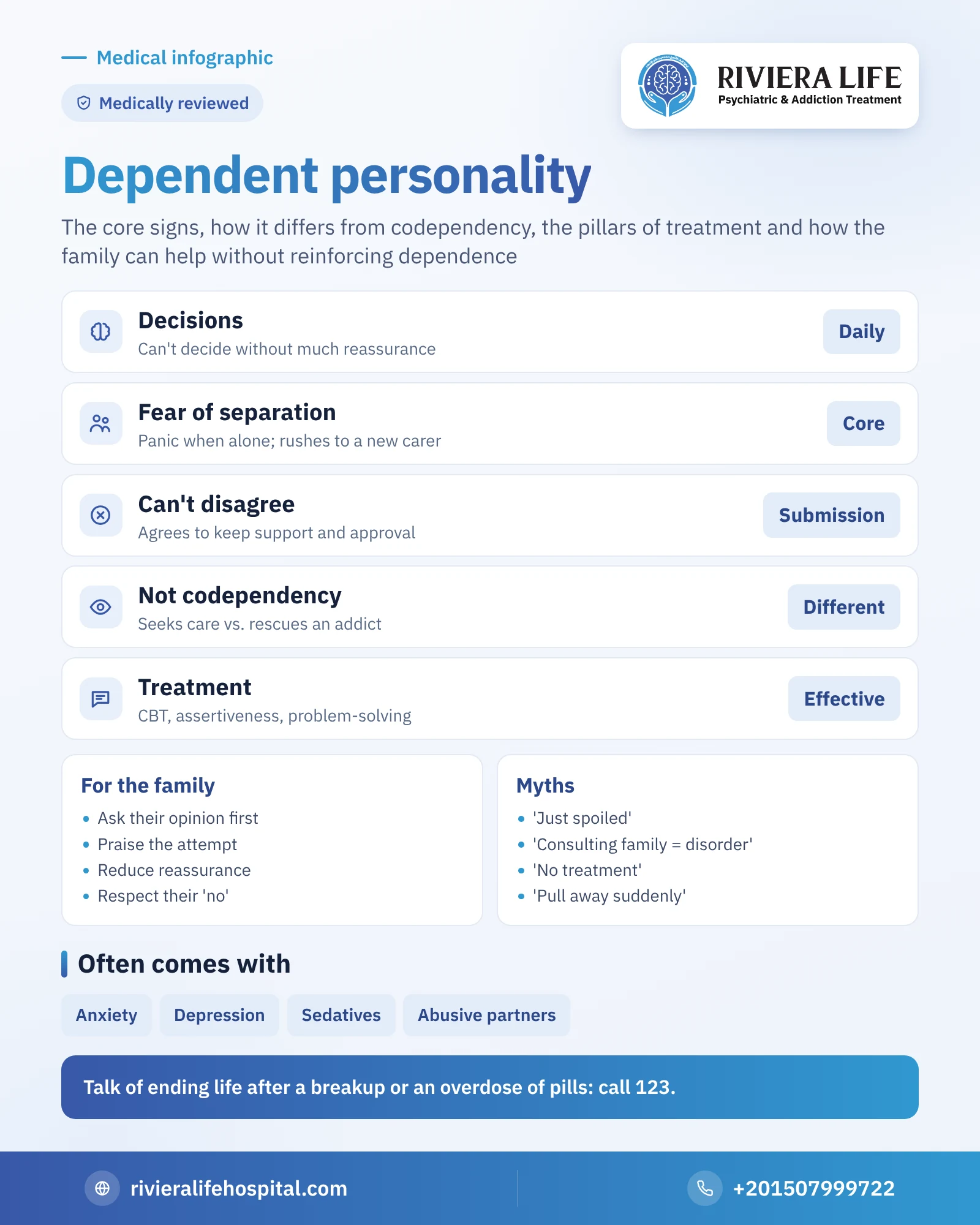
Signs of dependent personality and examples from everyday life
The American manual requires at least five of eight signs appearing in a fixed pattern:
- Difficulty with everyday decisions: doesn’t settle a simple matter such as choosing food or an appointment without a lot of advice and reassurance.
- Handing responsibility to others: leaves large areas of their life, such as money, housing and work, to others.
- Difficulty disagreeing: agrees to what they aren’t convinced of for fear of losing support or approval.
- Difficulty starting a project on their own: not for lack of motivation, but for lack of confidence in their ability and judgment.
- Going to excessive lengths to obtain care: may volunteer for exhausting or humiliating tasks to remain accepted.
- Intense discomfort when alone: an exaggerated fear of being unable to take care of themselves.
- Urgently seeking a replacement: if a close relationship ends, they rush into another relationship that gives them care.
- Unrealistic preoccupation with the idea of being left: often imagines that they will be left to fend for themselves.
What does this look like on an ordinary day? A university student who changes his major because his close friend changed his, not because he wants to. A wife who knows her husband abuses her but can’t imagine herself paying the rent on a flat or going to a doctor alone. An employee who accepts every extra task asked of him and then stays up until dawn, because refusal in his head equals being fired. The common factor isn’t kindness or generosity, but a fear that pushes its owner to pay from themselves the price of staying accepted.
Healthy dependence or a disorder? The role of culture
In Arab homes it is natural for a son to consult his parents about marriage and work, and for the family to remain a wide support network. This isn’t a disorder. The doctor takes the family’s culture into account, and asks about other things: can the person decide when they find no one to ask? Do they give up their basic needs to keep the relationship? Does this pattern cause them clear suffering or disrupt their life? Consultation is a choice, while pathological dependence is a feeling that there is no choice.
Causes of dependent personality
There is no single cause. An inherited temperamental predisposition, such as shyness and anxiety since childhood, overlaps with a style of upbringing that deprives the child of the experience of independence: overprotection that decides everything for them, an authoritarian style that punishes initiative, or repeated messages that the world is dangerous and that they can’t cope alone. Chronic illness in childhood or the loss of a parent may increase this predisposition. This doesn’t mean the family is to blame, as protection usually comes from love.
Its link to anxiety and depression
Dependent personality rarely comes alone. Anxiety is its constant companion, because the fear of abandonment lives in the background every day, and it often comes together with anxiety disorders such as generalized anxiety and panic attacks. Depression usually comes after the end of a relationship the person depends on, or when they realize how much of themselves they have given up. Treating anxiety or depression may be the door through which the doctor discovers the deeper dependent pattern.
The difference between dependent personality and codependency
Many confuse the two terms. Codependency isn’t an official medical diagnosis, but a description that originally arose in the families of addicts: a wife or mother whose whole life revolves around rescuing the addict, so she covers for his absence, pays his debts, and lies to protect him, until she forgets herself. Dependent personality, however, is a diagnosable disorder that begins early and appears in all relationships.
| Point of comparison | Dependent personality | Codependency |
|---|---|---|
| Medical status | A personality disorder in official classifications | A description of a relationship pattern, not an official diagnosis |
| Dominant role | Looks for someone to take care of them and decide for them | Takes care of the other and controls their problem |
| Onset | Early adulthood, and in all relationships | Usually within a relationship with an addicted or ill person |
| Treatment | Relatively long individual psychotherapy | Family support, learning boundaries and support groups |
The two may come together in one person. If you live with an addict and feel you are being drained, the guide on how to help someone who is addicted explains how to support them without protecting their addiction.
The risk of abusive relationships
Fear of loneliness may make someone with dependent personality stay in a relationship in which they are insulted or exploited, justify the abuse, and blame themselves for it. They may be attracted to controlling partners because they decide for them, so they sometimes meet narcissistic personality in a relationship in which each side feeds on the other’s weakness. Treatment here doesn’t start by forcing the person to separate, but by building their confidence and support network until they can see their options.
How is dependent personality diagnosed?
The diagnosis relies on a detailed psychological interview and a history extending back to youth, and sometimes on standardized scales. The doctor distinguishes it from the temporary dependence that accompanies a physical illness or a depressive episode, from avoidant personality disorder, in which fear of rejection and embarrassment dominates, and from borderline personality, in which the fear of abandonment is met by intense anger and instability, while in dependent personality it is met by submission and appeasement.
Treatment of dependent personality
The main treatment is psychological, and its aim is to build independence step by step, not to wrench it suddenly:
- Cognitive behavioral therapy: reveals thoughts such as “I can’t do it alone” and “if I refuse they’ll leave me”, and tests them with small, gradual experiments. Its details are in the article on cognitive behavioral therapy.
- Assertiveness training: practical exercises in saying “no”, asking for what you need, and expressing an opinion without excessive apology.
- Training in problem-solving and decision-making: from simple everyday decisions to bigger ones.
- Psychodynamic or schema therapy: to understand the roots of the feeling of helplessness.
- Group therapy: a safe space to try out independence and disagreement in front of others.
The therapist is aware that the patient may transfer their dependence to them, so they set clear goals and a duration for the therapy. There is no medicine that treats the disorder itself, but the doctor may prescribe treatment for accompanying anxiety or depression, with special caution about sedatives, on which the person may become dependent.
How can the family help without reinforcing dependence?
The hardest thing parents face is that their usual help may be part of the problem: every decision you make on their behalf confirms to them that they can’t. The solution isn’t sudden withdrawal, as this raises anxiety and pushes them to look for someone else to depend on, but transferring responsibility gradually and gently:
- Ask “what do you think?” before giving your opinion, and wait for the answer without rushing.
- Praise the attempt, not only the result, even if the decision turns out less than ideal.
- Reduce repeated reassurance gradually instead of cutting it off suddenly.
- Don’t take over tasks they can do, even if you would do them faster.
- Respect their “no” when they say it, as it is a sign of progress, not rebellion.
- Take part in family sessions if the therapist invites you, as some patterns at home need collective change.
Dependent personality and addiction
Someone with dependent personality may resort to sedative pills to calm the anxiety of loneliness, so dependence on people turns into dependence on a substance, as happens with benzodiazepines or alcohol. Use may begin to please a partner or company they fear losing. In these cases, treatment needs to address the addiction and the dependent pattern together, and any change to or stopping of prescribed medicines is done only with the treating doctor.
Common myths about dependent personality
The myth: it’s just being spoiled and a pampered upbringing. The truth: behind it lie real anxiety and pain, and it doesn’t go away with scolding or by leaving the person to face everything suddenly.
The myth: someone who loves their family and consults them has a dependent personality. The truth: consultation and closeness are a healthy part of our culture, and the disorder means an inability to decide and submission even at one’s own expense.
The myth: it has no treatment. The truth: many improve with psychotherapy, and gain tangible confidence and independence within months.
Related articles
These pages complete the picture:
- Anxiety: its types, symptoms and treatment, and it is what most often accompanies dependent personality.
- Depression: when sadness after a loss or separation is depression that needs treatment.
- Narcissistic personality: the party that often comes together with dependent personality in a harmful relationship.
- How to help someone who is addicted: a plan for the family that prevents draining rescue.
- Love addiction: when attachment to a person becomes compulsive.
When is the situation an emergency?
The end of a relationship the person depends on may be a big shock that opens the door to acute depression, and their safety may be at risk in an abusive relationship.
Seek urgent help immediately if any of these appear
Call the ambulance on 123 or go to the nearest emergency department, and stay close to the person until help arrives.
- Talk of death or ending their life after a separation or loss
- Stopping eating, sleeping and working for days with clear despair
- Taking a large amount of sedative pills or medicine
- Being subjected to physical violence or threats from the partner
You can also seek guidance from the hotline of the General Secretariat of Mental Health and Addiction Treatment on 16328 or 0220816831.
When should you ask for help?
If the inability to decide, the fear of loneliness and constant giving in are a pattern that has accompanied you for years and deprives you of a life you choose, a psychological assessment is a step towards real independence, not towards a rupture with those you love. At Riviera Life in Sheikh Zayed, the consultant psychiatrists carry out the assessment in complete confidentiality, the first consultation is free, and you can get in touch around the clock via +201507999722.