Love addiction isn’t an official medical diagnosis, but it describes a real pattern many people live through: a relationship that turns from a source of warmth into a center around which the whole of life revolves, so the other person’s absence becomes unbearable pain, and the attachment continues even when the relationship hurts the person. In this article we explain when strong love is normal and when it becomes emotional dependence, the symptoms that point to it, why some people fall into it more than others, and when it needs psychological treatment and what that looks like.
What is love addiction? Is it a recognized diagnosis?
Neither the American diagnostic manual (DSM-5) nor the International Classification of Diseases (ICD-11) contains an illness called “love addiction”. Therapists and researchers use the term to describe a compulsive emotional attachment to a person, or to the idea of the relationship itself, accompanied by loss of control and continuing despite harm.
Researchers differ in how they understand it. One group holds that ordinary feelings of love use the same reward system that addictions use, and that the problem is only one of degree. Another group restricts the description to cases in which the attachment becomes harmful and disrupts life. Either way, what matters to the therapist isn’t the name, but the extent of the suffering and its effect on daily life.
The difference between strong love and love addiction
The intensity of feelings alone isn’t a sign of illness, especially at the start of a relationship. The real difference is in the space the relationship leaves for the rest of your life, and in your ability to choose:
| Healthy love | Love addiction |
|---|---|
| Adds to your life without cancelling it | Swallows up friends, work and interests |
| A partner’s absence causes bearable longing | Absence causes panic and physical anxiety |
| Your worth stays steady in your own eyes | Your worth rises and falls with their messages |
| You can leave if the relationship becomes harmful | You stay or go back despite repeated harm |
| Trust that allows personal space | Monitoring, checking and a constant fear of abandonment |
Symptoms of love addiction: signs worth stopping at
One sign isn’t enough, but several together, persisting for months, deserve attention:
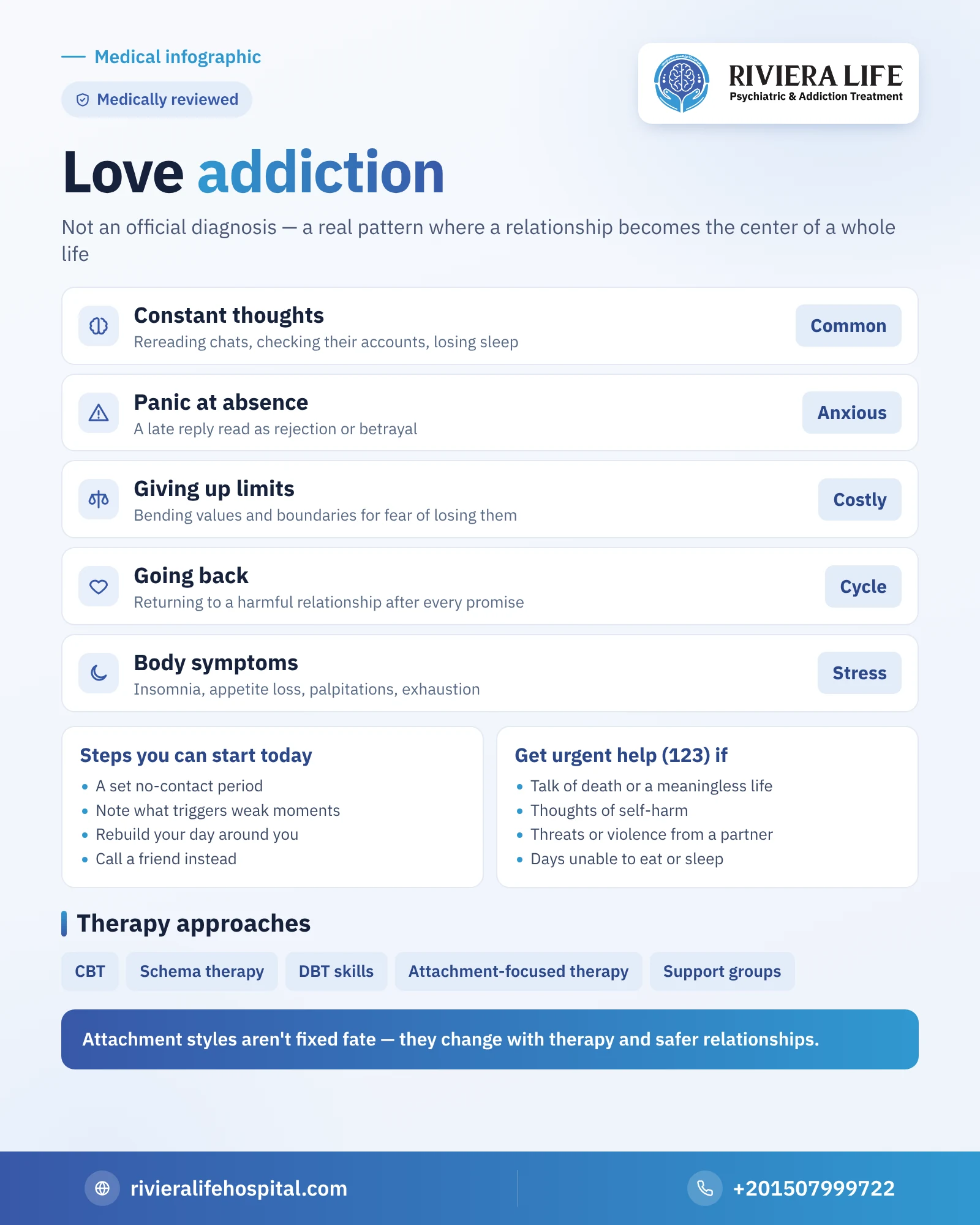
- Constant thoughts about the person that interrupt work and sleep, with conversations reread many times.
- Severe anxiety if a reply is late, with the delay immediately interpreted as rejection or betrayal.
- Compulsively checking their social media accounts, even after breaking up.
- Giving up clear personal values or limits for fear of losing them.
- Moving quickly from one relationship to another because being alone is unbearable.
- Going back to a harmful relationship after every promise to change, even though the same story repeats.
- Neglecting friends, family, study or work in favor of the relationship.
- Physical symptoms with arguments or distance: insomnia, loss of appetite, palpitations, exhaustion.
What happens in the brain with intense attachment?
Falling in love activates the brain’s reward circuits, the same circuits that reward-based learning relies on. The awaited message, the meeting and the reconciliation are all moments when dopamine rises — the messenger whose role we explained in our article on dopamine and addiction. Long-term bonding is linked to other hormones such as oxytocin, and we explained what research says about it in our article on oxytocin and addiction.
That is why some people feel something like withdrawal after a breakup: painful longing, insomnia, tightness in the chest, and a pressing urge to make contact “just once”. This doesn’t mean the person is weak-willed, but that the brain needs time to adapt to the absence of a source of reward it had grown used to.
What makes one person more prone to this attachment than another?
There is no single cause. Several factors usually come together:
- An anxious attachment style: someone who learned in childhood that love isn’t guaranteed and has to be worked for may live their important relationships in constant fear of abandonment.
- Low self-esteem: when a person draws their worth from being loved, losing the relationship becomes a threat to their identity.
- Previous painful experiences: losing a parent, neglect or trauma can all make being alone more frightening than it should be. If the trauma was major, our article on post-traumatic stress disorder may help.
- Accompanying mental disorders: depression and anxiety, and some traits of borderline personality disorder, such as an intense fear of abandonment and unstable relationships.
- Cultural images of love: songs and series that present jealousy and unhealthy attachment as proof of true passion.
Love addiction and harmful relationships
The hardest forms of love addiction appear in relationships that alternate between cruelty and tenderness. A partner who hurts and then apologizes lavishly, who withdraws and then suddenly comes back. This swing makes moments of reconciliation a powerful reward, so attachment grows as the harm grows — what some therapists call a “trauma bond”. Some people call this pattern “masochism” in everyday speech, although the word has a more precise medical meaning that we explain in our guide to masochism.
If the relationship involves threats, physical violence or control over money and movement, safety comes before any treatment of the attachment: tell someone you trust, ask for specialist help, and don’t face it alone.
Can love make you ill?
Yes, a person can become ill because of love, but the illness doesn’t come from love itself; it comes from the intense psychological stress that accompanies painful attachment, loss or rejection. The body doesn’t separate emotional pain from any other threat, and responds to it with the same stress hormones.
That is why some people show clear physical symptoms after a breakup or emotional disappointment, including:
- Disturbed sleep and early waking with repeated thoughts about the person.
- Loss of appetite or overeating, and the weight change that follows.
- Palpitations and heaviness in the chest, headache, and stomach pain or upset.
- Constant fatigue and poor concentration that affects study or work.
- Greater susceptibility to minor infections when stress lasts a long time.
In rare cases, sudden and intense grief causes what is known as broken heart syndrome, a temporary weakness of the heart muscle whose symptoms resemble a heart attack: sudden chest pain and shortness of breath. This condition needs the emergency department immediately, because it can only be told apart from a heart attack by examination in hospital.
Most of these symptoms settle gradually with time and support. But if sadness continues for weeks with a loss of interest in everything, or thoughts of self-harm appear, it is no longer ordinary heartbreak, and it may be depression that needs assessment by a psychiatrist. You will find its signs in our article on the symptoms of depression.
After a breakup: when is grief normal?
Grief after the end of an important relationship is normal, and may last weeks or months with good days and bad days. It becomes worrying when the pain doesn’t ease with time, or the person stops working or studying, isolates themselves completely, or shows signs of depression such as losing pleasure in everything and disturbed sleep and appetite.
Get urgent help immediately if you see
After a breakup or during a harmful relationship, call an ambulance on 123 or go to the nearest emergency department if you notice in yourself or someone close:
- Talk of death, or that life has no meaning after the relationship
- Thoughts of self-harm or preparing for it
- Threats of harm or physical violence from the partner
- Complete collapse and inability to eat or sleep for days
When does love addiction need psychological treatment?
Not every strong attachment needs a clinic. But consulting a therapist or psychiatrist becomes a wise step if:
- The same pattern repeats across more than one relationship.
- Your repeated attempts to keep away from someone who hurts you have failed.
- Your work, study or relationships with family and friends are clearly affected.
- Symptoms of depression or anxiety, or thoughts of self-harm, appear.
- You have started using alcohol, sedatives or any substance to ease the emotional pain.
The diagnosis here doesn’t come from applying the label “love addiction”, but from understanding what lies behind it: an attachment pattern, depression, anxiety, or personality traits that need therapeutic work.
Psychological treatments for love addiction
Psychotherapy is the foundation, and the therapist chooses the approach according to what the assessment shows:
- Cognitive behavioral therapy: uncovers the thoughts that feed the attachment, such as “no one else will love me”, and trains you to handle the urge to make contact without giving in to it.
- Schema therapy: traces the early roots of fear of abandonment and a sense of not deserving, and works slowly to change them.
- Dialectical behavior therapy skills: useful for those whose emotions swing sharply, including emotion regulation and tolerating distress without reckless decisions.
- Attachment- and relationship-focused therapy: helps build safer relationships, and may include couples sessions if the relationship is basically healthy.
- Support groups: hearing similar stories eases shame and offers practical ideas.
There is no medicine that treats the attachment itself. But if it is accompanied by depression or severe anxiety, the psychiatrist may decide on a medicine suitable for that accompanying condition after an assessment, within a plan for depression treatment or anxiety.
Steps you can start today
- Try a no-contact period of a set length, and delete or hide the conversations instead of rereading them.
- Write down moments of weakness and what came before them: a late hour? Being alone? A particular song?
- Rebuild your day around things that are yours: exercise, work, old friends.
- Agree with a trusted friend that you will call them instead of messaging the other person.
- Treat yourself kindly after a slip; recovering from attachment doesn’t move in a straight line.
How can you help a friend or relative living this pattern?
Avoid phrases like “just forget them” or mocking their feelings, which push them into silence. Listen first, then calmly point to the specific harm you see, and offer to go with them to a consultation. And if you see signs of danger to their life, don’t wait for their agreement before seeking urgent help. For more guidance, see how the family can deal with a psychiatric patient.
Unhealthy attachment: when does attachment to a partner become fear, not love?
Unhealthy attachment is the most common face of what people call love addiction. The person clings to their partner not because they enjoy being close, but because distance awakens an old panic about abandonment. So they watch the phone, interpret silence as punishment, and accept what they wouldn’t accept outside this relationship.
It helps here to distinguish between patterns of relating to others:
- Secure attachment: the person can ask for closeness without insisting, and can bear a partner’s absence for a day without their self-worth collapsing.
- Anxious attachment: needs repeated reassurance, and sees any delay as proof the relationship is ending.
- Avoidant attachment: pulls away when the other person comes closer, and often combines with anxiety to feed a cycle of pursuit and retreat.
The roots of these patterns usually go back to childhood and to experiences of loss or neglect, and attachment disorder may be the background for some people. And when attachment extends to someone who harms the person psychologically or physically, it may overlap with what we explained in Stockholm syndrome.
The good news is that attachment styles aren’t a fixed fate: they change with psychotherapy and with experiences of safer relationships. The practical signal to act is when the relationship turns from a source of reassurance into a constant source of anxiety, and your study, work or sleep is disrupted because of it.
The right hospital for love addiction: how to choose
The right hospital for treating love addiction is one that deals with it as real psychological suffering, and looks for what lies behind it instead of settling for advice. Ask before you choose:
- Is the assessment carried out by a psychiatrist who can identify accompanying depression, anxiety and personality disorders?
- Does it offer structured psychotherapy such as cognitive behavioral therapy and schema therapy?
- Is there a clear plan for dealing with thoughts of self-harm if they appear?
- Can the family or partner be involved in sessions when needed?
- Does it treat any alcohol or sedative use that began because of the emotional pain?
- Does it guarantee complete confidentiality for what happens in sessions?
And be wary of anyone who promises you will “forget” the person in days, or a guaranteed result.
Why Riviera Life for love addiction treatment?
Set these conditions against Riviera Life and you will find all of them met, which makes it a suitable option in Egypt for treating love addiction and harmful emotional attachment:
- Consultant psychiatrists: a careful assessment of the anxiety, depression or personality traits behind the attachment.
- Specialist psychotherapy: individual sessions using proven approaches suited to attachment patterns.
- Round-the-clock supervision: 24-hour medical follow-up when the case needs admission because of a risk to safety.
- A family program: helps those close to the person support them without pressure or blame.
- Aftercare: follow-up after the program ends to prevent a return to the same pattern.
- Complete confidentiality: full privacy for you and your story.
- A long treatment history: fourteen years in a facility licensed by the Ministry of Health, during which thousands of patients have recovered.
Your first consultation with a specialist is free; call at any hour on +201507999722 if attachment is draining you, or come to us in Sheikh Zayed, Giza.
Read also
- Borderline personality disorder: fear of abandonment and unstable relationships
- Oxytocin and addiction: the bonding hormone and what research says
- Sex addiction: when sexual behavior loses its balance
- Anxiety treatment: psychotherapy and medication
- Stockholm syndrome: why people bond with those who hurt them, and how to break free
- Emotional trauma: why a breakup hurts and how to recover
- Attachment disorder: the childhood disorder vs adult attachment styles
Questions many people ask
There is no official diagnosis by this name in the medical manuals, but it describes a harmful pattern of compulsive attachment. A psychiatrist assesses what lies behind it, such as anxiety, depression or personality traits.
It varies from person to person, and usually eases gradually over weeks to months. If it doesn't ease with time, or disrupts your life, that is a sign to seek specialist help.
Yes. Psychotherapy is the foundation. Medication is used only if the attachment comes with depression or severe anxiety, and the doctor decides on it after an assessment.
Swinging between cruelty and tenderness makes moments of reconciliation a powerful reward that strengthens attachment. Understanding this cycle with a therapist helps break it safely.
Consultant psychiatrists who look behind the attachment, structured psychotherapy, a plan for any thoughts of self-harm, and complete confidentiality. Riviera Life in Sheikh Zayed meets these standards, and the first consultation is free.