If your question is “how do I help a drug addict?”, the answer is that you help them when you make the road to treatment easier for them than the road to continuing: a calm conversation based on facts, real listening to their fears, firm limits that stop protecting them from the consequences of their use, and offering a small, specific step such as a single consultation. Persuading your son to get treatment rarely happens in the first conversation, but through repeated attempts with well-chosen timing. This article is a practical plan for the family: from getting the house in order before talking, to the moment they say “OK”, then how to support them during and after treatment.
How do I help a drug addict? Start by changing your own view
The hardest step is to see addiction as an illness that needs treatment, not a moral flaw or a weakness of manhood. This doesn’t mean exempting them from responsibility, but it means separating the person you love from the illness that controls their decisions now. When your view changes, your tone changes automatically, so shouting decreases and the chances they will hear you increase.
It helps to understand why many addicts refuse treatment despite their obvious suffering, which we explain in our article on how a drug addict thinks and why they deny.
Align the family’s position before any conversation
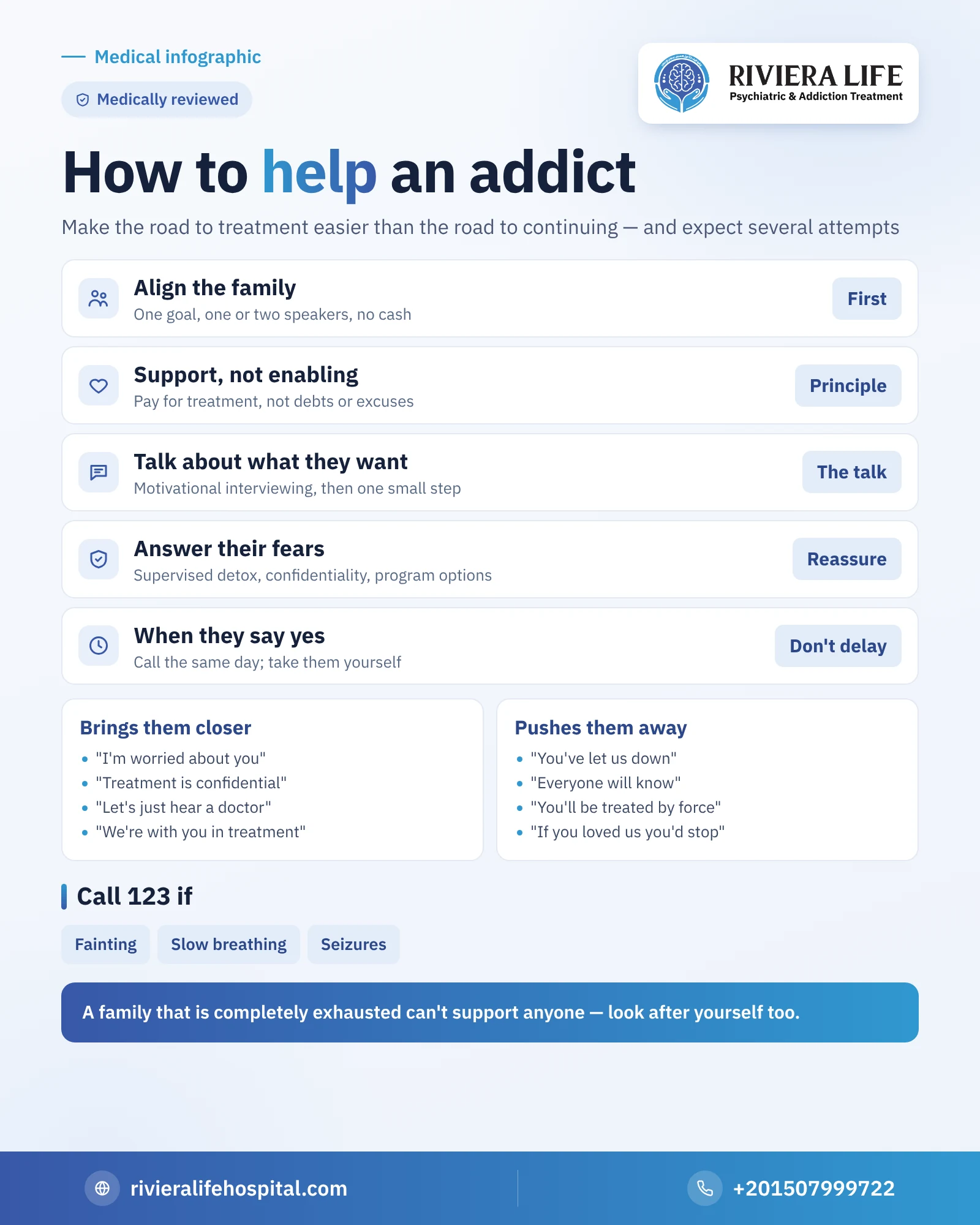
What most spoils attempts at persuasion is the father saying one thing and the mother the opposite, or one of the siblings secretly giving them money after the others refused. Sit together and agree on three things:
- The goal: reaching a specialist medical assessment, not extracting a confession or punishing.
- The speaker: one or two people they respect and trust, not the whole family.
- What will stop: everything that makes use easier, starting with cash.
Support or enabling: where does your love stand?
Many families protect their son from the consequences of his use with good intentions: they pay his debts, lie to his manager to justify his absence, repair what he broke, and give him money “so he doesn’t steal”. This is called enabling, and its result is that addiction becomes comfortable. Support means standing with the person against the illness: you pay for treatment, not debts, take them to the doctor, and let them face the results of their actions without abandoning them.
How to persuade them to get treatment: a conversation built on what they want
Successful persuasion doesn’t start with “you’re an addict and you must get treatment”, but with something that matters to them. Ask about their life: what do they want to be in a year? What have they lost recently? What bothers them about their current situation? When they see for themselves the gap between what they want and what they are living, change starts from within. This is the essence of an approach therapists use known as motivational interviewing.
Then offer them a small, specific step, not a huge project. “Come with me to one consultation, and then you decide” is much easier to accept than “you’re going into hospital for a month”.
Phrases that bring them closer and phrases that push them away
| Push them away from treatment | Bring them closer to treatment |
|---|---|
| You’re a failure and you’ve let us down | I’m worried about you and I miss the person you used to be |
| Everyone will know what you’re doing | Treatment is completely confidential and no one will know |
| You’ll be treated against your will | I want us to go together just to hear a doctor’s opinion |
| If you loved us you would stop | I know stopping isn’t easy, and that’s why treatment exists |
| This is the last time I’ll forgive you | We’re with you in treatment, not in continuing |
Answer their fears with information, not pressure
Behind refusal there is usually a specific fear. Listen to them to the end, then answer it:
- “Withdrawal is painful”: detox under medical supervision greatly reduces pain and risks compared with stopping suddenly alone.
- “People will find out”: treatment is carried out in complete confidentiality.
- “I’ll lose my job or my studies”: there are programs in different forms, and the doctor determines the most suitable after the assessment.
- “I can stop on my own”: agree with them on a trial with a fixed period, and if it doesn’t work they go for an assessment. You will find this question in detail in our article can an addict quit drugs on their own?
How do I persuade my addicted son to get treatment specifically?
With a son, the parent’s role mixes with that of rescuer, so parents swing between great harshness and complete leniency. What works best is combining firmness and warmth: the house rules are clear and non-negotiable, and love is clear too and not conditional on a confession. Avoid comparing him to his brother or the neighbors’ son, and avoid threatening to throw him out unless you are ready to carry it out, because a threat that isn’t carried out teaches him your words carry no weight.
If he is a teenager, the parents’ role in the treatment itself is bigger, which is what the students and teenagers program is built on. If you aren’t yet sure he is using, start with our article on how do I know if my son is addicted to drugs.
If they refuse treatment
The first refusal isn’t the end of the road. Keep the limits, reward any day that passes without use with attention and time together, and let the consequences of use fall on them, not on you. Then offer help again at the moments when they are more ready: after a problem with the police or at work, or the morning after a bad night. This idea is the basis of a family training approach known as CRAFT, and research indicates it brings a considerable proportion of users to treatment without a sharp group confrontation.
The family can start treatment for itself before they agree, learning how to handle everyday situations. And in specific cases where there is serious danger to their life or the lives of others, Egypt’s Mental Health Care Law regulates compulsory admission by medical decision; this is assessed after a specialist evaluation, not by the family’s decision alone.
If the addict is my brother or my friend
A brother or friend has something a father sometimes doesn’t: closeness in age, a shared language, and less room for preaching. The brother is often the first to know, and is torn between telling the parents and keeping the secret.
- Don’t promise absolute secrecy. You can tell them you won’t expose them, but you won’t stay silent if they are in danger.
- Don’t become their unintended financier: don’t lend them money, don’t cover their absence from work, and don’t lie to the parents for them.
- Be the bridge, not the judge: offer to go with them to the first appointment, as having someone close reduces the fear of the step.
- If you decide to tell the parents, choose the time and prepare them with information, not emotion, and suggest a clear plan instead of dropping the news and withdrawing.
- If it is a friend whose family you don’t know, contacting the closest person in their family may be the most responsible step if a danger to their life appears.
In a moment of danger, such as fainting, slow breathing or a seizure, don’t think about embarrassment; call an ambulance on 123 immediately. The signs of this are in drug overdose.
Why doesn’t treatment at home usually work?
Many families try to lock their son in a room for days and give him painkillers and sleeping pills. This may be dangerous, especially with alcohol and sedatives, and doesn’t treat the psychological side, so the risk of relapse stays high. You will find the safe limits of this option in our article on addiction treatment at home.
When they say yes: don’t delay
Agreement may be a short window that closes the next day. Contact the treatment provider the same day, and prepare their ID card, a list of the medicines they take and the substances they use as far as you know, and any chronic illnesses. Take them yourself if possible.
Your role during and after treatment
The success of treatment doesn’t depend on the patient alone. Take part in family sessions, learn the early warning signs, and change what needs changing at home, which is what the family rehabilitation program offers. If a relapse happens, don’t consider it a final failure, but a signal to return quickly to the treatment plan. And look after yourself too: a completely exhausted family can’t support anyone.
After leaving hospital comes a delicate stage. Don’t treat them as a suspect under surveillance, nor as if nothing happened. Ask them what they need from you, keep to what the treatment team agreed regarding money, going out and follow-up, and rebuild trust step by step.
Guides by type of addiction
Each substance has its own details in conversation and emergencies, so choose the right guide: a heroin addict, an ice addict, a cocaine addict, and a hash addict. And if the problem is a behavioral addiction rather than a substance, there is a guide to dealing with a gambling addict.
How can Riviera Life help you?
The family can contact us before the patient is persuaded, to get a free first consultation on how to talk to them and the most suitable step for their case. At Riviera Life in Sheikh Zayed, licensed by the Ministry of Health, consultants in psychiatry and addiction treatment follow the case around the clock, and treatment includes a family program and aftercare. To get in touch: +201507999722.
And when they agree to treatment, help them reach a licensed addiction treatment center in Egypt the same day if possible, before they change their mind.
Read also
- How does a drug addict think, and why do they deny needing treatment?
- How to know there is a drug addict in your home
- The relapse treatment program
- The residential addiction treatment program
- How to deal with an addicted husband: a wife’s guide to protection and treatment
- Treating an addict against their will: when is it justified and how is it done safely and legally?
- How to deal with a tramadol addict: a family guide between denial and withdrawal
- How to deal with a strox addict: safety during agitation and psychosis
- My father is a drug addict, what do I do? A guide for children on protection and support
Questions many people ask
There is no need to wait passively. The family can change how it deals with them, set limits and offer a small step, which brings the moment they accept treatment closer.
Cash makes use easier; it is better to buy his basic needs directly, with a clear readiness to pay for treatment.
The Mental Health Care Law regulates compulsory admission in specific cases decided by a psychiatrist when there is serious danger, and this is assessed after a specialist evaluation.
Repeated refusal is common and doesn't mean the end. Keep the limits, offer help at the right moments, and ask for a consultation for the family itself.
Taking part in the family program, keeping to what the treatment team agrees, rebuilding trust gradually, and moving quickly at any sign of relapse.