Narcissistic personality, medically called narcissistic personality disorder, is a fixed pattern of an inflated sense of importance, a constant hunger for admiration and a clear weakness in sensing other people’s feelings. Not all excessive confidence is narcissism, and not every selfish person is ill; the disorder means these traits are entrenched and extended and spoil relationships and work, and they often hide an intense fragility in the face of criticism.
This page explains the difference between traits and the disorder, its patterns, its signs, its effect on those who live around it, how to protect yourself, and what treatment offers. The diagnosis is made only by a psychiatrist or a clinical psychologist after a direct assessment, so do not use what you read here to diagnose a partner or a relative.
What is narcissistic personality?
Narcissistic Personality Disorder is one of the personality disorders described in the fifth edition of the American Diagnostic and Statistical Manual. Its essence is three things that repeat in many situations from early adulthood: a self-image larger than reality, a continuous need for others to see them as special, and a deficit in empathy that makes the needs of the people around them seem marginal in their eyes.
The name is taken from the myth of Narcissus, the Greek youth who became infatuated with his reflection in the water. But the medical picture is more complex than the myth. A person with the disorder does not love themselves with a secure love, as people think; their self-esteem depends on what comes to them from outside: praise, status, and winning every argument. When this supply is cut off, or they are wounded by a word of criticism, they may explode in anger or withdraw in shame and depression.
Narcissistic traits and the disorder: where is the line?
We all carry some healthy narcissism: being glad of appreciation, striving for success, and defending our image in front of others. A teenager may go through a phase of seeing themselves as the center of the universe and then move past it. Narcissistic traits, however, mean these tendencies are more pronounced than usual in a person, without wrecking their life. The disorder is a third thing: a rigid pattern that does not change as the situation changes, and causes real suffering or repeated harm at work, in marriage and in friendships.
The best question for telling them apart is not “Is he arrogant?” but: Can he apologize sincerely? Does he see the effect of his words on others when it is pointed out? Does the same falling-out repeat with different people? The answers to these questions say more than any single trait. This is why the word “narcissist” has spread on social media with a far broader meaning than its medical one, until it is now applied to everyone who has let us down.
How common is narcissistic personality disorder?
Estimates vary widely depending on how it is measured, and most references place it between less than one and a few percent of the general population. It is diagnosed in men more than in women. The real figures may be higher than what appears in clinics, because a person with the disorder rarely seeks help because of their narcissism itself; they usually come because of depression, a marital crisis, a job loss or substance use.
Grandiose narcissism and vulnerable narcissism
Not everyone with the disorder looks alike. Researchers usually distinguish between two faces that can coexist in the same person in different proportions:
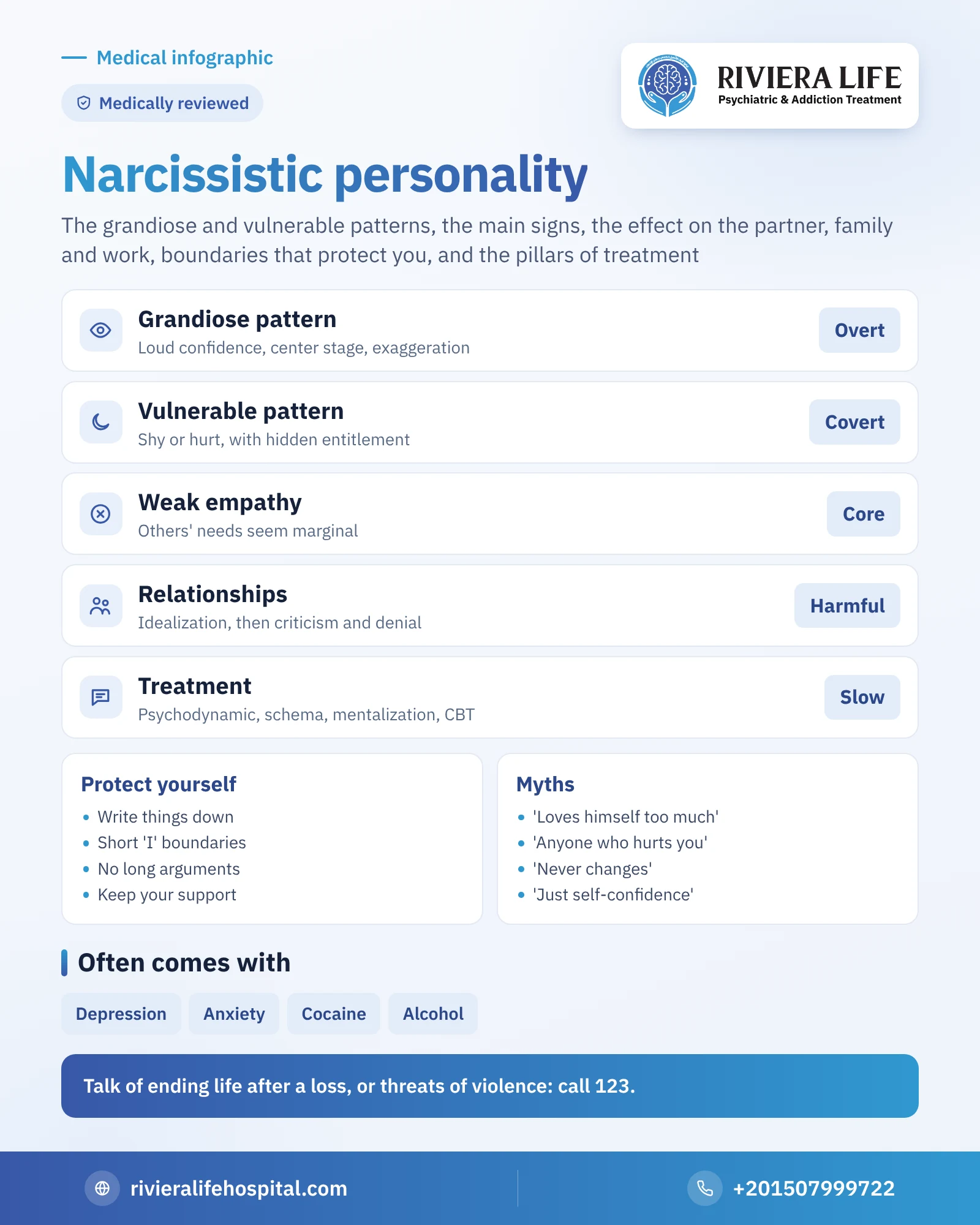
- The grandiose (overt) pattern: the familiar picture; a loudly confident person who loves to be at the forefront, exaggerates their achievements, and treats others as an audience or tools. They may seem charming at first, then their superiority shows over time.
- The vulnerable (covert) pattern: quieter and harder to detect. They seem shy, anxious or always hurt, but carry inside a feeling that they deserve special treatment they have not received, bitterly envy others, and are deeply hurt by the slightest neglect.
This division is descriptive and helps understanding; it is not two separate official types in medical classifications. The important idea is that overt arrogance and hidden fragility are two faces of an unstable self-image.
Signs of narcissistic personality
Doctors rely on an extended pattern, not a single situation. Among the most prominent things they notice:
- Overestimating oneself and one’s achievements, and expecting to be recognized as superior without anything to justify it.
- Preoccupation with fantasies of unlimited success, power, beauty or ideal love.
- Believing they are an exceptional person who can only be understood by people of high status.
- An excessive need for admiration and praise.
- A sense of entitlement; that rules apply to others, and that people must fulfil their wishes immediately.
- Exploiting others to achieve their goals.
- Weak empathy and indifference to other people’s feelings and needs.
- Envying others or believing that others envy them.
- Superiority and arrogance in behavior and speech.
The American manual requires at least five of these signs. One or two signs in someone you know does not mean they have the disorder.
Causes of narcissistic personality
Science does not know a single cause, and the most likely explanation is an interaction between inherited temperament and experience. Twin studies point to a genetic contribution to narcissistic traits. On the parenting side, contradictory models recur in people’s stories: a child treated as a prodigy who can do no wrong and showered with praise unrelated to real effort, and another child met with coldness or harsh criticism who built an inflated image to shelter behind. Abuse or neglect in childhood is also linked in some people to the vulnerable pattern in particular. This does not mean the parents “created” the disorder; siblings in the same home may turn out with completely different personalities.
Narcissistic personality in relationships: the partner, the family and work
With the partner
The relationship often begins with fascination and intense attention, then the partner gradually turns from an ideal beloved into a source of disappointment. Criticism and belittling increase, complaints are met with denial or turning the tables, and the other person finds themselves apologizing for things they did not do. Over time, they lose confidence in their own judgment.
With the family and children
A narcissistic parent may treat their children as an extension of their own image: celebrating the one who makes them proud in front of people, and neglecting or despising the one who disappoints their expectations. Some children grow up constantly striving to please, or afraid of expressing their needs.
At work
A person with the disorder may advance quickly thanks to their boldness and presence, but they credit success to themselves and blame failure on others, and cannot tolerate feedback, so conflicts with colleagues and managers repeat and their time in jobs is shortened.
Narcissistic abuse: how do you protect yourself and set boundaries?
“Narcissistic abuse” is not a medical diagnosis; it is a popular description of a pattern of repeated psychological harm in a close relationship: constant belittling, manipulation that makes you doubt your memory, punishment through silence, isolation from friends, and control over money or decisions. This pattern may come from a person with the disorder or without it; what matters is the behavior and its effect on you, not the label. Steps that help you:
- Write down incidents with their dates, because writing protects you from doubting your own account.
- Set short, clear boundaries in “I” form: “I won’t continue the conversation if voices are raised”, then calmly do what you said.
- Don’t get into a long argument to prove you are right; it is a battle no one wins.
- Keep your connection with friends and family and an independent source of income as much as possible.
- Seek psychological counseling for yourself, because the effects of these relationships on anxiety, mood and confidence are real and improve with treatment.
- If things turn into threats or physical violence, your safety and your children’s safety come first, so seek help immediately.
How is narcissistic personality diagnosed?
There is no blood test or scan for the disorder. Diagnosis relies on detailed psychiatric interviews, sometimes standardized scales, and information from those close to the person, because the person themselves may not see the problem. The doctor takes care to distinguish it from similar conditions: borderline personality, in which fear of abandonment and emotional swings dominate; manic episodes in bipolar disorder, in which superiority appears temporarily and then disappears; and delusions of grandeur in psychosis, where the person loses touch with reality, as well as the effects of stimulants and cocaine. The disorder often occurs together with depression, anxiety or substance use.
Treatment of narcissistic personality
The main treatment is psychological, and it needs time and patience from both sides. Approaches used include psychodynamic psychotherapy, which traces the roots of the need for admiration; schema therapy, which deals with deep patterns formed early; mentalization-based therapy, which trains understanding of what goes on in other people’s minds; and cognitive behavioral therapy to modify specific thoughts and behaviors. Couples or family sessions help in some cases after individual treatment has begun.
There is no approved medicine that treats the disorder itself. The doctor prescribes medicines only for what accompanies it, such as depression, anxiety, a mood disorder or addiction. The realistic starting point is often not the person admitting they are a narcissist, but their wish to be rid of suffering they feel, such as depression or repeated failure in relationships.
Narcissistic personality and addiction
The disorder occurs together with substance use at a higher rate than expected. Stimulants such as cocaine inflate the sense of power and superiority, while alcohol and sedatives numb the pain of feeling failure or rejection. The hardest part is that a person with the disorder often rejects the idea that they are “an addict” because it wounds their image, so treatment is delayed. That is why someone who has both conditions needs one plan that treats the addiction and the personality together, as in the dual diagnosis program, not treatment of one while ignoring the other.
Common myths about narcissistic personality
Myth: a narcissist loves themselves too much. Fact: their self-esteem is fragile and hangs on other people’s opinions, and superiority is often a shield that protects them from a feeling of inadequacy.
Myth: anyone who hurts you is a narcissist. Fact: harm is a behavior to be rejected whatever its source, while a diagnosis is made only by a specialist after an assessment.
Myth: a narcissist never changes. Fact: change is hard and slow, but it is possible for those who commit to treatment, and some traits ease with age in many people.
Myth: narcissism and self-confidence are the same thing. Fact: a confident person can tolerate mistakes and criticism and acknowledges others’ merit, while a narcissist collapses or attacks in the face of them.
Related articles
If narcissistic personality touches your life or the life of someone close to you, these pages may help:
- Borderline personality: another personality disorder often confused with narcissism, with different motives and treatment.
- Dependent personality: the opposite face in relationships, where a person dissolves into the needs of others.
- Love addiction: why it is hard to leave a harmful relationship despite knowing the harm.
- Dual diagnosis program: treating addiction and a mental disorder in one plan.
- Cognitive behavioral therapy: how its sessions run and what it can change.
To get a sense of how present narcissistic traits are, the narcissism self-test offers an initial reading to be completed by a psychological assessment.
When does a crisis become an emergency?
A person with the disorder may go through an acute collapse after a major loss, such as losing a job, a separation or a scandal, so superiority suddenly turns into deep despair. Anger in the relationship may also escalate into threats. In these moments there is no room for waiting.
Seek urgent help immediately if you see
Call the ambulance on 123 or go to the nearest emergency department, and do not leave the person alone if they are in danger.
- Serious talk of death or ending life after a loss or humiliation
- Sudden severe depression with withdrawal from food, sleep and people
- Threats to harm the partner, the children or anyone else
- Physical violence, smashing things, or locking up a family member
- Heavy use of a drug or alcohol with impaired consciousness
You can also ask for guidance from the hotline of the General Secretariat of Mental Health and Addiction Treatment on 16328 or 0220816831.
When should you seek help?
Seek an assessment if you notice in yourself a repeated pattern of conflicts, falling-outs and difficulty tolerating criticism, or if you live with someone who makes you doubt yourself and lose your confidence and peace of mind. The first step may be for you, not for them. At Riviera Life in Sheikh Zayed, consultant psychiatrists carry out the assessment in complete confidentiality, the first consultation is free, and you can reach us around the clock on +201507999722.
Medical sources and referencesThe information in this article is based on reliable scientific sources
1StatPearls — Narcissistic personality disorderncbi.nlm.nih.gov2MedlinePlus — Narcissistic personality disorder (medical encyclopedia)medlineplus.gov3APA — What are personality disorders? (American Psychiatric Association)psychiatry.org4NHS — Personality disordersnhs.uk5NIMH — Psychotherapiesnimh.nih.gov