Cognitive behavioral therapy, also called cognitive-behavioral therapy, is a type of talking therapy, but it doesn’t stop at venting. The patient and therapist agree on a specific problem, then together trace the thoughts and behaviors that feed it, and practice practical ways to change them. It is one of the most studied types of psychotherapy, and is used for depression, anxiety and obsessive-compulsive disorder, post-traumatic stress disorder, insomnia and addiction. In this guide you’ll find its core idea, its types, its key techniques, what happens in sessions, and how to choose a suitable therapist.
What is cognitive behavioral therapy?
It is a structured, relatively short-term psychotherapy that focuses on the present more than the past. Known by the abbreviation CBT, it arose from the meeting of two schools: the behavioral school, concerned with what we do and how we learn it, and the cognitive school, concerned with how we interpret what happens. The psychiatrist Aaron Beck played a pioneering role in developing it in the 1960s, when he noticed that patients with depression were dominated by automatic negative thoughts about themselves, the world and the future.
What sets it apart from open conversation is that each session has a goal and an agenda, progress is measured, and the patient leaves with skills they can use alone after treatment ends.
The core idea: the situation alone doesn’t make your feelings
The therapy rests on the idea that the situation, the thought, the feeling, the physical sensation and the behavior are linked, and that changing one link moves the rest. Take an example: an employee sent a report to his manager and got no reply all day. If he thinks “he didn’t like it and he’ll fire me”, he will feel anxious, his stomach will tighten, and he may avoid the manager the next day, so his fear is confirmed instead of dispelled. But if he thinks “maybe he was busy”, he will stay calm and simply ask him.
The therapy doesn’t ask you to think in an artificially positive way, but to examine the thought as a judge examines evidence: what supports it? What contradicts it? And is there a more realistic explanation?
The principles the therapy is built on
- Partnership: the therapist doesn’t dictate solutions, but works with the patient as a team.
- Specific goals: “to go to work by public transport on my own” is clearer than “to get better”.
- Focus on what keeps the problem going now: the past is understood to the extent it explains the present.
- Learning by doing: skills are practiced between sessions, not only within them.
- Measurement: simple questionnaires and scales show whether treatment is going in the right direction.
- Independence: the final goal is for the patient to become their own therapist.
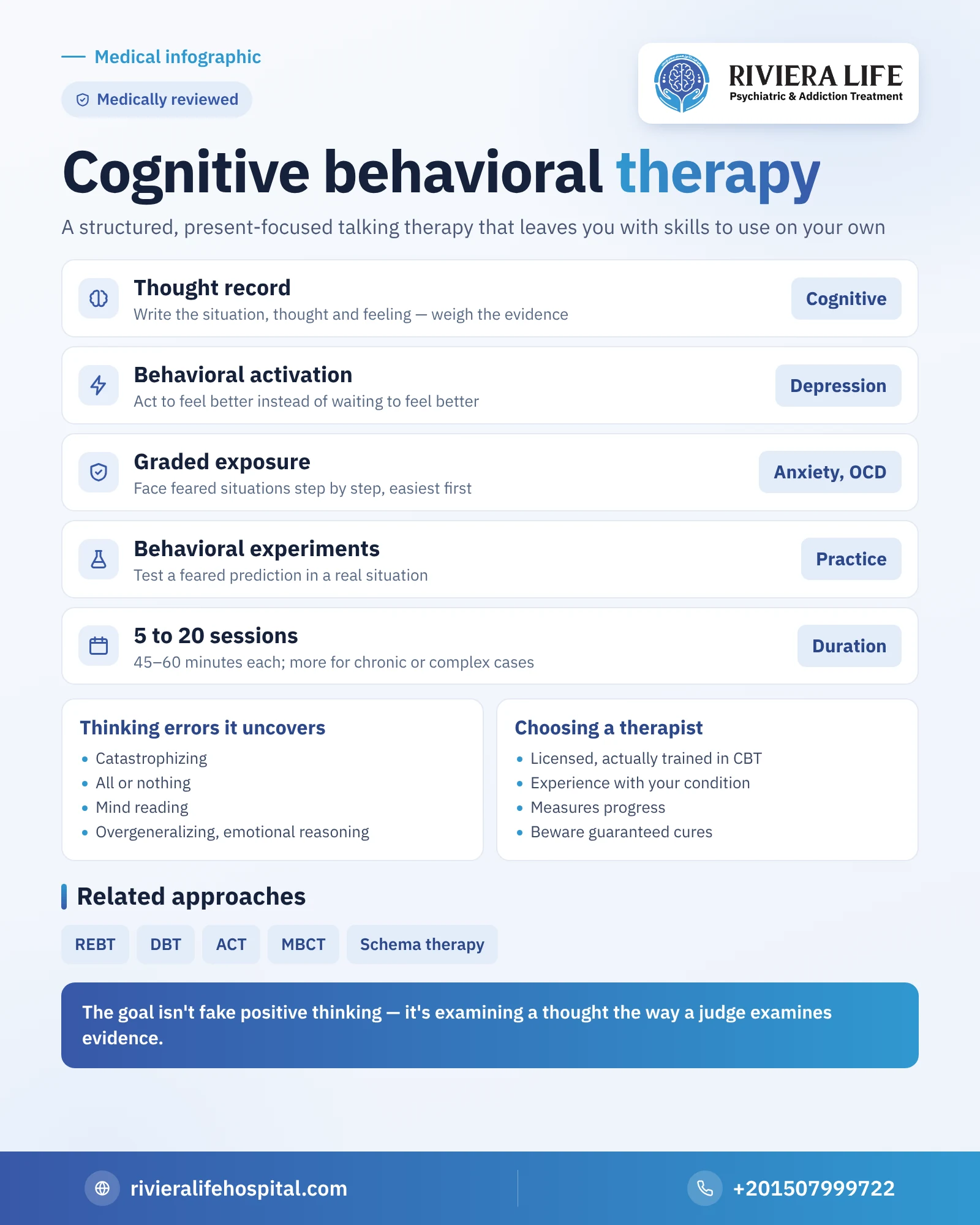
What disorders does cognitive behavioral therapy treat?
The therapy has protocols adapted to each disorder, so what happens in sessions for OCD differs from what happens in sessions for insomnia. The table summarizes the focus of work in the best-known conditions:
| Condition | Focus of work in sessions |
|---|---|
| Depression | Behavioral activation, and reviewing thoughts of helplessness and self-blame |
| Anxiety and panic attacks | Correcting the interpretation of physical symptoms, and reducing avoidance and reassurance-seeking |
| Obsessive-compulsive disorder | Exposure and response prevention to break the thought–ritual cycle |
| Social phobia | Graded exposure to situations, and less self-monitoring |
| Post-traumatic stress disorder | Trauma-focused therapy at a safe, considered pace |
| Chronic insomnia | A dedicated program to regulate sleep times and link the bed with sleep |
| Addiction | Identifying triggers, managing cravings, and a relapse prevention plan |
It is also used as part of a broader plan in bipolar disorder and schizophrenia alongside medication, and in chronic pain and coping with physical illness. In addiction specifically, it is part of rehabilitation after detox, and much of the Matrix program is built on it.
Types of cognitive behavioral therapy and related schools
- Traditional cognitive therapy: Beck’s school, focusing on automatic thoughts and core beliefs.
- Rational emotive behavior therapy: developed by Albert Ellis, targeting rigid demands such as “everything must succeed”.
- Dialectical behavior therapy: balances acceptance and change, teaches emotion regulation and distress tolerance, and is often used for borderline personality.
- Acceptance and commitment therapy: doesn’t try to change the content of a thought, but your relationship with it, and steers you toward what you value in life.
- Mindfulness-based cognitive therapy: combines mindful meditation with cognitive tools, and is used to prevent depression returning.
- Schema therapy: goes deeper into patterns formed in childhood, and suits chronic problems.
Key techniques of cognitive behavioral therapy
The thought record and cognitive restructuring
The patient writes down the situation, the thought and the strength of the feeling, then discusses the evidence with the therapist and formulates a more balanced alternative thought. With repetition, catching the distorted thought becomes faster.
Behavioral activation
In depression, the patient doesn’t wait for their mood to improve before moving; they move so their mood improves. A schedule of small enjoyable or meaningful activities is built and gradually increased.
Graded exposure
The patient ranks their feared situations from easiest to hardest, and faces them step by step until the brain learns that the expected danger doesn’t happen or can be tolerated.
Behavioral experiments and problem solving
Instead of arguing about a thought such as “everyone will laugh at me if I speak”, it is tested in practice in a real situation. The patient also learns to break a big problem into steps and to weigh alternatives calmly.
Thinking errors the therapy uncovers
- Catastrophizing: assuming the worst possible outcome as if it were certain.
- All or nothing: “if I’m not first, I’m a failure”.
- Mind reading: being sure what others think of you.
- Overgeneralizing: turning a single situation into a permanent rule.
- Emotional reasoning: “I feel guilty, so I must have done wrong”.
- Discounting the positives: treating any success as a fluke that doesn’t count.
How do cognitive behavioral therapy sessions work?
The first one or two sessions are given to assessment: the symptoms and when they began, their effect on work, sleep and relationships, medicines and any substance use, then forming a shared understanding of the problem and the goals of treatment. A typical session lasts roughly 45 to 60 minutes, and usually runs like this: a quick mood check, then agreeing the session’s agenda, reviewing what was applied during the week, then working on the main focus, and it ends with a summary and a new task.
Homework isn’t schoolwork the patient is punished for, but a bridge that carries the skill from the therapy room into life. If it is difficult or unrealistic, it is adjusted, not abandoned.
How many sessions, and when do results appear?
In many cases the number ranges from roughly 5 to 20 sessions, and is higher for chronic, complex or trauma-related cases. The patient may feel a clearer understanding of their problem early on, but changing symptoms needs practice and time. The real measure of improvement isn’t anxiety disappearing completely, but avoidance decreasing and the person returning to what they used to give up.
Does cognitive behavioral therapy replace medication?
In mild and moderate cases it may be enough on its own. But in severe depression, severe OCD, psychotic disorders and bipolar disorder, combining it with medication is usually better, and the psychiatrist decides this after assessment. You can learn how medication is chosen in our article on medication for depression and anxiety. The fixed rule: don’t stop a psychiatric medicine because you’ve started talking therapy without consulting your doctor.
Can it be done on your own or online?
Some tools, such as the thought record and activity scheduling, are useful for mild symptoms, and apps help with tracking mood and reminders. But they don’t replace diagnosis, and on their own they aren’t suitable for trauma exposure or sleep restriction. Remote sessions with a qualified therapist are a good option for those who find it hard to attend, as in online treatment, but they don’t suit someone with suicidal thoughts, acute psychotic symptoms or dangerous withdrawal; these people need a direct, urgent assessment.
The limits of the therapy, and why some patients don’t improve
Cognitive behavioral therapy doesn’t cause medication side effects, but it isn’t always comfortable. Exposure to fears raises anxiety temporarily before it falls, and facing painful thoughts may stir up difficult feelings in the first weeks. This is expected as long as it happens at a pace agreed with a trained therapist.
The therapy needs real participation between sessions, which is hard for someone with severe depression that drains their energy and concentration, so the doctor usually starts by easing symptoms first. If weeks pass without any progress, the common reasons are: an inaccurate diagnosis, an accompanying disorder that hasn’t been treated such as addiction or a sleep disorder, applying general techniques instead of a protocol tailored to the case, or a therapeutic relationship in which the patient doesn’t feel safe. Discuss this frankly with your therapist rather than withdrawing in silence.
The therapy can be given individually, in groups where participants learn from each other’s experiences, or by involving the family when its reactions are part of what keeps the problem going.
How do you choose a CBT therapist?
- Make sure they are a licensed psychiatrist or psychologist, with real training in this type of therapy.
- Ask about their experience with your condition specifically, as OCD and trauma need particular skills.
- Ask how they will measure progress, and how many sessions they expect initially.
- Beware of anyone who promises a guaranteed cure, asks you to stop your medication, or refuses to explain what they are doing.
Some people ask about hypnosis as a faster alternative; what the evidence says about it, and why it doesn’t replace cognitive behavioral therapy, is explained in hypnotherapy for addiction.
How can Riviera Life help you?
At Riviera Life in Sheikh Zayed, treatment begins with an assessment by consultants in psychiatry and addiction treatment, then cognitive behavioral therapy is built into the plan when appropriate, alongside medication, family therapy and aftercare. The hospital is licensed by the Ministry of Health, and the first consultation is free and completely confidential: +201507999722.
Read also
- Anxiety treatment: psychotherapy and medication
- Depression treatment and when you need a hospital
- OCD treatment and the steps to recovery
- Relapse treatment program
- Dialectical behavior therapy (DBT): its four skills, who it suits and how it works
- Electroconvulsive therapy: the facts today, indications and side effects
- Acceptance and commitment therapy (ACT): its six processes and who it suits
- Music and art therapy: how it works, who it suits and its limits
- Negative thinking and negative emotions: their patterns and how to break free
Questions many people ask
CBT is structured, with specific goals, an agenda for each session, tasks between sessions and measurement of progress, while some forms of talking therapy are more open-ended and less defined.
Yes, once its language and tools are adapted to the child's age using stories, drawing and role-play, and usually with parents taking part in some of the plan.
It is preferable, because techniques differ from one disorder to another, and the assessment reveals whether the case needs medication or a higher level of care alongside the sessions.
Yes. It is a core part of rehabilitation after detox, and helps identify triggers, manage cravings and build a relapse prevention plan.
Anxiety or distress may rise temporarily when facing fears or painful thoughts; this is expected and eases with a gradual pace. Persistent deterioration should be discussed with the therapist immediately.