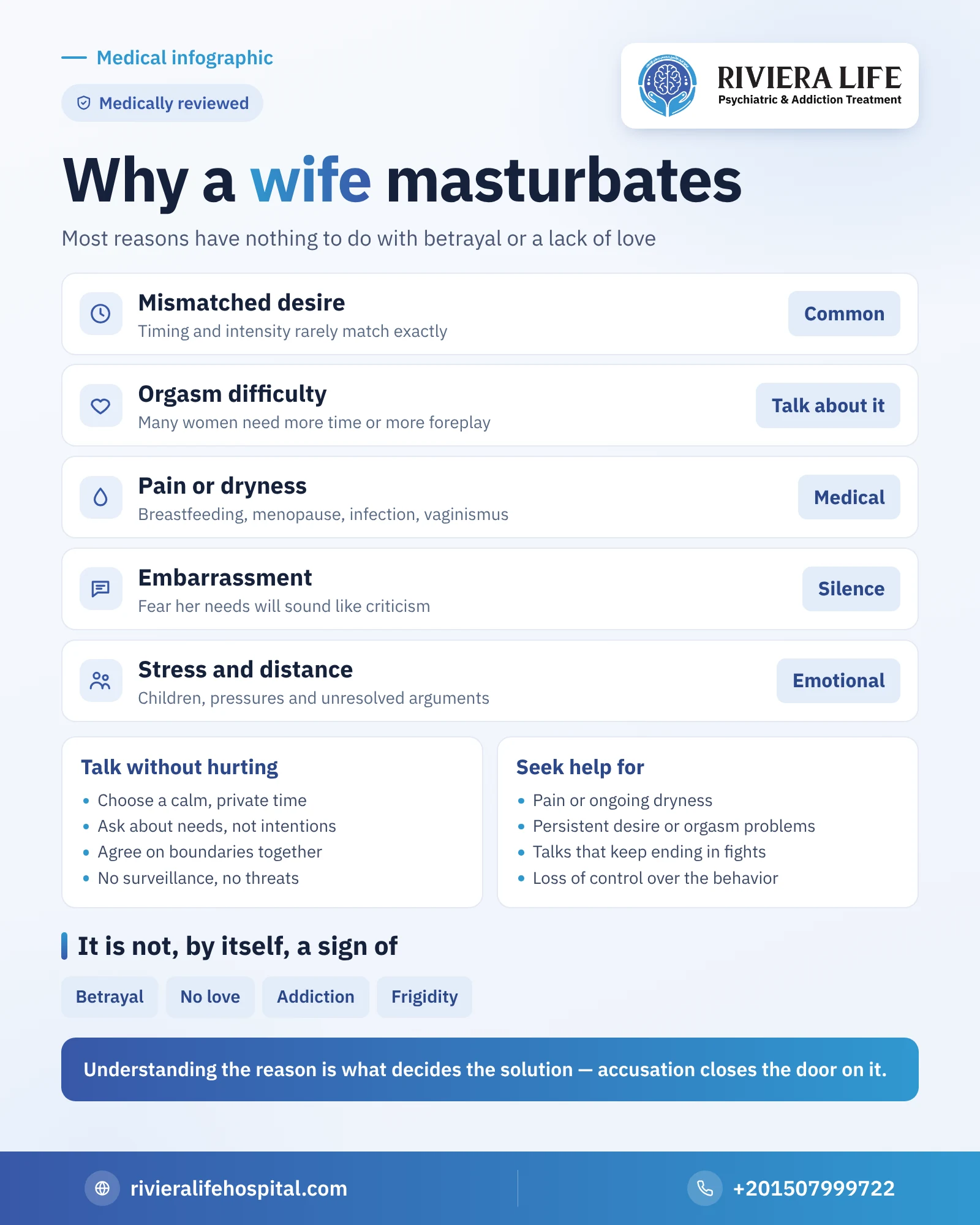
There are many reasons a wife may turn to masturbation, and most of them have nothing to do with betrayal or a lack of love: desire that comes at different times for each partner, difficulty reaching orgasm during sex, pain and dryness that make intercourse exhausting, embarrassment about expressing her needs, stress and emotional distance, or an old habit that continued after marriage. Understanding the reason is what decides the solution, and accusation closes the door on it. In this article we explain female masturbation medically, the reasons within marriage, its effects on a married woman, how a couple can talk without hurting each other, and when counseling is needed.
This article is written for couples. If your question is about masturbation in girls and unmarried women, see masturbation in girls and women.
Masturbation in women: what does medicine say?
Masturbation among women is more common than society believes, but it is talked about less because of embarrassment. A woman’s sexual desire is natural, and it is affected by emotions, fatigue, hormones, the stages of the menstrual cycle, pregnancy, breastfeeding and certain medications. Medically, external stimulation does not cause infertility, menstrual disturbance or harm to the womb. What deserves attention is when the practice is a silent message about a problem in the relationship that hasn’t been spoken about, or when it turns into a compulsive pattern that is hard to control.
Why does a wife turn to masturbation?
More than one reason may come together in the same wife, and the reason may change from one stage of the marriage to another:
1. Differences in the timing and intensity of desire
A couple’s desire rarely matches exactly. A wife may feel desire at a time when her husband is exhausted, traveling or busy, or her desire may be stronger than his at some stage. This is a common difference that doesn’t mean either of them is ill, but it needs talking about and coordinating.
2. Difficulty reaching orgasm during sex
A large proportion of women don’t reach orgasm through intercourse alone and need more time or enough foreplay. When this isn’t discussed, a wife may find that the only way to meet her need is on her own, when in fact she only needs better understanding.
3. Embarrassment about expressing her needs
Many wives fear that talking about their needs will be taken as criticism of their husband’s manhood, or that they will be seen negatively. So they choose silence and solo release over a confrontation that might hurt them both.
4. Wanting comfort and control
In solo practice there is no performance anxiety, no expectations and no fear of judgment. Some women find in it a personal space to relax, away from the pressure of pleasing someone else.
5. Pain and dryness during sex
Pain during intercourse is common and often neglected, and it has many causes: dryness linked to breastfeeding, menopause or certain medications; infections; an involuntary tightening of the vaginal muscles called “vaginismus”; or chronic vulval pain. Here the wife may keep her desire but avoid intercourse because it hurts — a medical problem that a gynecologist can treat.
6. Sexual difficulties in the husband
Premature ejaculation, erectile weakness or low desire in the husband can leave the wife’s needs unmet, so she turns to solo practice to protect his feelings and avoid embarrassing him. These are common, treatable difficulties if help is sought.
7. Stress and emotional distance
Daily pressures, caring for children and accumulated arguments can make physical closeness difficult, while the need for release remains. Sometimes the practice reflects an emotional coolness that needs addressing, but it isn’t proof of that in every case.
8. An old habit that continued after marriage
Some wives were used to masturbating before marriage, and it continued afterwards to varying degrees without meaning they are unhappy with their husband. If it is an old compulsive habit, it deserves treatment like any compulsive pattern.
9. Sexual content, for some women
For some women the practice may be linked to watching pornographic content, which carries its own risks for satisfaction with the real relationship and expectations of it. But this shouldn’t be assumed automatically; most women do it without any content at all. Our guide to pornography addiction explains when it becomes a problem.
Why does a wife masturbate even though her husband is there?
Because a husband being there doesn’t mean the timing of desire matches, that there is privacy, or that both partners are ready every time. A wife may sometimes want a quick, quiet release without the demands of full intimacy. This doesn’t necessarily mean she prefers it to her husband, or that she wants to replace him.
Why does a wife turn to it after sex?
The most common reason is that sex ended before the wife reached orgasm or before her arousal had settled. This usually points to a need for more time and communication, not to a failed relationship. A calm conversation about it solves many cases.
Why does she want release but not intercourse?
Wanting release is different from being ready for intercourse. A wife may be held back by things like severe exhaustion, fear of pain, worry about pregnancy, feeling uncomfortable with her body after childbirth, or an unresolved argument. Understanding the specific reason is what opens the way to a solution; pressuring her only increases the distance.
Does it mean betrayal or a lack of love?
The practice alone is not evidence of betrayal or a lack of love. Many wives who do it love their husbands and desire them. Trust and boundaries in a marriage are built by talking openly about what each partner accepts, not by checking up on each other or reading the behavior in the worst possible light.
Does a wife’s masturbation mean she is addicted?
No. Addiction, or a compulsive pattern, is measured by loss of control and harm to life, not by frequency alone or by a difference in the couple’s points of view. But if the wife herself tries to stop and can’t, if it takes time from her sleep and responsibilities, or if she uses it to numb ongoing sadness or anxiety, it deserves a specialist assessment, as our article on the causes of masturbation addiction explains.
The harms of masturbation for a married woman
Physical harm is limited with moderate practice, and is usually confined to local irritation when overdone, or injuries if unsafe objects are used. The more important harm is to the relationship: the practice becoming a permanent substitute that hides an untreated pain or difficulty, so the distance between the couple widens, the husband may feel rejected if he discovers it, and the wife lives with guilt and secrecy. You will find the details of the real medical harms and the myths in our article on the harmful effects of masturbation.
Is masturbation forbidden for a married woman in Islam?
The ruling here is a religious matter to be referred to Dar al-Ifta and qualified scholars, not to a doctor. In summary, what scholars report is that the majority of jurists do not permit masturbation and consider that having a husband makes the need for it more remote, while they distinguish between it and the foreplay and mutual pleasure between spouses, which they regard as permissible within marriage. Anyone with a question about her own particular situation would do best to ask Dar al-Ifta directly.
Our medical role is to help the couple understand what lies behind the practice: is it a difference in desire, pain during sex, or emotional distance that hasn’t been discussed? When the reason is treated, the need for it usually decreases, without conflict or accusation.
How can you talk without hurting each other?
Choose a safe time to talk
Don’t raise the subject after an argument or at the moment of a sudden discovery. Choose a calm time and a private place, and begin by saying the aim is to understand each other and grow closer, not for one of you to put the other on trial.
Ask about needs, not intentions
Instead of “Why are you doing this? Isn’t your husband enough for you?”, try: “What would make you feel closer and more comfortable in our relationship?” and “Is there anything that hurts or bothers you that you haven’t been able to say?” Asking about needs opens the conversation; asking about intentions shuts it down.
Agree on boundaries you both understand
Every couple has values and beliefs, and one of you may see the practice as religiously or morally unacceptable. That is your right, but the solution is an agreement that respects you both — not forcing the wife into intimacy she doesn’t want, and not surveillance.
What should a husband do if he finds out?
Calm first. Avoid accusations, insults or threats of divorce in a moment of anger; these reactions increase secrecy and damage trust more than the behavior itself. Give yourself time, then start a calm conversation in the way described above. And if talking is difficult between you, a session with a therapist specializing in marriage helps you both say what is hard to say.
When do you need counseling?
- Pain during sex or persistent dryness: the solution starts with a gynecologist.
- Persistent difficulty with desire or orgasm in either partner, or premature ejaculation and erectile weakness in the husband.
- Conversation between the couple breaking down, with repeated arguments about the subject.
- Loss of control over the behavior, or its link with pornography or with ongoing sadness and anxiety.
In these cases the couple may need couples or sex therapy, and the wife may need individual psychotherapy. Our article on masturbation addiction treatment sets out a plan for dealing with a compulsive pattern if there is one.
How can Riviera Life help you?
Riviera Life’s consultant psychiatrists offer individual or couples sessions in complete confidence, looking for the real reason behind the behavior — whether anxiety, depression, a compulsive pattern or difficulty communicating — and referring you for the appropriate medical examination if needed. The first consultation is free on +201507999722.
More from our masturbation guide
- Masturbation: the complete guide
- The harmful effects of masturbation for men and women
- The causes of masturbation addiction
- Masturbation addiction treatment
Questions many people ask
Being happy with her husband doesn't cancel individual desire; differences in timing and a need for personal space or quick release are reasons that fit perfectly well with a loving marriage.
No. Many women need more time or better understanding. A diagnosis of low sexual desire needs a specialist assessment, not a conclusion drawn from one situation.
Usually no single partner is responsible. The reasons overlap, and the solution comes from a shared conversation, not from looking for someone to blame.
Avoid an angry reaction and wait until you are calm, then start a private conversation that asks about her needs, not her intentions, and see a couples therapist if the conversation stalls.
Not necessarily. If you notice her pulling away from intimacy, there is most likely pain, difficulty or emotional distance behind it that needs talking about, and perhaps a medical examination.