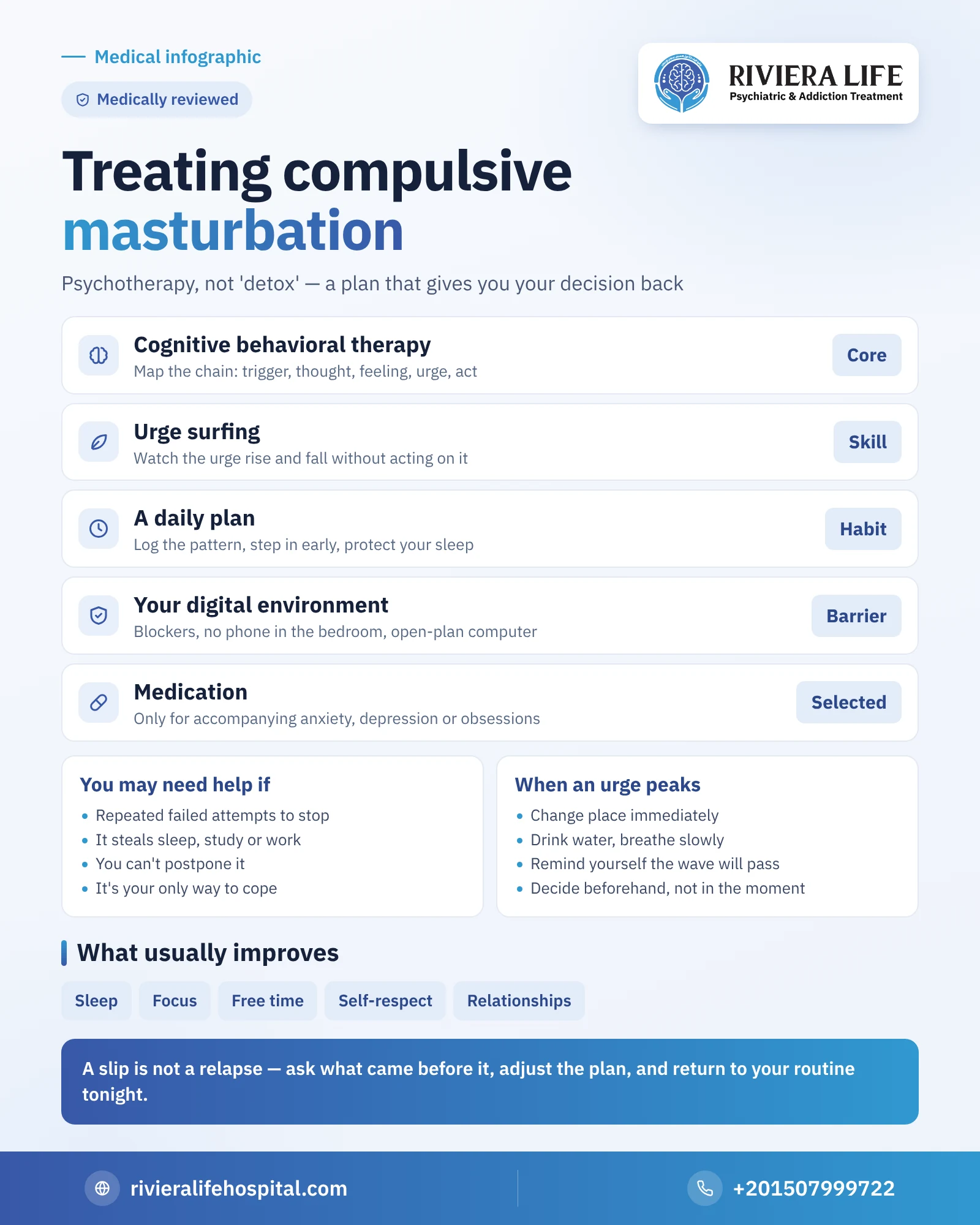
Masturbation addiction can be treated, and treatment relies mainly on psychotherapy rather than medication: cognitive behavioral therapy to understand the triggers and change how you respond to them, a daily plan to manage your environment, phone and sleep, and training in tolerating the urge without giving in automatically, together with treatment of anxiety or depression if they are present. There is no “detox”, and it isn’t cured in a week, but most people who stick to a clear plan regain control within months. In this article you will find a practical answer to the question “how do I stop masturbating?” for men and women, when you need a doctor, and how to deal with slips.
Does masturbation addiction really exist?
The American DSM-5 has no separate diagnosis by this name. But the World Health Organization has included “compulsive sexual behavior disorder” in the eleventh International Classification of Diseases (ICD-11), describing a persistent failure to control intense sexual urges, with the behavior continuing despite its consequences and life suffering because of it. Compulsive masturbation usually falls under this description. So people use the words “masturbation addiction” to express real suffering, while doctors use the term “compulsive pattern”. The name differs, but the suffering deserves treatment.
When do you need treatment for masturbation addiction?
Not every practice is a problem that needs treatment. But you need help if some of the following apply to you:
- You have tried to stop or cut down many times and failed each time after a few days.
- It takes longer than you intended, stealing hours from sleep, study or work.
- You can’t postpone it when the urge is strong, even at inappropriate times or places.
- You continue despite pain, irritation or problems in your marriage.
- It has become your only way of coping with anxiety, sadness or loneliness.
- It is followed by severe distress or guilt that pushes you towards despair.
If you first want to understand what lies behind this pattern, start with our article on the causes of masturbation addiction.
How does the doctor diagnose the problem before treatment starts?
No blood test or scan reveals “masturbation addiction”. The diagnosis is made in a calm, confidential psychiatric interview, in which the doctor asks when the pattern began and how often it happens, when it intensifies, what feelings come before it, its link with watching pornography, and its effect on your life. They also look for conditions that explain or accompany it: anxiety and depression, obsessive-compulsive disorder, attention deficit hyperactivity disorder, manic episodes, stimulant use and certain medications.
They may order tests or a physical examination only if there is a physical complaint such as pain or erectile weakness. The doctor also distinguishes between a real loss of control and a conflict of values that makes someone suffer over infrequent practice, because the plan differs between the two.
What is the goal of treatment?
The goal is not to erase sexual desire or block every thought — that is neither possible nor healthy. The goal is to get your decision back: to be able to say “no” or “not now”, to regain your time, sleep and focus, and to deal with your feelings in a variety of ways. Each person sets their own goal in line with their values: some want to stop completely, others want to be free of the compulsive pattern only. The therapist respects that goal and helps you reach it with realistic steps.
Cognitive behavioral therapy
This is the cornerstone. In it, a person learns to see the behavior as a chain with links: a trigger, then a thought, then a feeling, then an urge, then an act, then brief relief followed by distress. With the therapist they identify the strongest triggers — such as staying up alone with the phone, or feeling like a failure after a bad day — and set a way to break each link. They also work on the thoughts that feed the repetition.
An example of changing a thought that makes slips worse
After a single slip a young man thinks: “I failed as usual, there’s no point, I might as well carry on all day.” This thought turns a lapse into a full relapse. In sessions he practices an alternative: “I slipped once after eleven days, which is longer than ever before. What happened beforehand? I was awake at three in the morning. Tonight I’ll leave the phone outside the room.” The difference is not a prettier version of reality, but a way of looking that allows learning instead of self-punishment.
Accepting the urge, and mindfulness
Many people fight the urge hard and it only becomes more insistent, as happens when you try not to think about something. The “urge surfing” technique teaches you to observe the urge as a wave that rises and then falls on its own within minutes, describing it calmly to yourself: “There’s a strong urge right now, and I feel tension in my body.” With practice, the brain learns that an urge can pass without being acted on. Slow-breathing exercises and short meditation support this skill, and patients practice it daily at calm times so they can use it at difficult ones.
How do I stop masturbating? A practical daily plan
This is the practical answer to the question “how do I quit masturbation?” — steps patients apply between sessions:
1. Log the pattern briefly
For two weeks, write down in a minute: when the urge came, where you were, what you were feeling, and whether you acted on it. You will usually find it repeats at particular times and in particular situations — and that is what you will target.
2. Choose an early point to step in
Breaking the chain at its start is much easier than at its end. If the start is always aimless scrolling in bed, the intervention comes one step earlier: no phone in bed at all, instead of trying to stop at the end of the chain when the urge is at its peak.
3. Choose an alternative that meets the need
Ask yourself: what do I need right now? If it’s tension, a walk, a shower or breathing. If it’s loneliness, a call with a friend or sitting with family. If it’s boredom, a specific activity that occupies the hands and mind. A good alternative meets the same need — it isn’t just a punishment.
4. Organize your digital environment
Turn on tools that block pornographic content, remove the apps that lead to it, leave your phone outside the bedroom at night, and put the computer in an open space. This is not a sign of weakness; it is shortening the distance between the decision and acting on it. If pornography is a big part of the problem, see porn addiction treatment.
5. Protect your sleep and your basic commitments
Late nights, exhaustion and empty time are relapse’s strongest allies. A fixed bedtime, regular exercise, and a day with a clear shape — study, work or a goal — all reduce the space for the compulsive urge more than resistance alone can.
What to do when the urge peaks
Prepare a “ten-minute plan” in advance: change place immediately, leave the room or the house, drink water, breathe slowly, and tell yourself the wave will pass. Don’t argue with the urge for long, and don’t wait to decide in the difficult moment — the decision is made before it.
How do I stay away from masturbation for good?
Staying away for good doesn’t come from one strong decision, but from changing the lifestyle that fed the habit. People who keep it up for a long time have things in common: they treated the anxiety or depression behind it, built other sources of pleasure and meaning, kept their digital environment safe after they improved and not only before, and recognized risky periods such as holidays, stress and travel and prepared for them. A slip remains possible even after months; what matters is that it doesn’t turn into a relapse.
Treating masturbation in men
Many men seek treatment when the problem shows up in their marriage: difficulty ejaculating with their wife, performance anxiety, or a preference for solo practice. Here, behavioral sex therapy is added to the plan above to help adjust the private habit gradually, along with couples sessions when needed, and a physical examination if there is erectile weakness, to rule out causes such as diabetes. Our article on the harmful effects of masturbation explains what is really linked to the habit and what isn’t.
How can a girl stop masturbating for good?
In short, here are five practical steps for a girl who wants to stop for good:
- For two weeks, note when the urge gets stronger and what came before it: boredom, anxiety, loneliness or staying up late.
- Leave your phone outside the bedroom at night, since most episodes happen before sleep.
- Prepare a quick alternative for every trigger: a call, a walk, a warm bath or a breathing exercise.
- Don’t judge yourself a failure when you slip; start again the next day without self-punishment.
- Ask for a session with a female doctor or therapist if the distress continues or comes with anxiety and depression.
The same plan works for women, bearing in mind that embarrassment and guilt are usually greater, and that many girls do it to cope with anxiety, loneliness or insomnia. Start with the log so you know when the urge is strongest, pay attention to sleep and your phone at night, and look for other ways to calm down. Don’t hesitate to ask a female doctor or therapist for help if you feel the distress is taking over; the session is completely confidential. And remember that the fear of losing your virginity or becoming infertile because of external practice has no basis, and getting rid of that fear relieves a large part of the suffering.
Are there medicines for treating masturbation addiction?
No medicine is approved specifically for this purpose, and medication is not the first line. But a psychiatrist may turn to it in selected cases after assessment:
Certain antidepressants
These help when anxiety, depression or obsessive thoughts are driving the behavior: they treat the accompanying problem and may reduce the intensity of the impulse in some patients. They have sexual side effects, which the doctor discusses clearly with the patient.
Naltrexone in selected cases
A medicine that affects the reward system, with limited evidence for it in compulsive behaviors. It is only used on a doctor’s decision and after confirming there are no contraindications, such as liver disease or taking opioid medicines.
Don’t take any medicine, “mixture” or supplement promoted as a treatment for masturbation without a prescription, and don’t take sedatives to get rid of the urge, as they may add a new problem to the old one.
Does treatment need a detox?
No. Masturbation is a behavior, not a substance that builds up in the body, so there is no detox stage and no dangerous physical withdrawal symptoms. In the first weeks a person may feel tension, insomnia and repeated urges; this is normal and eases gradually with the plan.
How long does treatment take?
It varies from person to person. Many notice an improvement in their sense of control within a few weeks of commitment, while making the change stick usually takes several months of regular sessions and follow-up. Instead of focusing on counting days, watch more important indicators: are the urges weaker or shorter? Is the time between slips getting longer or shorter? Have sleep, focus and relationships improved?
What if you don’t improve despite sticking to the plan?
The therapist calmly reviews things with you: are you really applying the plan, or only on paper? Is the goal realistic? Is there untreated depression, anxiety, OCD or attention deficit? Is pornography still easily available? Is your relationship with the therapist comfortable? They may suggest more frequent sessions, involving your husband or wife, or adding medication for an accompanying condition.
Treatment at home or in hospital?
Most cases are treated in outpatient sessions with a home plan. An inpatient stay is only necessary when there is a severe accompanying psychiatric condition, such as severe depression with suicidal thoughts, a manic episode, or addiction to drugs or stimulants that needs safe withdrawal before the behavior is treated. If you have thoughts of harming yourself, call an ambulance on 123 or go to the nearest emergency department.
Slips during treatment: how to deal with them
A slip is an expected part of change, not proof of failure. Afterwards, don’t punish yourself or abandon the plan; ask three questions: what came before it? At which link could I have stepped in? What will I change tonight? Then return to your routine straight away. You don’t need to confess the details to others in order to “hold yourself accountable” — excessive shame pushes towards secrecy, and what helps is discussing it with your therapist.
Symptoms of quitting masturbation: what to expect in the first weeks
Quitting masturbation is not like quitting a drug; there is no dangerous physical withdrawal. But a brain that has become used to this quick way of calming tension protests at first — and the protest is real, even if temporary.
Common in the first weeks:
- Intense urges that come in waves, usually strongest at their usual times, such as at night or when alone with the phone.
- Irritability, restlessness and difficulty concentrating when the thing that used to relieve tension is missing.
- Disturbed sleep or a later bedtime.
- Low mood or a feeling of emptiness when bored.
- Sexual dreams or wet dreams in some men — a natural response of the body, not a sign of relapse.
These symptoms ease gradually, and faster with regular sleep, physical activity and controlled phone use. But if they come with severe despair, thoughts of self-harm or anxiety that disrupts your life, you need to see a psychiatrist, as there may be untreated anxiety or depression behind them. You will find the roots of this urge in our article on the causes of masturbation addiction.
When does the body return to normal after quitting masturbation?
There is no single date that applies to everyone, because “normal” here means two different things: the body and the behavior.
Physically, there is no exhausted organ that needs repairing; sexual function in a healthy person doesn’t change fundamentally when they stop. What usually improves is whatever was tied to the habit itself: sleep, focus, available time and self-respect.
The behavior, on the other hand, goes through rough stages:
- In the first weeks: the hardest period in terms of intense urges.
- After several weeks: the waves become less intense and the ability to postpone them grows.
- After months: a new pattern becomes established if the plan continues.
Beware of forums that promise amazing physical transformations after a certain number of days; there is no medical evidence for them. If you have a persistent sexual complaint such as erectile weakness, see a doctor, because its cause may be psychological or physical and unrelated to stopping. To see what medicine actually confirms, read the harmful effects of masturbation: the medical facts.
The right hospital for masturbation addiction treatment: how to choose
The right hospital for masturbation addiction treatment is one that offers exactly what this patient needs: complete confidentiality without judgment, structured behavioral therapy rather than sermons, and the ability to detect anxiety, depression or substance use that may lie behind the behavior. Before you decide, ask:
- Does the place guarantee complete confidentiality of data and sessions?
- Does it offer cognitive behavioral therapy with a written plan and tasks between sessions?
- Does the doctor assess accompanying conditions such as depression, anxiety, OCD and attention deficit?
- Does it deal with pornography and substance use if they are part of the problem?
- Does it respect the patient’s values without turning the session into blame or fear?
- Does it offer couples sessions and follow-up after improvement to prevent relapse?
And beware of any place that promises a complete cure in days or a guaranteed success rate.
Why Riviera Life for masturbation addiction treatment?
Here is how Riviera Life applies these standards:
- Complete confidentiality: the patient’s data and what they say in sessions are protected at every stage.
- A team of consultants: consultants in psychiatry and addiction treatment carefully assess each case and draw up its treatment plan.
- Structured behavioral therapy: an individual plan that targets the person’s own triggers and high-risk times.
- Dual-diagnosis treatment: accompanying depression, anxiety or substance use is treated within the same plan.
- Round-the-clock medical supervision: for the rare cases that need an inpatient stay because of a severe psychiatric condition.
- A licensed hospital with long experience: licensed by the Ministry of Health, and working for fourteen years, during which thousands of people have recovered.
- A family program and aftercare: sessions for couples or families, and follow-up after improvement.
The first consultation is free, and our line +201507999722 takes your call at any time in complete confidence. You can also visit us in Sheikh Zayed, Giza.
More from our masturbation guide
- Masturbation: the complete guide
- The harmful effects of masturbation for men and women
- The causes of masturbation addiction
- Why a wife turns to masturbation
- The benefits of quitting masturbation: what really changes and what doesn’t
Questions many people ask
Yes. Most cases improve with psychotherapy and a behavioral plan alone. A doctor only turns to medication when there is accompanying anxiety, depression, obsessions or severe impulsivity.
Not automatically. Marriage may reduce the behavior for some people, but a compulsive pattern linked to anxiety or pornography usually continues afterwards if its cause isn't treated.
Improvement can begin within days, but making the change stick usually takes several months of commitment, and promises of a cure in days are unrealistic.
No. A slip is an expected part of change. What decides the outcome is what you do next: understanding what came before it, adjusting the plan and returning to your routine straight away.
Complete confidentiality, consultant psychiatrists, structured behavioral therapy and treatment of any accompanying depression or anxiety, with a family program and follow-up. Riviera Life in Sheikh Zayed offers all of these.