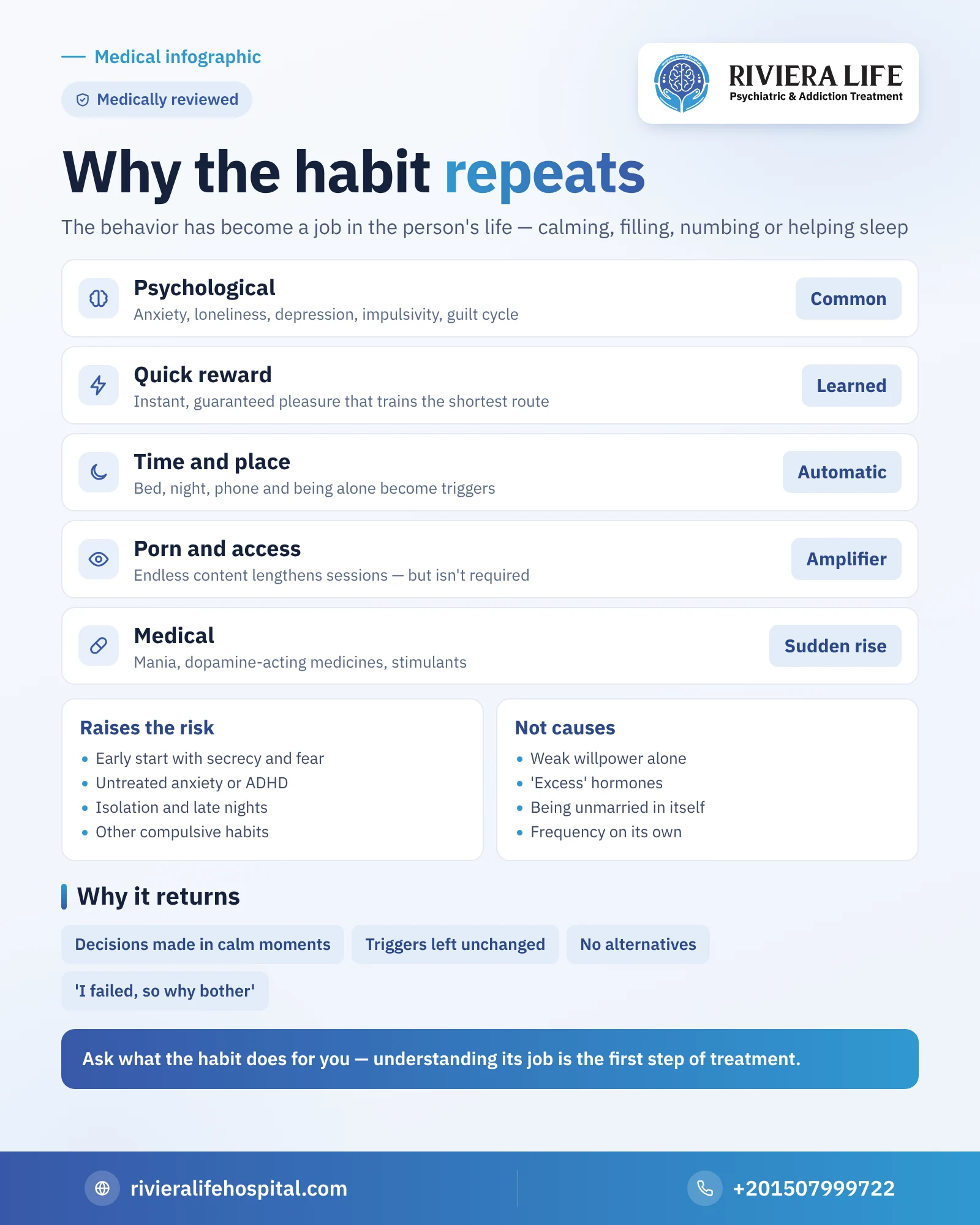
There is no single cause of masturbation addiction. Usually psychological pressure such as anxiety, loneliness or depression meets a behavioral habit built on a quick reward that is always available, daily triggers such as late nights, the phone and empty time, and sometimes a medical or medication cause that suddenly raises impulsivity. With repetition, the brain learns that this is the quickest route to calm, so stopping becomes harder than a simple decision. In this article we explain the psychological, behavioral and medical causes of masturbation addiction, why the behavior comes back despite a resolve to stop, and what is not a cause, contrary to what many people think.
What are the causes of masturbation addiction?
Doctors prefer to talk about a “compulsive pattern” rather than addiction in the strict sense, because the American diagnostic manual has no separate diagnosis by that name, while the eleventh International Classification of Diseases describes “compulsive sexual behaviour disorder”. The basic idea is that the behavior is no longer a free choice but has become a job it does in the person’s life: it calms tension, fills empty time, numbs sadness, or helps with sleep. The more efficiently and quickly it does this job, the harder it becomes to give up. So understanding “what does the habit do for you?” is the first step in treatment.
Psychological causes
1. Anxiety and stress
Many people turn to it as a quick way of releasing tension, especially before exams, after an exhausting day at work or during periods of family conflict. The relief is real but short, and doesn’t solve the source of the anxiety, so the need returns the next day, perhaps more strongly. And someone with a persistent anxiety disorder finds themselves repeating the behavior several times a day. To learn more about this condition, read our guide to anxiety.
2. Loneliness and emotional deprivation
Living abroad, living alone, weak friendships, delayed marriage and coolness within a marriage are all situations in which the behavior becomes a quick substitute for missing human closeness. It doesn’t actually make up for that closeness, but it eases the feeling of its absence for a few minutes.
3. Difficulty handling emotions and impulses
Some people haven’t learned varied ways of calming themselves, so every unpleasant feeling — anger, rejection or boredom — needs an immediate outlet. Attention deficit hyperactivity disorder is also linked to difficulty restraining impulses and a constant search for stimulation, and this may show in sexual behavior too.
4. Depression and painful experiences
In depression, pleasure in ordinary things decreases, so the behavior becomes one of the few remaining sources of feeling. And for those who went through painful experiences in childhood or adolescence, the behavior may take on the role of soothing or escaping memories. In these cases the behavior doesn’t improve through resistance alone before depression or trauma is treated.
5. A conflict of values and the guilt cycle
Recent research indicates that a person’s feeling that they are “addicted” is strongly linked to how much the behavior conflicts with their religious or moral values, not just to the number of times. And severe guilt after each time doesn’t prevent repetition as might be expected; instead it raises the tension that is then released through the same behavior, and the cycle turns. Respecting your values while letting go of self-punishment is what breaks this cycle.
Behavioral and environmental causes
1. Getting used to quick reward
The behavior gives immediate, guaranteed pleasure with no effort or waiting, while other sources of pleasure — sport, study and relationships — need patience. Over time the brain leans towards the shortest route whenever it feels any discomfort.
2. Linking the behavior to a time or place
When the behavior repeats in bed before sleep, in the bathroom, or when alone at home, the place and time become linked to it, so simply being there sets off the urge without thinking. This explains why many people feel it “just happens”.
3. Porn and easy access
A phone in your hand all the time puts pornographic content seconds away. This content renews itself endlessly, lengthening sessions and raising the threshold of arousal. Even so, the relationship isn’t inevitable: some people have a compulsive pattern without porn. Our article on the causes of porn addiction explains this side in detail.
4. Boredom, procrastination and a lack of alternatives
A day without a goal, long holidays, unemployment and constantly putting off difficult tasks all open a wide space for the behavior. Sometimes it is a way of escaping a heavy task, and so it turns into a form of procrastination.
5. An early start and curiosity in adolescence
Discovering the behavior at a young age with no calm educational conversation, or with early exposure to pornographic content, may establish a strong habit that lasts years, especially if it comes with constant secrecy and fear.
Why does it increase at night?
Night brings together what no other time does: complete privacy, tiredness that weakens self-control, a phone in bed, and the thoughts and worries of the day that surface when trying to sleep. Some people use it as a way to fall asleep when they have insomnia, so the two become linked. That is why many treatment plans begin by changing the pre-sleep routine.
What is dopamine’s role?
Dopamine is a neurotransmitter involved in motivation and reward learning — in making us repeat what made us feel relief. It becomes active with sexual behavior just as it does with food, achievement and success. But phrases like “my dopamine is burnt out” or “my brain is destroyed” are an exaggerated simplification. More precisely, constant repetition teaches the brain to link certain triggers with reward, so the urge grows stronger — and this learning can be changed with treatment.
Does genetics play a role?
There is no “gene” for compulsive masturbation. But some traits that raise the risk may have partly genetic roots, such as impulsivity, a tendency to anxiety and depression, and attention deficit hyperactivity disorder. In other words, a person may inherit a general predisposition to difficulty controlling impulses, while environment, habits and stress decide how that predisposition shows, and in which behavior.
Factors that raise the likelihood of the habit becoming compulsive
- Starting at a young age with intense secrecy and constant fear.
- Untreated anxiety, depression, obsessions or attention problems.
- Social isolation, living alone and a lack of activities.
- Regular late nights and long phone use in bed.
- A link with porn or with the use of stimulants or alcohol.
- A previous history of other compulsive behaviors such as gambling or video games.
Medical causes and a sudden increase
If desire and the behavior increase suddenly and unusually in someone who has never experienced this before, a medical cause should be considered:
Manic or hypomanic episodes
In bipolar disorder, sexual desire may rise sharply during an episode, together with less need for sleep, talking a lot, spending and impulsivity. Here the behavior isn’t the main problem, and it improves when the episode is treated.
Some medicines and substances
Some medicines that stimulate dopamine receptors, such as those used to treat Parkinson’s disease and restless legs, can cause compulsive behaviors, including sexual behavior, in a proportion of patients; the treating doctor should be told about this, and the medicine shouldn’t be stopped on your own. Stimulants such as methamphetamine and cocaine also strongly raise sexual impulsivity. Rarely there are other neurological causes that the doctor uncovers during assessment.
Why does the behavior return despite a decision to stop?
Because the decision is made in a calm moment, and the slip happens in a completely different moment: night, tiredness, loneliness, distress and a phone nearby. And stopping suddenly by willpower alone, without changing the triggers or finding alternatives, leaves the person facing the same urge with no tools. Then comes the thought “I failed, so there’s no point”, turning one slip into days. That is why masturbation addiction treatment focuses on changing the environment and dealing with emotions, not on resistance alone.
Is frequency a cause of addiction?
Frequency is more a result than a cause. Some people do it often without losing control or their life being affected, and some do it less but are unable to stop and suffer. The criterion is the loss of control and the harm done to sleep, work, relationships and the self. Our article on the harmful effects of masturbation explains where real harm begins.
What is not a cause?
- Weak willpower alone: this explanation increases guilt and doesn’t help, as many factors overlap in a compulsive pattern.
- “Excess” hormones: most people with this pattern have normal hormones, and hormone tests are only requested for another complaint.
- Being unmarried in itself: marriage doesn’t automatically cancel a compulsive pattern, and many married people have it.
How can Riviera Life help you?
In a confidential assessment session, a consultant psychiatrist helps you map your own causes: what the triggers are, what emotions lie behind them, and whether there is anxiety, depression or a medical cause that needs treatment, then sets a plan that suits you. The first consultation is free on +201507999722.
More from our masturbation guide
- Masturbation: the complete guide
- The real harmful effects of masturbation and the myths
- Masturbation addiction treatment
- Why a wife turns to masturbation
- The benefits of quitting masturbation: what really changes and what doesn’t
Questions many people ask
There is no direct genetic cause, but a general predisposition to impulsivity, anxiety or attention problems may be inherited, and environment and habits decide how that predisposition shows.
It may increase loneliness and empty time, but it isn't a sufficient cause on its own. Many unmarried people don't have a compulsive pattern, and many married people do.
Because the behavior has usually become a way of relieving tension, boredom or sadness rather than a source of pleasure. This is a sign of a compulsive pattern and deserves an assessment.
Yes. A compulsive pattern can be linked to anxiety, loneliness and late nights without any content, although porn makes it more intense for those who watch it.
No. Psychological, behavioral and sometimes medical factors overlap in the pattern. Blaming willpower alone increases the guilt that feeds repetition, while understanding and treating the triggers helps.