The benefits of quitting masturbation need an honest discussion, far from the exaggerations that fill online forums. The medical truth is that masturbation is very common and in itself doesn’t cause blindness, infertility, a weak spine or hair loss. On the other hand, certain people do benefit from stopping or cutting down: those who have lost control of it, whose sleep, work and relationship have been affected, who suffer from ongoing guilt, or who have chosen to stop out of personal conviction. This article explains what really changes, what doesn’t, and how to begin without punishing yourself.
Should everyone quit masturbation?
No. Medical bodies, including Britain’s NHS, regard masturbation as a common and medically normal behavior, and a person doesn’t need to stop for medical reasons as long as it doesn’t affect their life. The more precise question is: are you in control of the habit, or is it in control of you?
So cases fall into three groups:
- Someone who does it in moderation without harm or distress, with no medical need to change what they do.
- Someone who wants to stop because of their religious or personal values or because the habit distresses them — a choice the therapist respects.
- Someone who does it compulsively, in conflict with their life, and fails when they try to cut down — the person who needs a plan and perhaps specialist help. For the difference between frequent and compulsive, see the causes of masturbation addiction.
The realistic benefits many people notice
There are no large studies that precisely measure the “benefits of quitting”, and what is known here comes from clinical experience and research on compulsive behaviors in general. These are the main things people in recovery mention:
Getting time and energy back
When the habit repeats several times a day, it consumes real hours each week and interrupts study and work. Stopping returns this time to other activities, and this is usually the first change people notice.
Better sleep
Many people do it at night as a way of calming down and then stay up later than they meant to. Cutting down helps regulate bedtime, although sleep is usually also affected by the phone and lighting, not by the habit alone.
Peace of mind and less guilt
The guilt and shame after each time can weigh more than the habit itself, and push towards anxiety and isolation. When a person regains control, this inner conflict eases — although it is important to know that guilt isn’t proof of illness, and that treating it is part of the treatment, not something solved by being harsh on yourself.
Clearer focus
When repeated preoccupations, fantasies and pressing urges decrease, a person may find their mind calmer for study and work. This effect varies and is modest for most people — it isn’t a leap in intelligence.
A better relationship with your partner
For married people, relying on the habit can lead to distance or to preferring solo release over real closeness, so both partners benefit when attention returns to the relationship. But this isn’t a rule: some couples consider it a normal part of their life without any problem, and the judgment depends on its effect on your relationship. For the wider discussion, read why a wife turns to masturbation.
Relief for the skin and genitals
With overdoing it, irritation, redness or skin inflammation can happen, and it clears with stopping or cutting down. You will find the details in the harmful effects of masturbation, so we won’t repeat them here.
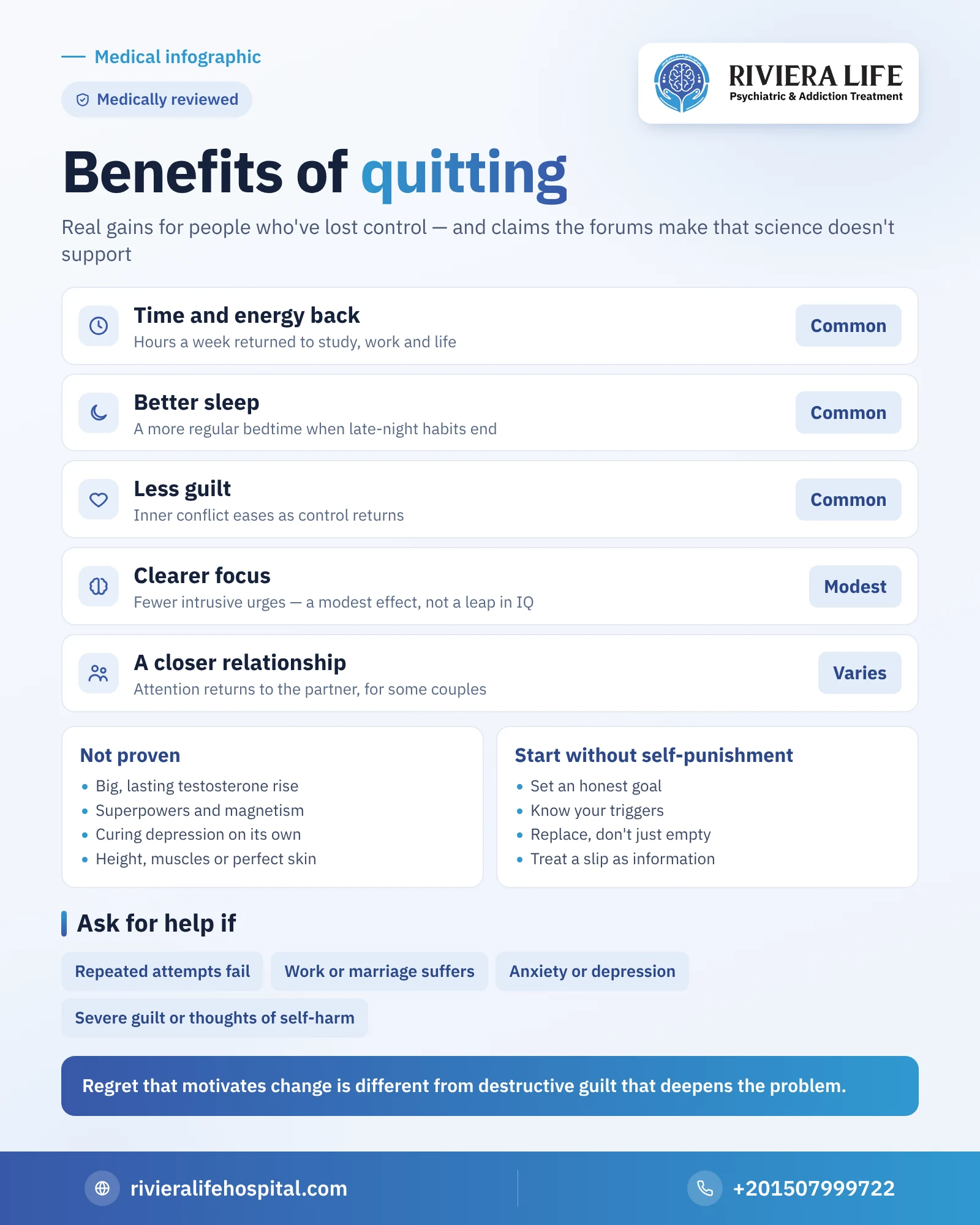
Benefits promoted by forums that aren’t proven
Many claims have spread around so-called “abstinence challenges”, and scientific honesty means telling them apart:
| The common claim | What we know |
|---|---|
| It raises testosterone greatly and permanently | There is no solid evidence for it; some studies mention small, short-lived changes that don’t last |
| It gives superpowers and greater attractiveness | No scientific evidence; the experience may be psychological, from the sense of achievement |
| It treats depression and anxiety on its own | Not true; these are conditions that need assessment and treatment |
| It increases height and muscle or radically improves the skin | No proven link |
| It fixes erections or permanently cures poor performance | It may improve in some people whose performance was tied to particular habits, but there are many causes of sexual weakness and they need a doctor |
What might you feel in the first weeks?
There is no fixed timetable, but it is usual to go through a temporary period of discomfort: tension, irritability, difficulty sleeping and strong intermittent urges, which fade gradually for most people. These aren’t serious symptoms of illness, but a reaction to a habit you had grown used to, and it helps to expect them instead of seeing them as failure. And going back to the habit once after a while doesn’t cancel what you have achieved; what matters is analyzing what happened and carrying on.
How to start without punishing yourself
- Set your goal honestly: do you want to cut down or stop? And why? A goal that comes from you lasts longer than one someone else imposed on you.
- Know your triggers: loneliness, late nights, boredom, stress, or the phone in bed? Then change the environment to match: the phone outside the bedroom, and not staying alone for hours at risky times.
- Replace rather than empty: put an immediate activity in the habit’s place, such as walking, a shower, a call or exercise.
- Look after sleep, exercise and food: an exhausted body is weaker in the face of urges.
- Deal with a slip calmly: ask what brought me here, and adjust your plan. Self-punishment increases the tension that feeds the habit.
You will find more detailed treatment steps in masturbation addiction treatment.
Does stopping itself harm the body?
No. Abstaining from masturbation doesn’t cause illness or harm fertility or sexual health; the body regulates itself, and some young men may have dreams with emission during sleep — a natural physiological phenomenon that needs no treatment. Severe pain, blood or difficulty urinating, however, call for a doctor’s visit whether you masturbate or not.
Religious and personal values: where do you stand?
Many people in our societies see the habit as contrary to their values, so they feel a conflict between what they do and what they believe. The therapist doesn’t ask you to abandon your values, but helps you move towards them with a realistic plan, and distinguishes between regret that motivates change and destructive guilt that deepens the problem.
To teenagers and parents
Adolescence is a stage when the body is discovered and anxiety about this subject is common. It is important for a teenager to know that it is common, that it doesn’t cause the imaginary harms some people frighten them with, and that turning to a parent, a doctor or a psychologist is nothing to be ashamed of. Parents should avoid threats, searching and punishment, as these push towards secrecy and shame. What is needed is calm conversation, an environment that protects sleep, and keeping busy with study, sport and friends.
When should you ask for help?
See a doctor or psychologist if your repeated attempts fail despite a sincere wish, if the habit disrupts your work, study or marriage, if it is linked to anxiety, depression or obsessions, if it causes repeated skin injuries, or if you feel guilt so severe it reaches despair. And if you have thoughts of harming yourself, call the mental health hotline on 16328 or the ambulance on 123 immediately. If you suspect the habit is part of a wider pattern, read sex addiction symptoms.
How can Riviera Life help you?
At Riviera Life, consultant psychiatrists listen to you without judgment or scare tactics, respect your values, and assess whether the habit is linked to anxiety, depression or something else, then set a suitable behavioral treatment plan. The first consultation is free and completely confidential, and you can reach us on +201507999722 in Sheikh Zayed, Giza.
More from our masturbation guide
- Our masturbation guide: every aspect in its own article
- The harmful effects of masturbation: the medical facts
- The causes of masturbation addiction
- Masturbation addiction treatment
Questions many people ask
Many people notice they get time back, sleep better, feel less guilty, focus better and feel closer to their partner — especially those for whom the habit was compulsive.
No. It is common and medically normal, and there is no need to stop as long as it doesn't affect your life; but stopping makes sense for anyone who has lost control, is distressed by it, or has chosen to stop.
There is no solid scientific evidence of a large or lasting change, and what is published about superpowers is exaggerated.
Tension, insomnia and intermittent urges may appear and fade gradually for most people, and a temporary return to the habit doesn't cancel what you have achieved.
When repeated attempts fail, when work or marriage is affected, when there is anxiety, depression or severe guilt — and immediately if there are any thoughts of self-harm.