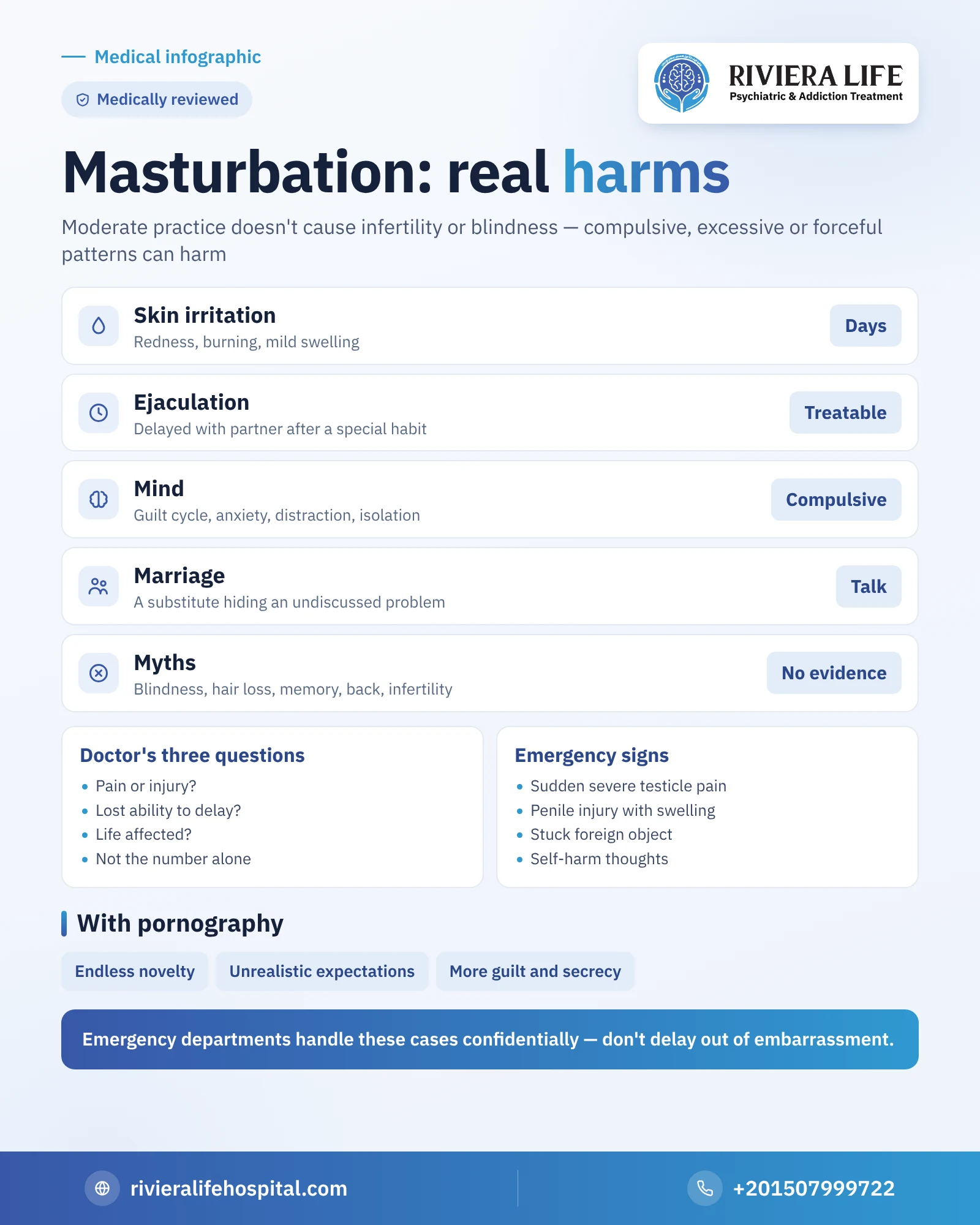
Is masturbation harmful? The precise medical answer: moderate practice doesn’t cause infertility, blindness, weak memory or hair loss, but an excessive or compulsive pattern or a forceful method may leave real harms. These include skin irritation and swelling, difficulties with ejaculation or orgasm with a partner in some who have become used to a particular method, anxiety, guilt and distraction, loss of sleep and time, and tension in marriage. In this article we detail the harmful effects of masturbation for men, women, teenagers and married women, distinguish between what science proves and what is myth, and identify the signs that call for a doctor or emergency care.
Is masturbation harmful? The criterion the doctor judges by
The doctor doesn’t judge harm by the number of times alone, but by three questions: is there pain or physical injury? Has the person lost their ability to delay or stop? Has their life been affected, in sleep, study, work and relationships? A young man who practices it occasionally without pain and without it stealing his day doesn’t carry the same harm as someone who stays up until dawn every night then misses work, continues despite painful irritation, or can no longer enjoy the relationship with his wife. That is why most of the harms mentioned here are linked to excess, compulsion or force in the method, not to the practice itself.
Does masturbation weaken the body? Its real effect on the body
The direct physical effect is limited in moderate practice: a temporary rise in pulse, then relaxation and drowsiness that pass quickly. Actual physical harms usually appear with intense or repeated friction over long periods, using unsafe objects, or continuing despite pain. The body doesn’t lose “vitamins”, “protein” or “marrow” because of it that need supplements; this is a common idea with no medical basis, and the fatigue some feel usually comes from the accompanying late nights and anxiety, not from the practice itself.
Harmful effects of masturbation for men
These are the concerns men ask about most in the clinic, arranged from most to least common:
1. Skin irritation and mild swelling
Strong or prolonged friction may cause redness, burning, superficial pain and mild swelling, and it increases with dryness or the use of soap and scented products. It usually calms within days if the friction stops and the area is kept clean and dry. Continuing despite pain prolongs the inflammation and may cause cracks.
2. Temporary reduced sensation
After intense and repeated stimulation some may notice a temporary reduction in sensation, which differs from nerve damage and improves with rest. Numbness that continues for weeks, or is accompanied by weakness in the legs or urination problems, has other causes and needs a medical examination.
3. Does it cause erectile dysfunction?
There is no good evidence that usual practice causes permanent erectile dysfunction. Difficulty getting an erection directly after orgasm is normal and is called the “refractory period”. But some young men complain of erectile weakness with a partner while it is normal alone, and here the cause is usually performance anxiety, expectations created by watching pornography or tension in the relationship, all treatable causes. Persistent erectile dysfunction has important organic causes such as diabetes, heart disease and smoking, so don’t attribute it to masturbation before examination.
4. Premature and delayed ejaculation
Some men learn from adolescence to finish quickly out of fear of being discovered, and some doctors think this habituation may contribute to premature ejaculation later, though it has many other causes.
On the other side, clinic observations indicate that those who have become used to a very particular method, intense pressure or a speed unlike intercourse may find it difficult to ejaculate or reach orgasm with their wife, which is known as delayed ejaculation. The evidence here is from observations and small studies, not conclusive, but the good news is that gradually adjusting the habit with behavioral sex therapy improves the condition greatly.
5. Does masturbation cause infertility or affect reproduction?
No. Usual practice isn’t a proven cause of infertility, as sperm production is continuously renewed. The volume of semen may decrease or its consistency change if ejaculation is repeated in a short time, and this is temporary and doesn’t reflect fertility. Real fertility assessment is by semen analysis after abstinence for several days as the laboratory requests.
6. Testicular or pelvic pain or a change in the shape of the penis
A heaviness or mild pain in the testicles may occur after prolonged stimulation without orgasm, and it goes away by itself. But sudden severe pain in a testicle is an emergency that may be testicular torsion and doesn’t wait. And if a new curvature, a hard lump or persistent pain after an injury appears, a urologist must be consulted.
7. Blood in the semen
It causes a lot of worry but is usually minor and disappears by itself, especially in young men, and its causes are multiple, including inflammation of the prostate or seminal vesicles. Don’t automatically attribute it to masturbation, and see the doctor if it recurs or is accompanied by pain, burning or fever, or if you are over roughly forty.
8. Does masturbation cause low sexual desire?
Masturbation in itself doesn’t cause low sexual desire, meaning a persistent weakness of desire, in either men or women. The temporary waning of desire after ejaculation is normal and passes within hours. But desire may actually decrease in two situations: when repeated practice is linked to watching pornography, so arousal with a real partner weakens in some people, and when feelings of guilt and anxiety besiege the person so they suppress their desire.
In most cases weak desire has another cause that deserves examination: depression and chronic stress, some medicines such as antidepressants, low testosterone in men, hormonal changes in women, and marital disputes. That is why if weak desire continues for weeks and bothers you or your partner, it is better to see a doctor rather than just blaming the habit.
Harmful effects of masturbation in women and girls
Many girls and women are embarrassed to ask, so fears grow. These are the medical answers to the most frequent ones:
1. Vulval irritation and burning
Intense friction may cause redness and burning in the external tissues, and it increases with dryness, scented washes or tight clothing. It usually calms by stopping and gentle cleaning with water. But discharge with an odor or persistent itching may be an infection that needs a female doctor.
2. Wounds and bleeding from inserting objects
Inserting objects not intended for this, especially hard, sharp or breakable ones, may cause wounds and bleeding, and the object may become stuck and need medical removal. Don’t try to remove it with tools, and don’t delay going to the emergency department out of embarrassment, as the medical team deals with these cases with confidentiality and respect.
3. Does masturbation affect the hymen?
External practice without insertion doesn’t usually affect the hymen. Insertion may cause injury depending on its nature and force. It is worth noting that the shape of the hymen naturally varies between girls, and that the absence or presence of bleeding isn’t an accurate test of anything.
4. Does it cause infertility or menstrual disturbance?
There is no evidence that the practice depletes eggs or affects fertility. Menstrual disturbance has many known causes such as polycystic ovaries, thyroid disorder, stress and weight change, and these are what deserve examination.
5. What happens to the body after masturbation for girls?
Usually nothing worrying: relaxation and perhaps drowsiness, and some girls may feel mild cramps in the lower abdomen that pass within minutes, or a temporary increase in normal discharge. What deserves follow-up is persistent pain, bleeding, burning on urination, or unusual itching and discharge. As for psychological distress and guilt after each time, this is what girls actually suffer from most, and it deserves talking to a specialist.
6. Does pleasure decrease or orgasm become difficult later?
There is no evidence of permanent damage. Some women may become used to a certain type of stimulation so it is difficult for them to reach orgasm in a different way at first, and this usually improves with communication and time. Some medicines such as antidepressants, vaginal dryness and stress affect the response much more than the habit itself.
You will find more details about the facts and myths concerning girls, and practical steps to stop, in the article on masturbation in girls.
Harmful effects of masturbation for married women
Occasional practice doesn’t harm a married woman’s body or fertility, but the problem appears when it becomes a permanent substitute that hides an undiscussed difficulty: pain during intercourse, difficulty with orgasm, emotional coldness, or weakness in the husband. Then the distance widens, the husband may feel rejected if he discovers it, and the wife feels guilt or embarrassment. The solution starts with understanding the reason, not accusation, which we explain in the article on the reasons a wife turns to masturbation. The same applies to a husband who prefers it to the relationship or compares his wife with what he watches.
Harmful effects of masturbation on the mind and psyche
Masturbation doesn’t destroy brain cells or directly weaken memory; this is a myth. But the compulsive pattern leaves clear psychological effects:
- The guilt and relapse cycle: severe distress after each time, then an attempt to calm this distress with the same behavior, so the cycle intensifies.
- Anxiety and low self-esteem: a feeling of weakness and loss of control, especially after repeated promises that weren’t kept.
- Distraction: not because of the practice itself, but because of late nights and constant mental preoccupation with resisting or with sexual content.
- Isolation: spending hours alone with the phone instead of with friends, family and activity.
- Hiding depression or anxiety: repeated practice is often a way of soothing a sad or tense mood, so it delays its treatment. If you notice this, see the guide to depression.
Harmful effects of masturbation for teenagers and young people
In adolescence masturbation is common with the changes of puberty, and the practice in itself doesn’t stunt growth, shorten height or weaken the body. But there are real risks at this age: late nights that harm study and concentration, early exposure to pornographic content with its distorted images of the body and relationships, exploitation by strangers online, and forming a strong habit tied to the phone that is hard to break later.
The most psychologically dangerous is the fear planted by wrong scare tactics, as some young people spend years convinced that they have “destroyed” themselves or lost their fertility. In young people in their twenties the harms usually appear as wasted time, postponed responsibilities and performance anxiety before marriage, all concerns that have solutions.
Is masturbation forbidden for teenagers?
This is a religious question, and the reference for it is Dar al-Ifta and specialized scholars, not the doctor. The summary of what the majority of jurists hold is that it isn’t permissible, with an opinion among some of them allowing it in necessity out of fear of falling into what is forbidden, and they agree that patience and occupying oneself with what is beneficial is better. The role of medicine is to reassure the teenager that it doesn’t cause a serious illness or infertility, and to help them control it if it has become compulsive, away from the scare tactics and threats that increase the problem.
Harmful effects of pornography and masturbation together
When masturbation is linked to watching pornography, the problem multiplies. The content is endlessly renewed and lengthens the session, and the person may need more extreme content to feel the same arousal. This forms unrealistic expectations about the body and the relationship that may be reflected as anxiety and weak performance or coolness with a real partner. It also increases the feeling of guilt and secrecy. The details of these effects are in the article on the harmful effects of pornography.
Does masturbation cause infections or sexually transmitted diseases?
Solo practice doesn’t transmit sexually transmitted diseases, because it doesn’t involve exposure to another person. But unclean hands or objects may cause local infections, and irritation may resemble infection in its symptoms. And if ulcers, discharge or persistent burning on urination appear, these are symptoms that need examination, not self-interpretation.
Can masturbation cause death or affect the heart?
No, masturbation in itself doesn’t cause death, nor does it weaken the heart muscle in a healthy person. The effort it requires resembles climbing a short flight of stairs, and the pulse returns to normal within minutes. The rare cases of death mentioned in research are linked to accompanying dangerous practices, the best known being self-strangulation or restricting breathing to increase arousal, inserting objects that cause wounds and bleeding, or using stimulants and drugs during the practice. As for a patient with severe heart disease, they should ask their doctor about any physical exertion, including sexual activity in all its forms.
The truth in brief: common questions about the harmful effects of masturbation
| Question | Brief medical answer |
|---|---|
| Does it cause death? | No, except with accompanying dangerous practices such as self-strangulation |
| Does it harm the heart? | Not in a healthy person; a severe heart patient consults their doctor |
| Does it cause weakness of the body or muscles? | No, and temporary fatigue afterwards passes with rest |
| Does it cause infertility? | Not in men or women |
| Does it affect marriage? | It may if it becomes compulsive or is linked to pornography |
| Does it weaken memory, eyesight or hair? | No, these are myths without evidence |
| When does it become a problem? | When there is inability to delay, pain or disruption of daily life |
Baseless myths: memory, hair, eyesight and back
Many myths have spread about masturbation to frighten young people, and no scientific evidence supports them: that it causes blindness or weak eyesight, hair loss, weak memory, back pain and “weak marrow”, acne, thinness, or short stature. The real harm of these myths is that they create doubled fear and guilt, and may push the person to buy random supplements or “treatments” they don’t need.
Is masturbating once a day, a week or a month harmful?
Not necessarily. The number alone isn’t enough to judge, but daily practice deserves review if it is combined with pain or recurrent irritation, inability to delay, late nights and problems at work or study, or practicing several times a day to calm tension. If this applies to you, read the article on the causes of masturbation addiction to understand what feeds this pattern.
When do the harmful effects of masturbation go away after stopping?
This differs according to the type of harm. Mild irritation usually improves within a few days. Ejaculation or erection difficulties linked to habituation or pornography may need weeks to a few months of adjusting the habit, and sometimes sex therapy sessions. Psychological effects of anxiety and guilt improve when the cycle itself is treated, not by stopping alone. And any symptom that continues despite stopping means it has another cause that must be diagnosed.
Harms that call for urgent care
These cases are rare, but they can’t wait and shouldn’t be hidden out of embarrassment:
Call the ambulance on 123 or go to the emergency department immediately if any of these appear
Emergency departments deal with these cases confidentially, and delay out of embarrassment may cause permanent harm.
- Sudden severe pain in a testicle with swelling or nausea
- A sudden injury to the penis with sharp pain, rapid swelling and a change in color
- Bleeding that doesn’t stop with pressure
- Inability to urinate or blood in the urine
- A stuck foreign object that can’t be removed
- Thoughts of self-harm because of guilt or despair
When do you need treatment?
If your repeated attempts to stop fail, if the practice takes from your time, sleep and relationships, or if the distress afterwards is increasing, this isn’t weakness of will but a pattern that can be treated. The article on masturbation addiction treatment presents the practical steps and the psychotherapy available. At Riviera Life the psychiatry consultants receive you in a confidential assessment session, and the first consultation is free.
More from the masturbation guide
- Masturbation: the comprehensive guide
- Masturbation addiction treatment step by step
- The causes of masturbation addiction
- The reasons a wife turns to masturbation
- Benefits of quitting masturbation: what really changes and what doesn’t?
Questions many people ask
There is no evidence of that in men or women. If pregnancy is delayed, the assessment is done with the usual fertility tests for both partners, not by assuming that the old habit is the cause.
There is nothing proving that it causes permanent weakness. Weakness only with a partner is usually linked to anxiety or expectations shaped by pornography, and persistent weakness deserves examination for causes such as diabetes and heart disease.
Usually not, as the hymen isn't affected by external stimulation. Inserting any object may cause injury depending on its nature and force.
Mild irritation usually goes away in days, while ejaculation difficulties and anxiety linked to habituation may need weeks to several months, and sometimes therapy sessions.
No, the body doesn't lose elements that need replacing. The accompanying fatigue usually comes from staying up late and stress, and supplements marketed for this purpose are of no benefit.