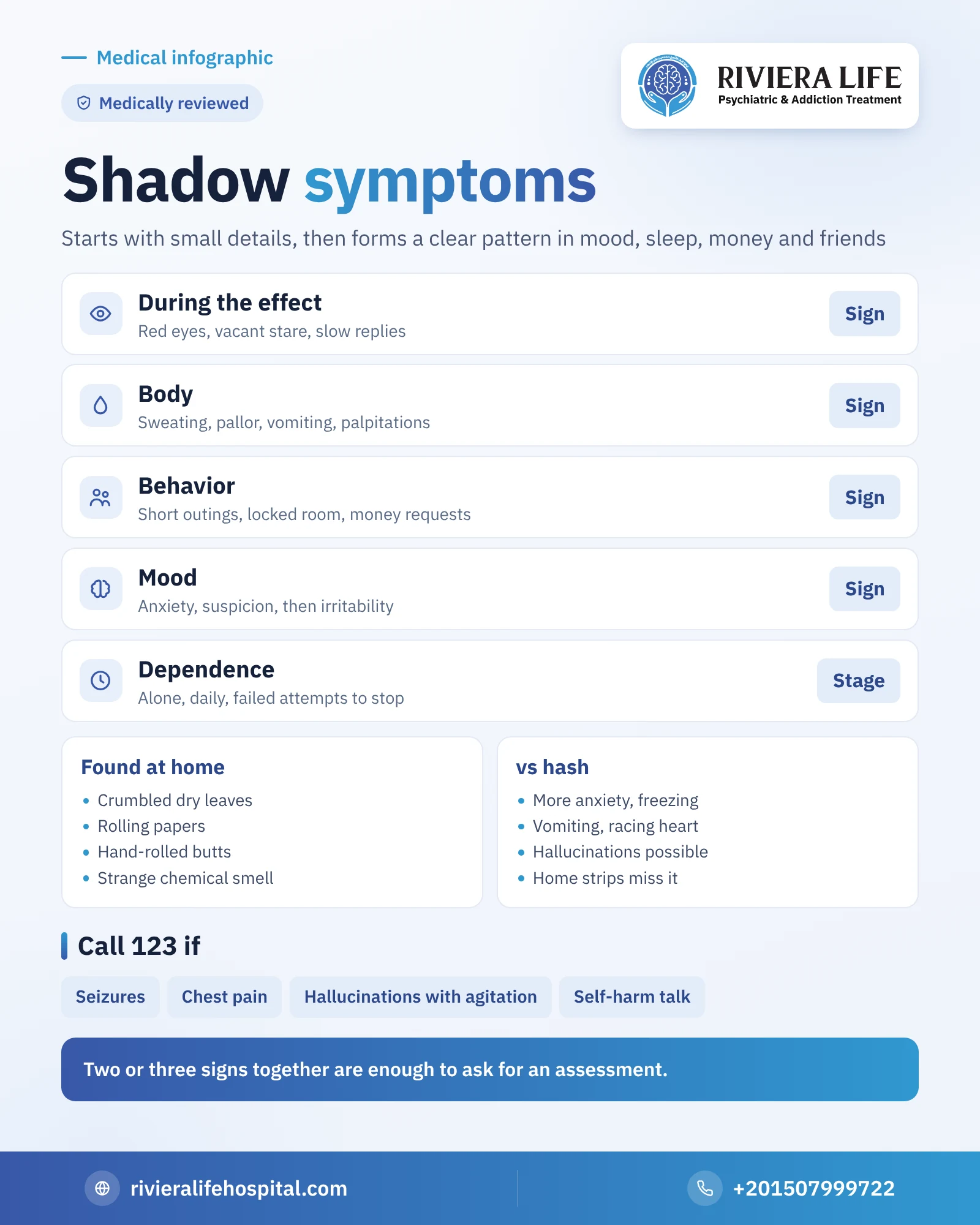
Shadow addiction symptoms don’t usually start with something shocking, but with small details: red eyes after a short outing, a vacant look that doesn’t respond quickly, and unexplained irritability in the evening. With repetition these details gather into a clear pattern of changes in mood, sleep, money and friends. This article sets out the signs the family can see for itself, physical, behavioral and psychological, explains when use turns into an addiction that needs medical assessment, and how to act without losing the trust of the person you are trying to help.
Signs that appear during the effect or shortly after
Shadow’s effect begins within minutes of smoking, and usually lasts a few hours, during which you may notice one or more of these signs:
- Red eyes and a dry mouth, with drinking a lot of water.
- A fixed stare and absence from the place, and clear slowness in answering simple questions.
- Broken or heavy speech, or laughing at the wrong moment.
- Sweating and pallor, or nausea and vomiting without a clear medical cause.
- Palpitations the person complains of, or sudden anxiety and a wish to isolate in a closed room.
- Staggering when walking or bumping into things.
What distinguishes shadow from hash here is that this state may be more intense and swing faster: heavy calm one moment, then confusion or fear the next.
Daily behavioral changes
Behavior reveals more than the eye does, especially when it repeats over weeks:
- Frequent outings for short periods, and returning in a different state from when they left.
- Keeping the bedroom door closed for long, and opening windows or using air fresheners a lot.
- Increasing requests for money with changing reasons, or sums and small items disappearing from the house.
- Suddenly changing friends and being very guarded about the phone.
- Absence from study or work, waking late and taking less care of appearance.
Things at home that may catch your attention
Many families begin their story with shadow because of something found by chance. Among the most common: small bags containing dry crumbled leaves resembling marjoram or tobacco, rolling papers, hand-rolled cigarette butts, and many lighters. You may notice a strange smell that resembles neither ordinary cigarettes nor hash exactly, sometimes described as sharply chemical or herbal. These things alone don’t confirm use, but they deserve to be linked with the changes in behavior and mood you see.
Psychological and mood signs
Shadow’s psychological effect is clearer than that of many similar substances, and sometimes appears in two contradictory forms. During the effect, acute anxiety or suspicion that someone is watching or plotting against them may appear, and they may hear or see things that aren’t there. Between times they may become quick to anger, impatient and short-tempered at the simplest discussion, then suddenly calm after using. Over time general apathy and loss of enthusiasm for what they used to love may appear, with disturbed sleep that only comes after a joint. This swinging between tension and calm linked to use is one of the clearest signs that things have gone beyond experimenting.
Physical signs that appear with continued use
After weeks or months of regular use, signs begin that aren’t linked to the moment of the effect itself, but to the lifestyle shadow has imposed. Among the most noticeable:
- Weight loss and poor appetite, or bouts of morning nausea that recur without explanation.
- A persistent cough, a hoarse voice and breathlessness on exertion.
- Constant exhaustion, a pale face and dark circles under the eyes.
- Recurrent headaches and complaints of palpitations even at rest.
- Reversed sleep: staying up till dawn and sleeping in the daytime.
These signs may have other causes, so they are read alongside others, not alone. Their deeper effect on the heart, kidneys and brain is explained in the article on the harms of shadow.
Signs that it has turned into dependence
There are signs that separate someone who has tried from someone whose body and mind now demand the substance:
- Needing larger amounts or more times to get the same effect.
- Using in the morning or before sleep as a fixed daily habit.
- Using alone after it used to be in sessions with friends.
- Irritability, insomnia, loss of appetite and sweating if the usual time to use is delayed.
- Open or secret attempts to stop that end in a return within days.
These unpleasant symptoms during absence are the beginning of withdrawal, and their details and timing are in the article on shadow withdrawal symptoms.
When is use considered addiction medically?
The doctor doesn’t judge addiction from a single sign, but from a set of criteria recurring over about a year, including: using in larger amounts or for longer than the person intends, craving, failing to cut down, neglecting study, work or home, continuing despite clear problems with the family or health, giving up important activities for use, tolerance, and withdrawal symptoms. The more criteria apply, the greater the severity of the disorder. The family doesn’t need to wait for the picture to be complete; two or three signs are enough to ask for an assessment.
Shadow or hash? How do you tell the signs apart?
Some signs are similar, such as red eyes and a dry mouth, but there are differences that help the family. With hash relaxation, hunger and laughter dominate, and it rarely reaches the emergency department. With shadow, more common are intense anxiety, freezing or sudden absence, vomiting and a racing heart, and hallucinations or seizures may occur. The signs shared between shadow, strox and voodoo are almost identical because they belong to the same class, so don’t dwell too much on the name of the substance, and focus on the severity of what you see.
Why may a home test come back negative despite suspicion?
Some parents turn to rapid test strips, and the result comes back negative despite clear signs. The reason is that ordinary hash strips are designed to detect the by-products of the cannabis plant, and usually don’t recognize synthetic compounds. A negative result here neither clears nor convicts anyone, and a specialized laboratory test is the reference. The article on how long shadow stays in the body explains the types of these tests and their limits.
Signs specific to teenagers and university students
At this stage signs of use mix with normal age-related swings, so changeable mood alone isn’t enough for suspicion. But pay attention when more than one change comes together at the same time: a sudden drop in grades, new friends you don’t know, long late nights followed by sleep until the afternoon, and evading simple questions about where they are. And pay more attention if an unexplained bout of fear or panic appears after an outing with friends, as it is one of the common pictures of a first encounter with shadow.
What do you do if you notice these signs?
Gather your observations on a sheet: what you saw, when and how often. Then choose a time when the person is clear-headed, and talk about your fear for them with sentences that start “I’m worried”, not “you do”. Don’t get into an argument while they are under the influence, and don’t threaten what you won’t carry out. Ask for a specialist consultation to assess the case and for the family to learn how to deal with it. And if you want to understand what pushed them onto this road in the first place, read the causes of shadow addiction.
Danger signs that can’t wait
Call an ambulance on 123 immediately if you see
Some of what happens after smoking shadow isn't just a passing effect, but poisoning that needs hospital.
- Seizures or loss of consciousness
- Chest pain or a very fast pulse that doesn’t settle
- Hallucinations with agitation or violent behavior
- Talk of self-harm
More from the shadow guide
- Shadow: the complete guide
- Shadow addiction treatment
- The harms of shadow
- Shadow withdrawal symptoms
Questions many people ask
Usually red eyes with a vacant look and slow replies after a short outing. But a single sign isn't enough; what matters is the changes repeating and coming together.
Many describe it as a sharp herbal or chemical smell that resembles neither cigarettes nor hash exactly. Even so it may be masked with air fresheners or tobacco, so the smell alone isn't relied on.
Home hash strips usually don't recognize synthetic cannabinoid compounds. A specialized laboratory test is what can be relied on in this case.
It may be, if it is linked to the substance's absence and disappears after use, which is a sign of beginning dependence. Passing irritability alone has many causes.
When two or three behavioral and psychological changes come together, an attempt to stop fails, or anxiety and suspicion appear after use. There is no need to wait for complete certainty.