Shadow addiction treatment is possible, and many young people who reached the stage of a joint every two hours have gone back to their studies and work after an organized plan. But successful treatment doesn’t mean stopping for a week and hoping for the best; it is a path that starts with a careful assessment that takes into account that the substance is of unknown composition, then safe management of withdrawal, then psychological and behavioral therapy that treats the reason for use, then follow-up that protects against relapse. This article explains each stage, the role of medicines and their limits, the expected duration, and how to choose the right hospital for this case specifically.
Stages of shadow addiction treatment
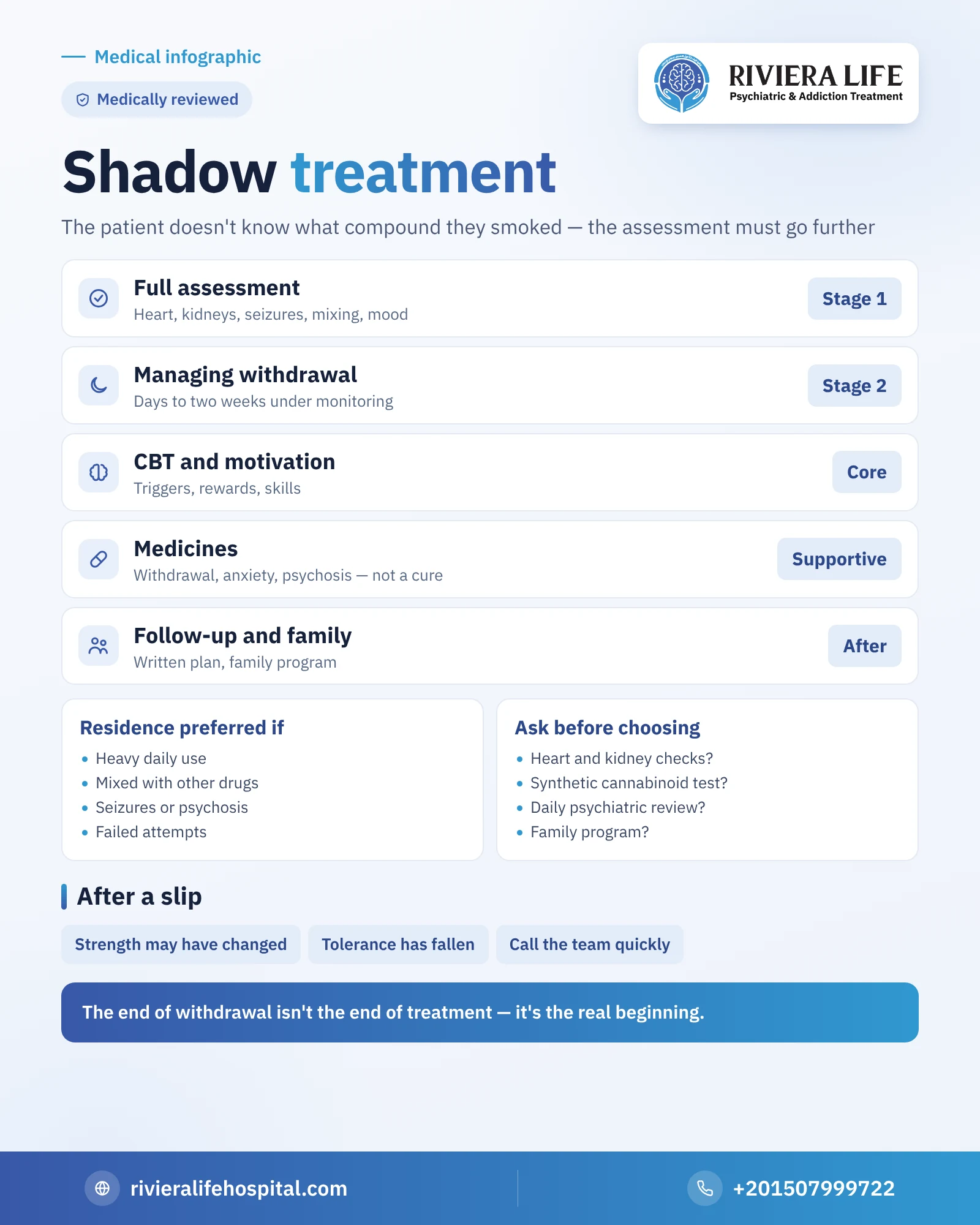
The details differ from patient to patient, but a good plan usually passes through these stations:
- Comprehensive assessment: a medical and psychological examination and tests, and understanding the pattern of use and what is mixed with it.
- Managing withdrawal: getting through the hard first days safely and under monitoring.
- Psychological and behavioral therapy: understanding what drives use and building practical alternatives.
- Treating what accompanies the addiction: anxiety, depression, insomnia and any psychotic symptoms.
- Follow-up and relapse prevention: regular sessions, a written plan and a family program.
The first assessment: why is it more important with shadow?
With most drugs the doctor knows the substance they are dealing with. With shadow, however, the patient themselves doesn’t know which compound they were smoking, or its strength. That is why the assessment goes beyond the question “how much do you use?” to checking the heart, blood pressure and kidney function, and asking about any previous seizures or fainting, the hallucinations or suspicion that may have appeared during use, and the other substances used with it such as tramadol or pregabalin. Mood and the risk of self-harm are assessed from the first day. This information is what determines the place of treatment and the intensity of monitoring needed.
Managing withdrawal: a few days that make a big difference
The first days after stopping are what the patient fears most, and in them most dropping out of treatment happens if they are left alone. The goal here isn’t to punish the body, but to make this period bearable: monitoring vital signs, sleep and fluids, treating anxiety, insomnia and nausea as needed, and quick intervention if more severe symptoms appear. The timing and details of the symptoms are in the article on shadow withdrawal symptoms. What matters is that the family understands that the end of this stage isn’t the end of treatment, but its real beginning.
Are there medicines to treat shadow addiction?
To date there is no approved medicine that treats synthetic cannabis addiction specifically, as is the case with hash addiction. This doesn’t mean medicines have no role, but it is a specific role:
- Treating withdrawal symptoms: such as insomnia, anxiety, agitation and nausea, for a limited period and under supervision.
- Treating accompanying disorders: such as antidepressants or anxiety medicines when the diagnosis is confirmed.
- Treating psychotic symptoms if they appear, with medicines determined and followed up by the psychiatrist.
Doctors avoid using sedatives for long periods, because they may create a new dependence. And it is never right for the patient or their family to try medicines from the pharmacy based on a friend’s advice.
Psychological and behavioral therapy
This is the heart of shadow addiction treatment, because what keeps the person using is usually their relationship with the substance, not the substance alone. Among the most evidence-supported methods:
- Cognitive behavioral therapy: sessions in which the shadow patient spots the moments and thoughts that lead them to the joint, and learns how to respond to them differently.
- Motivational interviewing: turns hesitation into a decision, and suits young people who came under pressure from their parents.
- Reward-based motivation: a clear system that rewards commitment and negative test results, one of the useful methods in cannabis addiction.
- Skills training: dealing with pressure, boredom and refusal in social situations.
- Family therapy: repairing the way of communicating at home so it becomes a source of support, not tension.
Treating accompanying anxiety and depression
Many who are addicted to shadow started it to escape anxiety, insomnia or sadness. If the addiction is treated and this cause left, the patient goes back to the joint at the first pressure. That is why the psychiatrist assesses these symptoms after acute withdrawal has passed, so as not to confuse what stopping caused with what existed before it, then sets a separate treatment for them. The article on the causes of shadow addiction explains this relationship in detail.
How long does shadow addiction treatment take?
Managing withdrawal usually takes from days to about two weeks. The intensive treatment program, inside or outside the hospital, usually extends from several weeks to a few months, followed by outpatient follow-up that may continue for months. The rule that research in addiction treatment generally confirms is that continuing for a sufficient period is linked to better results, and that a sudden break between one stage and another is the greatest threat to treatment.
Residential or outpatient treatment?
Residence is preferred when use is daily and heavy, or mixed with other substances, or when seizures, psychotic symptoms or thoughts of self-harm have appeared, or when previous attempts failed, or the surrounding environment is full of triggers. Outpatient treatment suits milder cases, or the stage after residence. Often the best path is a short start in residence then a gradual move to follow-up.
The family’s role in the treatment journey
The family is a partner in treatment, not just a visitor. In the family program it learns how to support without covering up use, how to set clear limits on money and going out without cutting off dialogue, and how to act if a slip happens. It is useful to know the early signs of going back, which are explained in shadow addiction symptoms.
Relapse prevention after treatment
The first months after the intensive program are the most dangerous. What protects the patient in them: commitment to follow-up sessions, staying away from friends and places linked to shadow, a daily routine with regular sleep, physical activity and study or work, and a written plan for what to do when craving is urgent. If a slip happens, it is a signal to adjust the plan, not cancel it. And with every slip the patient must remember that the strength of shadow may have changed, and that their body is no longer used to it.
The right hospital for shadow addiction treatment: how to choose
The right hospital for shadow addiction treatment is the one that provides what a patient on this substance specifically needs: physical monitoring for a substance of unknown composition, strong psychiatry, and organized behavioral therapy. Ask before you choose:
- Does it check the heart and kidney function and do a test specific to synthetic cannabis, not just a hash strip?
- Is there a consultant psychiatrist who assesses anxiety, depression and psychotic symptoms and follows them daily at the start?
- Is there round-the-clock medical monitoring to deal with a seizure or agitation if it happens?
- Does it offer cognitive behavioral therapy and an organized program, or settle for residence and detox?
- Does it deal safely with mixing shadow with tramadol, pregabalin or sedatives?
- Is there a family program and clear follow-up after discharge?
And avoid anyone who guarantees you a certain cure rate or promises to get rid of shadow for good in days.
How Riviera Life meets these standards in shadow addiction treatment
At Riviera Life these criteria take the following form:
- Official license: a hospital licensed by the Egyptian Ministry of Health.
- Years of experience: fourteen years in addiction treatment, and thousands of cases that have recovered.
- Specialist consultants: doctors in psychiatry and addiction treatment who assess the anxiety, depression and psychotic symptoms linked to shadow.
- Uninterrupted follow-up: medical supervision around the clock and every day, which is necessary at the start of shadow withdrawal especially since the composition of the substance is unknown.
- An individual plan: takes into account the pattern of use, what is mixed with it and the reason behind it.
- Support for the family: sessions that guide the family to the right way of support and to setting clear limits without confrontations.
- Aftercare: follow-up after discharge and a written plan to prevent relapse.
- Complete confidentiality: the data of the patient and their family are fully protected.
You get the first consultation free, and our lines are open all day on +201507999722, and you can also come to our location in Sheikh Zayed, Giza. You will find the details of the substance itself on the shadow drug page.
More from the shadow guide
- Shadow: the complete guide
- Shadow withdrawal symptoms
- The harms of shadow
- How long shadow stays in the body
Questions many people ask
There is no approved medicine specific to it yet. Medicines are used to treat withdrawal symptoms, anxiety, depression or psychotic symptoms, while psychological and behavioral therapy remains the foundation.
Managing withdrawal takes days to about two weeks, the intensive program weeks to months, then follow-up that may extend for months. Continuing for a sufficient period is linked to better results.
Outpatient follow-up may suit milder cases without mixing or severe psychological symptoms, but stopping at home without any supervision usually ends in going back. Medical assessment is what determines the place.
Look for round-the-clock medical monitoring, psychiatry, behavioral therapy and a family program together. Riviera Life in Sheikh Zayed, licensed by the Ministry of Health with fourteen years of experience, meets these criteria.
Relapse is possible in all types of addiction, and means adjusting the plan, not its failure. What matters is going back quickly to the treating team, because the strength of shadow may have changed and the body's tolerance has fallen.