The harms of shadow don’t wait years to appear. Besides the harms that accumulate with continued use, a single cigarette from a strong batch may cause a dangerous racing of the heart, a seizure, or a state of panic and hallucinations that ends in the emergency department. The reason is that the substance sprayed on its leaves is synthetic, strong and of unknown composition. This article explains what shadow does to the heart, brain, kidneys and mental health, what mixing it with other substances adds, its effect on daily life, then the signs that mean the situation has become an emergency.
Short-term harms of shadow
In the first hours after smoking one or more of these harms may appear, and their severity can’t be predicted in advance:
- A racing heartbeat and raised blood pressure, and sometimes chest pain.
- Nausea and repeated vomiting that may cause dehydration.
- Acute anxiety and a panic attack, or suspicion and persecutory thoughts.
- Confusion, disorientation and difficulty speaking or walking.
- Auditory or visual hallucinations, and agitation that may push towards dangerous behavior.
- Seizures or loss of consciousness in severe cases.
Why do the harms of shadow vary from one time to another?
Two people may smoke from the same bag, and it passes relatively calmly for one while the other ends up in the emergency department. There are clear reasons for this: the sprayed substance isn’t distributed evenly on the leaves, the compound itself may change from one batch to another without the name or look of the bag changing, and bodies’ sensitivity, heart condition and psychological predisposition differ from person to person. That is why a previous experience that “passed safely” is no proof that the next time will be safe.
Harms of shadow on the heart and blood vessels
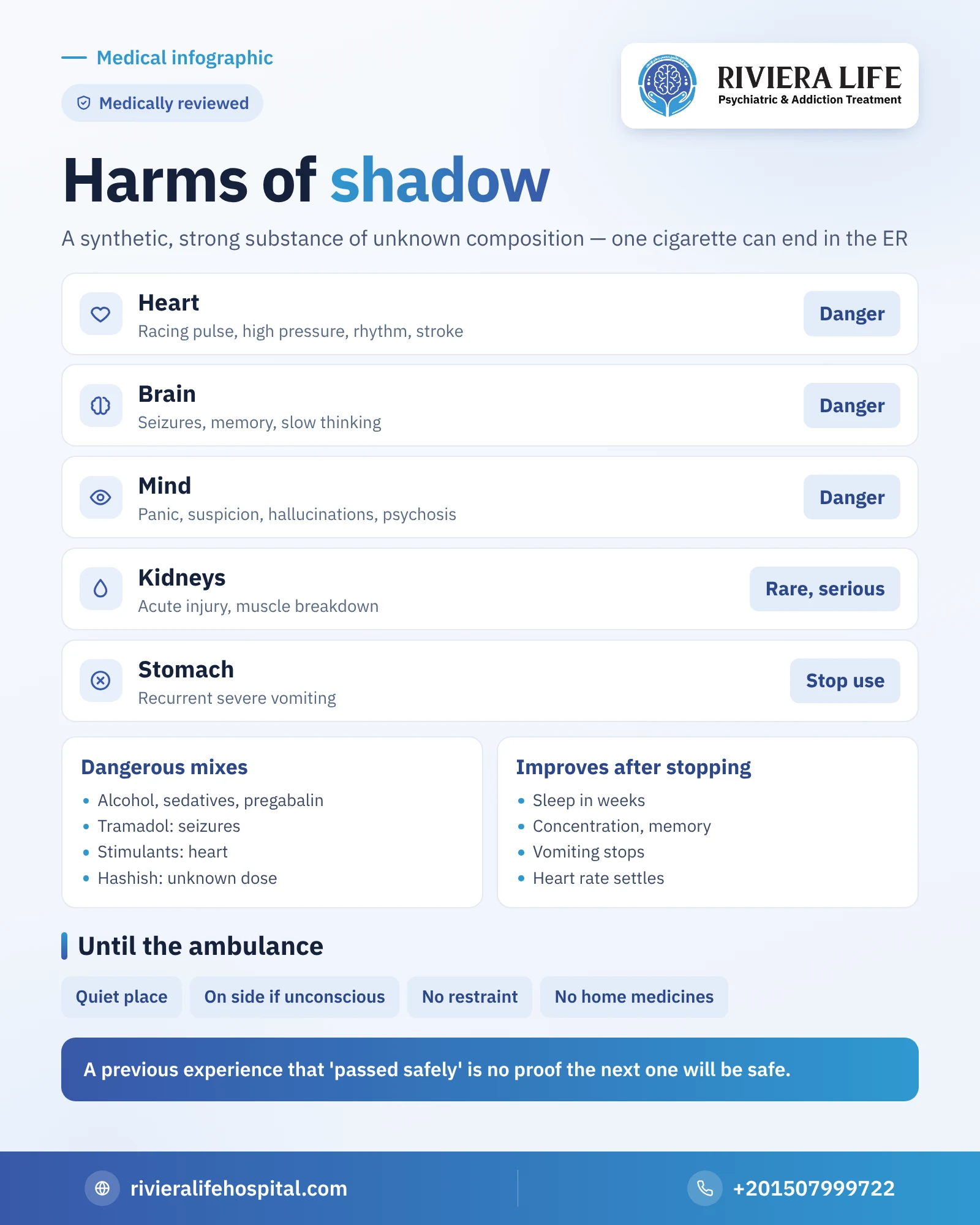
The heart is among the organs most affected by synthetic cannabinoids. The racing pulse and raised blood pressure may reach a degree that exhausts the heart even in a young person with no illness. Cases of heart rhythm disturbance, heart attacks and strokes have been recorded in young users after using these substances. The risk increases in those with an undiscovered heart problem, those who combine shadow with stimulants, or those who use it after physical exertion or in hot weather.
Harms of shadow on the brain and nervous system
Seizures are among the most dangerous things linked to shadow, and they may happen to people who have never had epilepsy. With repeated use many complain of poor concentration and short-term memory, slow thinking and difficulty learning, effects that show clearly in students’ grades and in workers’ repeated mistakes. Shadow also affects sleep, so it becomes interrupted and full of nightmares, or comes only with a cigarette, which deepens exhaustion and irritability during the day.
Shadow and mental health: from anxiety to psychosis
The psychological effect of shadow is more severe than the user expects. During the effect they may experience a real panic attack, become convinced that people are conspiring against them, or hear voices. In most cases these symptoms calm down as the substance wears off, but in some people they continue for days or weeks, and may reveal an underlying psychotic disorder, especially in those with a family history of mental illness. With continued use the likelihood of depression, chronic anxiety and apathy increases, and thoughts of self-harm may appear, a sign that requires seeking help immediately.
The kidneys and muscles
Synthetic cannabinoids have been linked to cases of acute kidney failure in healthy young people, appearing as flank pain, vomiting and little urine after use. Severe agitation, seizures and high temperature may also lead to muscle breakdown, releasing substances into the blood that in turn burden the kidneys. These complications aren’t common in every user, but they are serious if they happen, and need early diagnosis in hospital.
Repeated vomiting and digestive problems
Some who use shadow regularly for long periods develop recurrent bouts of severe nausea, vomiting and abdominal pain, resembling what is known as cannabinoid hyperemesis syndrome. The patient sometimes notices that a hot shower eases the symptoms, so they repeat it often without linking it to use. These bouts cause dehydration and disturbance of the body’s salts, and their real treatment is stopping the substance.
The lungs and mouth
Because shadow is smoked, it adds the harms of the smoke itself to the harms of the chemical substance: a chronic cough, irritation of the throat and airways, and shortness of breath on exertion. It is often mixed with tobacco, so the harms of cigarettes combine with the harms of synthetic cannabinoids in the respiratory system. Someone who combines shadow with shisha adds a larger amount of smoke and carbon monoxide in a single session, and mouth and throat infections may be transmitted by sharing the shisha hose or cigarette among friends.
The most dangerous things shadow is mixed with
In Egypt shadow isn’t always used alone. Mixing it with other substances raises the danger in different ways:
- With alcohol, sedatives or pregabalin: increases confusion, vomiting, the risk of choking and depressed consciousness.
- With tramadol: the risk of seizures rises, because each of them may cause them.
- With stimulants: the burden on the heart doubles and temperature and agitation rise.
- With hashish or bango: it becomes hard for the user to estimate what has entered their body, and recovery takes longer.
Why are teenagers harmed more?
The brain in the teenage years is still building the connections responsible for attention, impulse control and planning, and the internal cannabinoid system takes part in this building. Exposing this system to strong, repeated activation at this age is linked to a greater decline in achievement, and higher susceptibility to addiction and psychological disorders later. A teenager is also less able to estimate danger and more inclined to repeat the experience in front of friends, so the strength of the substance and lack of experience combine against them.
Harms to daily life
Away from the hospital, shadow leaves its mark on the details of life: absence from study or work, declining performance, ongoing disputes at home, small debts that grow, and drifting away from old friends. There remain legal risks, as the substance is listed in the drug schedules in Egypt and its possession is punishable by law. Driving under its influence is a direct danger to the driver and others because of slow reactions and confusion. The family bears a large part of this price: constant worry, emergency treatment expenses, and tension that extends to younger siblings who watch what is happening in silence.
When do you need emergency care?
Call the ambulance on 123 immediately if any of these appear
These are signs of poisoning that can't be treated at home, and every minute counts.
- Seizures or loss of consciousness
- Chest pain, severe palpitations or fainting
- A very high body temperature with confusion
- Hallucinations with violent agitation or talk of self-harm
- Repeated vomiting with drowsiness or difficulty breathing
- Flank pain with very little urine
Until the ambulance arrives, keep the person in a quiet place, and if they lose consciousness and are breathing, put them on their side. Don’t try to restrain them violently and don’t give them any medicine from home.
Do the harms of shadow go away after stopping?
Many of them clearly improve. Sleep returns gradually within weeks, concentration and memory improve, bouts of vomiting disappear, and the heartbeat settles. Acute complications such as heart attacks, severe kidney injury or persistent psychosis may leave an effect that needs longer follow-up. And the earlier the stopping, the greater the chance of full recovery. The first days after stopping have their own symptoms, explained in the article on shadow withdrawal symptoms, and you will find the recovery plan itself in shadow addiction treatment.
More from the shadow guide
- Shadow: the complete guide
- Causes of shadow addiction
- Symptoms of shadow addiction
- How long shadow stays in the body
Questions many people ask
Yes, in relatively rare cases, through complications such as heart rhythm disturbance, prolonged seizures, stroke or accidents during agitation. Its danger is that these complications can't be predicted in advance.
It may cause psychotic symptoms such as hallucinations and suspicion during the effect, and in some people they continue for days or longer, especially with a predisposition or family history of mental illness. These symptoms need a medical assessment.
Synthetic cannabinoids have been linked to cases of acute kidney injury. Flank pain with vomiting and little urine after use are signs that call for going to hospital.
Vomiting may be part of acute poisoning, or recurrent bouts with long use resembling cannabinoid hyperemesis syndrome. Stopping the substance is the main treatment.
In most cases concentration, memory and sleep improve gradually within weeks to months of stopping, and the chance of improvement is greater the earlier one stops.